Paw Prints, Fur and Keepsakes: Deciding in the Moment
Alastair Greenway
BVM&S MRCVS
A lot of owners turn the same small thought over in the days before they say goodbye, and almost none of them say it out loud. It runs something like: I think I might want to keep something. A print of her paw. A little of his fur. And then, often in the very same breath, comes the shame of it. Is it morbid to be thinking about this while she is still here, curled on the sofa beside me? Am I giving up, planning a keepsake while my pet is still alive?
Let me answer that part first, before anything else. That thought is not morbid, and it is not disloyal. It is one of the most normal and gently human things a person facing a loss can feel, and it is part of grieving well, not a betrayal of the animal you love. There is no right or wrong way to do any of this (PDSA, n.d.). And the reason I want to put this page in front of you now, rather than after, is a practical one: some of these small tokens can only be taken at or very near the end, and one of them cannot be taken later at all. Knowing that in advance means the choice stays yours, instead of being lost by accident. This is not a checklist to complete. It is simply permission, and a little information, offered early enough to be useful.
Asking is welcomed, not awkward
If part of you suspects that asking the vet for a paw print is a strange or awkward request, the profession would gently disagree. The veterinary end-of-life consensus is explicit that "memorializing a pet is frequently helpful in the grieving process because it acknowledges and honors the human-animal bond", and that "helping the caregiver memorialize their pet is one of the best ways of expressing support and empathy for bereaved clients", with offering a memorial item listed among the recognised, supportive things a good team does (Bishop et al., 2016). A vet or nurse who makes a clay paw print for you is not humouring an odd request. They are doing exactly what the guidelines describe as kind, ordinary, good practice.
The same idea runs through the owner-facing advice. Honouring and memorialising your pet is described as "an important part of the grieving and healing process" (AVMA, n.d.). So if you want to ask, please do, and please do not apologise for it. And if you do not want to ask, that is equally fine, a thread I will keep returning to, because it matters just as much as the menu itself.
What a small token can and cannot do
Let me be careful here, because this is a place where it would be easy to over-promise. A keepsake is not medicine. It will not shorten grief or spare you the ache. What a small physical object can do is something quieter and, for many people, real: it gives the loss somewhere to land. The best evidence we have on this comes by analogy from human bereavement, where a study of grieving parents found that a kept object helped people through the transition, affirmed the relationship, and let them hold on to a continuing bond with the one who had died (Værland et al., 2024). A token can make grief feel a little less invisible later, when the rest of the world has moved on and you have not.
The same study is candid about the other side, and so will I be. Those objects "stir up both good and painful emotions", and some were "hard to look at just after" the death, with people using their own timing before they could face them (Værland et al., 2024). Both halves are useful to know. A keepsake can genuinely help, and it is completely fine if you do not want one, or cannot bear to look at one yet. There is no correct way to feel about a lock of fur in a drawer.
Keepsakes you can take at the end
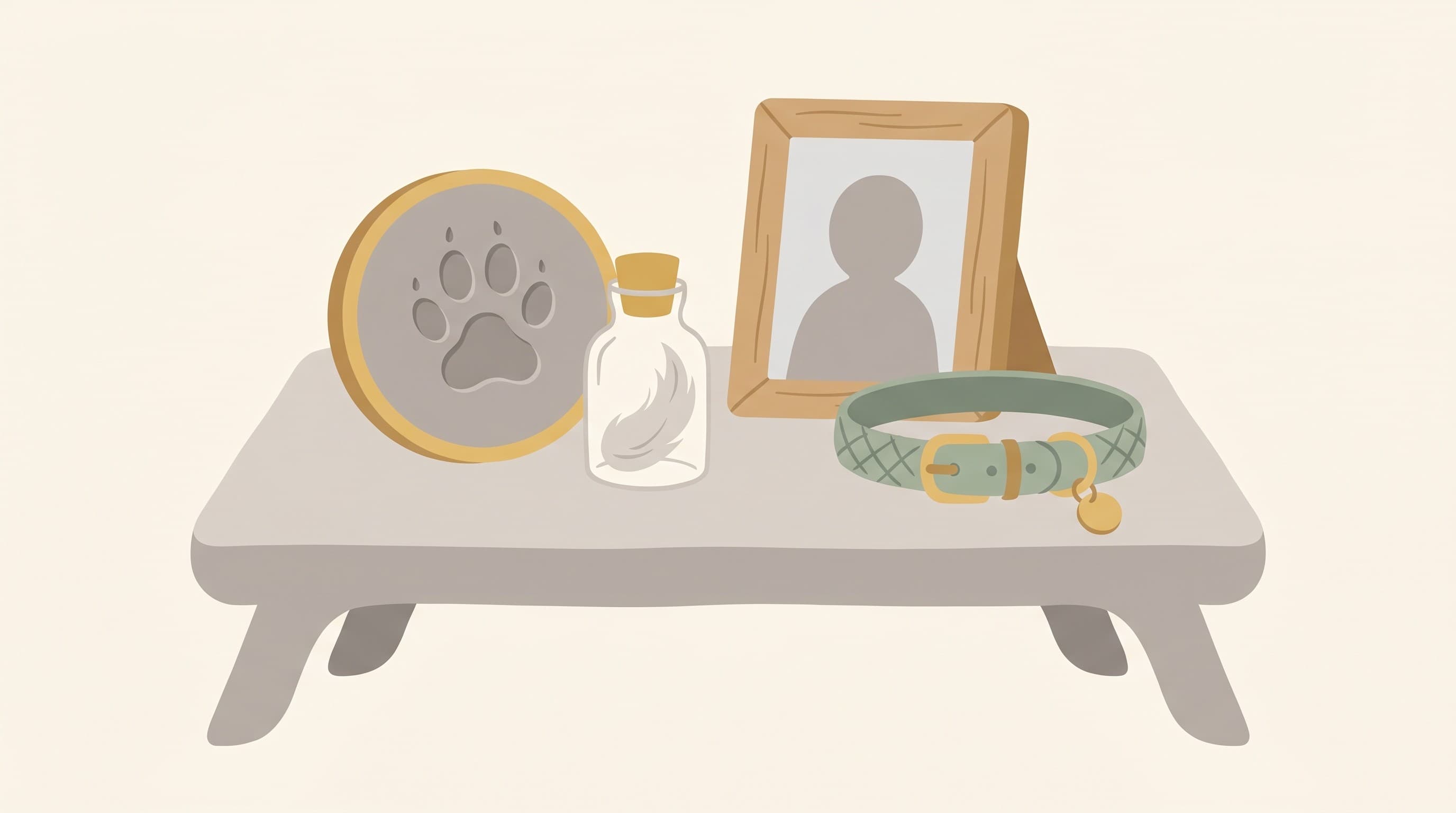
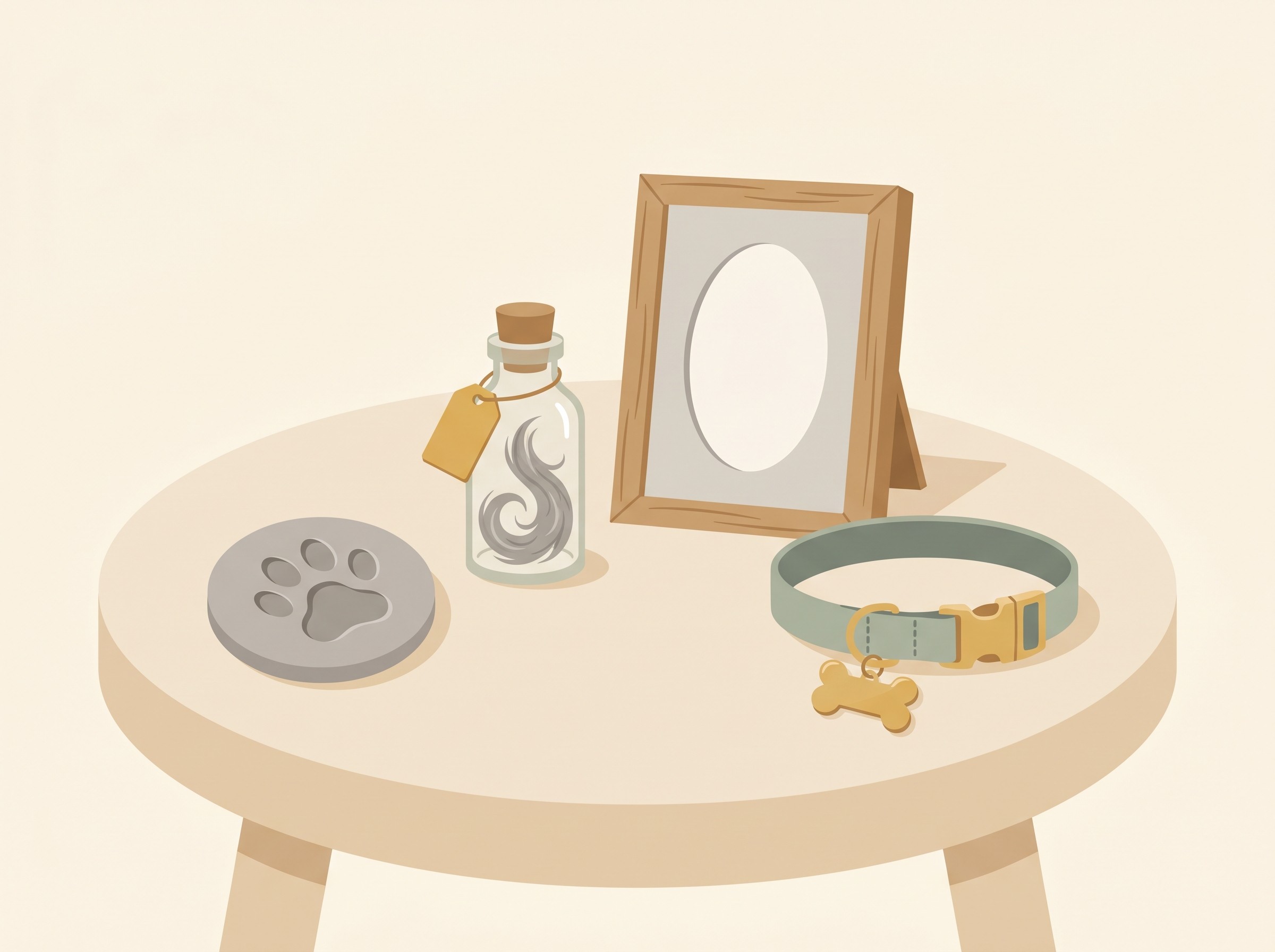
Here is the small menu of things owners most often keep from at or near the very end. None of it is compulsory. Read it the way you would a list of options, taking only what speaks to you.
A paw print, in ink or in clay. For many people this is the one that matters most: the paw that walked beside them for years (Lap of Love, n.d.). It comes in two forms. An ink print is pressed onto card, like a little inked signature. A clay or soft-dough impression is pressed into a pad that then sets, leaving a three-dimensional dent of the pads and claws you knew so well (AAHA, n.d.; Lap of Love, n.d.). Some owners keep one, some keep both. A home-visit service will often bring a clay-print kit, while a clinic may have ink cards to hand (Lap of Love, n.d.).
A clipping of fur. A small lock of fur, kept just as it is in a little bottle or a locket, is one of the simplest and most enduring tokens (The Ralph Site, n.d.; AVMA, n.d.). In the UK this is something you can simply ask for: the PDSA puts it plainly, that "you can also ask for a keepsake such as a clipping of fur to take home with you" (PDSA, n.d.). It is gentle, it is small, and as you will see in a moment, it is also the most forgiving in terms of timing.
A nose print. Less commonly offered, but possible. There is a lovely truth underneath it: a dog's nose pattern is genuinely individual to that dog and stable over its whole life, working as an identity marker in much the same way a human fingerprint does, which is part of why a nose print feels so personal (Choi et al., 2021; AAHA, n.d.). The research that established that uniqueness was done in dogs, so I will say it carefully for cats: each cat's print is their own, even if it has not been studied in the same way.
A last photograph. Not the posed, smiling photos from healthier days, those are a different and lovely thing to gather while your pet is well, which is owned by making memories: a good last week. I mean the still, quiet photograph some people take at or near the end: a hand resting on a sleeping flank, the whole family gathered close, your pet warm on a favourite blanket. If it feels right, take it. If it does not, do not, and feel no guilt either way.
The small, everyday things. The collar and the name tag, kept exactly as they are, are a keepsake in their own right (Blue Cross, n.d.). So is a single whisker, or a paper rubbing of the tag. These are easy to overlook and easy to keep, and for some people the worn collar on a hook by the door says more than anything else could.
The one thing worth knowing in advance: timing
This is the part I most want you to carry away, because it is the thing this page can do that a kind word on the day cannot. You can tell your vet, or the home-visit vet, or the crematorium, beforehand that you would like a paw print or some fur, and most will arrange it for you (PDSA, n.d.; Blue Cross, n.d.). Saying so early, even just a quiet word in advance, means the choice is yours and is not lost in the blur of a hard day.
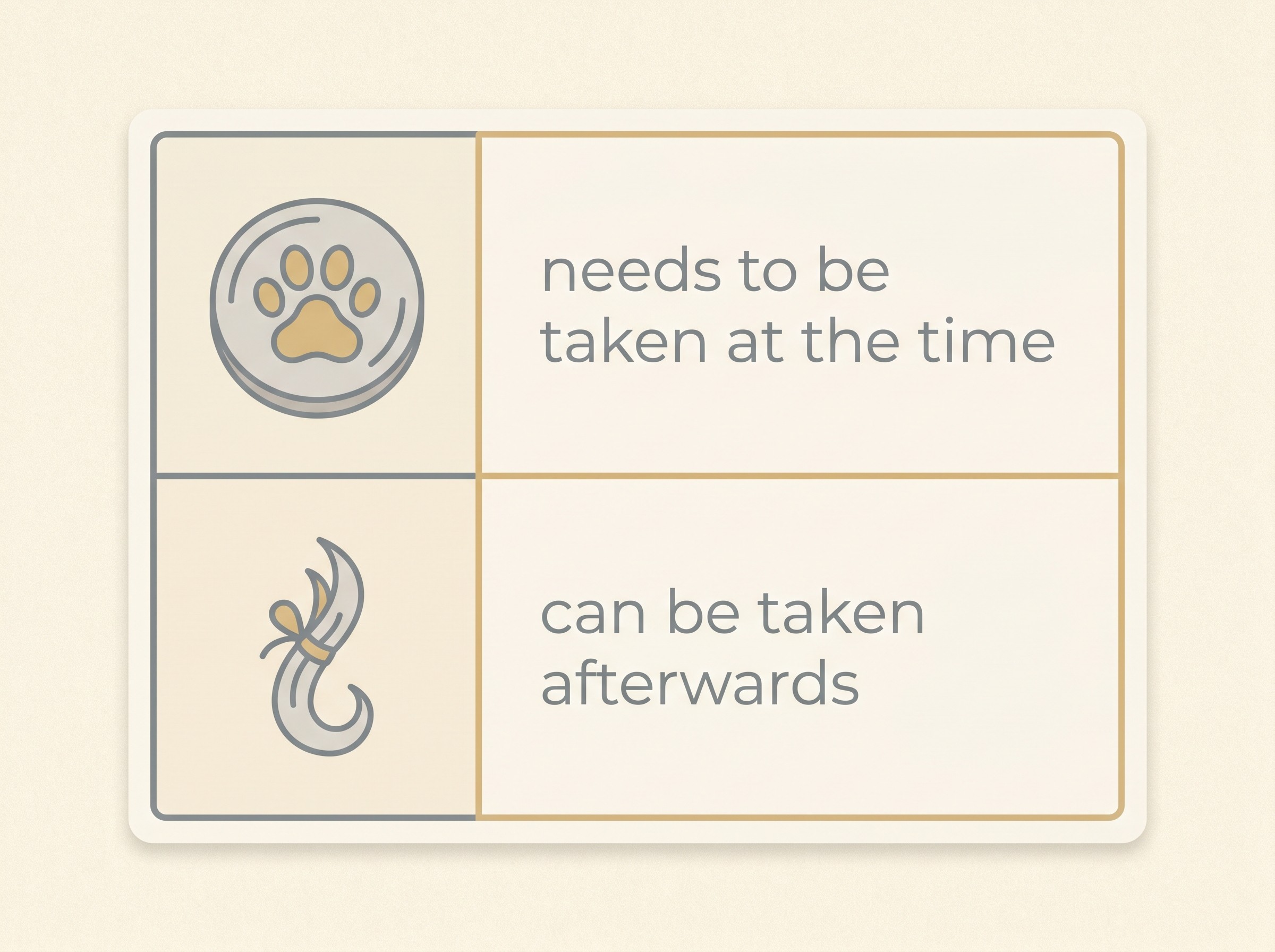
It matters because the windows are not all the same. A paw print impression needs your pet's body to take it, so it has to be done at the time and cannot be taken once a pet has been cremated (Dignity Pet Crematorium, n.d.). A clipping of fur is different and far more forgiving: it can be taken after death, and is commonly available even at the crematorium when you arrange things there (Dignity Pet Crematorium, n.d.; Kingshill Cremations, n.d.). I am not telling you this to add pressure to an already heavy time, but so that nothing is closed off by accident. If a paw print is something you think you might want, even if you are not sure, it is worth mentioning early, because that particular door does not reopen. The fur, you can decide about later. UK crematoria will usually ask you to mention any keepsake wishes when you arrange the cremation, so there is a natural moment to say so (Kingshill Cremations, n.d.). How cremation and ashes actually work, individual versus communal, ashes returned, home burial, belongs to aftercare: cremation and burial options in the UK.
A word on practices, because they vary. Some clinics and home-visit services offer paw prints and fur as a matter of course and free of charge, some make a small charge for extra prints or clippings, and some may simply not have a kit to hand on the day (Lap of Love, n.d.; Dignity Pet Crematorium, n.d.). None of that is a reason to hesitate. It is a reason to ask, simply and early, and to know you can bring your own little print kit if you would rather. Where you choose to say goodbye lightly shapes who takes the keepsake and how, a decision with its own guide in at home or at the clinic?. The day itself is owned by what actually happens when a pet is put to sleep; all you need to hold here is that some keepsakes are taken just before or just after, which is exactly why it helps to have said what you would like.
Lost your pet suddenly, with no chance to plan any of it? Please hear this clearly: not everything is lost. A clipping of fur can usually still be taken after death, and can be asked for from the practice or the crematorium even now (Dignity Pet Crematorium, n.d.; Kingshill Cremations, n.d.). You did not fail your pet by not knowing to ask in advance, and the gentler reckoning of a loss with no time to prepare is held in when there is no time to prepare.
Doing it for, or with, a child
If there are children in the family, a keepsake can give a grieving child something rare and steadying: a concrete thing to hold, and a small thing to do. A child can press the clay paw print themselves, choose which photograph is kept, or tuck a little tuft of fur into a box they decorate. Offered gently, by invitation and never insistence, a small role like this can help a child meet a loss they do not yet have the words for. Keep it light, and let them lead. The deeper work, what children of different ages understand about death, how to talk to them beforehand, and how to help them afterwards, belongs to preparing the family when a pet is dying and helping children after losing a pet. Here, the keepsake is just one small, holdable thing a child can keep.
Wanting nothing is also fine
I have given you a menu, so now let me give the other choice the same weight, because it deserves it. Some owners want every keepsake on offer. Some want one small thing. And some want nothing at all, and not one of these says anything about how much they loved their pet (PDSA, n.d.; AVMA, n.d.). Declining a paw print is not a test you have failed.
There are good reasons a person might want nothing. For some, a physical token is more painful than comforting, and that is a known, entirely normal response, not a sign of grieving wrongly (Værland et al., 2024). For others, the memory lives so vividly in them that an object feels beside the point. The bond you had does not sit in a clay impression or a lock of fur. It sits in you, in the years and the ordinary mornings and the particular weight of them against your leg, and none of that depends on having kept a thing. So if the whole idea leaves you cold, let it go without a second thought. That is not a lesser way to grieve. It is simply yours.
No deadline on any of it
A last, gentle word on what these small tokens can become, if you want them to. A paw print or a lock of fur often turns out to be the heart of a memory box or a longer remembrance later, assembled slowly and only when you are ready; that whole, unhurried work of honouring a pet over the weeks and months has its own guide in ways to honour and remember your pet. And if your pet is cremated and the ashes returned, a little of them can be set into jewellery or sealed in glass, with the how-it-works detail again living in aftercare: cremation and burial options in the UK.
But none of that is for today, and none of it is owed. Today, the only thing worth knowing is small and kind: these tokens exist, you are allowed to ask for them, one of them (the paw print) is best mentioned early, and wanting none of them is just as loving as wanting them all. Whether you end up with a clay print on the windowsill, a curl of fur in a drawer, a worn collar on its hook, or simply the memory of them held close and nothing else at all, the bond does not depend on the object, and there is no deadline on deciding.
If the weight of all this ever feels too heavy to carry on your own, please reach for support; it is never an overreaction to grieve a member of your family, and you do not have to wait until after the loss to be allowed to. In the UK, the Blue Cross Pet Bereavement Support Service offers a free, confidential listening line on 0800 096 6606, open 8.30am to 8.30pm every day, and it supports owners who are facing or anticipating a loss as much as those grieving after a death (Blue Cross, n.d.). The Ralph Site provides free written resources, online memorials and a supportive community. If you have lost, or are losing, a cat, Cats Protection's Paws to Listen is a cat-focused grief line on 0800 024 94 94, Monday to Friday, 9am to 5pm (Cats Protection, n.d.). Dogs Trust offers written bereavement guidance and a memory wall, and points anyone wanting to talk towards the Blue Cross line above. The fuller map of where to turn is gathered in pet loss support: where to turn. And if the dread or the grief ever brings you to a thought that you cannot go on, please ring the Samaritans on 116 123, free, day or night, every day of the year (Samaritans, n.d.). You do not have to be at the very edge to be allowed to make that call.
References
- American Animal Hospital Association (AAHA). (n.d.). 12 things pet owners should know about end-of-life care for dogs and cats.
- American Veterinary Medical Association (AVMA). (n.d.). Coping with the loss of a pet.
- Bishop, G., Cooney, K., Cox, S., Downing, R., Mitchener, K., Shanan, A., Soares, N., Stevens, B., & Wynn, T. (2016). 2016 AAHA/IAAHPC end-of-life care guidelines. Journal of the American Animal Hospital Association, 52(6), 341-356.
- Blue Cross. (n.d.). Preparing to say goodbye to your pet.
- Blue Cross. (n.d.). Pet loss support; about pet loss support.
- Cats Protection. (n.d.). Paws to Listen grief support service.
- Choi, H.-I., Kim, M.-Y., Yoon, H.-Y., Lee, S., Choi, S. S., Han, C. Y., Moon, H. P., Byun, C., & Kwon, S.-H. (2021). Study on the viability of canine nose pattern as a unique biometric marker. Animals, 11(12), 3372.
- Dignity Pet Crematorium. (n.d.). Pre-cremation options; remember your pet with paw print keepsakes.
- Kingshill Cremations. (n.d.). Pet cremation paw prints and keepsakes.
- Lap of Love. (n.d.). In-home euthanasia; pet memorial keepsakes.
- PDSA. (n.d.). When it's time to say goodbye.
- PDSA. (n.d.). How to cope with the loss of a pet.
- Samaritans. (n.d.). Contact us; how we can help.
- The Ralph Site. (n.d.). Your pet memory box: eight ideas of what to include; ways to remember your pet.
- Værland, I. E., Johansen, A. B. G., & Lavik, M. H. (2024). "That is what we have left of her": The significance of transitional objects after the death of an infant in a Norwegian context. Qualitative Health Research, 35(6), 626-639.
Free downloads
Companion worksheets to put what you've read into practice. Free PDFs, print at home.