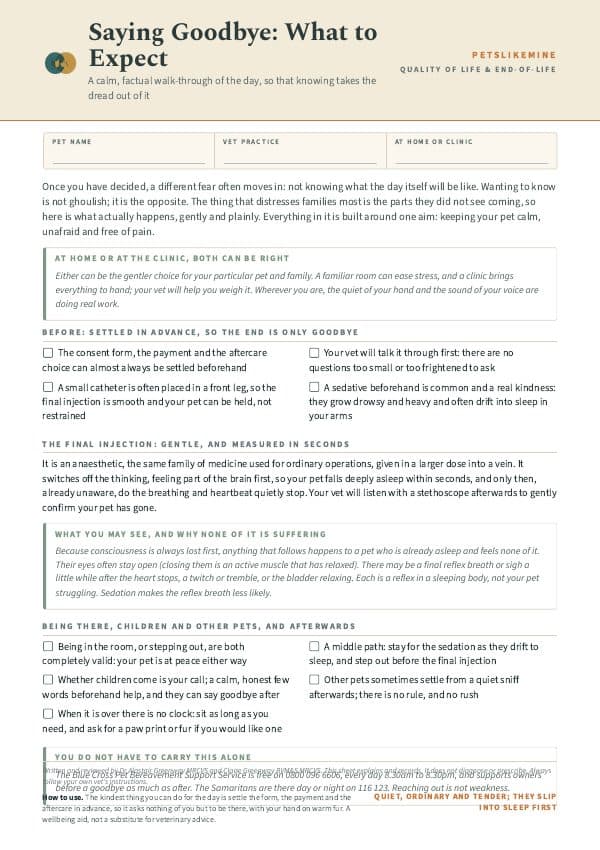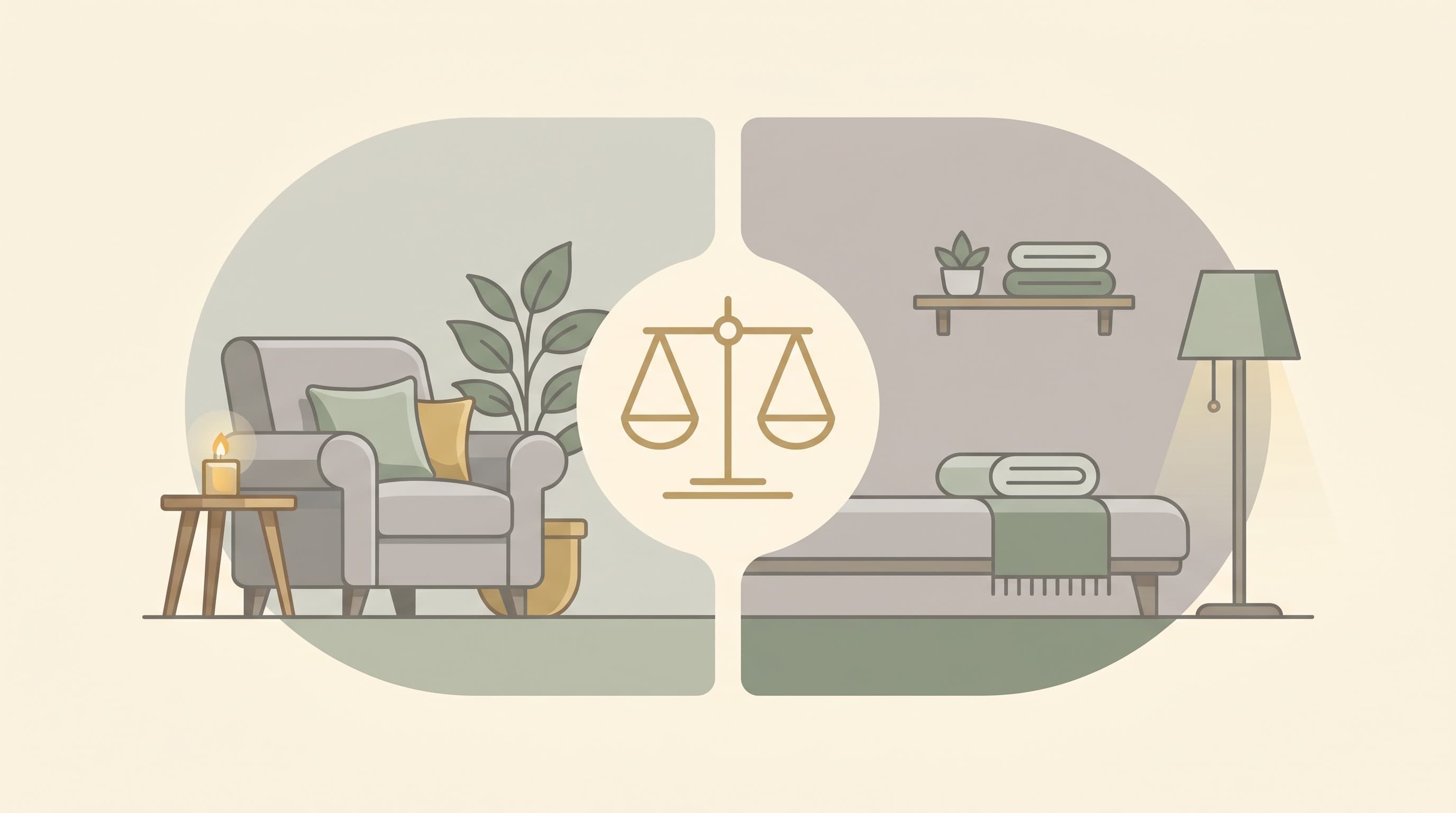
At Home or at the Clinic? Choosing Where to Say Goodbye
Alastair Greenway
BVM&S MRCVS
The hardest decision an owner ever faces is made, or very nearly made, and just when you thought the deciding was done, one more choice is waiting. Where. At home, in their own bed or a sunny patch of the garden, or at the practice where you have taken them all their life. The most important thing comes first: there is no right answer here, and there is no wrong one. Both are loving. Both are gentle. Wherever it happens, your pet will be in trained, careful hands, and the medicine and the kindness are the same in either place.
That last part is not a comfort I am inventing for you. In the UK, euthanasia is held to a single standard wherever it is carried out: it is defined as "painless killing to relieve suffering", and because these moments are "often highly emotionally charged" and "small actions and/or omissions can take on a disproportionate level of importance", practices are guided to take "a planned, rehearsed and coordinated approach" with fully trained staff (RCVS, 2024). The gentleness is a trained standard, not luck, and not something only a home visit can offer. This page lays out both options plainly, including the money, so that you can choose the place that lets you be present in the way you need to be. The decision about when belongs to a different page, how will I know when it is time; this one is only about the where. And the steps of the procedure itself, what the vet does and what you may see, are the same wherever it happens and are owned by what actually happens during euthanasia. Here, we are choosing the room.
A home goodbye, weighed honestly
The appeal of a home goodbye is easy to feel and worth saying out loud. There is no last car journey, no waiting room, no clinic smell. Your pet stays where they are most themselves: on the sofa they were never quite allowed on, on their own bed, on the kitchen floor in a square of afternoon sun, in your lap. A home visit lets a pet "stay in a familiar environment, so the process may feel less stressful for them", and many owners find it "a more peaceful and private experience for both you and your pet" (Vets Now, 2024). The clinical principle underneath that is a genuine consensus position, not marketing: "for virtually all animals, being placed in a novel environment is stressful; therefore, a euthanasia approach that can be applied in familiar surroundings may help reduce stress" (AVMA, 2020). Hospice vets put it the same way, that being at home lets a pet pass "in a familiar and comfortable environment while minimizing the stress and anxiety associated with visiting a veterinary clinic" (IAAHPC, 2024). There is no carrier and no disruption, the day can move at your pace, and other animals in the household can be nearby, which some owners find helps the pets left behind (that question has its own page in do other pets grieve).
A home goodbye is not automatically the better one, so let me name the trade-offs in the same breath rather than leave you to discover them. There are three, and none of them should frighten you; they are just things to weigh.
First, a home visit usually costs more, for reasons I will come to in a moment, and it needs booking ahead. A planned home visit is rarely available at short notice, because a vet has to travel to you and set aside unhurried, one-to-one time, so both dedicated mobile services and your own practice book these appointments in advance, and same-day visits, where they are offered at all, often carry a surcharge.
Second, a visiting vet carries fewer resources than a clinic has on hand. As one UK provider puts it plainly, the process "can be more logistically complicated", and "if complications arise (although rare), the vet may not have the resources to handle them as effectively as in a clinical setting" (Vets Now, 2024). Let me be calm and exact about this: complications are genuinely uncommon, so this is a trade-off to be aware of, not an alarm. But it is true, and you deserve to know it.
Third, and this matters most if you have a cat, home does not magically remove stress. This is the point owners are least often told. Bringing the appointment into a cat's own home "does not remove the potential for distress, which is associated with unfamiliar people entering and performing unfamiliar procedures in their territory" (Rodan et al., 2022). For a deeply territorial cat who hates strangers in the house, the clinic may be no harder, and sometimes kinder. A good visiting vet knows this and will work slowly and quietly to soften it, but the idea that home is always gentler for a cat is simply not true, and it would be unkind to pretend otherwise.
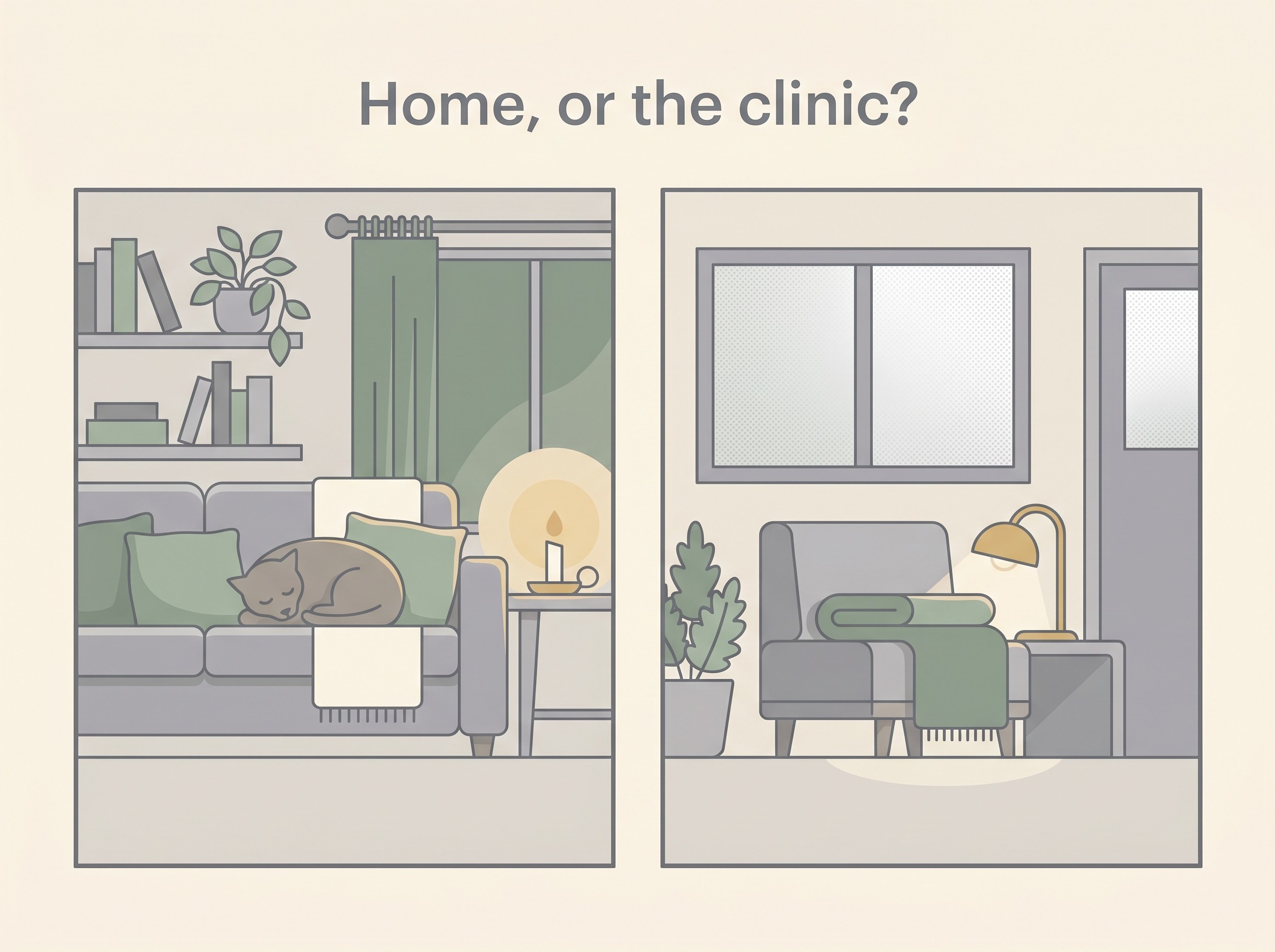
The clinic, redrawn
If your picture of the clinic is a bright, busy room and a rushed five minutes, let me redraw it, because the visit can be shaped far more than most owners realise. You can choose a quiet time: "you can often choose a quiet time for your visit to the surgery" (Blue Cross, 2024), and it is a normal, reasonable thing to ask for the first appointment of the morning or the last of the day, "a time when the clinic is less busy, so the appointment doesn't feel rushed" (Vets Now, 2024). Many practices keep a comfort room or quiet room for exactly this, with softer lighting and somewhere to sit on the floor with your pet rather than on a clinical table.
There is a practical kindness owners almost never know to ask for: you do not have to sit in the waiting room. "When you arrive at the clinic, you may prefer to wait in the car with your pet and be called in when the vet is ready" (Vets Now, 2024). Many practices also have a side door or back entrance, so that afterwards you need not walk back out through a busy reception with your face in pieces. It is completely fine to ask for both. No good practice will think it an odd request; they will have done it many times before.
The clinic also has things home cannot. The full team and all the equipment are there if they are needed, which is the flip side of the resources point above. The staff "will treat both you and your pet with sensitivity and care", you are given "a few minutes alone with your pet to say your final goodbyes" afterwards, and the aftercare can be arranged on the spot rather than over the phone later (PDSA, 2024). And for many people the deepest reason to choose the clinic is the simplest: it can be your own vet, the one who has known your pet for years, whose steadiness in the room is itself a comfort. Across large surveys of bereaved owners, feeling supported, included and unhurried by the vet is linked to a gentler grief afterwards (Matte et al., 2020; Silva et al., 2025), and for many people that supported feeling is easiest to find with the vet they already trust.
One last point of plain fact, because it lifts a quiet worry off a great many people. Not every practice can send a vet to your home. Charity and many first-opinion practices are clinic-only: "PDSA aren't typically able to offer home visits for our clients" (PDSA, 2024), and that is common rather than unusual. If the clinic is what is available to you, please hear this clearly. It is not a fallback, and it is not a lesser goodbye. For an enormous number of well-loved pets, the last gentle moment happens in a quiet room at the practice, in their owner's arms, and it is every bit as full of love as any goodbye at home.
Cats and the journey
Cats deserve a short section of their own here, because the car is a real part of the decision for them in a way it usually is not for dogs. Cats are "solitary survivors and territorial animals who need a sense of control, safety, choice and familiarity", and their distress on a trip to the vet is tied to "a lack of control getting into the carrier, carrier confinement, carrier instability and movement during the trip, and the transportation itself", so much so that "events that precede entry to the veterinary practice commonly increase feline and caregiver distress" (Rodan et al., 2022). For a cat, in other words, a fair amount of the hardness of a clinic visit happens before they ever arrive.
That travel stress is real, and it is also, in calmer times, something that can be softened: in a controlled study, cats given several weeks of gentle, reward-based carrier training showed fewer signs of stress on a short car journey, and their examinations at the practice were quicker than untrained cats' (Pratsch et al., 2018). For a planned goodbye there is rarely time to train, so I mention it only to explain why the no-journey option can weigh more heavily for a cat than for many dogs. If you do travel, the small things genuinely help: a carrier your cat already knows rather than one dug out that morning, a familiar-smelling blanket inside it, the carrier covered with a towel, and as calm and quiet a car as you can manage.
And then the balancing truth, the same one as before, because a cat owner deserves the whole picture. Home is not a guaranteed fix for a cat who loathes visitors, since it still means unfamiliar people doing unfamiliar things in their territory (Rodan et al., 2022). For one cat the no-journey peace of home will be the kinder path; for another, a quiet clinic they tolerate well may be no worse and easier to arrange. The right answer depends on the individual cat in front of you, and your vet, who knows that cat, can help you read which they are.
Talking about cost, without judgement
Let me talk about cost directly, because pretending it does not matter helps no one, and because I never want money to be a silent, shameful thing in the background of a goodbye. A home visit generally costs more than the same procedure at the practice, for the straightforward reason that a vet travels to you and gives you unhurried, one-to-one time. That is the plain trade you are paying for.
To put real numbers on it, dedicated UK home-visit services tend to start in the low-to-mid hundreds of pounds for the visit, scaling mainly with the size of the pet. As an illustration from June 2026, one national service lists home euthanasia from around £289 for cats and small dogs, rising to roughly £369 for the largest breeds (Cloud 9 Vets, 2026), while another lists cats from about £230 and dogs from around £250 upward by weight (Dignity Vets, 2026). I give you two examples precisely so you read them as a range, not a fixed price, because these vary by provider, by your pet's size, by the time of day and by how far the vet travels. Always ask for a full, itemised quote. Extras commonly apply: a same-day or out-of-hours visit often carries a surcharge, there may be a travel fee for longer distances or, in London, the congestion charge (Cloud 9 Vets, 2026). And cremation or burial is almost always charged separately and varies by weight and by your choices, so factor it in as an additional cost; the options themselves are owned by aftercare: cremation and burial in the UK. One thing worth doing before you assume a national service is your only home option: ask your own practice, because many will do a home visit themselves, usually as a call-out fee added to their standard charge, and sometimes for less than a dedicated service.
Cost is a legitimate, ordinary reason to choose the clinic, and choosing the clinic, for cost or for any reason at all, takes nothing whatsoever away from the love in the goodbye. A goodbye at the practice is not a compromise your pet will feel. If money is a genuine barrier even at the clinic, charities such as the PDSA and Blue Cross help eligible owners, and it is always worth a quiet word with your vet, who would far rather have that conversation than have you suffer in silence. There is no version of this where loving your pet enough is measured in pounds.
Settling things ahead, whichever room
Whichever room you choose, a little planning beforehand changes the day itself, because every practical thing you settle in advance is one less thing standing between you and simply being with your pet. A handful of arrangements make the most difference.
Bring someone. You do not have to do this alone, and you should not if you can help it: "you can bring a trusted family member or friend for support if you feel that this may help" (PDSA, 2024), and it is wise to consider taking a friend or family member with you for support (Blue Cross, 2024). For a home visit, that means someone there with you in the house, before and after; for a clinic visit, it can also solve the next one.
Sort the lift home in advance. This is the single most practical thing to arrange, and the one people most often forget until it is too late. You may simply not be in a state to drive afterwards: "you may feel that you might not be able to drive or be alone afterwards. In this case it may be a good idea to invite a friend to come with you" (PDSA, 2024). Ask someone to drive, or to be at home waiting. Grief is not safe behind a wheel.
Settle the paperwork beforehand. The consent form, the payment and the aftercare choice can almost always be handled earlier, by phone or at an appointment before the day, so that no one is standing at a desk or signing a form in the final minutes. Deciding the aftercare in advance, in particular, spares you a hard question at the hardest possible moment (the options are laid out, gently, in aftercare: cremation and burial in the UK). The aim of all of this is simple: that when the moment comes, it can hold only the goodbye.
Decide who will be present, and know that it is entirely your choice. Whether you stay for everything, step out after the sedation, or say your goodbye and let the team take over is yours to decide, and your pet is at peace either way. Blue Cross is clear that some owners choose to be present and others find it too difficult and prefer to say goodbye afterwards, and that either way it is the owner's decision to make (Blue Cross, 2024). The setting touches this: home can make staying feel more natural, while at the clinic the team can gently take over if you need to step away. Whatever you choose, there is no wrong answer, and the full, tender version of that decision lives in should I be there at the end.
Should all of this feel like more than you can carry, the logistics and the looming day simply too much, please do not sit with that alone. The run-up to losing a pet can be one of the loneliest, heaviest stretches there is, and there is help made for exactly this. The Blue Cross Pet Bereavement Support Service is free and confidential, staffed by trained volunteers who have lost pets themselves, and it is there for the time before the loss as much as after it (0800 096 6606, every day 8:30am to 8:30pm). And if the weight ever tips into feeling that you cannot go on, the Samaritans are there day or night, free, on 116 123. Reaching out is not weakness. It is one of the kinder things you can do for yourself this week.
Why the room is worth choosing well
It is easy to feel that the setting is a detail. It is not. The experience of the goodbye tends to shape the grief that follows it. In a large survey of bereaved owners, satisfaction with the euthanasia was tied to the things that can be planned, the practicalities handled smoothly, feeling emotionally supported, not feeling rushed, and grief sat more heavily where people felt the opposite (Matte et al., 2020). A separate study found grief ran deeper where owners felt excluded from the decision or unsupported through the process (Silva et al., 2025). The setting is one of the few things in all of this that you can actually control, and the reason to choose it thoughtfully is not to find the option that is somehow "best" on paper. It is to choose the place that will let you be present in the way you need to be, so that afterwards you can look back and feel you were there, and it was gentle. Your pet, meanwhile, is in trained, kind hands either way.
If this all arrived without warning, in an emergency where there was no time to weigh any of it, please be gentle with yourself: the luxury of choosing a setting often simply is not there in a crisis, and that is no failing of yours. That harder, unplanned situation has its own page in when there is no time to prepare.
So, home or the clinic? Picture each one for a moment, and notice which lets your shoulders drop. Whichever you choose, the same things can be true of it: a quiet room, the people who love your pet close by, your pet warm and unafraid, in your arms or on a favourite blanket, and a vet whose whole training is bent on keeping it peaceful. Settle the setting, the lift home and the aftercare ahead of time, and you give yourself the one gift that matters most on the day, which is that the day can hold nothing but the goodbye. That is not a small thing to arrange. It may be the last, and best, piece of care you give them.
References
- American Veterinary Medical Association. (2020). AVMA Guidelines for the Euthanasia of Animals: 2020 Edition. Schaumburg, IL: AVMA.
- Blue Cross. (2024). Preparing to say goodbye to your pet; Euthanasia and how to say goodbye to your dog; Time to say goodbye to your cat. Blue Cross advice pages, accessed June 2026.
- Cloud 9 Vets. (2026). Pricing: cost of pet euthanasia at home. cloud9vets.co.uk, pricing page accessed June 2026.
- Dignity Vets. (2026). Services and prices: home euthanasia. dignityvets.co.uk, pricing page accessed June 2026.
- International Association for Animal Hospice and Palliative Care. (2024). In-home pet end-of-life care. iaahpc.org, accessed June 2026.
- Matte, A. R., Khosa, D. K., Coe, J. B., Meehan, M., & Niel, L. (2020). Exploring pet owners' experiences and self-reported satisfaction and grief following companion animal euthanasia. Veterinary Record, 187(12), e122.
- PDSA. (2024). When it's time to say goodbye. PDSA pet help and advice, accessed June 2026.
- Pratsch, L., Mohr, N., Palme, R., Rost, J., Troxler, J., & Arhant, C. (2018). Carrier training cats reduces stress on transport to a veterinary practice. Applied Animal Behaviour Science, 206, 64-74.
- Rodan, I., Dowgray, N., Carney, H. C., Carozza, E., Ellis, S. L. H., Heath, S., Niel, L., St Denis, K., & Taylor, S. (2022). 2022 AAFP/ISFM Cat Friendly Veterinary Interaction Guidelines: Approach and Handling Techniques. Journal of Feline Medicine and Surgery, 24(11), 1093-1132.
- Royal College of Veterinary Surgeons. (2024). Code of Professional Conduct for Veterinary Surgeons, Supporting Guidance, Chapter 8: Euthanasia of animals. RCVS, accessed June 2026.
- Silva, M. V., Santos, R. R., & Barbosa, M. (2025). Euthanasia and prolonged grief: a cross-sectional study with bereaved pet owners. Journal of Veterinary Behavior, 79, 60-67.
- Vets Now. (2024). Pet euthanasia explained: what to expect and how to cope. vets-now.com, accessed June 2026.
Free downloads
Companion worksheets to put what you've read into practice. Free PDFs, print at home.