


How Will I Know When It Is Time?
Alastair Greenway
BVM&S MRCVS
Owners carry this question to me more than any other, usually in a near-whisper, often with a hand resting on a greying head. "How will I know when it is time?" Underneath it sit two fears at once: that I will leave it too late and let them suffer, and that I will act too soon and steal days we still had. So let me take one weight off you straight away. You are not failing your pet by asking. Asking is the most loving, responsible thing you can do, and the owners I worry about are the ones who never ask at all.
I also have to be candid with you, because candour here is itself a kindness. There is rarely a single, neon sign that says "now." The promise you may have heard, that "you will just know," is one of the cruellest myths in this whole subject, because when the moment comes and you do not simply "know," you are left feeling you failed a test everyone else apparently passed. The Ohio State veterinary teaching hospital, which runs a dedicated programme for exactly this decision, names that very belief among the myths it sets out to dispel, and says plainly that while there are sometimes signs that make the choice obvious, "often the choice is not clear" (Ohio State, 2024). The veterinary hospice service Lap of Love puts it the same way: "It's not as simple as saying 'when he stops eating' or 'you'll just know'", and there is rarely one perfect moment, only "a subjective time period, which may be hours, days, weeks, or months" in which letting go becomes the kindest thing (Lap of Love). So I am not going to hand you a verdict, because no vet truly can. What I can do is more useful: replace the one impossible question with a set of answerable ones, and walk through them the way I would in the consult room.
It helps to be clear about what the decision is even for. The word euthanasia comes from the Greek eu, meaning good, and thanatos, meaning death, and the profession's guidelines frame the welfare question gently: the humane choice arises when an animal, on balance, no longer has a life worth living, when its life no longer holds positive value for it, or when it will shortly be overwhelmed by suffering it cannot escape (AVMA, 2020). So you are not looking for the day the disease wins. You are watching, gently and closely, for the point at which life stops being something your pet can take pleasure in, where the good has drained out of it. Unlike the mythical "moment," that is something you can genuinely observe.
More good days than bad: the one test that matters most
The single most useful question is not "is today a bad day?" but "is the balance tipping, week on week, towards more bad days than good?" This is not a soft phrase I have invented to comfort you. "More good days than bad" is the final, summarising line of the canonical veterinary quality-of-life scale used across the profession (Villalobos HHHHHMM, via VCA, 2024), and the Ohio State team build their whole approach around it: as the bad days begin to outnumber the good, they say, it may be time to consider euthanasia (Ohio State, 2024). The UK charities reach for the very same words in plain owner language. Blue Cross describes the turning point as the moment when, taking the whole picture together, "it's a case of them having more bad days than good" (Blue Cross), and the PDSA's quality-of-life checklist ends on exactly that question: "Are they having more bad days than good days?" (PDSA, 2024).
The reason this matters so much is that a single day, in either direction, lies to you. A pet deep in decline can still have one bright morning, lift their head, eat a little, wag at the door, and a loving owner seizes on it as proof things have turned a corner, quietly resetting the clock. And a well pet can have one rotten, sickly day that frightens you into thinking the end has come, when tomorrow they bounce back. Both traps are completely human, and both are why I plead with owners not to decide on the evidence of a single day. The recognised fix is simple: mark the good days and the bad ones on a calendar and watch which begins to outnumber the other (Ohio State, 2024), or as PDSA puts it, "keep a diary or a log to track changes over weeks, or even months" (PDSA, 2024). The truth lives in the trend, not the snapshot, and the full method has its own guide in more good days than bad: tracking the trend, not the day. Watch the direction of travel, not the weather on any one morning.
Signs worth watching, in cats and in dogs
So what counts as a "good day" or a "bad day"? "Watch their quality of life" is not much help when you are anxious and unsure what you are even looking for. Here are the concrete markers, drawn from the PDSA's owner-worded checklist and echoed by Blue Cross, with examples for both cats and dogs (PDSA, 2024; Blue Cross).
Are they eating and drinking? Not "did they clean the bowl every time," but is there still genuine interest? PDSA flags the loss of appetite even for favourites, "turning down their favourite treats" (PDSA, 2024). A dog who used to inhale dinner now picking at it, or a cat who sits over the food and turns away and has stopped visiting the water bowl, is telling you something.
Can they get about, and stay clean? Mobility and hygiene sit close together because they so often fail together. PDSA asks whether your pet struggles "to get up without your help" or lies "in the same place all day," and puts the dignity questions head-on: has your cat stopped using the litter tray; is your pet "pooing and weeing where they rest"; do they "smell of wee" or struggle to keep their "bum clean" (PDSA, 2024)? Blue Cross notes the same picture of changed toilet habits and incontinence (Blue Cross). A pet who can no longer keep clean, and cannot move away from where they have soiled, has usually lost something that mattered a great deal to their dignity.
Are they still interested in life? This is the one owners feel most keenly, because it is the part of their pet they most recognise. Do they still greet you, follow you about, or have they "stopped greeting you when you come home" (PDSA, 2024) and gone "withdrawn or quiet," no longer seeking the contact they once craved (Blue Cross)? The Ohio State team turn this into a practical exercise: write down three to five things your pet most loves to do, the walk, the lap, the sunny windowsill, the particular game, and "when your pet is consistently unable to enjoy these things, it may be time to discuss euthanasia" (Ohio State, 2024). I love that test because it is specific to your pet, and you are the world expert on it.
Are they in pain? Pain sits slightly apart, and I will come back to why it can outweigh everything else. For now, know how quietly it hides. PDSA's tells are the subtle ones: do they "shake, tremble or pant even when they're resting," do they "hide away and not want to be touched" (PDSA, 2024)? Cats in particular are masters of disguise: they "do not always show pain by crying or yowling and they tend to change their natural behaviours to cope," sleeping more than usual, and "may also mask other signs of struggling until their condition is serious" (Blue Cross). Spotting pain in a stoic pet is a skill with its own guide in spotting pain in a pet who hides it; here I only ask you to take it seriously, and to remember that a quiet pet is not always a comfortable one.
When one sign outweighs all the rest
Most of the time this is an exercise in addition: you weigh several fading things against several that still hold. But owners so often cling to one preserved comfort as proof it cannot be time, "but he still eats so well, surely it isn't time?", that I have to be straight about an important exception. Sometimes a single item is severe enough to overwhelm everything else. The Ohio State worksheet says it directly: even one item on the assessment chart, "for example: pain", may indicate a poor quality of life "even if many of the other items are still positive" (Ohio State, 2024).
And suffering is not only physical pain. Lap of Love makes a point I wish more owners heard: "you should be as concerned about your pet's anxiety as you are about their pain. Frankly, anxiety can be worse than pain to animals," and the two feed each other, because "pain increases anxiety and anxiety increases pain. It's an escalating cycle" (Lap of Love). So a dog still eating well and greeting you at the door but in pain we cannot control, or a cat bright in herself but breathless and frightened and unable to settle, is not a pet with "mostly good quality of life and one problem." Suffering of that kind is not outvoted by the things still working, and if it is anywhere in your picture, that is the moment to phone your vet rather than keep totting up the brighter columns.
Why it is so hard to see from inside the house
There is a reason this is harder for you than for a stranger, and naming it lifts a great deal of guilt. You live with your pet every single day, and gradual decline is almost invisible up close: a little less spark this week, a little more sleep the next, each step so small your eye adjusts to it. This is not a failing of love or attention, and it is why cats and stoic dogs, who mask their struggles by instinct, are often far down the road before we notice (Blue Cross). The fix is to find a way to see your pet from the outside, and Ohio State suggest two practical tricks: dig out photos and videos from before the illness and compare them squarely with your pet today, and ask someone who sees your pet less often, a friend or your dog walker, what they notice, because the gradual change "may be more obvious to them" (Ohio State, 2024). If a visitor's face falls at a change you had stopped seeing, listen to that.
Your vet is your partner in this, never the judge
No one can make this decision for you, but you do not have to make it alone, and your vet will help you weigh it. A good vet will never hand down a verdict, never tell you flatly "it is time" as though it were a clinical fact, because it is not one. What we are there for is the one thing you cannot get from inside the fog of love and fear: a clear medical read on what your pet is actually experiencing, and a realistic sense of what lies ahead. Ohio State frame it precisely: even though your veterinarian "cannot make the euthanasia decision for you, they will be able to give you an honest medical perspective about your pet's current condition and comfort" (Ohio State, 2024). Lap of Love describe the vet as the family's partner, "our job is to help a family make this difficult decision," while reminding owners of something just as true: "you know your pet better than anyone, including your veterinarian" (Lap of Love). You bring the irreplaceable knowledge of who this animal is; your vet brings the medicine and the prognosis.
When you sit down together, three questions cut through the fog better than any others (Ohio State, 2024):
- What is the best case, and the worst case, from here?
- In your candid professional view, is my pet suffering or in pain we cannot control?
- Roughly how much time are we likely talking about?
You will not get neat, certain answers, because medicine cannot give them, but you will get the perspective that turns a lonely decision into a shared one. Both PDSA and Blue Cross, after all their checklists, land on the same instruction: speak to your vet, talk the options through (PDSA, 2024; Blue Cross). And it is worth starting early, while your pet is still comfortable rather than in crisis. Ohio State advise thinking about these things early in the illness, "when your mind may be more clear," since decisions "may seem forced or pressured if you wait until there is a crisis" (Ohio State, 2024); Lap of Love make the same case, that the aim is "preventing any suffering in the first place" rather than ending suffering that has already happened (Lap of Love). Thinking now about where your lines are is not morbid or disloyal: it protects you both. One caveat, so that "there is time to plan" never becomes "there is always time": sometimes there is not, and PDSA notes that occasionally "the vet may advise that the euthanasia needs to happen right away to preserve your pet's welfare" (PDSA, 2024). If your pet is in crisis tonight, breathless, collapsed, or in pain that will not settle, ring your vet or an emergency clinic now.
"A week too soon is kinder than a day too late," and why both fears are normal
Now to the twin fear I opened with. There is an old veterinary maxim, established enough that it titles a chapter section in a professional clinical manual: "Better a week too early than a day too late" (BSAVA Manual, 2016). I offer it to you carefully, because it is reassurance, not a push.
Here is the observation behind it. The Ohio State team, who have sat with countless families through this, report that families far more often tell them afterwards they waited too long than that they let go too soon (Ohio State, 2024). The more common and more painful regret is "too late," not "too soon." If the kind window is genuinely approaching, the gift you can give your pet is a peaceful, planned goodbye on a calmer day, rather than a frightening crisis death in the small hours.
But, and I cannot stress this enough, this is not me telling you to act early. It is reassurance against the more common fear, not a new pressure. Both of your fears are entirely normal, and second-guessing yourself does not mean you got it wrong. Ohio State put it so well I will borrow it almost whole: second-guessing this decision is normal, it "does not mean you made the wrong choice," and in cases of illness or declining quality of life "there is truly no wrong decision to be made" (Ohio State, 2024). You are choosing between kindnesses, not between right and wrong. That tension between too soon and too late is so heavy, and so worth sitting with properly, that it has a guide of its own in too soon, or too late? Living with the timing. And the guilt that circles all of this, before and after, including the guilt of relief and the guilt of cost, is so universal and so undeserved that it too has its own guide in the guilt is normal: making peace with the decision; if you are already losing sleep over it, read that next. (And if the weight of this ever tips into feeling you genuinely cannot carry on, please reach out to the Samaritans on 116 123, any hour of the day or night. You matter in this too.)
Turning the question into something you can answer
Notice what we have done together. We have taken one unanswerable question, "how will I know," and broken it into a handful of answerable ones: is the trend tipping towards more bad days than good; are they eating, moving, staying clean, still enjoying the things they love; is there pain or distress we cannot control; and what does my vet actually see? That shift, from an impossible verdict to a set of observable signs, is exactly what the veterinary quality-of-life scales were built to do.
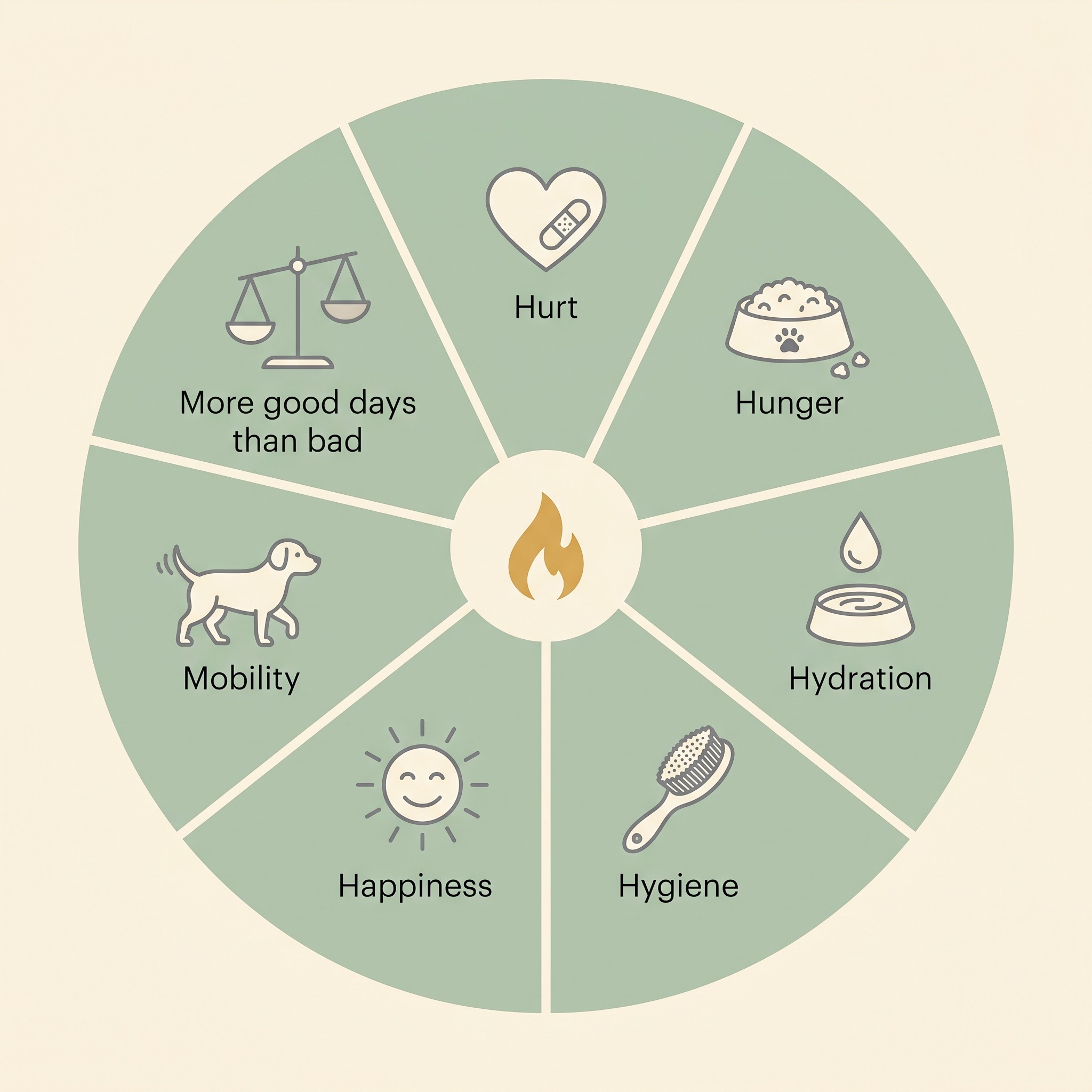
The most widely used is Dr Alice Villalobos's HHHHHMM scale, and the letters are simply the things we have already walked through: Hurt, Hunger, Hydration, Hygiene, Happiness, Mobility, and More good days than bad (Villalobos HHHHHMM, via VCA, 2024). Each is scored from 1 to 10, and as a rough guide "a score above 5 in each category, or an overall score greater than 35, suggests that the [pet's] quality of life is acceptable and that it is reasonable to continue end-of-life care and support" (Villalobos HHHHHMM, via VCA, 2024). It is not folk wisdom dressed up either: a peer-reviewed study (a single validation, in an Italian sample of owners) found the scale holds together as a consistent instrument, with good internal consistency (Testoni et al., 2023). The dimension-by-dimension detail, with how to score truthfully when love tilts the scales, is owned by measuring quality of life: the HHHHHMM scale, and how to use it.
But I have to be firm about one thing, because it is where the scale most often gets misused. A score is a prompt and a tracking aid. It is never a verdict, and a low number is not a green light to let go, any more than a high one is a guarantee all is well. Look closely at what that threshold actually says: a total above 35 is framed by the scale's own author as a reason it is "reasonable to continue" care, not as a signal to stop (Villalobos HHHHHMM, via VCA, 2024). Its real value is not in any single reading but in what it shows when you score the same way week after week: it makes the trend visible and gives you and your vet a shared, plain language instead of you trying to put an unbearable feeling into words.
Keep that record however suits you. A simple notebook or a calendar of good days and bad does the job perfectly well. In the app, the Quality-of-Life Check walks you through the seven HHHHHMM dimensions in a few minutes whenever you want a structured snapshot. And if you would like the trend tracked and plotted for you, Sightline (sightline.vet), a separate ConciergeVet tool, runs a short adaptive weekly assessment with a quality-of-life focus mode built around exactly these frameworks, tracks a single composite score over time, and produces a Sightline Report PDF you can bring to your vet. There is no hard paywall on any of this, and you never need a tool to do it properly: a written log, or our printable QoL sheet, does much the same job. Watch the right things over time, rather than frightening yourself by scanning your pet for signs of death every single day.
Keep watching, and keep talking
I have deliberately not described the day itself here, what happens during the procedure, how peaceful it genuinely is, because that is a different question for a different moment. When you are ready, and only then, what actually happens when a pet is put to sleep sets it out plainly and gently, and knowing in advance removes almost all of the fear from it. For now you only need to keep watching, and keep talking.
So let me leave you where the truth actually is. The goal was never to identify the one perfect day, because there isn't one, and waiting for it only torments you. The goal is to keep asking the answerable questions, openly and together with your vet: are the good days still outnumbering the bad, and can my pet still do the few small things that make them themselves? Do that, week by week, and you will not be ambushed. When the kind window comes you will meet it with clear eyes rather than panic, having already done the loving, careful watching this question really asks of you. You do not have to know tonight. You only have to keep looking, and you do not have to look alone.
If you want somewhere gentle to go next, read measuring quality of life: the HHHHHMM scale to put real shape on the signs above, then more good days than bad: tracking the trend, not the day to start seeing the direction of travel rather than the weather of a single morning. Whichever you reach for, you have already done the hardest and bravest part by asking the question at all. No one can make this decision for you, but you do not have to make it alone, and your vet will help you weigh it.
References
- American Veterinary Medical Association. (2020). AVMA Guidelines for the Euthanasia of Animals: 2020 Edition. American Veterinary Medical Association.
- Blue Cross. (n.d.). Euthanasia and how to say goodbye to your dog and Saying goodbye to your cat. Blue Cross (UK). and https://www.bluecross.org.uk/advice/cat/wellbeing-and-care/time-to-say-goodbye-to-your-cat
- BSAVA. (2016). Better a week too early than a day too late: euthanasia. In BSAVA Manual of Practical Veterinary Welfare (ch. 29, sec. 1). BSAVA Library.
- Lap of Love Veterinary Hospice. (n.d.). How Will I Know It Is Time? and How Will I Know It's Time? https://info.lapoflove.com/how-will-know
- Ohio State University Veterinary Medical Center, Honoring the Bond Program. (2024). How Will I Know? Assessing Quality of Life and Making Difficult Decisions for Your Pet (rev. March 2024).
- PDSA. (2024). How can I tell if my pet still has a good quality of life? and When it's time to say goodbye. People's Dispensary for Sick Animals (UK). and https://www.pdsa.org.uk/pet-help-and-advice/looking-after-your-pet/all-pets/when-its-time-to-say-goodbye
- Testoni, I., De Cataldo, L., Ronconi, L., Colombo, E. S., Stefanini, C., Dal Zotto, B., & Marogna, C. (2023). Validation of the HHHHHMM Scale in the Italian Context: Assessing Pets' Quality of Life and Qualitatively Exploring Owners' Grief. Animals, 13(6), 1010.
- Villalobos, A. E. (2004/2011). Quality of Life Scale (The HHHHHMM Scale). Originally "Quality of Life Scale Helps Make Final Call," Oncology Outlook, Veterinary Practice News, September 2004; formalised in Canine and Feline Geriatric Oncology: Honoring the Human-Animal Bond (2007); reproduced and threshold-confirmed by VCA Animal Hospitals.
Free downloads
Companion worksheets to put what you've read into practice. Free PDFs, print at home.
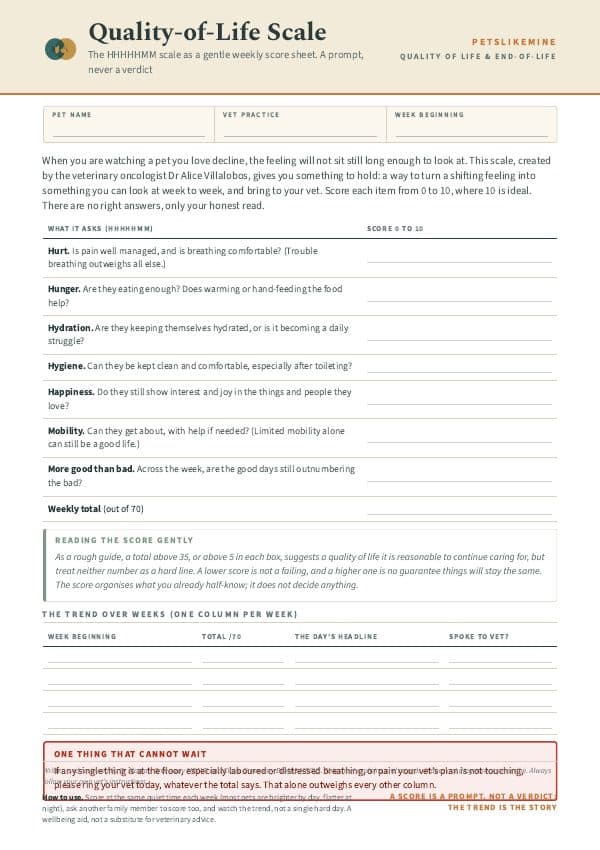
Quality-of-Life Scale
PDF · 230 KBThe HHHHHMM framework (Hurt, Hunger, Hydration, Hygiene, Happiness, Mobility, More good days than bad) as a gentle weekly score sheet, each item 0 to 10, with a multi-week trend grid. A prompt, never a verdict; the trend matters more than any single day.
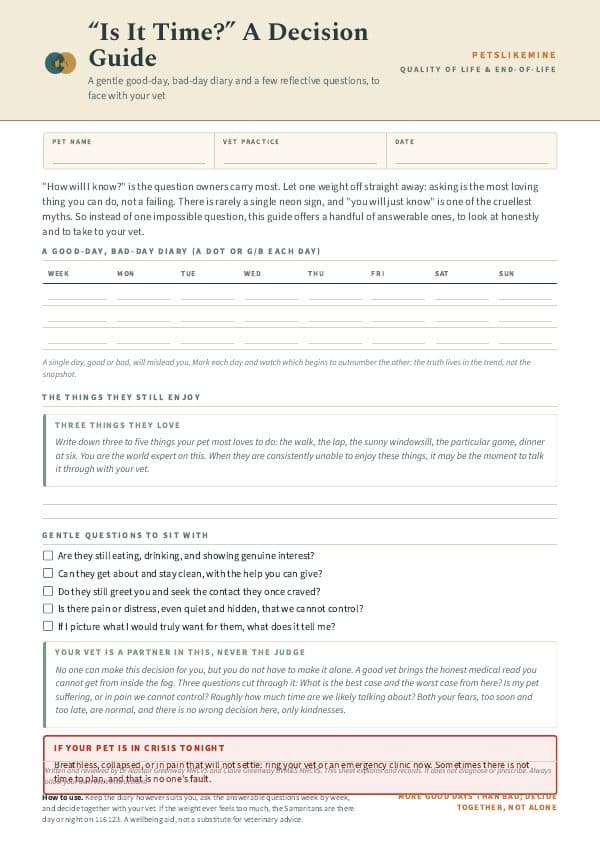
"Is It Time?" A Decision Guide
PDF · 213 KBA gentle good-day, bad-day diary plus reflective questions (the things they still enjoy, a three-things-they-love list, what you would want for them). There is no single right answer: decide together with your vet.