


More Good Days Than Bad: Tracking the Trend, Not the Day
Alastair Greenway
BVM&S MRCVS
Reading your pet one day at a time wears you down in a way few people warn you about. This morning he ate his breakfast, lifted his head when you came in, managed the garden, and the relief floods you, along with a guilty little voice asking how you could ever have doubted him. Then tonight he turns from his food and will not settle, and the floor drops away: you have left it too late, this is it. Tomorrow he rallies, and the whole thing begins again. If you are being whipsawed like this between hope and dread, sometimes within a single afternoon, I want to hand you a way out of it. Not a verdict, and not false comfort. A simple, steadying instrument you can hold in shaking hands.
The way out is to stop reading single days and start reading the line. This page is the companion to the two big questions in this part of the journey, how will I know when it is time and the HHHHHMM scale, and it does the one practical job they hand to it: how to watch the trajectory over weeks, so the decision rests on the direction of travel rather than the weather of any one morning. The calendar, the jar of marbles, the lines you draw while you are calm: this is where they live.
A single day lies to you, in both directions
Start with the thing nobody warns you about, because it is the whole reason any of this is necessary: a single day misleads, and it misleads in both directions at once.
A pet deep in decline can still surface a bright morning, lift their head, take a little food, wag at the door, and a frightened owner seizes on it as proof the corner has been turned, quietly resetting the clock. And a pet still enjoying life can have one rotten, sickly evening that convinces you the end has come, when by morning they are themselves again. Both reactions are completely human, and both are why veterinary teams who guide families through this ask you, gently but firmly, to "look for weekly patterns for a better indication of your pet's overall health and well-being, rather than a single day" (Lap of Love, n.d., QoL assessment blog), and to "focus on the pattern across days, not a single score" (Lap of Love, n.d., usage page).
The eye deceives you a second way, too, and naming it lifts a good deal of guilt. When you live with a pet every day, a slow decline becomes almost invisible up close: a little less spark this week, a little more sleep the next, each step so small your eye adjusts to it, the way you do not notice a child growing until a relative who has not visited in months exclaims at how tall they have got. Ohio State's bereavement team suggest a simple fix, because "sometimes changes are gradual, and therefore hard to recognise": "look at photos or videos of your pet from before the illness" and compare them squarely with today (Ohio State, n.d., QoL fact sheet). A photo from three months ago cannot talk itself into hope or into dread. It is an unflinching witness the daily eye, blurred by love and tiredness, cannot be.
So the problem cuts two ways: any one day is noise, and slow change hides from the people closest to it. The answer to both is to measure, lightly and consistently, and read the line the measurements make.
"More good days than bad" is a real test, not a folk saying
You may have heard the phrase "more good days than bad" and assumed it was a kindly thing people say. It is not. It is the seventh and integrating dimension of the canonical veterinary quality-of-life scale, the HHHHHMM scale created by Dr Alice Villalobos, and on the scale itself the guidance is plain: "when bad days outnumber good days, quality of life might be too compromised" (Villalobos, 2004/2007). It is the dimension that pulls the other six together over time, and a quality-of-life assessment is in large part a way to "determine whether your pet is having more good days than bad" (Lap of Love, n.d., QoL assessment blog).
Everything below is simply a method for making "more good days than bad" something you can see rather than something you anxiously guess at each night. The dimension-by-dimension scoring belongs to its own guide, the HHHHHMM scale; here we are only learning to track the one summarising line it produces.
The simplest method: a calendar and two faces
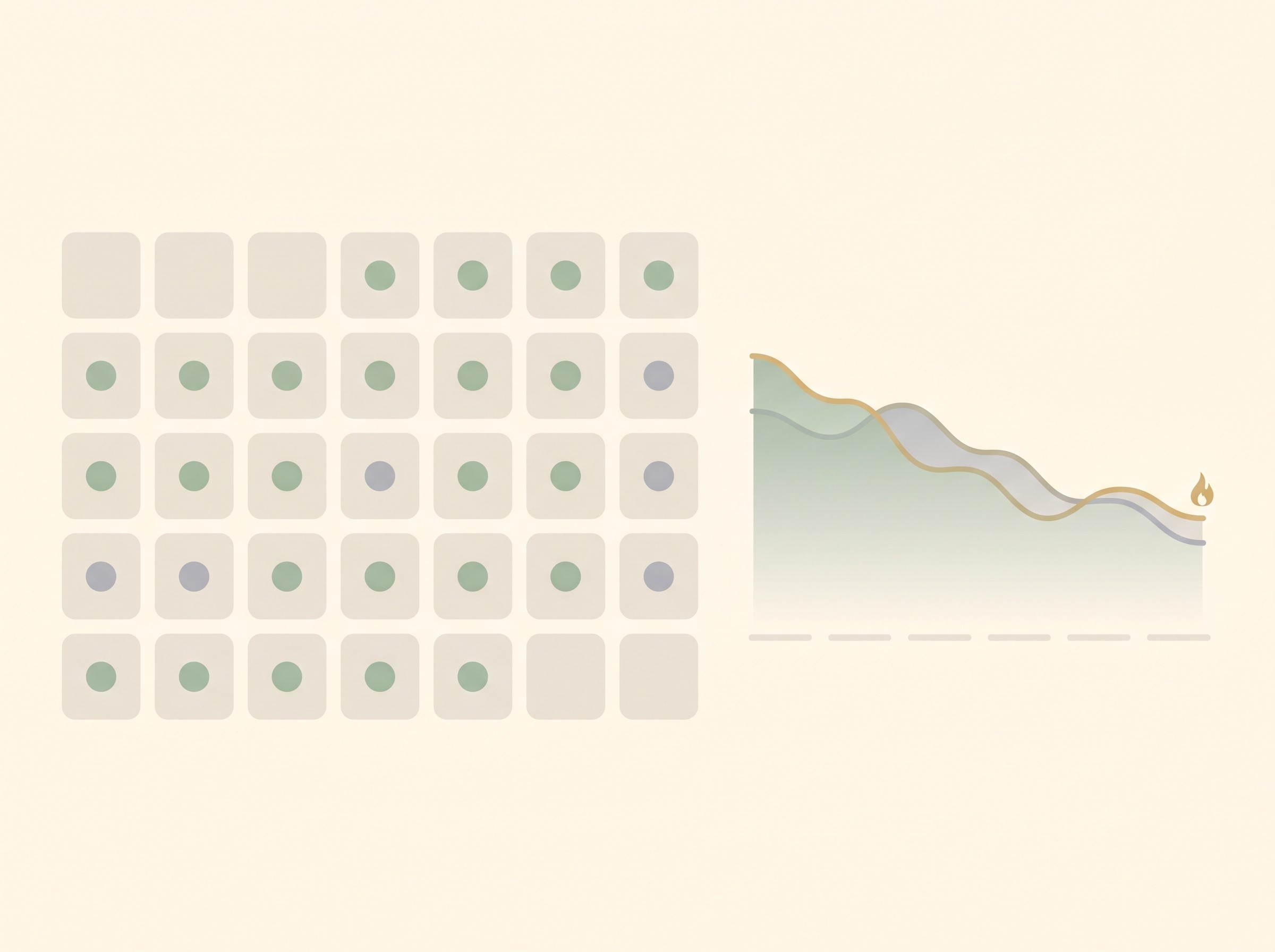
You do not need an app or anything clever to start. The most-taught method in veterinary hospice is also the cheapest, and a teaching hospital sets it out in one sentence. Ohio State: "mark good and bad days on a calendar. This could be as simple as a happy or sad face for good or bad. As the bad days start to outnumber the good, it may be time to consider euthanasia" (Ohio State, 2024); an earlier fact sheet adds that you "may choose to distinguish morning from evening" if your pet's days are uneven (Ohio State, n.d., QoL fact sheet). Colorado State University's veterinary health system teaches the same routine: "each evening, recall the day and decide if it was a good or bad day, marking a calendar with a happy face or a sad face" (CSU Veterinary Health System / Allen, n.d.).
That is the entire method. A wall calendar, or any month-to-view grid, and two marks: a tick for a good day, a cross for a bad one. At the end of the week, and again at the end of the month, you stand back and count. Lap of Love publishes a dedicated printable monthly calendar for exactly this, with the cleanest version of the instruction, "mark a tick for good days and X for bad days," and a footer to add it up: "monthly tally: good days, bad days" (Lap of Love, n.d., Pet Quality-of-Life Calendar); our own printable QoL sheet does the same job if you would rather use ours. Such a humble tool works precisely because it is humble: it asks one small thing of you each evening, light enough to keep up on the hard days, and turns a slippery, unbearable feeling into something you can look at and count.
A marble jar, or your phone, if a calendar is not for you
For some people a calendar full of sad faces is more than they can face. If that is you, there is a gentler, tactile version of the same idea, taught by the same teaching hospital. Colorado State: "for each good day, a marble is placed in a jar. For every bad day, a marble is removed from the jar" (CSU Veterinary Health System / Allen, n.d.). Many families prefer two jars, a good jar and a bad jar, dropping a marble, coin or button into the one that fits the day, so a glance shows which is fuller and a month shows the balance shifting on the windowsill where you cannot help but notice it. I offer it with no sense that it is second-best; for many owners it is the kinder instrument, and the only judgement I have about how you track this is that you find a way you can bear to keep up.
If instead your worry is that you will start a calendar and abandon it, your phone can carry the habit. Ohio State names "the Grey Muzzle phone app" as "an example of an easy quality of life calendar for your smartphone" (Ohio State, 2024). The app, developed with the hospice service Lap of Love, lets you mark each day as good, bad or neutral, shows a calendar so you can take in the whole month at a glance, and draws a summary of the proportion of good days to bad (Grey Muzzle / Lap of Love, n.d.). I mention it the way Ohio State does, as one real example rather than a recommendation, because you should use whatever you will actually open each day. And you need not leave this site to do the same: in the app, the Quality-of-Life Check walks you through the seven HHHHHMM dimensions in a few minutes whenever you want a structured snapshot, so you can start the record today.
Decide what a good day means, for this pet, before you start
Here is the step most owners skip, and it is the one that makes the whole trend trustworthy. Before you mark a single day, decide what a good day and a bad day look like for your particular animal. Colorado State puts it as the first task: "evaluate what a good day would be for your pet, and also what a bad day looks like" (CSU Veterinary Health System / Allen, n.d.). Skip it, and you end up re-deciding the definition every night, through tears, when you are least able to think.
The cleanest way is to anchor the definition in the things your pet loves. Ohio State's exercise is to "make a list of three to five things your pet likes to do, such as going for walks, playing with other pets, or enjoying their meals" (Ohio State, 2024). Write your three to five down now, while you are calm. For an old Labrador a good day might be greeting you at the door, finishing breakfast and pottering round the garden; for an elderly cat, jumping to the windowsill, grooming properly, seeking your lap in the evening. A bad day is the photographic negative of that list. Once it is taped to the fridge, "was today a good day?" stops being a fresh agony each evening and becomes a small, answerable question with your own pet's name on it. (This is the rubric, not the full scoring; the seven-dimension assessment is owned by the scale guide.)
Lines in the sand, drawn while you can still think clearly
Now to the most delicate part, where an owner is most tempted to hear a verdict I am not going to give. A "line in the sand" is a condition you decide in advance, in a calm moment, that will prompt you to phone your vet. Not an automatic ending. A trigger to talk.
The reason to set these lines before a crisis is humane. Ohio State recommends that "you start thinking about these issues early in the process, when your mind may be more clear," because "decisions may seem forced or pressured if you wait until there is a crisis" (Ohio State, 2024). And the reality that makes it matter: while some decisions are made in a sudden emergency, "many euthanasia decisions are made after a gradual decline in quality of life," and in that slow slide "it can be challenging to trust, moment to moment, that now is the time" (Ohio State, 2024). A line in the sand is a gift from the calmer version of you to the frightened, exhausted version standing in the kitchen at midnight. Colorado State frames it inside the calendar method: "decide how many bad days in a row occur before quality is compromised" (CSU Veterinary Health System / Allen, n.d.).
A line might be "when he can no longer get outside to toilet," "when she stops eating her favourite food for three days running," or "when more than half the week is bad days." Some families put a proportion on it; the Grey Muzzle guidance offers, as an illustration, that "you may decide as a family that if your pet has 30% bad days, that it is appropriate to say goodbye" (Grey Muzzle / Lap of Love, n.d.). I want to be very careful here. That 30%, and any "half the week" figure, is an illustration of how a family sets its own line. It is not a recommended cutoff, and no proportion of bad days is an instruction. A line in the sand is the moment you have agreed in advance to stop and talk to your vet, never a sentence that fires on its own. When you reach it, the next step is a phone call, not a foregone conclusion.
This is the place for the sentence I come back to with every family facing this. No one can make this decision for you, but you do not have to make it alone, and your vet will help you weigh it. Drawing your lines now is not morbid and not disloyal. It is one of the most loving things you can do, because it means the choice gets made with a clear head rather than wrenched out of you in the worst hour of the worst day. If thinking about these lines ever brushes your own ability to cope, the guilt that circles all of this is held gently in the guilt is normal; and if your thoughts ever turn darker than grief, to a sense that you cannot go on yourself, please talk to someone tonight: the Samaritans are there around the clock on 116 123.
Pick a rhythm and hold to it
The trend only appears if you measure consistently, so pick a rhythm and hold to it. Ohio State's advice is to "set a strict interval for repeating the quality of life scale," giving the examples "every three days or every Tuesday, or whatever works best for your schedule" (Ohio State, 2024). Lap of Love suggest letting the cadence follow the illness: "for a stable senior or geriatric pet, a quick daily check-in plus a weekly quality-of-life scale score is a helpful rhythm," and "if symptoms worsen, score daily for seven to fourteen days to see trends clearly" (Lap of Love, n.d., usage page). In practice that means a daily good-or-bad mark, light enough to sustain, and a weekly look-back at the same time on the same day, which is where the trend actually reveals itself. Pick a fixed slot, perhaps Sunday evening with a cup of tea, and compare like with like, so one hard Tuesday night will not throw off a record you read on Sundays.
What the trend does, and what it cannot do
I need to be as clear about what the trend is not as about what it is. A downward line is not an instruction, and no proportion of bad days hands down a sentence. Lap of Love put it in one sentence worth holding onto: "the scale helps organise your thoughts, not make decisions for you" (Lap of Love, n.d., usage page). The calendar, the jar and the trend line all do precisely that, and only that: they take an unbearable, slippery feeling and turn it into something you can look at, count and talk about. They organise what you already half-know. They do not decide.
What they do, and this is their real gift, is make the conversation with your vet concrete. Instead of walking in and saying "I think he's getting worse," which is almost impossible for anyone to act on, you can put four weeks of small marks on the desk and say "here is the last month." Ohio State frames your vet as the partner who reads prognosis and suffering with you: "even though your veterinarian cannot make the euthanasia decision for you, they will be able to give you an honest medical perspective about your pet's current condition and comfort" (Ohio State, 2024). They suggest taking three questions in: "what are the best and worst case scenarios for the available options?", "what is your perception of the pain or suffering that my pet may be experiencing?", and "are you able to estimate my pet's life expectancy?" (Ohio State, 2024). A trend turns each of those from a guess into a discussion grounded in something real. (The decision framework itself is owned by how will I know when it is time; bring your trend to it.)
When the trend is a guide, not a tyrant
There is one situation where you must not let "watch the trend" quietly become "wait and see," and it matters enough to be unmissable. The trend governs the slow, hard-to-read decline. It does not override an emergency.
If today is a day of unrelieved pain, obvious distress, a seizure, or extreme difficulty breathing, that is a reason to phone your vet now, today, regardless of how the week has been running. Ohio State is explicit that physical symptoms such as unrelenting pain or extreme difficulty breathing "should weigh heavily in the euthanasia decision," because "these factors constitute very poor quality of life, regardless of other factors" (Ohio State, 2024), and the fact sheet notes that even one item, "for example pain, may indicate a poor quality of life, even if many of the other items are still positive" (Ohio State, n.d., QoL fact sheet). The profession's euthanasia guidelines are built on the same priority, that the overriding aim is the relief of an animal's pain and suffering (AVMA, 2020). One genuinely terrible day of suffering is not outvoted by a column of good marks. Spotting pain in a pet who hides it, especially a stoic cat, has its own guide in spotting pain in a pet who hides it; here I only ask you to hold the rule plainly. The trend is your default lens for the slow slide, not a reason to sit out a crisis.
"A week too early," and why a downward line is worth heeding
Why heed a downward trend at all, rather than hoping each bad week is a blip? Because of a real asymmetry that vets and hospice teams see again and again. Ohio State states it from long experience: "many families tell us that they waited too long; families rarely tell us they made the decision too soon" (Ohio State, 2024). There is an established veterinary maxim behind that, established enough that it titles a chapter in a professional clinical manual: better a week too early than a day too late (BSAVA Manual, 2016). The kindness in a downward trend you have actually watched is that it lets a peaceful, planned goodbye arrive on a calmer day, rather than a frightening crisis death in the small hours.
But I must pair that immediately with its other half, because on its own it can read as a push, and it is not one. Watching the trend is not about acting sooner. It is about not being blindsided by a slow decline you were too close to see. And second-guessing yourself afterwards is not evidence that you got it wrong. Ohio State again: "it is normal and natural to second-guess a decision, and that second-guessing does not mean you made the wrong choice. In cases of illness or declining quality of life there is truly no wrong decision to be made, only the decision you feel is best for your pet and your family" (Ohio State, 2024). The takeaway is gentle, not urgent: track the line so that when the kind window comes, you meet it with clear eyes instead of panic. The fuller treatment of those twin fears is owned by too soon, or too late? Living with the timing.
The structured version, if you want the line drawn for you
Everything here can be done with a wall calendar and two faces, or a jar of marbles, and I mean it when I say that is enough. But some owners want the trend captured and plotted properly over many weeks, and that is part of what we built Sightline for. Sightline (sightline.vet), a separate ConciergeVet tool, runs a short adaptive weekly assessment with a quality-of-life focus mode built around exactly these frameworks, tracks a single composite score over time so you can see the trend rather than judge a single bad day, and produces a Sightline Report PDF you can bring to your vet. A written log, or our printable QoL sheet, does much the same job. There is no hard paywall on any of this. The point is never the format; it is to read the line instead of the day.
The gift of the trend, in the end, is not a verdict but relief from the whiplash. A calendar and two faces, a jar of marbles on the windowsill, the snapshot in your account: each one turns an impossible, slippery question into a line you can read, with your vet beside you, on a day when you can think. The kindest thing you can do for the frightened version of yourself who will one day have to look at that line is to start marking today, while you are calm, so the record is already there when you need it. When you are ready to put real shape on what counts as a good day, the HHHHHMM scale is the next step, and how will I know when it is time holds the larger decision the trend feeds into. You do not have to read the whole future tonight. You only have to mark today, truthfully, and remember the line I come back to with every family: no one can make this decision for you, but you do not have to make it alone, and your vet will help you weigh it.
References
- American Veterinary Medical Association. (2020). AVMA Guidelines for the Euthanasia of Animals: 2020 Edition. American Veterinary Medical Association.
- British Small Animal Veterinary Association (BSAVA). (2016). Better a week too early than a day too late: euthanasia. BSAVA Manual, BSAVA Library.
- Colorado State University Veterinary Health System (Allen, E.). (n.d.). Considering Your Pet's Quality of Life in the Midst of Disease. Colorado State University Veterinary Health System.
- Grey Muzzle / Lap of Love. (n.d.). Quality of Life Calendar (smartphone app developed in association with Lap of Love; named by Ohio State as an example quality-of-life calendar app). The Grey Muzzle Organization.
- Lap of Love Veterinary Hospice. (n.d., Pet Quality-of-Life Calendar). Pet Quality-of-Life Calendar (printable monthly calendar PDF; "mark a tick for good days and X for bad days"; "monthly tally: good days, bad days"; content may not be reproduced without written consent from Lap of Love Veterinary Hospice).
- Lap of Love Veterinary Hospice. (n.d., QoL assessment blog). Quality of Life Assessment: A Critical Tool for Your Senior Pet (scales by Dr Dani McVety and Dr Mary Gardner).
- Lap of Love Veterinary Hospice. (n.d., usage page). How do I use Lap of Love's Quality-of-Life Scale? / How often should I assess my pet's quality of life? ("the scale helps organize your thoughts, not make decisions for you"; "focus on the pattern across days, not a single score"; cadence by stage).
- Ohio State University Veterinary Medical Center, Honoring the Bond Program. (2024). How Will I Know? Assessing Quality of Life and Making Difficult Decisions for Your Pet (booklet, rev. March 2024). The Ohio State University Veterinary Medical Center.
- Ohio State University Veterinary Medical Center, Honoring the Bond Program. (n.d., QoL fact sheet). How Do I Know When It's Time? Assessing Quality of Life for Your Companion Animal and Making End-of-Life Decisions (quality-of-life fact sheet and scale, adapted with permission from the HHHHHMM Quality of Life Scale, Dr Alice Villalobos). The Ohio State University Veterinary Medical Center.
- Villalobos, A. E. (2004/2007). Quality of Life Scale (The HHHHHMM Scale). Originally "Quality of Life Scale Helps Make Final Call," Oncology Outlook, Veterinary Practice News, September 2004; scored table format created for Canine and Feline Geriatric Oncology: Honoring the Human-Animal Bond, Blackwell Publishing, 2007.
Free downloads
Companion worksheets to put what you've read into practice. Free PDFs, print at home.
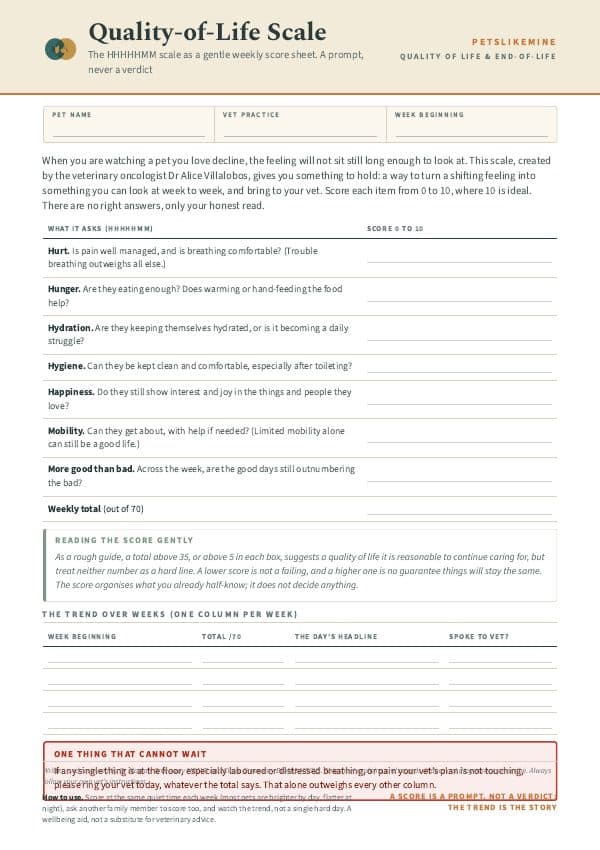
Quality-of-Life Scale
PDF · 230 KBThe HHHHHMM framework (Hurt, Hunger, Hydration, Hygiene, Happiness, Mobility, More good days than bad) as a gentle weekly score sheet, each item 0 to 10, with a multi-week trend grid. A prompt, never a verdict; the trend matters more than any single day.
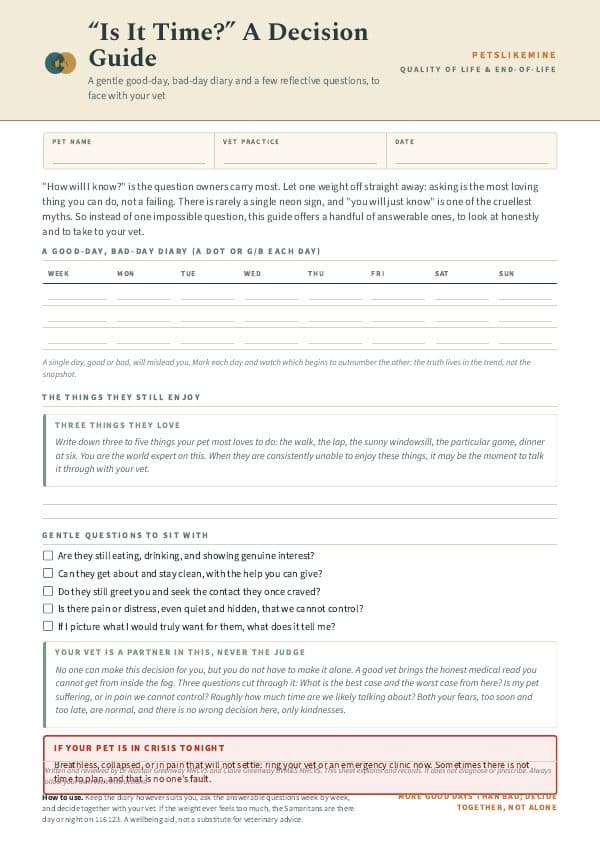
"Is It Time?" A Decision Guide
PDF · 213 KBA gentle good-day, bad-day diary plus reflective questions (the things they still enjoy, a three-things-they-love list, what you would want for them). There is no single right answer: decide together with your vet.