Spotting Pain in a Pet Who Hides It
Alastair Greenway
BVM&S MRCVS
One question tends to surface in the quiet of the final chapter, often at night, once the diagnosis has settled and the busy part is over. You watch your pet asleep in their usual spot, and you wonder: is he in pain, and I just can't see it? It is one of the hardest questions an owner carries, because it turns love into vigilance and every nap into a worry.
So let me answer the worst part of it first. If you are afraid you might be missing your pet's suffering, you have not failed, and you are not a bad owner. Pets, cats especially, are built to hide pain, and the evidence is clear that subtle pain is genuinely hard to read, even for experienced vets and even for the people who love an animal most (Evangelista et al., 2019; Gardeweg et al., 2026). Spotting hidden pain is not a test you have already flunked by not noticing sooner. It is a craft, and a craft can be taught: why pets conceal pain, the small signs that give it away in cats and stoic dogs, the one tool that lets you read a cat's face, and a way of watching that turns an unanswerable "is he hurting?" into an answerable "is this worse than a fortnight ago?".
Why a calm, settled pet can still be hurting
To read hidden pain, it helps to understand why it is hidden in the first place. Take cats, because they are the masters of it. A cat is both predator and prey, and in the wild an animal that visibly limps or cries draws the wrong kind of attention, so concealment is instinct rather than stoicism as a virtue. As the comparative pain centre led by one of the field's foremost researchers puts it plainly, "like their wild ancestors, domestic cats are very good at hiding their pain" (NC State Comparative Pain Research and Education Center, n.d.). That is why feline pain goes so under-recognised: cats are stoic and genuinely hard to read, so their pain is often missed (AVMA, 2019). Dogs do it too, just less completely, masking discomfort with a wagging tail and a brave face, particularly the slow, grinding pain of age.
A point of precision rather than folklore here, because it protects you from a trap. The blanket claim that "prey species hide their pain" has been examined critically: a review in animal ethics argues it is an oversimplification, and that the species whose pain we read most reliably (dogs) earns that not through its predator-or-prey role but through the trusting relationship people build with them and the time they put into watching (Mota-Rojas et al., 2020). Recognition improves for any animal when the human looks carefully and consistently. So the practical lesson, the foundation of everything below, is twofold. Do not take a calm, still, "settled" pet as proof of comfort. And do not assume that because they are not crying out, they are not hurting. Absence of obvious signs is not absence of pain.
That principle has hard reassurance behind it. The team who built the modern cat-pain tools put it directly: "pain management is frequently overlooked in cats and they are prescribed less analgesic drugs when compared with dogs," largely because it is so hard to recognise (Evangelista et al., 2019). Across the board, pets are under-treated for pain, not over-treated. So the instinct that brought you here, the urge to ask your vet about pain relief, is not over-reacting. It is exactly right.
The quiet signs, in cats and in dogs
Hidden pain does not announce itself. It leaks out in small changes to how an animal moves, grooms, sleeps and relates to you. None of these signs alone is proof, and a pet can be in real pain without showing any one of them: an expert consensus on feline pain concluded that twenty-five behavioural signs were each sufficient to indicate pain, but no single sign was necessary for it (Merola & Mills, 2016). So read the lists below as a vocabulary, not a checklist to tick. You are learning the language in which your particular pet might speak discomfort.
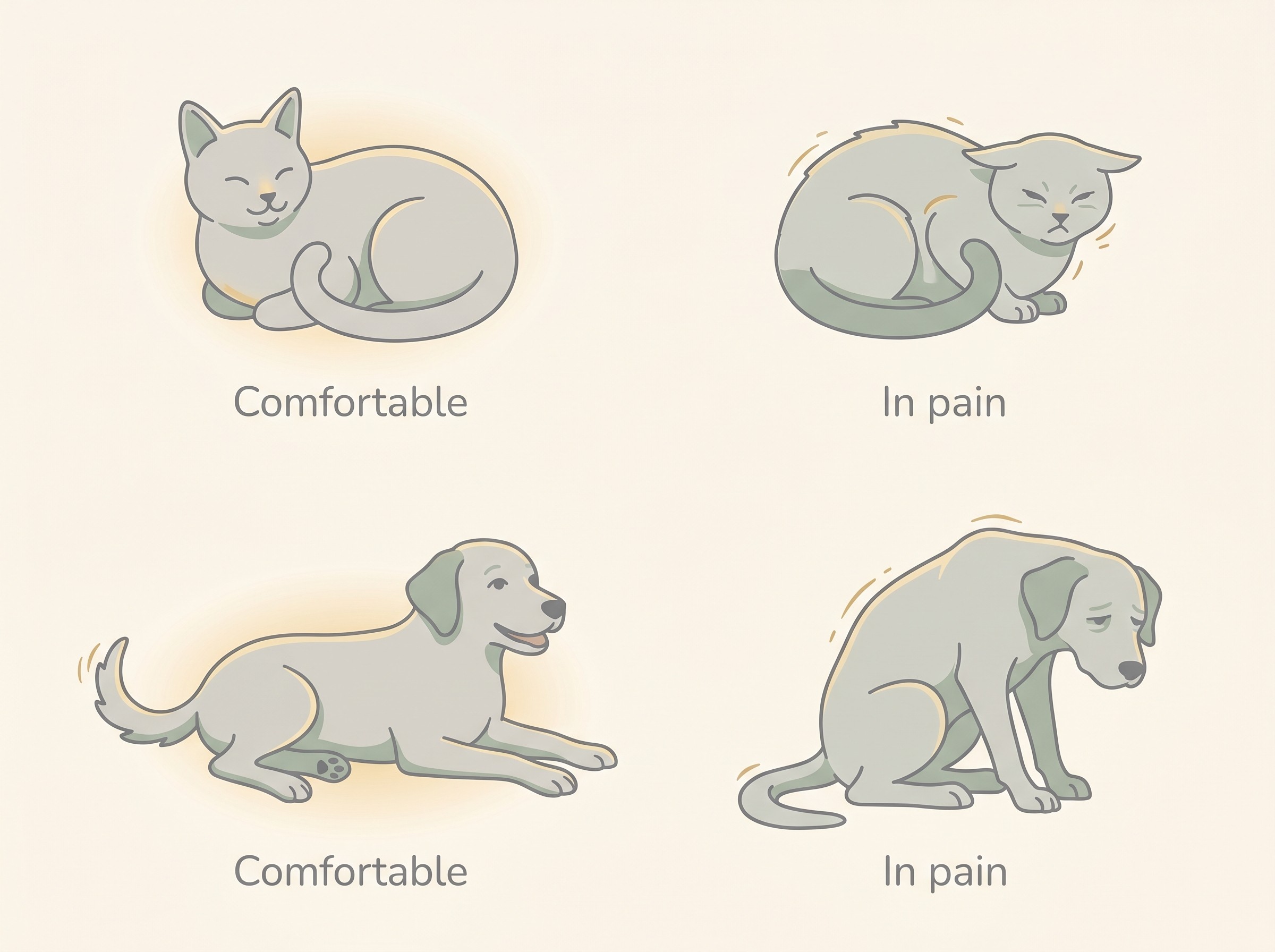
In cats, the signs cluster around withdrawal and a quiet shrinking of life. The most reliable owner-observable changes, drawn from the centre that studies this, are hiding or withdrawing; decreased grooming (an unkempt, greasy or matted coat) or, conversely, excessive licking of one sore area; increased aggression or irritability when handled; avoidance of the litter tray, sometimes soiling outside it because the sides have become too high to climb into comfortably; and the mobility cluster: reduced willingness to jump up or down, lowered or aborted jumps, difficulty with stairs, stiffness, less activity, more sleeping (often in new, easier-to-reach places) and reluctance to play (NC State Comparative Pain Research and Education Center, n.d.). International Cat Care, the owner-facing arm of the feline-medicine profession, adds a lovely, specific tell: a sore cat often stops curling into a relaxed "bagel" or "pretzel" shape, sits hunched and still instead, and may become defensive, hissing or growling, when stroked over a tender area (International Cat Care / ISFM, n.d.).
In dogs, especially the stoic and the elderly, the signs are similar in spirit. Watch for reluctance to climb stairs, jump into the car or get up; slowness or stiffness rising, worst after a long rest; restlessness, repeatedly settling and re-settling as they fail to get comfortable; lagging on walks or wanting them shorter; a muted or delayed greeting; altered sleep; panting at rest or trembling; licking or guarding one part of the body; going off food; and a change in temperament, new grumpiness or new clinginess. Owners often know their own dog's normal better than anyone, which is precisely why "this isn't like him" is worth taking seriously rather than explaining away (Blue Cross, n.d.).
Reading a cat's face: the Feline Grimace Scale
For cats, there is one genuinely brilliant tool that does something nothing else quite manages: it lets you read pain in the face itself. The Feline Grimace Scale (FGS) was developed and validated at the Université de Montréal and published in 2019, and it scores five facial "action units", each from 0 (absent) to 1 (moderate or uncertain) to 2 (obvious) (Evangelista et al., 2019).
The five things it looks at, in the researchers' own words, are: ear position ("the tips of ears pulled apart and rotated outwards"); orbital tightening ("narrowing of the orbital area ... or tightly closed eyelid (squinted eyes)"); muzzle tension ("flattening and stretching of the muzzle from round to an elliptical shape"); whisker position ("movement of whiskers forward ... as if standing on end (spiked)"); and head position ("head below the shoulder line or tilted down (chin toward the chest)") (Evangelista et al., 2019). Put simply, a comfortable cat's face is open and round, with forward ears and the head held up, while a painful cat's flattens and tightens. Once you have studied your own cat's comfortable face, the painful version becomes far easier to recognise.
You do not have to do this from memory. There is a free Feline Grimace Scale smartphone app, made by the same Montreal team and downloaded more than a hundred thousand times, with a "practice your skills" tutorial that even lets you photograph your cat's own face and share it with your vet if you suspect pain (WSAVA, 2020; Feline Grimace Scale, Université de Montréal). Pair it with the matching advice from International Cat Care, which exists because cats so often clam up in the clinic and show the vet nothing: film your cat at home, being themselves, so the vet can see the behaviour you are worried about (International Cat Care / ISFM, n.d.). Between them, these two simple actions, a photograph of the face and a video of the behaviour, turn "I think something is wrong" into something your vet can actually see and act on.
One word of caution about what the FGS is for, because using a tool well means knowing its edges. It was validated against naturally occurring acute pain and is very good at it, correlating strongly with an existing validated measure and agreeing well between observers (Evangelista et al., 2019). That makes it a superb way to learn a painful cat's face and to catch acute flares. It is not a quality-of-life verdict or a chronic-pain score: day-to-day decline in the final chapter is read more through sustained behaviour change, which is the next part. And no score ever decides anything. A higher grimace score simply suggests your cat may need pain relief and is a good reason to phone your vet, no more and no less.
The whispering pain of the final chapter
There are two broad flavours of pain, and the end of a pet's life usually serves up the harder one to spot. Acute pain tends to shout: a sudden lameness, a yelp, a cat guarding a fresh wound. Chronic pain, the slow ache of arthritis, cancer, or age-worn joints, whispers. It develops insidiously over weeks and months and shows up mainly as gradual behaviour change: reduced activity, reluctance to do things they used to do easily, altered grooming, altered temperament and altered sleep (2022 WSAVA Pain Management Guidelines, Monteiro et al., 2023; 2022 AAHA Pain Management Guidelines, Gruen et al., 2022). The final chapter is nearly always this whispering kind, which is exactly why it is so easy to miss and so important to learn to read.
The part that matters most for you happens at home. Both major sets of professional guidelines stress that, for chronic pain especially, the owner's observation is central, and that validated owner-facing tools exist precisely for that reason. As the American guidelines put it, "particularly for chronic pain, capturing owner evaluation is important, with pain-assessment instruments for pet owners described" (Gruen et al., 2022). The UK professions agree in plainer terms: International Cat Care frames behaviour change (grooming, posture, activity, litter-tray use) as the way arthritis pain shows itself in cats (International Cat Care / ISFM, n.d.), and the British Small Animal Veterinary Association holds that owners should be given clear information on the signs of pain as part of normal, good care (BSAVA, n.d.). The thread through all of them is empowering rather than frightening: at home, behaviour watched over time is the instrument, and you are the one holding it.
You did not fail: the science of why this is hard
Owners punish themselves for "not noticing", so here is why none of this is your fault, with the evidence firmly on your side. Start with how invisible pain can be even when it is widespread. Just over 90% of all cats have radiographic evidence of degenerative joint disease somewhere in the body (NC State Comparative Pain Research and Education Center, n.d.). Sit with that figure: a great many cats are quietly arthritic, purring on the sofa and seemingly perfectly fine, while carrying joint disease that goes unrecognised because the signs are so subtle (the origin study goes back to a survey of geriatric cats, Hardie et al., 2002). This is not a story about careless owners. It is a story about pain built, by evolutionary design, to be missed.
And owners are simply not naturally good at spotting the subtle kind, which is normal. A 2026 study presented detailed case descriptions to 530 dog owners and 117 non-owners and measured how well each group recognised pain (Gardeweg et al., 2026). For an obvious, movement-related problem (a kneecap dislocation), owners edged ahead only narrowly: 97% rated pain a likely explanation, against 92% of non-owners. But for a subtle, behavioural presentation (a dog with bone-inflammation pain showing up as increased clinginess, shadowing its owner, night-time restlessness and a shorter walk), owners were no better than people who had never owned a dog: only 53% rated pain likely, versus 55% of non-owners, with no meaningful difference (Gardeweg et al., 2026). The gap is specifically in the quiet signs, the very ones that matter at the end of life.
There is a hopeful coda, and it is the reason you are reading this. Owners who had previously cared for a pet with a painful condition were markedly better at spotting the subtle case: 62% rated it pain-likely, against 46% of those without that experience (Gardeweg et al., 2026). Recognition is learnable; knowing what to watch for genuinely improves what you see. The same shows up in cats, where owners informed about feline joint-disease pain scored their cats as impaired far more often than uninformed owners (Enomoto et al., 2020). The simple act of learning the signs, the thing you are doing right now, is itself the intervention. You are not behind. You are catching up, and the evidence says it works.
The fix: structured watching, read as a trend
So if instinct alone is not reliable for subtle pain, what is? Structure. The single most useful shift you can make is to stop asking the unanswerable daily question ("is he in pain today?") and start asking an answerable one over time ("is this worse than it was a fortnight ago?").
The reason this works is that daily proximity blinds you to gradual change. The slide is slow, you see your pet every day, and love filters it: a tiny loss of spring in the jump, a slightly greasier coat, none of it large enough to alarm you on the day, all of it adding up over a month. The fix is to take the judgement out of the moment. As NC State's centre frames it, "although cats cannot describe their pain to us, the effects can be measured through evaluating behavior", and "people living with cats are best at assessing these changes" (NC State Comparative Pain Research and Education Center, n.d.). You are the best-placed observer there is; you just need a method that does not rely on memory or mood. A good method has three parts. First, pick the few things that tell you most about this particular animal: the windowsill they always jump to, the stairs they take, how thoroughly they groom, their greeting, how easily they settle to sleep. Second, record them the same way on a schedule, rather than trusting "he seems alright today". Third, compare against the past: dig out old photos and videos to see the difference time has hidden, and ask someone who sees your pet less often what they notice, because fresh eyes catch the change that daily eyes have stopped seeing (Ohio State University, Honoring the Bond, 2024).
This is not guesswork dressed up. Validated, owner-usable versions already exist and they work: for cats there is a clinically tested six-question owner checklist for joint-disease pain, asking about the cat's ability to run, jump up, jump down, climb stairs, descend stairs and chase objects, whose authors conclude that "owners remain a critical part of the diagnosis and monitoring of DJD-associated pain" (Enomoto et al., 2020), with broader owner-completed instruments validated for both species (Monteiro et al., 2023; Gruen et al., 2022). Putting numbers on a few behaviours, week after week, is a serious clinical method, not a gimmick, and one you can do at the kitchen table.
There are good tools to carry this for you. Because reluctance to jump and climb and stiffness are so central to the pain we are discussing, our 2-Minute Mobility Check puts numbers on exactly those mobility signs in a dog or a cat, repeatable over weeks so you see a trend rather than a single day, and our in-app quality-of-life snapshot walks through the wider picture. If you want the trend tracked properly, Sightline (sightline.vet), a separate ConciergeVet tool, runs a short adaptive weekly assessment with a quality-of-life focus mode built around exactly these frameworks, tracks a single composite score over time so you see the trend rather than judge a single bad day, and produces a Sightline Report PDF you can bring to your vet. A written log, or our printable QoL sheet, does much the same job. The tool matters far less than the habit of watching a few things the same way, over weeks.
When to phone the vet, and when not to wait
Learning the quiet signs is about more than reassurance. Some things are "phone now", not "let's see how he is in a few days". Phone your vet if you suspect pain that is escalating, or pain that medication does not seem to be touching; if your pet cannot rest, settle or sleep, because an animal that cannot get comfortable is telling you something; or if they cry out or react with aggression when a particular area is touched. And above all, any laboured, rapid or distressed breathing outranks everything else on this page and warrants contacting your vet straight away (Monteiro et al., 2023; Gruen et al., 2022). These are consistent with the wider red-flag picture in the home comfort-care guide.
Two firm points sit underneath all of that. Suspected pain is always worth a vet conversation, because, as we have seen, pets are under-treated for pain rather than over-treated (Evangelista et al., 2019): you will never be told off for asking, and far from a fob-off, pain assessment is a real, systematic discipline at the surgery, where vets use validated tools such as the short-form Glasgow Composite Measure Pain Scale for dogs to link a score to whether pain relief is needed (Reid et al., 2007, cited in Monteiro et al., 2023). And please never reach for a human painkiller from the cupboard. Paracetamol and ibuprofen are dangerous to pets, paracetamol especially so to cats, where even a small dose can be fatal. The proper treatment picture, the medicines your vet may prescribe and how to give them, belongs to giving medication and managing comfort at home, reached through the comfort-care guide. Spotting the pain is your job here; treating it is a partnership with your vet, never a trip to the medicine drawer.
If recognising pain naturally raises the larger question of where all this is heading, that is its own careful conversation, held with frameworks and signs rather than verdicts, in measuring quality of life: the HHHHHMM scale and how will I know when it is time. No one can make this decision for you, but you do not have to make it alone, and your vet will help you weigh it. For now, this page asks only that you learn to see.
What to do tonight
You cannot watch for everything at once, and you do not need to. Watching a few chosen things the same way each week turns pain from something you only see in hindsight into a change you can act on early, while there is most you can do about it, and it means the conversation with your vet starts from what you have actually observed rather than from a fear in the dark. The dread that brought you here, that your pet might be quietly suffering and you would never know, is the hardest part, and it loosens its grip the moment you have a method. You are not someone who failed to notice. You are someone learning, tonight, to notice well, and the evidence says that learning genuinely changes what you see (Gardeweg et al., 2026; Enomoto et al., 2020). Watch the right few things, the same way, over time, and you will catch the whisper your pet would never tell you out loud.
References
- AVMA. (2019). New scale interprets pain from feline facial expressions. JAVMA News, American Veterinary Medical Association, 1 October 2019.
- Blue Cross. (n.d.). How to spot if your dog is in pain. Blue Cross.
- BSAVA. (n.d.). Pain management and behavioural medicine resources (BSAVA Library; BSAVA Manual of Canine and Feline Behavioural Medicine). British Small Animal Veterinary Association.
- Enomoto, M., Lascelles, B. D. X., & Gruen, M. E. (2020). Development of a checklist for the detection of degenerative joint disease-associated pain in cats. Journal of Feline Medicine and Surgery, 22(12), 1137-1147.
- Evangelista, M. C., Watanabe, R., Leung, V. S. Y., Monteiro, B. P., O'Toole, E., Pang, D. S. J., & Steagall, P. V. (2019). Facial expressions of pain in cats: the development and validation of a Feline Grimace Scale. Scientific Reports, 9, 19128.
- Feline Grimace Scale, Université de Montréal. (n.d.). Feline Grimace Scale (Steagall Laboratory).
- Gardeweg, S. M. A., Picard, D. E., & van Herwijnen, I. R. (2026). The abilities in dog pain sign recognition as assessed by presenting seventeen listed dog behavioural signs and three case descriptions to dog owners and non-dog owners. PLoS ONE, 21(4), e0344512.
- Gruen, M. E., Lascelles, B. D. X., Colleran, E., Gottlieb, A., Johnson, J., Lotsikas, P., Marcellin-Little, D., & Wright, B. (2022). 2022 AAHA Pain Management Guidelines for Dogs and Cats. Journal of the American Animal Hospital Association, 58(2), 55-76.
- Hardie, E. M., Roe, S. C., & Martin, F. R. (2002). Radiographic evidence of degenerative joint disease in geriatric cats: 100 cases (1994-1997). Journal of the American Veterinary Medical Association, 220(5), 628-632.
- International Cat Care / ISFM. (n.d.). Arthritis in cats and Cat Carer Guide to Acute Pain. International Cat Care (International Society of Feline Medicine).
- Merola, I., & Mills, D. S. (2016). Behavioural signs of pain in cats: an expert consensus. PLoS ONE, 11(2), e0150040.
- Monteiro, B. P., Lascelles, B. D. X., Murrell, J., Robertson, S., Steagall, P. V. M., & Wright, B. (2023). 2022 WSAVA guidelines for the recognition, assessment and treatment of pain. Journal of Small Animal Practice, 64, 177-254.
- Mota-Rojas, D., Olmos-Hernández, A., Verduzco-Mendoza, A., Hernández, E., Martínez-Burnes, J., & Whittaker, A. L. (2020). Do "prey species" hide their pain? Implications for ethical care and use of laboratory animals. Journal of Applied Animal Ethics Research, 2(2), 216-236.
- North Carolina State University College of Veterinary Medicine, Comparative Pain Research and Education Center. (n.d.). Arthritis Pain in Cats.
- Ohio State University Veterinary Medical Center, Honoring the Bond. (2024). How Do I Know When It's Time? Assessing Quality of Life for Your Companion Animal.
- Reid, J., Nolan, A. M., Hughes, J. M. L., Lascelles, D., Pawson, P., & Scott, E. M. (2007). Development of the short-form Glasgow Composite Measure Pain Scale (CMPS-SF) and derivation of an analgesic intervention score. Animal Welfare, 16(S), 97-104.
- WSAVA. (2020). Feline Grimace Scale app launched! World Small Animal Veterinary Association.
Free downloads
Companion worksheets to put what you've read into practice. Free PDFs, print at home.