

Pet Hospice: Comfort Care at Home in the Final Chapter
Alastair Greenway
BVM&S MRCVS
A decision has been made, by you or by the disease, and the aim is no longer to fix this. The aim now is to give your pet the best of whatever time is left, at home, where they are loved. A quieter worry usually arrives once the house has gone still: can I actually do this well, or will I just stand here and watch him decline and hope?
You are not improvising this alone, and you are not meant to. Home hospice is not you becoming an amateur nurse in the dark. It is a real plan, built with your vet, with named people to call and clear things to watch for. The international body that defines this field is unequivocal: animal hospice care "cannot be provided without the medical direction of a licensed veterinarian," and supervision by vets with expertise in palliative and end-of-life care "is paramount" (IAAHPC Guidelines, Shanan et al.). You are the daily expert on your pet. Your vet is the medical director. This page is your map of how those two roles fit together, what comfort care actually covers, and what to do when it stops being enough.
Palliative care and hospice: two words, and why the difference matters
People use these terms interchangeably, but the distinction tells you where you are. Palliation means "relieving or soothing the symptoms of a disease or disorder at any stage of an illness" (IAAHPC Guidelines, Shanan et al.). It can run alongside treatment that is still trying to cure or control the disease. Hospice care begins at a different point: when the focus shifts away from cure and diagnostics, toward comfort for the time that remains (Lap of Love, n.d.).
Lap of Love, a veterinary hospice service, frames the shift as a change in the question you are asking. It stops being "How do we fix this?" and becomes "How do we help them feel as comfortable as possible today?" (Lap of Love, n.d.). That is the doorway you have walked through, and the guidelines describe what lies beyond it not as giving up but as skilled work, to "focus on maximizing patient comfort and minimizing suffering while providing a collaborative and supportive partnership with the caregiver client" (Bishop et al., 2016). Comfort at any stage is palliative care. When comfort has become the whole plan, that is hospice. You have not stopped caring. You have changed what caring means.
What hospice is for, and who it is for
In the absence of "cure" it can feel as though there is no goal at all. There is. "Hospice care is about giving patients and caregivers control, dignity, and comfort during the time they have remaining to live" (IAAHPC Guidelines, Shanan et al.). Those are not soft words: they mean your pet stays comfortable and stays themselves for as long as possible, and that you are not left feeling powerless.
Notice who that sentence includes. Hospice is for patients and caregivers, a principle sometimes called the unit of care: it looks after the family, not only the animal. The guidelines say plainly that hospice and palliative care help caregivers "ease into an acceptance of death, provide time for them to adjust emotionally to the loss of their animal, and reduce the stresses arising from end-of-life decision-making and care" (IAAHPC Guidelines, Shanan et al.). So if part of what you need from these weeks is time to prepare your own heart, that is not selfish. It is written into what hospice is.
Turning a vague intention into a written plan
The most useful thing you can do this week is turn a vague intention into a real plan, on paper, made with your vet. A good end-of-life plan is not a feeling; the guidelines describe concrete components: "client education; evaluating the caregiver's needs and goals for the pet; and a collaborative, personalized, written treatment plan" (Bishop et al., 2016). The goals are set together, the medicine your vet's and the goals yours to define alongside them: "Goals of care can then be defined by the animal's caregivers in collaboration with the attending veterinarian" (IAAHPC Guidelines, Shanan et al.). You are allowed to say what matters most, whether that is no needles, staying at home, or holding on until a family member can get back.
So ask, in as many words, for a written hospice plan covering four things: the medicines and how to give them, the day-to-day comfort measures, exactly what to watch for, and what to do in a crisis. Ask without embarrassment; this is standard care, not a favour. And hold one thing lightly: the plan is not fixed. Your pet will change, and so will your own capacity to cope. The guidelines build that in, advising that the patient's condition and the caregiver's ability to cope "can change frequently, so both must be reassessed regularly and the plan of care promptly modified" (IAAHPC Guidelines, Shanan et al.). A plan that bends with the week is not a plan that failed. It is the plan working.
Five comfort domains: your map
So what does comfort actually consist of? The guidelines structure end-of-life care into a hierarchy, with physical care at the base, the patient's social wellbeing in the middle and emotional wellbeing at the apex (Bishop et al., 2016), and they list the concrete sources of suffering a plan must address: "physical pain, nausea, inappetence, respiratory distress, loss of mobility, incontinence, dehydration, boredom, anxiety, and the inability to engage in meaningful" activity (IAAHPC Guidelines, Shanan et al.). I have grouped that into five comfort domains, the map I would draw for you in the consult room. Each has a specialist guide that goes far deeper than I will here; my job is to hand you the whole shape, then point you to the detail.
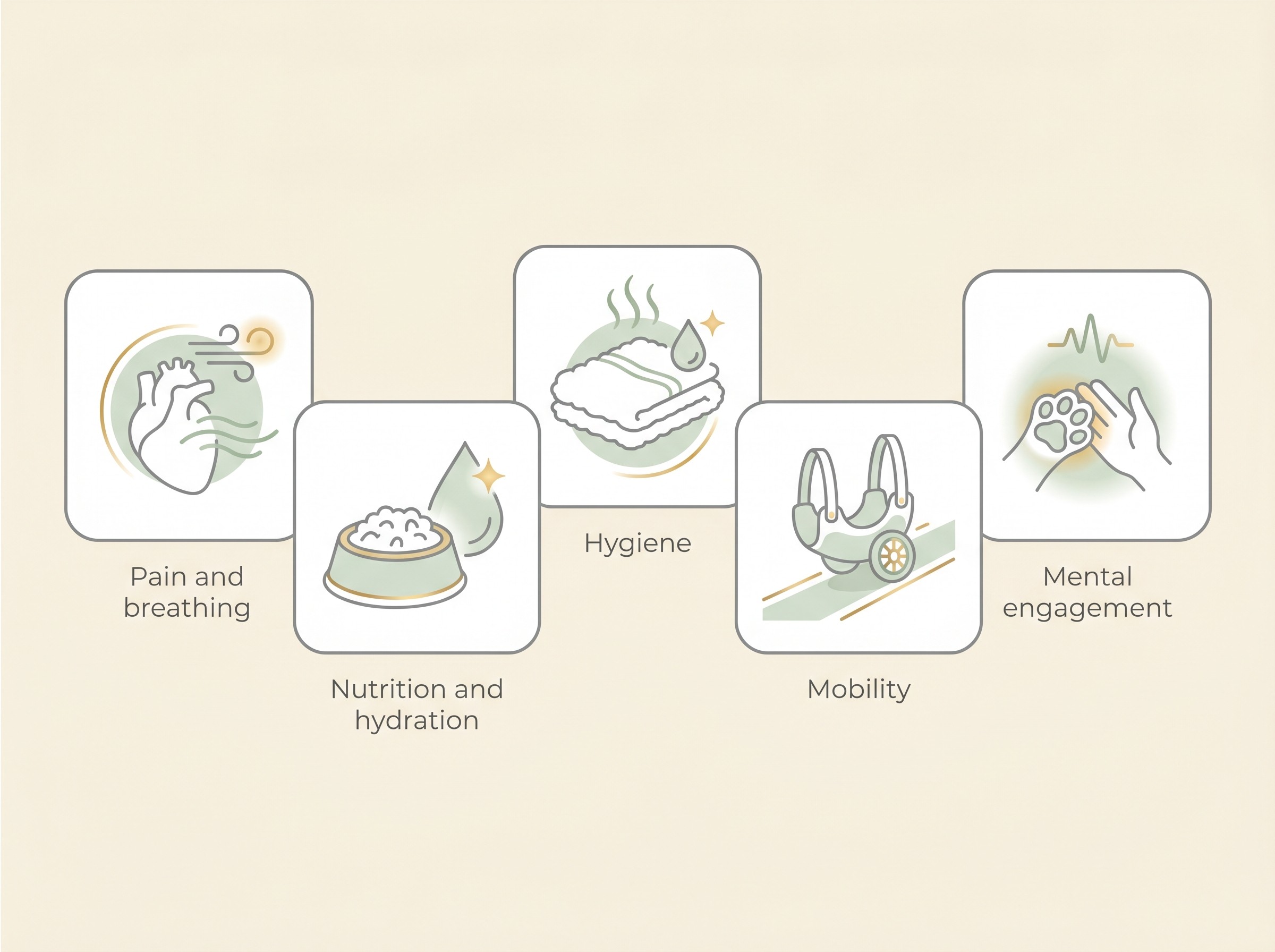
Pain and breathing comfort. Pain is the headline, always, because a pet in pain cannot eat well, settle, or enjoy anything. The hard part is that pets, and cats above all, hide pain instinctively; recognising the subtle signs is a skill, and spotting pain in a pet who hides it teaches it properly. The medicine to control it runs to your vet's plan, in giving medication and managing comfort at home. For this page, hold one rule: uncontrolled or escalating pain, and any laboured or distressed breathing, is a reason to phone your vet now, not to wait and see (IAAHPC Guidelines, Shanan et al.).
Nutrition and hydration. Appetite fading is one of the most frightening things to watch, and one of the most normal. It does not always mean the end is upon you, and much helps: vets can manage nausea, tempt a faltering appetite, and teach you to give fluids under the skin at home. There is also a point, gently, where pushing food does more harm than good. All of that, including the genuine ethics of assisted feeding, belongs to appetite, hydration and the final weeks.
Hygiene. A pet who can no longer keep clean, or who has become incontinent, has not lost their dignity, and keeping them clean and dry is one of the kindest things hospice nursing does. The guidelines describe hospice care as keeping the animal "on comfortable bedding" and managing "the animal's hygiene as well as maintaining cleanliness around" the animal (IAAHPC Guidelines, Shanan et al.). Soft, dry bedding also prevents pressure sores in a pet who lies still. The hands-on technique is owned by keeping a frail pet comfortable.
Mobility. Helping your pet get about safely matters to the end: traction underfoot, a ramp or a few steps, a sling for a wobbly back end, a low-sided litter tray a stiff cat can step into. Loss of mobility is named in the guidelines as a core source of suffering (IAAHPC Guidelines, Shanan et al.), and small adaptations buy back real comfort and confidence. The how-to, again, sits in keeping a frail pet comfortable.
Mental engagement. This is the domain owners most often forget, and it sits at the very top of the hierarchy of care (Bishop et al., 2016). Boredom, anxiety and "the inability to engage in meaningful" activity are explicitly named as suffering (IAAHPC Guidelines, Shanan et al.). For a frail animal this is not grand outings; it is keeping them near the family rather than shut away, a sunny spot to doze in, a gentle stroke, the quiet company of the people they love. Making the most of that time, presence rather than performance, is the subject of making memories: a good last week.
Equipment and home adaptations, at survey level
You do not need to turn your home into a hospital, and most of what helps is simple. A short checklist, with the detail in keeping a frail pet comfortable:
- Soft, supportive, dry bedding to cushion bony points and prevent pressure sores.
- Non-slip mats and runners over slippery floors, so a wobbly pet has traction rather than skidding limbs.
- Ramps or low steps, and a sling or supportive harness for a large or unsteady dog.
- Easy access to everything they need: food, water and a litter tray within a few steps, raised or lowered to suit your pet, with warmth close by.
- Their bed where the family is. This matters more than any equipment. The guidelines specifically advise keeping the animal near family activity rather than isolated (IAAHPC Guidelines, Shanan et al.). A pet tucked away in a back room for "peace and quiet" is often just lonely. Bring them to the heart of the house.
Caring for the carer: the part nobody warns you about
I have to be straight about something the brochures skate over. Caring for a dying pet at home is hard. Not just sad, hard: physically tiring, emotionally heavy, and relentless in a way that broken sleep makes worse. The guidelines do not dress this up. They acknowledge that being a primary caregiver "can be experienced as a burden on personal resources of time, energy, and finances," that it can be "emotionally and physically exhausting and can strain relationships," and that a caregiver "may experience feeling burdened, resentful, guilty, devastated, traumatized, or suicidal," as well as, at other times, "enlightened, relieved, refreshed, or blessed" (IAAHPC Guidelines, Shanan et al.). All of those, sometimes in the same day. None means you are doing it wrong.
This is measurable, not just sentiment. Owners caring for chronically or terminally ill pets carry real, quantifiable strain, with "greater stress, symptoms of depression and anxiety and poorer quality of life than owners with healthy animals" (Spitznagel et al., 2017). So if you are exhausted and frayed and crying in the kitchen, that is not weakness or a failure of love. It is the predictable weight of what you carry, and it is exactly why hospice is meant to look after you too.
So take the advice the guidelines give the professionals looking after families like yours, and give it to yourself. They are told to ask caregivers whether they are managing to get adequate sleep, and "whether they might be able to ask for respite care from family, friends, or neighbors" (IAAHPC Guidelines, Shanan et al.). Share the nursing. Let someone take a night shift so you can sleep. Accept the help you would normally wave away. Rest is not abandoning your pet; an exhausted carer cannot give good care.
And one thing I will not bury at the bottom of the page. If the weight of this ever tips toward feeling you cannot carry on, please reach out straight away. The Samaritans are there, free, day or night, on 116 123. You can ring them about a dying pet and the exhaustion of caring for one; that is exactly what they are for, and you do not have to be in crisis to call. The specific guilt that so often rides alongside this is held with care in the guilt is normal.
Plan for a crisis before it happens
If one practical thing turns frightened watching into confident care, it is this: plan for the bad moment in advance, so that when something goes wrong at three in the morning you are not paralysed. This is the distinctive discipline of hospice, and the guidelines are specific.
Know what a crisis looks like, before you are in one. Every caregiver, the guidelines say, "must be educated on what a medical crisis looks like and when to reach out for veterinary assistance," and emergency numbers and contacts "should be discussed and provided as part of the initial animal hospice plan of care" (IAAHPC Guidelines, Shanan et al.). Ask your vet plainly: what would a crisis look like in my pet specifically, and what should I do if it happens?
Have a route to help around the clock, sorted now. The guidelines hold that a hospice professional "must be reachable around the clock for caregivers to consult with if a crisis situation is unfolding," and where that is not possible, "coverage by a knowledgeable emergency service is an acceptable alternative" (IAAHPC Guidelines, Shanan et al.). In UK terms, that means knowing your practice's out-of-hours arrangement and the number for the emergency vet, written down by the phone, before you ever need it.
Ask about an emergency comfort kit, but only as a question for your vet. Some vets prescribe a small set of comfort medicines to keep at home "for use in the event of a medical crisis." This is firmly a vet's decision: the drugs are "determined individually for each patient by his or her attending veterinarian, depending on diagnosis and body weight," and you "must receive specific instructions" (IAAHPC Guidelines, Shanan et al.). I am giving you no drug names and no doses here on purpose, and you should never improvise medication. Above all, never reach for a human painkiller: paracetamol can be fatal to cats and is dangerous to dogs, and human anti-inflammatories such as ibuprofen are toxic to both, even in small amounts. Just ask your vet whether a small kit makes sense, and let them direct it; the wider picture is in giving medication and managing comfort at home.
The guidelines sum up the mindset: families should "plan for a variety of likely and less likely scenarios" so that medicines, equipment and support are "available in anticipation of problems" (IAAHPC Guidelines, Shanan et al.). This is not living in dread of disaster. It is the opposite: once you have a plan for the worst, you are freed to enjoy the good days, because you know what you would do.
So the red flags worth knowing as "phone the vet now," not "wait it out": uncontrolled or escalating pain; laboured or distressed breathing; a seizure; an inability to rest or settle; or a sudden collapse. None is a moment to ride out at home hoping it passes.
Watching quality of life with your eyes open
Running a hospice well does not mean scanning your pet for signs of death each morning and frightening yourself. It means watching the right things, gently, over time. Within hospice, assessing quality of life is "one of the essential tasks of the animal hospice," ongoing and shared between you and your vet (IAAHPC Guidelines, Shanan et al.). The canonical tool vets use is Dr Alice Villalobos's HHHHHMM scale, which scores seven everyday things: Hurt, Hunger, Hydration, Hygiene, Happiness, Mobility, and whether there are more good days than bad. I will not re-teach it here; it has its own home in the HHHHHMM quality-of-life scale, and the trend over time, which matters far more than any single day, is owned by tracking the trend, good days and bad days. Score it regularly and you will see the direction of travel, instead of being whipsawed by one bright morning or one rotten afternoon.
A lighter sense-check sits alongside it: the Five Freedoms, freedom from hunger and thirst; from discomfort; from pain, injury or disease; to express normal behaviour; and from fear and distress (Five Freedoms). Villalobos applies it usefully here: while those five basic needs and desires can still be met, there is justification to continue palliative or hospice care, and when they genuinely cannot, that is meaningful (Villalobos, via Grey Muzzle, n.d.). Offer it to yourself as a gut-check, not a rival scoring system.
You can track all of this however suits you. A notebook or a calendar where you mark good days and bad does the job. In the app, the Quality-of-Life Check walks you through the seven HHHHHMM dimensions in a few minutes whenever you want a structured snapshot. And if you would like the trend tracked and plotted for you over weeks, that is part of what we built Sightline for. Sightline (sightline.vet), a separate ConciergeVet tool, runs a short adaptive weekly assessment with a quality-of-life focus mode built around exactly these frameworks, tracks a single composite score over time so you can see the trend rather than judge a single bad day, and produces a Sightline Report PDF you can bring to your vet. There is no hard paywall on any of this, and you never need a tool to do it well: a written log, or our printable QoL sheet, does much the same job. The point is never the format. It is that you watch the right things, gently, over time.
When comfort can no longer be maintained: the handover
Comfort care has a horizon. Hospice is not forever, and recognising the point at which comfort can no longer be maintained is not a failure of the plan. It is part of the plan, and an act of good care.
The guidelines treat the move toward euthanasia as a legitimate modification of the plan, not a defeat of it: "One such plan modification might be a decision by the animal's caregiver to request that the animal be euthanized" (IAAHPC Guidelines, Shanan et al.). They even encourage families to find out in advance who they would call, so that "should the need arise for euthanasia, especially in an emergency, they will know who to contact" (IAAHPC Guidelines, Shanan et al.). This is the same forethought as the rest of crisis planning. Euthanasia is not the opposite of hospice; it is, in this framework, one of its accepted, humane endings, a way of relieving suffering when comfort runs out.
One sign carries more weight than any other, and you should know it clearly. Villalobos, who created the quality-of-life scale, states it without hedging: "Respiratory distress is an emergency and it must be relieved immediately or there is no QoL for the animal and there is no humane justification to continue the hospice" (Villalobos, via Grey Muzzle, n.d.). A pet who genuinely cannot breathe comfortably is suffering in a way it is not acceptable to wait out, and that is a phone-your-vet-now moment in every sense.
The decision itself, how you will know, the signs to weigh, the framework for thinking it through without a verdict imposed on you, is not mine to lay out here; it is held, carefully and gently, in how will I know when it is time. Watching the quality-of-life trend, and being willing to recognise the handover when it comes, is part of running a hospice well, not a betrayal of it. And when that point approaches, please remember the line I come back to with every family I walk through this: no one can make this decision for you, but you do not have to make it alone, and your vet will help you weigh it. The next chapter, if and when it comes, is what happens during euthanasia, written so that nothing about it has to take you by surprise.
For tonight, though, you do not need the last chapter. You need the next page in this one. Sit down with your vet and ask for a written plan: the medicines, the comfort measures, the things to watch, and the number to ring at 3am. Get the bed into the warm room where the family is. Read the one comfort domain that worries you most, and leave the rest until you need them. The frightened version of you reading this, certain you are not equal to it, is almost always wrong about that. With a plan, a phone number, and your vet on the other end of it, you can do this, and you will not be doing it alone. If you ever need a kind voice for yourself along the way, the Blue Cross Pet Bereavement Support Service is there by phone (0800 096 6606) and email, every day, 8:30am to 8:30pm (Blue Cross, n.d.). Comfort care is not a holding pattern while you wait for the worst. It is the work of love, and you have already started it.
References
- Bishop, G., Cooney, K., Cox, S., Downing, R., Mitchener, K., Shanan, A., Soares, N., Stevens, B., & Wynn, T. (2016). 2016 AAHA/IAAHPC End-of-Life Care Guidelines. Journal of the American Animal Hospital Association, 52(6), 341-356. (PMID: 27685363)
- Blue Cross. (n.d.). Saying goodbye to your pet and Pet Bereavement Support Service (0800 096 6606; phone, email and webchat, 8:30am to 8:30pm daily). Blue Cross (UK).
- Five Freedoms. (Farm Animal Welfare Council). The five freedoms of animal welfare: freedom from hunger and thirst; from discomfort; from pain, injury or disease; to express normal behaviour; and from fear and distress. Applied to end-of-life care by Villalobos (see Grey Muzzle reference).
- IAAHPC Guidelines (Shanan, A., August, K., Cooney, K., Hendrix, L., Mader, B., & Pierce, J.). Animal Hospice and Palliative Care Guidelines. International Association of Animal Hospice and Palliative Care.
- Lap of Love Veterinary Hospice. (n.d.). What is palliative care for pets?
- Samaritans. (n.d.). Free, 24-hour support for anyone struggling to cope. Call 116 123 (UK and ROI).
- Spitznagel, M. B., Jacobson, D. M., Cox, M. D., & Carlson, M. D. (2017). Caregiver burden in owners of a sick companion animal: a cross-sectional observational study. Veterinary Record, 181(12), 321. (PMID: 28870976)
- Villalobos, A. E. (via The Grey Muzzle Organization). (n.d.). Helping Your Dog Cross the Bridge: How to Assess Your Dog's Quality of Life.