


Keeping a Frail Pet Clean, Comfortable and Mobile
Alastair Greenway
BVM&S MRCVS
Most of what you are doing for your pet right now will not happen in a consult room. It happens on the kitchen floor at six in the morning, with a towel and a damp cloth and a dog who can no longer stand to be cleaned. It happens lifting a cat onto the windowsill she used to jump to, or kneeling beside a bed at 3am wondering whether you are helping or just upsetting them. If that is your week, I want to start by saying the thing nobody says out loud often enough: this is real nursing, it is one of the most loving and dignified things you will ever do for an animal, and you can learn to do it well.
I will also be straight with you, because reassurance that skips the hard part is no use to a tired person. Some of this is physically heavy and some of it is grim, and none of it makes you squeamish or weak for finding it so. The whole job of this page is to turn "I don't know how to do this and I'm exhausted" into "I can do this, here is how." It sits alongside home hospice and comfort care, the plan you build with your vet, and stays deliberately in your hands: the practical doing, step by step, for a frail dog or cat.
You build this care with your vet, not instead of them
Before the technique, one piece of permission. Hands-on hospice nursing is a recognised discipline, not something you are improvising in the dark. Veterinary nurses "are an essential part of the animal hospice team" and "provide expertise in recommending, assembling, and training caregivers in the use of assistive equipment to maximize the patient's quality of life", and hospice providers "can advise caregivers on equipment and methods for maintaining the animal's hygiene as well as maintaining cleanliness around the animal" (IAAHPC Guidelines, Shanan et al.). In plain terms: most of what follows, your vet or nurse can show you on your own pet, with your own hands, and asking them to is exactly what good care looks like. It is not a sign you are failing.
The small, tiring acts themselves matter more than people realise. The 2016 AAHA/IAAHPC end-of-life guidelines, a peer-reviewed consensus document, list "preservation of dignity" as a clinical goal, achieved by working to "minimize house soiling, manage incontinence, maintain good hygiene and grooming" (Bishop et al., 2016). The cleaning, the turning and the gentle grooming are not chores around the edges of the real medicine. For a pet who can no longer do these things for themselves, they are the care.
Setting up: warm, soft, and near the family
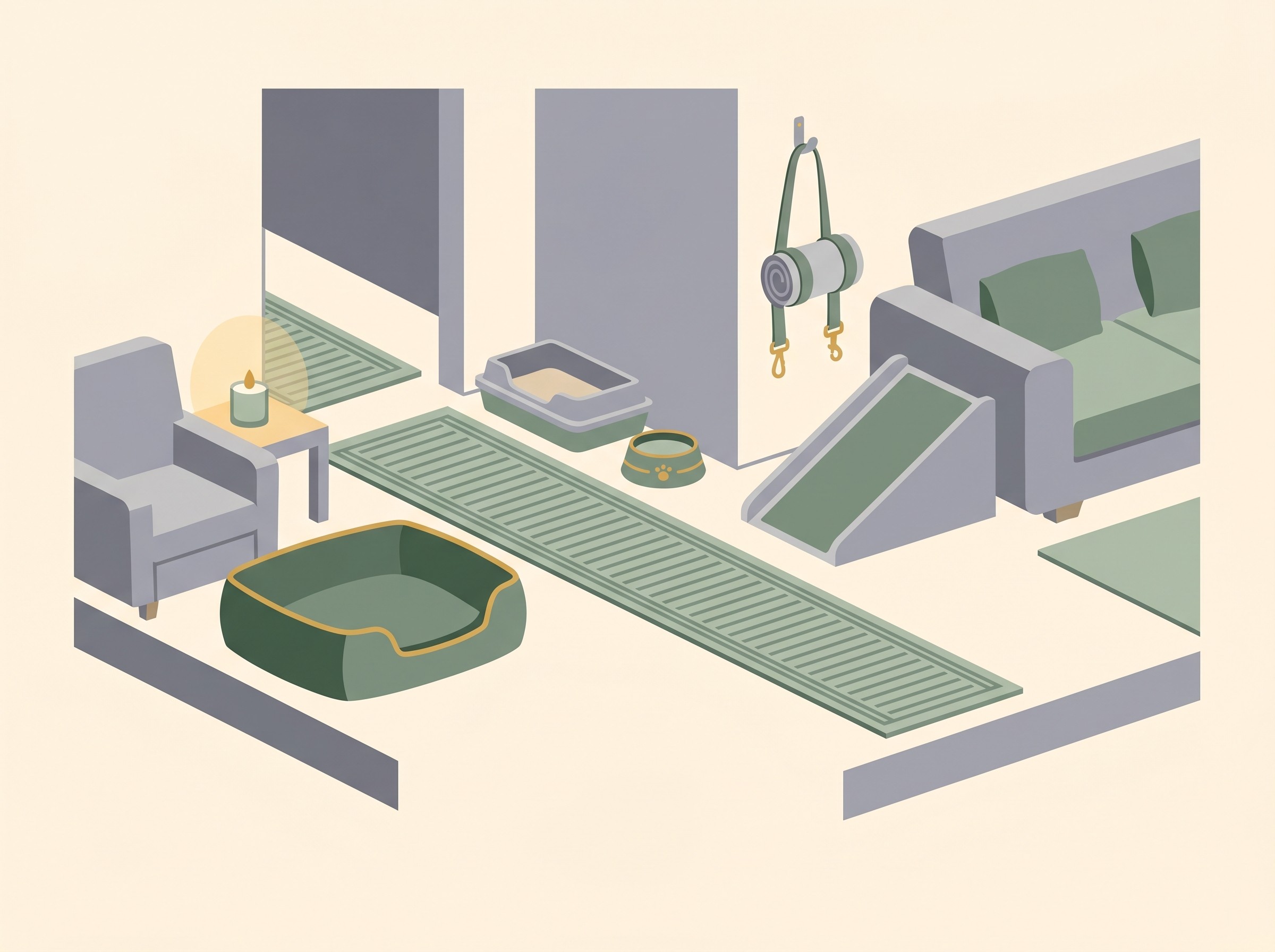
Start with where they live. A frail animal's resting place wants "comfortable bedding, temperature and ventilation control, adequate space, peaceful environment" (Bishop et al., 2016): deep and soft, in a warm spot out of draughts, somewhere calm.
The part owners most often get wrong, out of kindness, is the location. It is tempting to move a poorly pet somewhere quiet and out of the way to "let them rest." Resist that. The guidelines are clear that you should "involve pet in family activities as illness allows" and "avoid or minimize extended periods of isolation or non-socialization" (Bishop et al., 2016). Your pet has spent their whole life wanting to be where you are, and that does not stop now. Put the bed in the corner of the room the household actually uses, where they can see you and be part of the ordinary noise of home. That, more than any piece of equipment, is the heart of a good set-up.
Bedding and pressure sores, where prevention beats cure
If your pet is spending most of the day and night lying down, read this section twice, because a little effort now saves real suffering later.
A pressure sore (a decubitus or decubital ulcer) forms where sustained body weight presses the skin against a hard surface over a bony point, squeezing off the blood supply until the tissue is damaged. They develop over the bony prominences: the at-risk sites in dogs and cats include the hip (the greater trochanter), the point of the buttock, the point of the shoulder, the elbow, the hock, and the bony wings of the pelvis (Clinician's Brief, n.d.; Royal Canin Academy, Zlatinov, n.d.). The classic set-up is a heavy or very thin pet who can no longer shift their own weight, lying on a hard floor, and the guidelines list "skin integrity (e.g., local infections, pressure sores)" among the things a hospice patient must be examined for (Bishop et al., 2016). Here is the blunt truth that makes prevention worth the effort: once a sore opens it is slow and painful to heal, so almost the whole game is stopping one forming in the first place.
There are three levers, and you can pull all three at home.
Soft, deep, supportive bedding. For a pet lying down for long stretches, the recommended surfaces are thick foam (an egg-crate-style foam pad), memory-foam mattresses, sheepskin, and air mattresses (Clinician's Brief, n.d.; Royal Canin Academy, Zlatinov, n.d.). Sheepskin, real or synthetic, gets a special mention because it "minimizes friction, absorbs moisture, and can be laundered" (Royal Canin Academy, Zlatinov, n.d.). The simple test: press a knuckle into the bed and it should not hit the floor through the padding. Have at least two beds or covers, so a clean dry one is always ready while the other is in the wash.
Turning a pet who cannot turn themselves. A pet who can no longer reposition on their own needs help to change sides, and to be propped upright on their chest where they can manage it, on a rough schedule. The veterinary advice clusters around every two to four hours while they are awake: Royal Canin Academy advises that a recumbent patient "should be turned every 4 hours" (Zlatinov, n.d.), and Clinician's Brief describes changing position on a regular cycle, from left side to chest-down to right side (Clinician's Brief, n.d.). Use rolled-up towels to hold each position. Two humane caveats matter as much as the schedule: you do not wake a peacefully sleeping pet just to turn them, and for a pet in their final days, comfort and rest come before any rota. The schedule serves the pet, never the other way round.
Keeping the skin clean and dry. Moisture is the accelerant. "Moist skin increases the risk of sores developing, so the skin should be kept clean and dry" (Royal Canin Academy, Zlatinov, n.d.), which is exactly why the cleaning below is part of preventing sores, not a separate job. (Good nutrition also supports the skin, but the eating side belongs to appetite, hydration and the final weeks, not here.)
A gentle extra, if your vet or physio shows you how: slow passive movement of the limbs and light massage can support circulation and comfort in a pet lying still for long periods (Royal Canin Academy, Zlatinov, n.d.; IAAHPC Guidelines, Shanan et al., who list massage and passive range of motion among palliative physical therapies). Learn it from them on your own pet rather than from a page, because over a sore joint it can hurt.
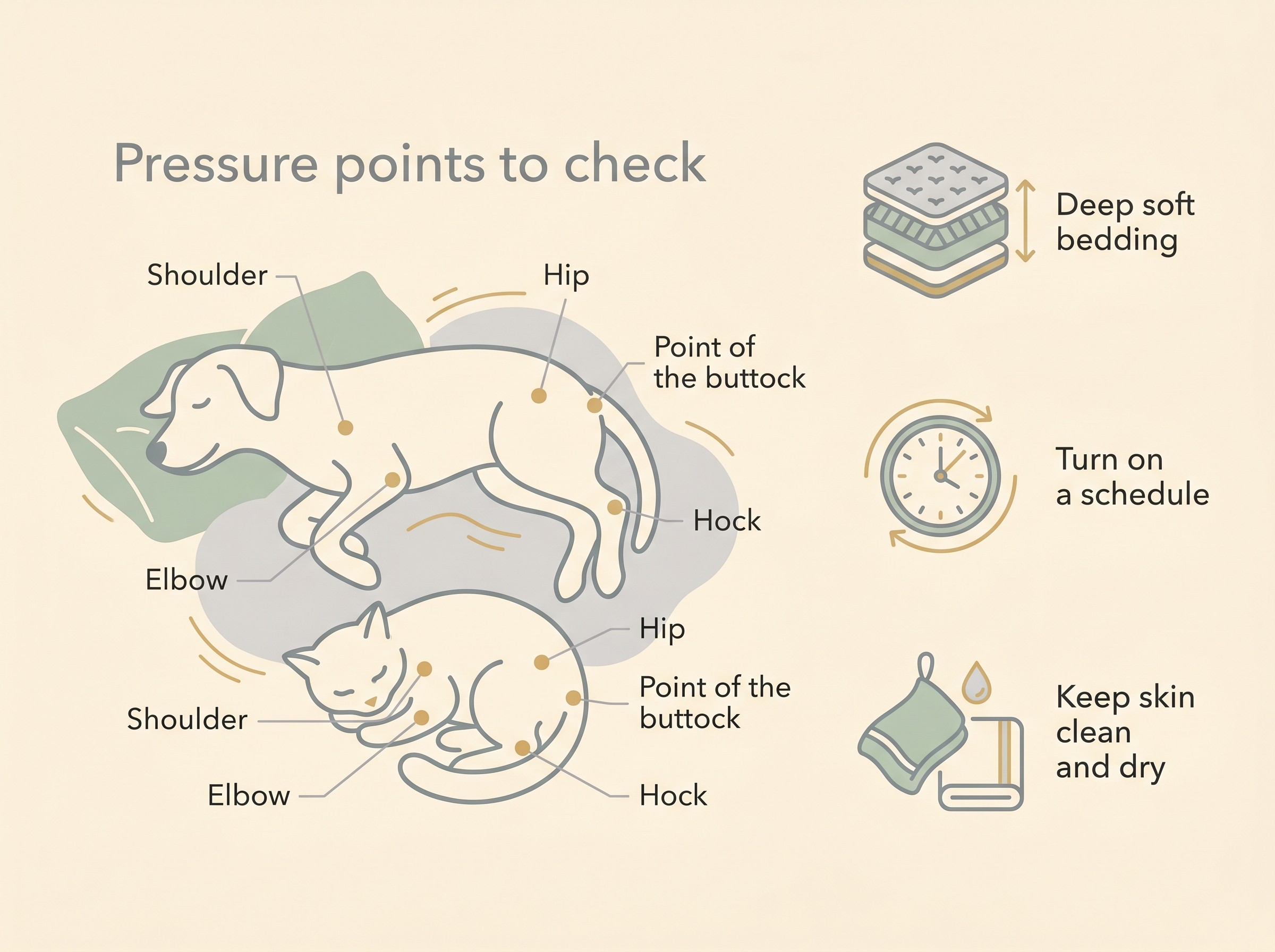
Check the bony points every day. What you are looking for is early change: a patch over a bony point that has gone reddened, thinned, rubbed bare, damp or sore. If you see it, this is a calm "show the vet or nurse" moment, not a soldier-on-alone one. An open pressure sore needs veterinary management, and catching the very first sign is the whole point of looking.
Keeping an incontinent or immobile pet clean and dry
A pet who soils where they lie has not let you down, and is often distressed by it themselves. How you handle this protects them from shame as much as from sore skin, and the method matters as much as the doing. The guidelines name the task plainly: "maintain urine and feces sanitation, access to elimination sites" (Bishop et al., 2016).
Keep urine and faeces off the skin. Waste left against the skin causes urine scald and skin breakdown, so clean a soiled pet promptly and keep the area dry. For a pet who is soiling repeatedly, gently clipping the hair around the back end helps it stay cleaner and dry faster: the recumbent-care literature describes managing soiling by "frequent examination and cleansing, shaving the perineum, and wrapping the tail", and by reducing moisture against the skin (Royal Canin Academy, Zlatinov, n.d.; Clinician's Brief, n.d.). Absorbent, washable, waterproof-backed bedding pads under the pet catch accidents and are far kinder than letting them lie in it.
Clean gently, do not scrub. Use warm water and a mild, pet-appropriate cleanser or pet wipes, and pat dry rather than rub, because ageing skin "can become thin" and tears easily (Blue Cross, n.d.). Quiet, matter-of-fact, kind handling is the whole skill here: talk to them softly, work calmly, do not make a drama of it.
Barrier creams, with one firm safety line. A thin layer of a vet-approved barrier ointment over at-risk skin can protect against urine scald. The safety point is not optional: do not reach for a human nappy-rash cream containing zinc oxide, because if a pet licks zinc oxide off their skin it can upset the stomach and irritate the gut, with vomiting and diarrhoea, and warrant a vet visit (Pet Poison Helpline, n.d.). Treat barrier cream as an "ask your vet which one" item, never something to grab from the human bathroom cabinet, and check any product with your vet before you use it.
This is, in the end, dignity work. The guidelines file managing incontinence and keeping a pet clean explicitly under "preservation of dignity" (Bishop et al., 2016). When you clean your pet without fuss or disgust, you tell an animal who cannot help it that nothing has changed between you. That is worth doing well.
A note for cats: it is usually an access problem first
A less mobile cat who suddenly stops using the litter tray is almost never being naughty. Far more often the tray has simply become too hard to climb into or stand in. International Cat Care advises that older cats do best with litter trays whose low sides make them easy to get into, large and placed somewhere easy to reach, with a soft, fine, sandy litter that is gentler under sore paws than a hard pellet (International Cat Care, n.d.). Before you conclude anything sadder about a cat who has started having accidents, try a low-sided tray with soft litter close to where they now rest. It solves the problem surprisingly often. Cats are quieter about all of this than dogs, and easier to overlook, so they need you to go looking.
Helping a wobbly pet get about
Mobility is where small home changes pay off the most, and the order matters: start with the floor.
Traction is the single highest-yield change. Smooth floors (laminate, tile, wood) are treacherous for a weak or arthritic pet. The guidelines prescribe "nonskid flooring in pet's living area" (Bishop et al., 2016), and the IAAHPC lists "enhanced floor traction" among assistive measures (Shanan et al.). Canine Arthritis Resources and Education (CARE) puts it bluntly: laying down rugs, runners and non-slip flooring is "one of the most effective things you can do", using "carpet or rugs (with non-slip pad) and/or yoga mats or gym floor tiles" (CARE, n.d.). Lay non-slip runners along the routes your pet actually uses (bed to water, bed to door, bed to litter tray) so they are never asked to cross a skating rink. For cats, International Cat Care gives the matching advice: laminate, tiled or wood flooring "can be slippery for older cats", so "place mats and runners around the home to make walking easier" (International Cat Care, n.d.).
Slings, harnesses, ramps and steps. The guidelines list "physical assistance devices (harnesses, slings, carts, and wheelchairs)" (Bishop et al., 2016). A support sling or harness takes weight off weak hindquarters and lets you steady a dog for a toileting trip across the room; CARE rates a two-piece support harness with handles as the best tool for helping a dog that struggles to get up, comfortable to support standing, walking and stairs (CARE, n.d.). For an unplanned lift, a rolled towel slung under the belly is the free, immediate version. Whichever you use, lift with the sling or harness under the body, never by pulling on legs, collar or skin. Ramps and steps let a pet reach a sofa, bed or car without jumping; they need to be "wide enough for your dog to feel secure" and "not too steep", and given a little patience to learn (CARE, n.d.). The same goes for a cat: a series of "shallow steps, or a gently sloping ramp" can keep a favourite windowsill within reach (International Cat Care, n.d.).
Bring everything close, and raise the bowls. A raised food and water bowl can be more comfortable for a dog or cat who struggles to crouch to the floor (Blue Cross, n.d.; CARE, n.d.). (That is purely posture and access; for the eating and drinking itself, see appetite, hydration and the final weeks.) Keep water, a litter tray and a familiar bed all within a few steps, so a frail pet never has to travel far for anything they need (Bishop et al., 2016). Wheelchairs and carts exist for severe cases but are a considered, vet-guided choice; CARE cautions against jumping to a cart "unless it is a last resort, as we ideally want dogs to use their limbs in order to retain the joint range of motion and muscle strength" (CARE, n.d.). For most frail pets near the end, this is about a few assisted steps, not equipment for long walks.
Warmth, positioning and the comfort of being groomed
Old, thin, frail animals feel the cold. The guidelines call for "temperature and ventilation control" (Bishop et al., 2016), and International Cat Care suggests a washable thermal blanket and beds in warm, easy-to-reach spots (International Cat Care, n.d.). One safety point: any heat source must be safe for a pet who cannot move away from it. Use a pet-safe heated bed or a well-wrapped warm (not hot) source, never a bare hot water bottle or a radiator a pet could be trapped against, and always leave room for them to move off the heat. Prop a comfortable position with rolled towels, and keep the head and chest a little raised if breathing is at all laboured (laboured breathing is a call-the-vet sign, below).
Grooming deserves its own moment, because it is quietly one of the kindest things left to do. A frail dog or cat often stops grooming themselves, and the coat mats, traps dirt and can hide sore or scalded skin. International Cat Care notes that as cats age and become less flexible "they often struggle with maintaining their usual grooming routine", that regular grooming with a soft brush and fine comb "can help keep matts at bay and remove any excess hair", and that claws should be trimmed when needed because an older cat's claws "can also overgrow, curl around and embed into pads, which is not only painful but can also lead to infection" (International Cat Care, n.d.). Blue Cross gives the matching dog advice: help an older dog stay clean with grooming that focuses on places that are harder for them to reach (such as their back end), using a soft-bristled brush so you do not scratch thinning skin (Blue Cross, n.d.). Keep the sessions short and calm, on the pet's terms. They double as a daily skin-and-comfort check, and they are one of the last, gentlest forms of contact you have. (If a brush ever finds an area that seems to hurt, that is a pain conversation, owned by spotting pain in a pet who hides it.)
Looking after your own back, and your own self
You cannot nurse anyone well if you are flat on the floor with a wrenched back, and the guidelines say so: the owner "should be instructed in the safe handling of their pet to prevent injury to self and the pet" (Bishop et al., 2016), with owner safety named as a planning category in its own right. So this is not indulgent, it is part of doing the job. Use a sling or harness so the pet's weight is carried by the equipment and your legs, not your lower back. Raise the bed to a workable height for cleaning where you can. Keep your supplies (wipes, pads, clean bedding, gloves) in one grab-bag right by the bed, so you are not hunting for things at 3am. And accept help with the lifting and the endless laundry.
The lifting, though, is rarely the heaviest part. This is tiring in a way that goes well beyond the physical, and feeling worn down by it does not mean you love them any less or are doing it wrong. The deeper exhaustion, and the respite and support you are allowed to ask for, are held in the home hospice guide. For now, just this: if you ever find yourself at the point of not being able to keep going, you are allowed to reach out for yourself, not only for your pet. The Samaritans are there, free, any hour, on 116 123, and the Blue Cross Pet Bereavement Support Service (0800 096 6606, 8.30am to 8.30pm every day) understands this particular kind of tiredness too.
When to phone the vet
Good home nursing handles a great deal, but some things are theirs, not yours, and calling early is the right move, not an overreaction. Contact your vet promptly, rather than waiting it out, for any of these:
- an open or worsening pressure sore, or skin that is badly scalded
- skin you cannot keep clean, or that starts to smell infected
- a pet who seems to be in pain you cannot settle
- laboured or distressed breathing
- a pet who cannot rest or get comfortable at all, or who has become unable to get up and cannot be made comfortable lying down
None of these is a failure on your part. They are simply the points where the right hands are veterinary ones. (One firm line that belongs here: never give a human painkiller to a dog or cat. That warning, and the whole medication routine, lives in giving medication and managing comfort at home.)
The gentle horizon
Good nursing can carry a pet comfortably for a long time, and it is also, quietly, one of the truest ways to watch how they are doing: the same daily care that keeps them clean and warm tells you, day by day, whether comfort is getting easier or harder to keep. If a point comes where the cleaning, turning and lifting can no longer keep your pet comfortable and dignified, that information is not a verdict for you to deliver alone. It belongs in the conversation with your vet about what comes next. No one can make this decision for you, but you do not have to make it alone, and your vet will help you weigh it. How you will recognise that point, and how to think it through, is held carefully in how will I know when it is time.
Watching how the daily care goes is, in fact, part of watching the trend, and that is something you can put on a steadier footing than memory and worry. A quick, repeatable way to track how your pet is getting about is the 2-Minute Mobility Check: it puts a number on their movement so you can see the direction of travel over weeks rather than agonise over a single stiff morning. For the wider quality-of-life picture, that is part of what we built Sightline for. Sightline (sightline.vet), a separate ConciergeVet tool, runs a short adaptive weekly assessment with a quality-of-life focus mode built around exactly these frameworks, tracks a single composite score over time so you can see the trend rather than judge a single bad day, and produces a Sightline Report PDF you can bring to your vet. A written log, or our printable QoL sheet, does much the same job, so do not let the lack of an app stop you keeping notes.
You cannot stop a body growing old. But you can make the floor safe under their feet, the bed soft under their hips, and the routes short between the things they need. You can keep them clean when they cannot, warm when they feel the cold, and close enough to hear you in the next room. That is what this last chapter can be: spent clean, warm, near the people they love and still able to get to them, with your vet and nurse a phone call away, and the quiet work of your hands telling you both, gently, how they are doing.
References
- Bishop, G., Cooney, K., Cox, S., Downing, R., Mitchener, K., Shanan, A., Soares, N., Stevens, B., & Wynn, T. (2016). 2016 AAHA/IAAHPC End-of-Life Care Guidelines. Journal of the American Animal Hospital Association, 52(6), 341-356. (PMID: 27685363)
- Blue Cross. (n.d.). Caring for older dogs and Pet Bereavement Support Service (0800 096 6606; phone, email and webchat, 8.30am to 8.30pm daily; Samaritans signposted out of hours). Blue Cross (UK).
- Canine Arthritis Resources and Education (CARE). (n.d.). Assistive Devices for Dogs with Arthritis.
- Clinician's Brief. (n.d.). Pressure-Related Wounds: Prevention & Treatment. North American Veterinary Community.
- International Cat Care. (n.d.). Special considerations for senior cats, Choosing a litter tray for your cat, and Making your home cat friendly. International Cat Care / International Society of Feline Medicine (ISFM).
- IAAHPC Guidelines (Shanan, A., August, K., Cooney, K., Hendrix, L., Mader, B., & Pierce, J.). Animal Hospice and Palliative Care Guidelines. International Association of Animal Hospice and Palliative Care.
- Pet Poison Helpline. (n.d.). What is zinc oxide and how does it affect dogs?
- Royal Canin Academy (Zlatinov, V. K.). (n.d.). Supportive care for recumbent dogs and cats (the spinal patient). Royal Canin Academy (CPD).
- Samaritans. (n.d.). Free, 24-hour support for anyone struggling to cope. Call 116 123 (UK and ROI).