Making Memories: A Good Last Week
Alastair Greenway
BVM&S MRCVS
A particular pressure tends to arrive once the first shock of a hard prognosis has settled. The appointments thin out, and your pet is still here, still reasonably comfortable, dozing in their usual spot. And then a thought creeps in that can feel almost worse than the diagnosis itself: I should be doing something. There's a clock running now, and I am wasting it. People talk about bucket lists and last great adventures, and you look at your tired old dog or your frail cat, and at yourself, exhausted, and the not-knowing-where-to-begin curdles into guilt.
I want to take that particular weight off you first, because I think it is the wrong weight entirely. A good last week is not a performance you have to put on, and it is not measured by how much you cram into it. It is measured by your pet's comfort and by the two of you being together, which is something you are almost certainly already doing. The whole task is gentler than the pressure makes it sound. So let me give you some real ideas, but first let me lift the thing that is making them feel impossible.
The pressure is the problem, not your pet
There is a quiet trap here, and naming it usually helps. The grand gesture, the long drive to the beach, the party, the farewell tour, is very often for you and not for them. It is a way of trying to prove, to yourself and to anyone watching, that you loved them enough and did enough. That impulse is pure love and there is no shame in it. But a frail animal does not experience a bucket list as a tribute. They experience a long car journey, unfamiliar smells, strangers, and a tired body asked to do more than it wants to, and many would choose the sofa.
The hospice professionals who help families through exactly this stretch are surprisingly blunt about it. Lap of Love, an end-of-life veterinary service, puts the whole idea in its proper place: the activities should be built around your pet, you should "think carefully about the physical and emotional limitations that may preclude them from certain activities," watch closely for any "indications of discomfort, anxiety, or stress," and, in the line I most want you to keep, "this bucket list is mostly for your pet" (Lap of Love, n.d.-a). The International Association for Animal Hospice and Palliative Care attaches the same gentle condition: "if your pet's health permits, fulfil a bucket list of their favourite activities" (IAAHPC, n.d.). If, that is. The qualifier is the whole point. Anything that exhausts, frightens or hurts your pet has stopped serving them and started serving the guilt, and you are allowed to let that go.
So the test for any idea on the list is simple: would they actually enjoy this, in the body they have right now, today? If yes, lovely. If it is really for you, that is worth knowing too, and there are kinder ways to meet that need than asking a sick animal to carry it.
Scale it to the pet in front of you
Once the pressure is off, the ideas get smaller, easier and, I'd argue, far truer. The right scale is the favourite afternoon, not the once-in-a-lifetime outing. Lap of Love's own suggestions are deliberately modest: "an afternoon sunbathing," "a stroll with a favourite canine or human companion," "snuggling on the couch all day," and small amounts of special foods (Lap of Love, n.d.-a). Notice that none of those need a healthy animal. They need a warm spot, a familiar person, and time, and you have all three.
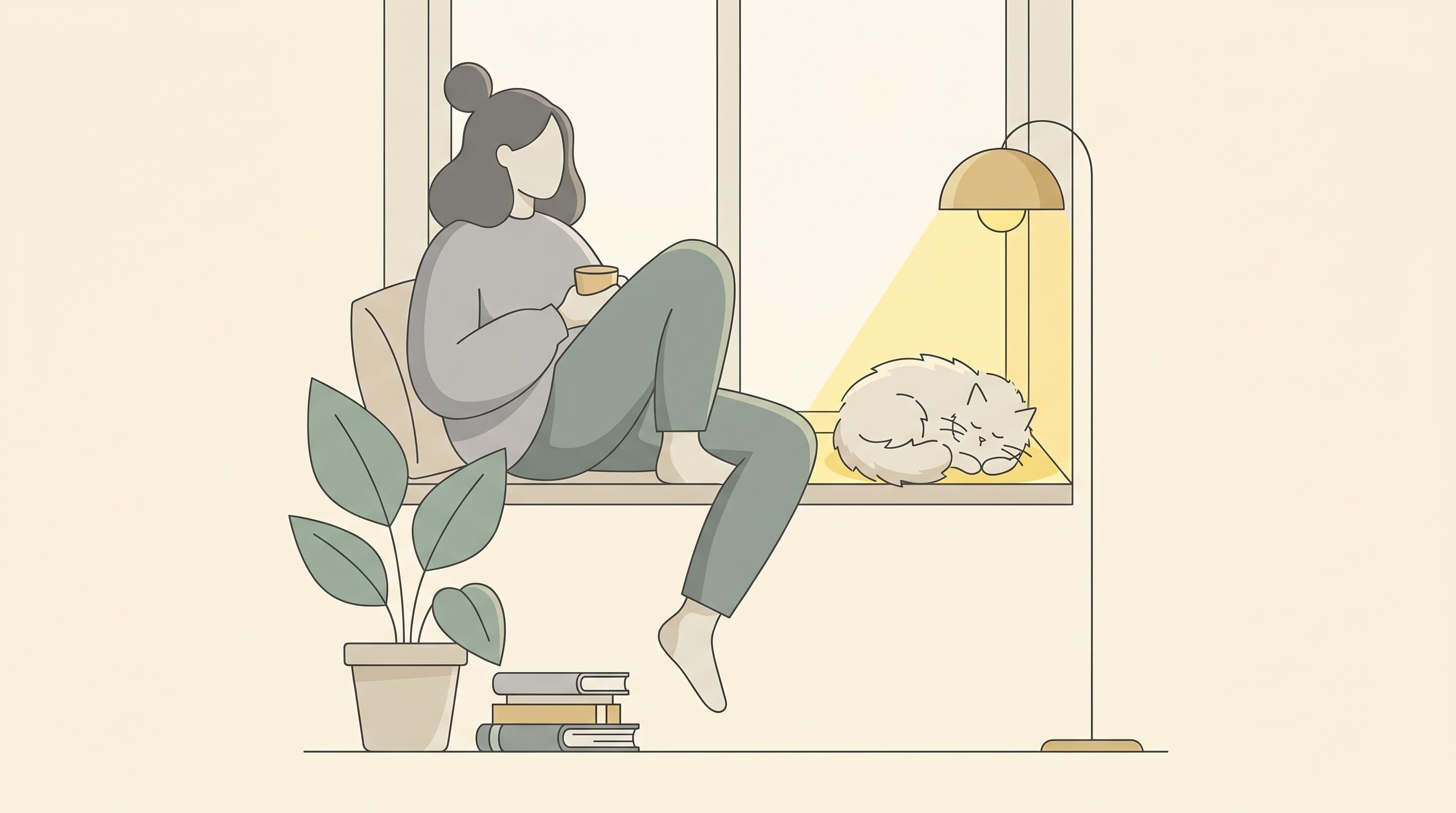
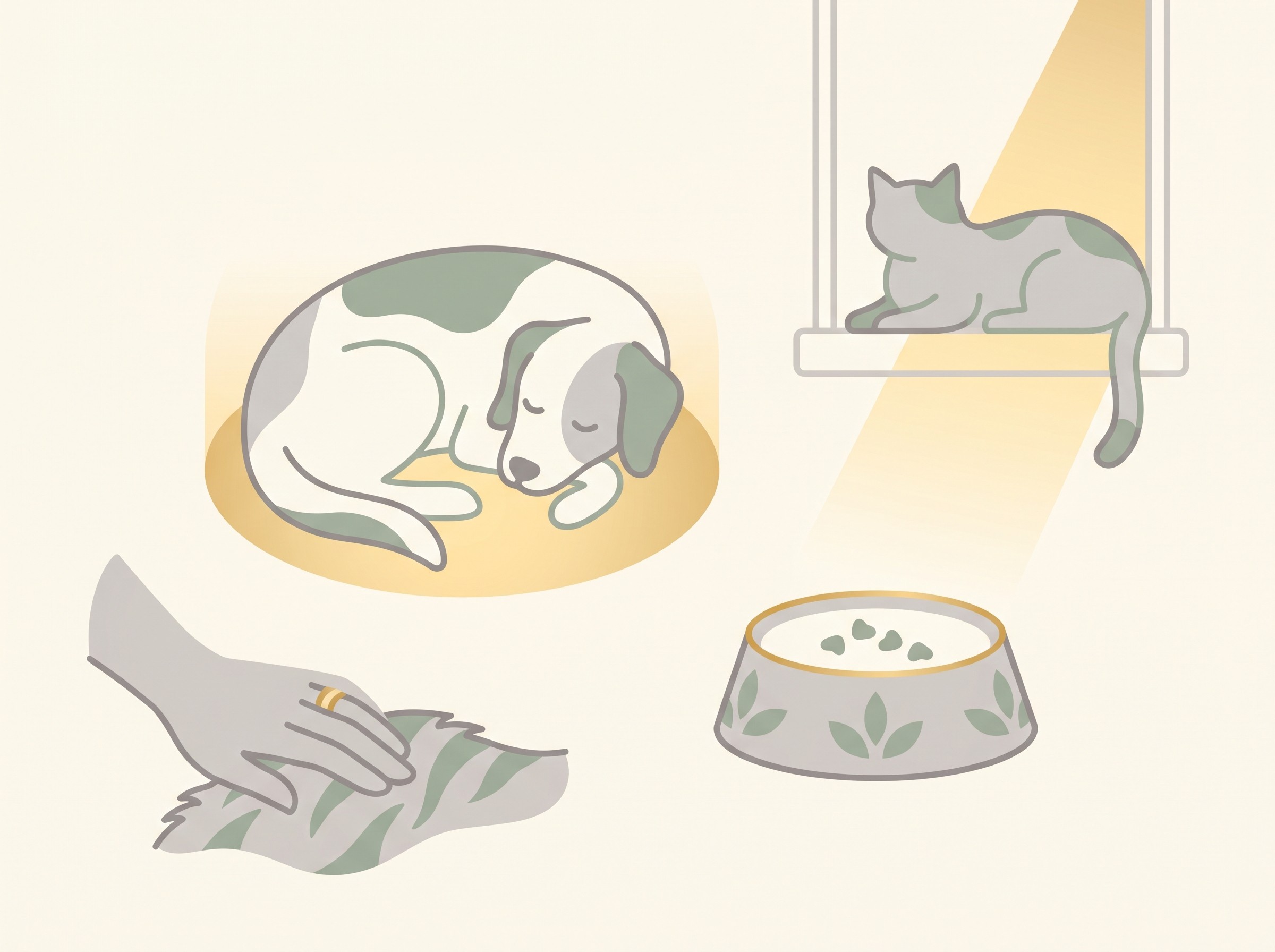
Match the joy to the body, and the species, in front of you. For a dog, this is the season of the shrunken walk: not the old four-mile loop but a slow wander to the end of the road and back, or just out to the garden to read the morning on the breeze, sniffing being the richest thing many dogs do. It might be the favourite ball rolled gently across the kitchen floor rather than thrown, or a sit on a blanket in the sun while you have your tea beside them. For a cat, whose pleasures were always quieter, it is the warm windowsill, a sunlit patch on the carpet, a cardboard box left out, a slow and gentle brush, a lap to fold into, the company of their few chosen people. Lap of Love makes a point that matters especially for cats and for any anxious animal: a pet who "prefers to stay close to only a few loved ones" should "avoid busy, chaotic adventures filled with a multitude of strange people or pets" (Lap of Love, n.d.-a). A houseful of visitors come to say goodbye can be the opposite of a gift. Quiet, familiar and small is not a lesser version of a good last week. For most frail pets it is the better one.
A word about the special meal, because it is one of the simplest and kindest joys and also one people get wrong with the best intentions. A favourite treat in a small amount is endorsed by the hospice sources (Lap of Love, n.d.-a), and there is real tenderness in letting the dog who never gets toast have a corner of toast. But keep it within reason, choose something you know is safe for them, and check with your vet first if your pet is on a prescription diet, prone to pancreatitis, nauseous, or diabetic, because a rich meal can backfire into a miserable night that undoes the whole point. Some everyday human foods are genuinely dangerous to pets, chocolate and grapes among them, so this is not the moment to improvise from the cupboard. The detail of tempting a fading appetite, and what is genuinely safe given their condition, belongs to appetite, hydration and the final weeks, and that is the page to read before you raid the fridge.
And a good day only counts as good if your pet is genuinely comfortable on it, which is easy to assume and easy to get wrong, because cats and stoic dogs hide pain so well. If something about their week feels flat in a way that warmth and company are not fixing, it is worth making sure pain is not quietly sitting underneath it; spotting pain in a pet who hides it shows you what to look for. Comfort is the floor the good days are built on.
Presence is the active ingredient, and it does not need a healthy pet
The active ingredient in a good last stretch is not the doing. It is the being there. And being there is the one thing that does not require a well animal, a long walk or a grand plan. It is available to you no matter how frail your pet has become.
There is psychology research that gives this a firm backbone rather than leaving it as a nice sentiment. Psychologists use the word savouring for the capacity to attend to, appreciate and enhance a positive experience, whether by anticipating it, being fully in it, or reminiscing afterwards (Bryant & Veroff, 2007). It is, in plain terms, the skill of noticing and treasuring the good while it is in front of you, and it matters a great deal: the ability to savour the moment is reliably linked to greater happiness and life satisfaction (Smith & Bryant, 2016). The finding I find genuinely moving here comes from a study of 266 older adults, where the capacity to savour moderated the link between health and life satisfaction, so that people who savoured more held on to their satisfaction with life largely regardless of how poor their health had become (Smith & Bryant, 2016).
Let me be careful about what that does and does not say, because it is about people, not pets, and I will not stretch it into a claim about your animal's inner life. But it earns its place as permission, and the analogy is gentle and true. The capacity to be present, to sit with your pet and actually notice this ordinary, finite, precious afternoon, is yours no matter how unwell they are. It turns the helpless thought, "I can't fix them, so what is the point," into something you can act on tonight: I cannot fix them, but I can be here, fully, and being here is not a consolation prize. It is the thing itself. The afternoon on the sofa, your hand on their side, the radio on, nothing happening, is not a failure to make a memory. It is the memory.
Gather the ordinary while they are well enough
Alongside being present, there is one practical thing genuinely worth doing while your pet still has good days in them, and that is gathering a few photographs and, especially, a little video. Hospice services encourage this without hesitation: this time together, Lap of Love notes, "provides perfect picture-taking opportunities, to remind you of your furry companion long after they're gone" (Lap of Love, n.d.-b), and the IAAHPC suggests you "chronicle your favourite experiences ... through a collection of photos and videos showcasing everyday moments" (IAAHPC, n.d.). Hold on to that last phrase, everyday moments, because it is the part people get wrong. The instinct is to stage something: the good portrait, the posed shot in the garden. Those are lovely. But they are not what you will ache for.
What fades first, and what people most wish they had kept, is the ordinary motion and the sound. The particular way they bark at the door or chirrup for their dinner. The trot, slow now but still theirs, across the kitchen to greet you. The enormous sigh as they finally settle. A photograph cannot hold any of that, and a thirty-second video can. So film the dull stuff: the breakfast, the patch of sun, the half-asleep tail-thump when you say their name. You do not need to make a film, just a handful of clips of nothing in particular, because nothing in particular is exactly what you will want to see and hear again.
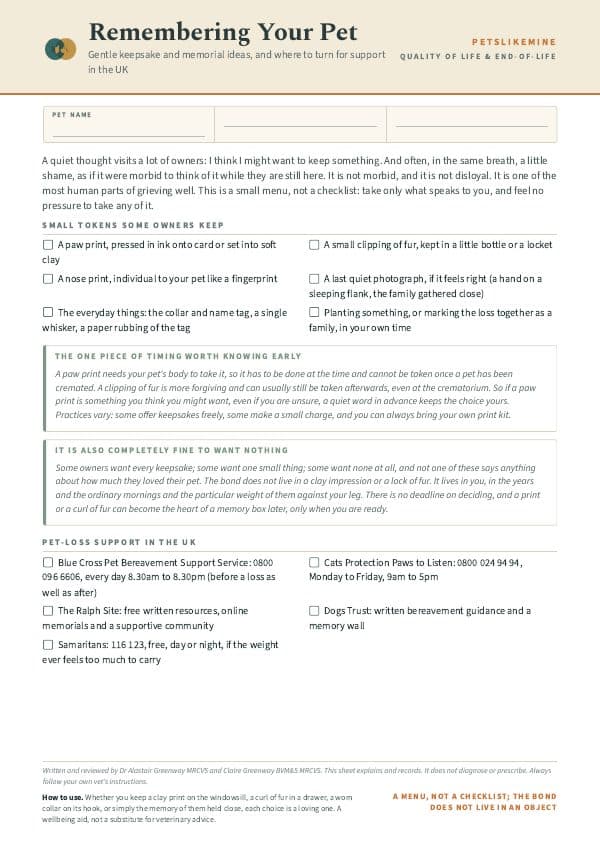
A keepsake you can hold belongs on this list too. A paw print, in particular, is a tender thing to have, and there is no harm in a gentle home print on a quiet day if your pet would not mind their paw being handled. The version most people most want, though, the clay or ink print taken with care, and a clipping of fur, is usually best arranged with your veterinary practice, who can take it calmly and at the right moment. Because the how and the when of asking deserve their own careful answer, that part lives in paw prints, fur and keepsakes, and it is worth reading before the day rather than trying to think of it on the day itself.
Let me be straight about why I am suggesting all this, because there is a tempting half-truth I will not repeat. It is sometimes implied that gathering memories now will somehow pre-pay your grief and soften the blow, getting some of the mourning done in advance. That is not what the evidence shows, and the sibling page on anticipatory grief handles it plainly: the most rigorous review of the question found that doing your "grief work" before a loss does not reliably ease the grief that comes after (Nielsen et al., 2016). So I am not offering photographs as insurance. The real reasons to capture these moments are two, and both matter. First, it makes the time itself richer right now, because reaching for the camera is a small act of savouring, of deciding that this ordinary moment is worth noticing (Smith & Bryant, 2016). Second, it leaves you a treasury you can return to later, on your own terms, and keeping an ongoing, treasured connection to the one you have lost is a recognised and healthy part of grief, not a thing to be ashamed of (Klass, Silverman & Nickman, 1996). What you eventually do with that treasury, a memory book, a small ritual, a way of marking their place in the home, is for the weeks and months afterwards, and there is a whole page on it in ways to honour and remember your pet for when that time comes. For now, your only job is to gather it. Treasure for the time you have, and a treasury for afterwards. Not a debt you have to pay in advance.
A gentle word about the children
If there are children in the house, they can be part of this, and being included tends to help them, but the touch should be light and by invitation rather than instruction. A child might draw a picture of the dog, take a photo with the cat, help with a small and gentle bit of care, or just be encouraged to share their favourite story about them. What matters most is that a child is offered a choice in how involved they want to be, rather than pushed, because having that choice helps them cope (VCA Hospitals, n.d.). I am keeping this short on purpose, because doing it justice, the age-by-age guidance and the careful business of a child's conscious goodbye, belongs to preparing the family when a pet is dying, and that is where to go if this is part of your week.
Ordinary days are allowed to stay ordinary
You do not have to make every remaining day special. You are allowed ordinary, undramatic Tuesdays where nobody is performing a goodbye and nothing is being commemorated, just the usual walk, the usual nap, the usual lap, the usual nothing-much. A normal day is not a wasted day. It may be exactly the day your pet would choose.
This is not me being permissive to make you feel better. It reflects how grieving actually works. The dual process model of bereavement, one of the better-supported frameworks we have, describes healthy coping not as relentlessly facing the loss but as an oscillation, a moving back and forth between confronting the grief and stepping away to get on with living, and it treats that oscillation as essential to coping rather than something to feel guilty about (Stroebe & Schut, 1999). The breaks are not avoidance. They are part of coping. Carried into these anticipatory weeks, that gives you genuine permission: the ordinary days where you are not braced for the end, where you forget for an hour and simply potter about together, are not you failing to treasure the time. They are you, and your pet, living it. That is allowed. It might even be the best of it.
Lap of Love offers the same counsel from the other direction, and it is worth holding when a day is hard: "take one day at a time ... focus on the best parts of that day," and "try not to become bogged down with a poor prognosis" (Lap of Love, n.d.-b). Some days the best part will be small. A good day with a soft bed and a sunny window and your hand within reach is a good day, and it is enough.
This article is about living the time, not ending it, and being in the comfort-and-hospice phase is not a signal that the end is due. If the harder question of timing is starting to take shape in your mind, that is its own separate and careful conversation. No one can make this decision for you, but you do not have to make it alone, and your vet will help you weigh it. For tonight, it is not the task. The task is the evening you actually have.
What the evening you have is for
So put down the bucket list, or shrink it to one warm afternoon that your pet would genuinely enjoy. Film thirty boring seconds of them doing nothing. Then sit down next to them and stop trying. The good last week you are so afraid of getting wrong is, in the end, made mostly of evenings like the one in front of you right now: undramatic, finite, and yours.
One last, practical kindness, because you are grieving already even though your pet is still breathing, and that is exhausting in a way few people around you will understand. Support exists for exactly this, now, before any goodbye. The Blue Cross Pet Bereavement Support Service is free and confidential, open every day from 8.30am to 8.30pm on 0800 096 6606, and it explicitly supports owners whose pet is still alive, not only those who have already lost one (Blue Cross, n.d.). The feeling underneath this whole week, the dread of what is coming while your pet sleeps beside you, has a page of its own that meets it properly and carries the further support lines in full, including Samaritans on 116 123 if a night ever tips from sadness into not being able to go on, in anticipatory grief. You do not have to hold all of this by yourself.
But that is for whenever you need it. Tonight has a smaller and simpler job. Go and find your pet, wherever they are dozing, and just be there for a while. Not to make a memory, not to do it right, not to make up for anything. Just to be with them, in this ordinary evening, which is the one that was always going to matter most.
References
- Bryant, F. B., & Veroff, J. (2007). Savoring: A New Model of Positive Experience. Lawrence Erlbaum Associates.
- Blue Cross. (n.d.). Pet Bereavement Support Service (PBSS) / Saying goodbye to your pet.
- International Association for Animal Hospice and Palliative Care (IAAHPC). (n.d.). Honoring Your Beloved Pet: Memorial Ideas For Before And After Their Passing.
- Klass, D., Silverman, P. R., & Nickman, S. L. (Eds.). (1996). Continuing Bonds: New Understandings of Grief. Taylor & Francis.
- Lap of Love. (n.d.-a). How to Create a Bucket List for Your Pet.
- Lap of Love. (n.d.-b). How to Deal with Anticipatory Grief.
- Nielsen, M. K., Neergaard, M. A., Jensen, A. B., Bro, F., & Guldin, M. B. (2016). Do we need to change our understanding of anticipatory grief in caregivers? A systematic review of caregiver studies during end-of-life caregiving and bereavement. Clinical Psychology Review, 44, 75-93.
- Smith, J. L., & Bryant, F. B. (2016). The benefits of savoring life: Savoring as a moderator of the relationship between health and life satisfaction in older adults. International Journal of Aging and Human Development, 84(1), 3-23.
- Stroebe, M., & Schut, H. (1999). The dual process model of coping with bereavement: rationale and description. Death Studies, 23(3), 197-224.
- VCA Animal Hospitals. (n.d.). Children and Pets: Grief Following Loss of a Dog.
Free downloads
Companion worksheets to put what you've read into practice. Free PDFs, print at home.