What Actually Happens When a Pet Is Put to Sleep
Alastair Greenway
BVM&S MRCVS
Once the deciding is done, or very nearly done, a different fear tends to move in to take its place: not knowing what the day itself will be like. Owners ask me about it in a lowered voice, almost apologetically, as though wanting to know is somehow ghoulish. It is the opposite. The single thing that causes families the most lasting distress is not the procedure but the parts of it they did not see coming, so I am going to walk you through it plainly, the way I would across the desk, because knowing, in advance, almost always takes the dread out of it.
I know, too, that for some people the dread of the day runs deeper than nerves, to a place where it feels almost unbearable to face at all. If that is you, please do not sit with it alone in the small hours. The Samaritans are free, day or night, on 116 123, for anyone struggling to cope, and the Blue Cross Pet Bereavement Support Service (0800 096 6606, every day 8:30am to 8:30pm) is staffed by people who have lost pets themselves and who help owners through the run-up to a goodbye, not only the aftermath. Reaching for one of those numbers is not weakness. Anticipating this kind of loss is one of the heaviest things a person carries.
One promise before we start. Nothing here is designed to shock, and everything in it is built around one aim: keeping your pet calm, unafraid and free of pain. That is not a sentiment, it is the literal definition the profession works to. Euthanasia takes its name from the Greek eu, good, and thanatos, death, and the veterinary guidelines define it as ending an animal's life "in a way that minimizes or eliminates pain and distress," the vet's duty being to "induce the most rapid and painless and distress-free death possible" (AVMA, 2020). In the UK the Royal College of Veterinary Surgeons puts it just as simply: "painless killing to relieve suffering" (RCVS, accessed 2026). The calm you will see is not luck. The RCVS recognises that these moments are "often highly emotionally charged," where "small actions and/or omissions can take on a disproportionate level of importance," and so advises that everyone involved is "fully trained and a planned, rehearsed and coordinated approach is taken" (RCVS, accessed 2026). The care you are hoping for is not something you have to ask for. It is the point of the whole thing.
This page is only about the procedure. The decision itself, whether it is time, belongs to how will I know when it is time, and I am not going to re-open it here. Where you say goodbye, at home or at the clinic, has its own guide in at home or at the clinic. And whether to be in the room is its own question, held in should I be there at the end. Here I just want to take you, gently, minute by minute, through what actually happens.
Before: the parts handled in advance, so the end is only goodbye
Much of what makes the day feel manageable happens before the medicine is ever drawn up, and a great deal of it can be settled in advance precisely so that the final moments are not cluttered with paperwork or decisions.
You will be asked to sign a consent form, which the PDSA describe as a form "to show you understand what will happen and which gives your permission for the vet to go ahead" (PDSA, accessed 2026). This, and ideally the payment and the aftercare choice too, can almost always be settled beforehand, so that you are not handed a clipboard or steered to a desk in the moment you most need to be present. It is worth asking your practice to arrange exactly that. The aftercare options themselves, cremation or burial and what each involves, are laid out without rush in after they have gone: cremation, burial and the options; the only thing I would say here is that deciding ahead spares you from choosing in tears.
Your vet will talk it through with you first. "The vet will explain the procedure and what to expect," the PDSA note, adding the part that matters: "Don't be afraid to ask questions or discuss your worries" (PDSA, accessed 2026). There are no questions too small or too frightened here. If, in the days beforehand, you are tempted to reach into the bathroom cabinet to ease your pet's discomfort while you wait, please ring the practice first instead: many ordinary human painkillers, paracetamol and ibuprofen among them, are genuinely dangerous to dogs and cats, and your vet would far rather prescribe something safe than have you spend the last days frightened that you have done harm (PDSA, accessed 2026).
Very often a small catheter, also called a cannula, is placed first: a patch of fur clipped, usually on a front leg, and a thin, soft tube secured in the vein (Blue Cross, accessed 2026). Owners sometimes read this as the procedure starting before they are ready, and it is not that at all. The catheter gives reliable access to the vein, so that the final injection goes smoothly with no fumbling at the worst moment, and it lets your pet be held and settled rather than restrained. With cats in particular, a well-placed catheter can mean the cat "does not have to be removed from the room," staying in your arms throughout (AAFP, accessed 2026). Not every vet places one in every case, especially where a pet is sedated deeply first, so if yours does it differently, that is normal too.
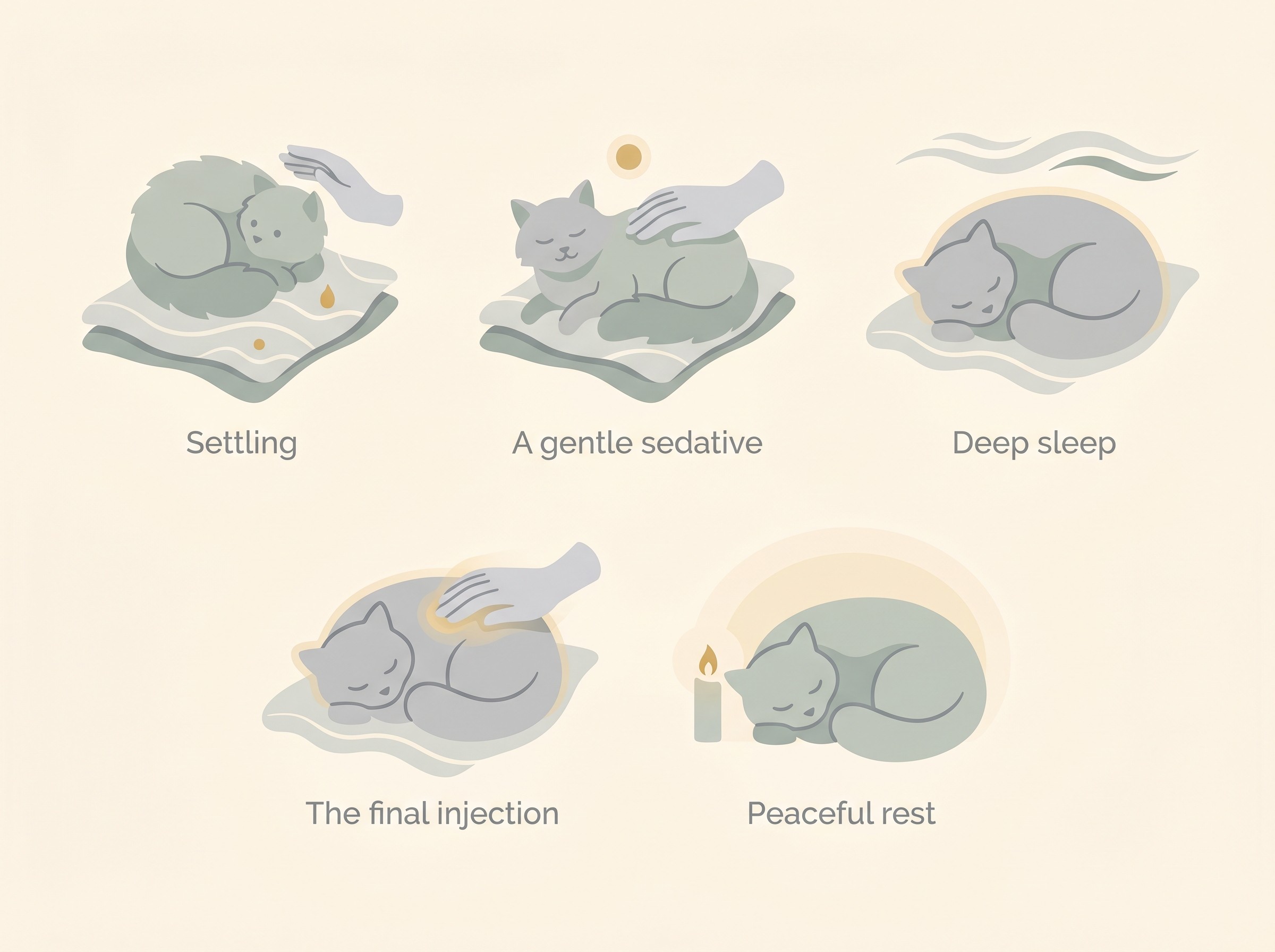
A sedative or light anaesthetic beforehand is now common, and it is a genuine kindness rather than a sign something is wrong. The euthanasia guidelines state plainly that "sedation and/or anesthesia may assist in achieving the best conditions for euthanasia" (AVMA, 2020). For cats, the feline practitioners' guidance goes further, advising that "deep sedation or anesthesia is preferred to ensure the cat is fully asleep prior to administering the final injection," because sedation "minimizes fear, anxiety, and pain; lessens the need for restraint; allows for closeness with caregivers; and can lessen unwanted side effects" (AAFP, accessed 2026). This is not a fringe practice: in a survey of Australian vets, 71.0% gave a sedative before a non-emergency euthanasia, the overwhelming reason being "to reduce stress to the patient" (Chan et al., 2023). And you are allowed to ask for it, as the Blue Cross say directly: "You may want to ask for your pet to be given a sedative first to help relax them" (Blue Cross, accessed 2026).
It helps to know what the sedative is like. It is often given under the skin or into a muscle, may sting or burn very briefly before that passes, and can take a few minutes to work fully (PDSA, accessed 2026). What you will see over those minutes is your pet growing drowsy, heavy and deeply relaxed, very often sinking into sleep in your arms, before anything else is done. If the timing varies from what you expected, the reason is simple: a sedative changes the circulation, which "may delay the onset of the euthanasia agent" (AVMA, 2020). Nothing has gone wrong; bodies simply differ.
Your surroundings and your own voice are part of the medicine too. The guidelines note that "for virtually all animals, being placed in a novel environment is stressful," so an approach used in familiar surroundings "may help reduce stress," and that gentle restraint, "careful handling, and talking during euthanasia often have a calming effect" (AVMA, 2020). Whether home or clinic is kinder for your particular pet is its own decision, held in at home or at the clinic. Wherever you are, the quiet familiarity of your hand and the sound of your voice are doing real work.
The final injection: what it is, and how quickly and gently it works
When you and your pet are ready, and only then, the final injection is given, and it helps to understand what it actually is, because the truth is far less frightening than the imagination. It is an anaesthetic, the same family of medicine used for ordinary operations, given deliberately in a larger than normal dose, into a vein, usually on a front leg (Blue Cross, accessed 2026; PDSA, accessed 2026). The agent is a barbiturate, most commonly pentobarbital (AVMA, 2020). That single fact reframes everything: this is not a poison or a shock to the system, it is the medicine that puts pets gently to sleep for surgery, simply more of it, so the sleep deepens past the point of return.
How it works explains why it is peaceful. Barbiturates "depress the CNS in descending order, beginning with the cerebral cortex, with loss of consciousness progressing to anesthesia," and with an overdose "deep anesthesia progresses to apnea... followed by cardiac arrest" (AVMA, 2020). In plain words, it switches off the thinking, feeling part of the brain first: your pet falls deeply, completely asleep, and only then, already unconscious and aware of nothing, do the breathing and the heartbeat quietly stop. The part your pet could in any sense experience, the slipping into sleep, comes first and is over in moments.
And it is fast. The guidelines describe "a rapid onset of action," with the slipping into sleep causing only "minimal or transient pain associated with venipuncture," meaning the brief sting of the needle and nothing beyond it (AVMA, 2020). The charities say the same more gently: your pet "will lose consciousness within seconds" (Blue Cross, accessed 2026), and "will first start to feel sleepy and then peacefully fall unconscious within a few seconds" (PDSA, accessed 2026). The feline guidance gives concrete figures for the injection straight into the vein, which hold broadly for dogs too: loss of consciousness often within about five seconds, deep anaesthesia by around ten, and the heart stopping within roughly forty seconds, though this "depends on factors like circulation times" (AAFP, accessed 2026). Owners find it steadying to know the whole thing is measured in seconds, not minutes, and that everything after those first few seconds happens to a pet who is already asleep.
Afterwards, your vet will listen to your pet's chest with a stethoscope to confirm that the heart has stopped (PDSA, accessed 2026). It is a quiet, careful moment, and it is how they make certain, for your sake as much as anything, that your pet has gone gently and completely.
What you may see, and why none of it is suffering
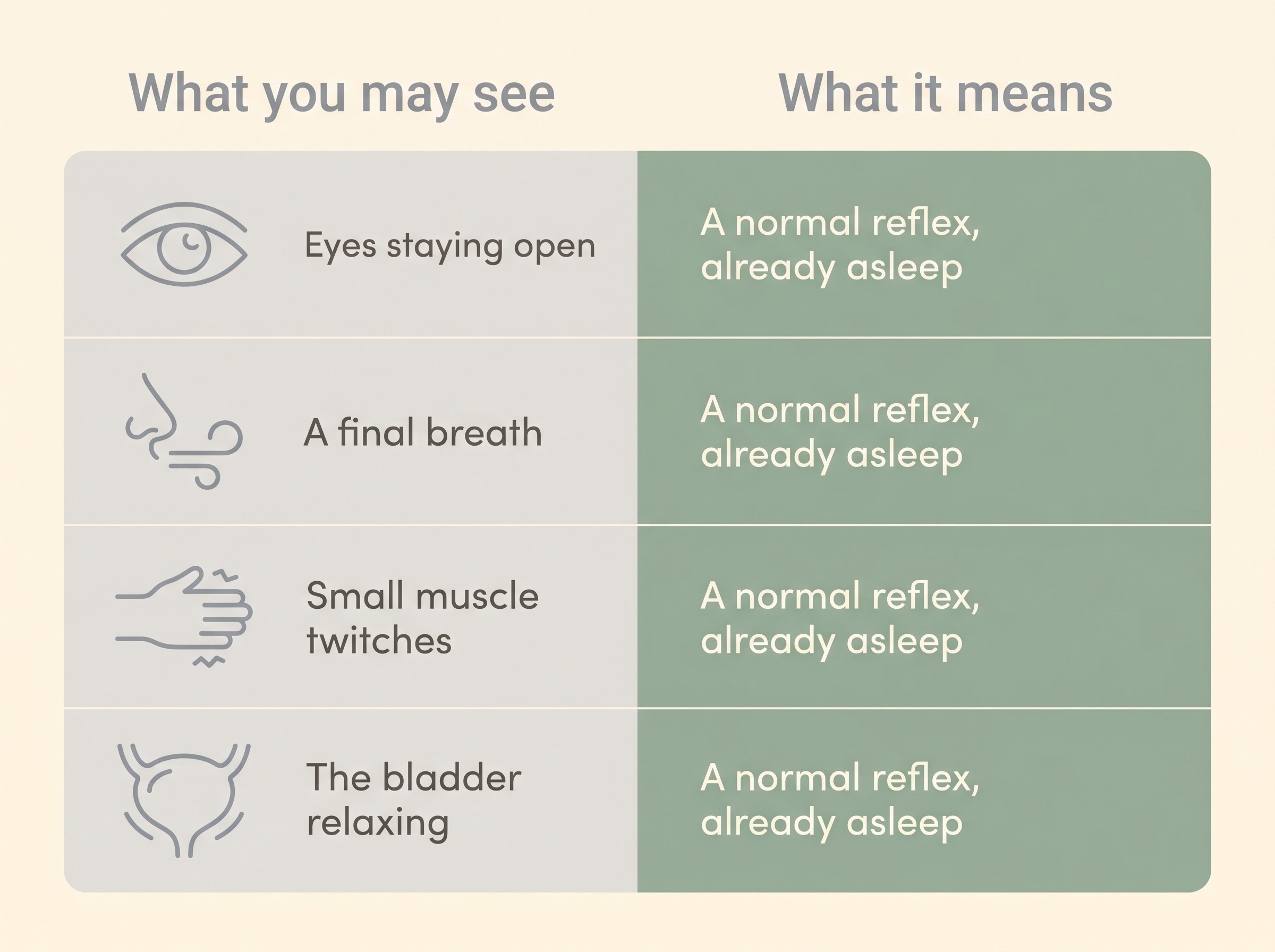
A body, in the moments around death, does some things that can look alarming if no one has prepared you, and that surprise is what haunts owners afterwards. Every one of them is a reflex in a body that is already asleep, not a pet who is struggling. I can say that with confidence because it rests on one governing clinical fact: "loss of consciousness should precede loss of muscle movement" (AVMA, 2020). Your pet is unconscious first. Everything below happens after that, to a pet who cannot feel it, know it, or be frightened by it.
Their eyes often stay open. This surprises almost everyone. The feline guidance is blunt: "the cat's eyes don't close, either after the cat is sedated or after the cat has died" (AAFP, accessed 2026), and the Blue Cross say the same for dogs, that "your pet's eyes will probably remain open" (Blue Cross, accessed 2026). The reason is simple once you hear it: closing the eyes is an active muscular action, and that muscle has relaxed. It does not mean they are still watching, or still here. Your vet can gently close them afterwards if you would like; you only have to ask.
There may be a final breath, or two. This is the one I most want you ready for, because unprepared it can be genuinely frightening, and prepared it is not. A short while after the heart has stopped, you may see what looks like a deep breath, a gasp, a sigh, even something like a stretch. The guidelines name it directly, that "an aesthetically objectionable terminal gasp may occur in unconscious animals" (AVMA, 2020), and the Blue Cross prepare owners gently: "there might be an involuntary gasp or two. These are normal reactions after a death" (Blue Cross, accessed 2026). The mechanism is the reassurance. This is called agonal breathing, and it "is caused by a reflex in the lower brainstem that can remain active for a short period after the brain has shut down... These final breaths are not under conscious control," so that "the pet is not conscious or aware at this stage, so there is no perception of panic or discomfort" (Lap of Love, accessed 2026). It is not your pet trying to breathe, and not the medicine failing. It is a reflex firing in a brain that has already gone quiet, and it passes in a moment. Sedation beforehand makes it less likely and less pronounced, one more reason vets so often reach for it (Chan et al., 2023).
There may be muscle twitches or small tremors. As the nerves and muscles quieten, you may see a twitch or a tremble (Blue Cross, accessed 2026; PDSA, accessed 2026). These are reflexes too, the body settling, not pain. The guidelines are clear that where such movement or a sound occurs after consciousness is lost, these responses "do not appear to be purposeful" (AVMA, 2020). Distressing to watch if it catches you unawares, yes. Felt by your pet, no.
The bladder or bowel may empty. As everything relaxes, the body can release urine or faeces (PDSA, accessed 2026). This is so expected that vets routinely "place a waterproof pad under the patient before you administer medications," simply so it is handled quietly and with dignity (AAFP, accessed 2026). It is ordinary, it is prepared for, and it takes nothing away from the gentleness of the moment.
Every item on that list is the body, not the pet. Once a pet has slipped past consciousness, any movement that follows belongs to what the guidelines call "the second stage of anesthesia, which by definition lasts from loss of consciousness to the onset of a regular breathing pattern" (AVMA, 2020), the ordinary stage every anaesthetised patient passes through. The whole framework of a humane death rests on consciousness being lost first, which is why the profession insists on that ordering above all else (AVMA, 2020). What you are watching, if you choose to watch, is reflexes in a sleeping body. You are not watching your pet suffer, because the part of them that could suffer has already, peacefully, gone.
Holding them, and being there, or not
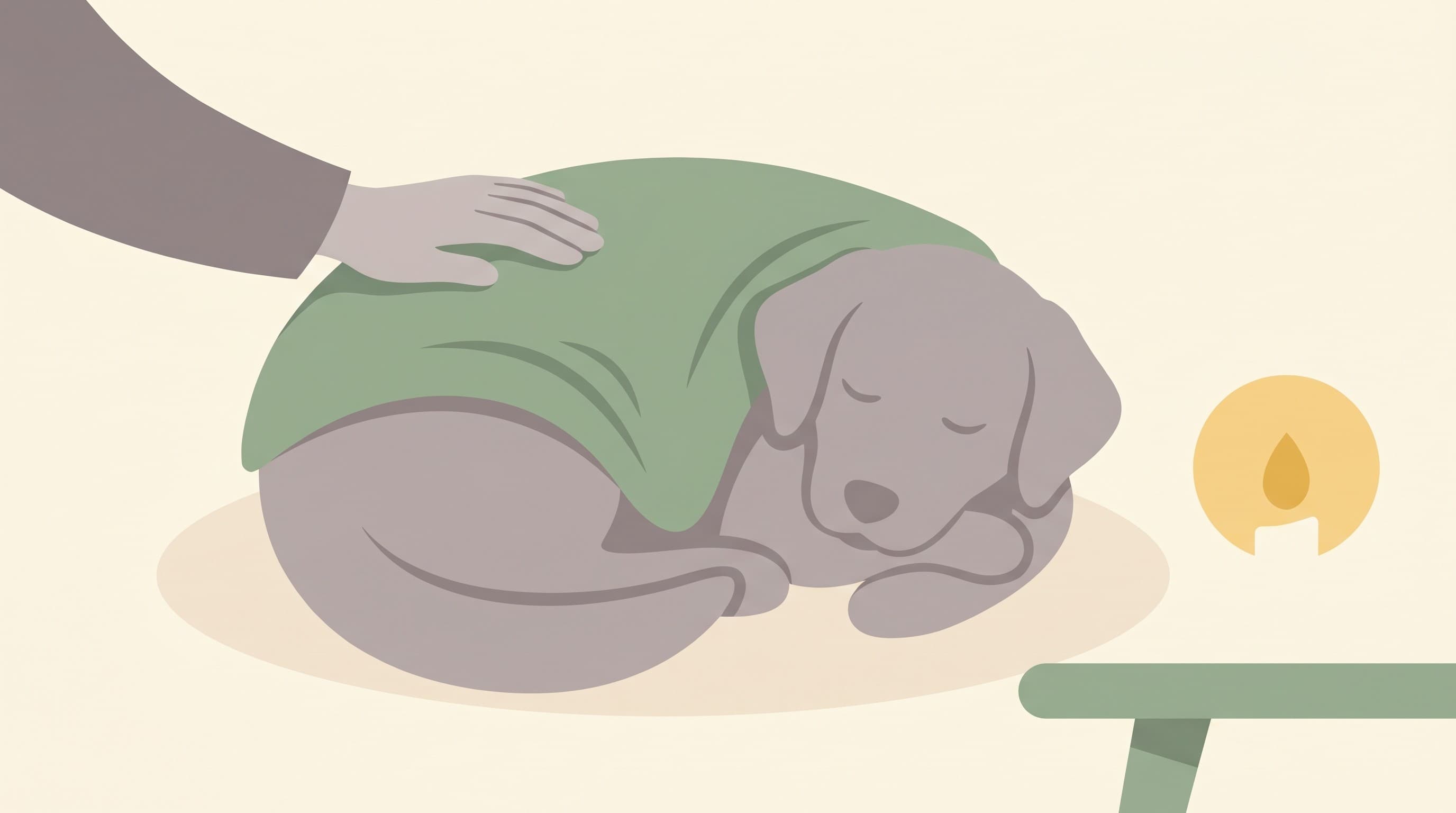
Through all of this, you can hold your pet and talk to them. Many owners want to, and it is exactly right to. The feline guidance puts it simply: "caregivers can hold their cats as they pass, honoring the human-animal bond" (AAFP, accessed 2026), and a familiar voice and a gentle hand are themselves calming to the very end (AVMA, 2020). The last thing your pet knows, in the seconds before sleep, can be the warmth and the sound of you.
I also want to say this plainly, because it bears on what the day is like and the guilt around it is heavy and unearned. Being in the room and stepping out of it are both completely valid, and your pet is at peace either way. Some people "prefer to be with their pet during euthanasia" and others "feel it's just too difficult and feel unable to stay, preferring to say goodbye afterwards" (Blue Cross, accessed 2026); as the PDSA say, "this decision is completely up to you... do whatever feels right for you and your pet" (PDSA, accessed 2026). There is also a middle path many people do not know exists: you can stay for the sedation, be there as your pet drifts into that deep, easy sleep, and step out before the final injection if that is what you can bear. Whatever you choose, your pet, already sedated and unaware, is not abandoned and is not afraid. This is genuinely your decision and not a test of love, and the full, gentle weighing of it lives in should I be there at the end. If there are children in the household, whether they come too is its own careful question, gathered in should children be present.
Afterwards: time, and what comes next
When it is over, there is no rush. Practices will offer you "a few minutes alone with your pet to say your final goodbyes," and there is normally no fixed clock on it (PDSA, accessed 2026). You can sit with them, stroke them, say what you need to say, and if you want longer, ask: within the practice's day they will almost always find a way. Some people want to stay a while, and some would rather not linger once their pet has gone. Both are right.
The small, tender things you might want to keep, a paw print pressed in clay, a clipping of fur, can usually be arranged, and it is worth knowing they exist before the moment passes. Wanting them is not morbid, and wanting none of them is equally fine; what they are and how to ask is held in paw prints, fur and keepsakes. Aftercare, the choice between cremation and burial, can likewise be settled ahead so you are not deciding it through tears at the desk, and is laid out calmly in after they have gone: cremation, burial and the options. I mention both only so nothing takes you by surprise.
One note on something this page has assumed. I have written all of this as a planned goodbye. Sometimes there is no time to prepare at all: a sudden collapse, an accident, a crisis decided in an hour you never saw coming. The same gentleness applies to the procedure, but the particular shock of a sudden loss deserves its own words, in when there is no time to prepare. And whenever the loss comes, however ready you felt, the grief that follows can be far larger than people expect; if it is, is it normal to grieve this much and the wider pet loss support directory are there for you when you need them.
Underneath all the fear of it, this day is, far more often than people expect, quiet and ordinary and tender. A familiar room, or your own front room. A pet who grows sleepy and heavy and relaxed, very often in your arms, and then simply slips into a sleep they never feel themselves leave. A few seconds, a last warm breath of being held, and a peace that arrives before anything else does. Everything that comes after, the open eyes, the reflex sigh, the stillness, happens to a pet who is already gone somewhere gentle and feels none of it. The kindest thing you can do for the day is the one thing you can do now, while your hands are steady: settle the form, the payment, the aftercare in advance, so that when it comes, the day asks nothing of you at all except to be there, with your hand on warm fur, and to say goodbye.
References
- American Association of Feline Practitioners (AAFP). (accessed 2026). End of Life Educational Toolkit: The Euthanasia Process. catvets.com.
- American Veterinary Medical Association. (2020). AVMA Guidelines for the Euthanasia of Animals: 2020 Edition. American Veterinary Medical Association.
- Blue Cross. (accessed 2026). Euthanasia and how to say goodbye to your dog and Saying goodbye to your cat. Blue Cross advice pages.
- Blue Cross Pet Bereavement Support Service (PBSS). (accessed 2026). Pet bereavement and pet loss support. Freephone 0800 096 6606, every day 8:30am to 8:30pm; email pbssmail@bluecross.org.uk.
- Chan, H., Pepper, B. M., Ward, M. P., & Quain, A. (2023). Euthanasia of Cats by Australian Veterinarians: A Survey of Current Practices. Veterinary Sciences, 10(10), 627.
- Lap of Love Veterinary Hospice. (accessed 2026). Agonal Breathing in Pets: What It Is, What It Means, and What To Do.
- PDSA. (accessed 2026). When it's time to say goodbye. PDSA pet help and advice.
- Royal College of Veterinary Surgeons (RCVS). (accessed 2026). Code of Professional Conduct for Veterinary Surgeons, Supporting Guidance, Chapter 8: Euthanasia of animals.
- Samaritans. (accessed 2026). Free, 24-hour support for anyone struggling to cope. Call 116 123 (UK and ROI).
Free downloads
Companion worksheets to put what you've read into practice. Free PDFs, print at home.