Should Children Be There When a Pet Is Put to Sleep?
Alastair Greenway
BVM&S MRCVS
It is one of the hardest small decisions inside a very large one. You are at, or close to, the point of letting a much loved pet go, and now a second question sits just behind the first: should your child be in the room when it happens? Perhaps your eight-year-old has asked to be there and you do not know if you can bear it, or your teenager has gone very quiet, or your four-year-old has no idea yet what "put to sleep" even means. Whatever shape it takes in your house, the most important thing is this: there is no single right answer here, and you will not get it wrong by choosing either way. The leading veterinary-hospice guidance treats this as a very personal decision and is clear that parents "know what is best for their little ones, and should make the decision based on what they feel their child or children can emotionally handle" (McVety, Lap of Love, n.d.). No one can make this decision for you, but you do not have to make it alone, and your vet will help you weigh it.
This piece is about one specific thing: a child being physically present in the room during the procedure itself, how to let them choose, and how to prepare them if they will be there. The wider conversation, the truthful telling before the loss and the age-by-age map of what children understand about death, belongs to its companion in preparing the family when a pet is dying, the place to start if you have not yet had that talk. Helping a child grieve afterwards, the weeks of "is it my fault?" and "will you die too?", lives in helping children after losing a pet, and whether you, the adult, should be there is its own separate question in should I be there at the end?. Here I want to stay with the room, and the child at the door of it.
First, a word for you
Before any of the guidance, one note for the parent carrying this, because you are often closer to the edge than you will admit even to yourself. Steering a child through a pet's death while your own heart is breaking is genuinely heavy, and there is no shame in finding it almost too much to hold. If the weight ever tips into a feeling that you cannot go on, please stop and ring the Samaritans on 116 123: free, from any phone, day or night, and you do not have to be in crisis to call (Samaritans, n.d.). You are allowed to be a person who is hurting, not only the steady one managing everyone else's hurt.
What a child imagines is worse than what they will see
If there is one thing I would most want a frightened parent to hear, it is this. A child's imagination of death is almost always more frightening than a peaceful, planned euthanasia turns out to be. The bereavement specialists at Ohio State's veterinary teaching hospital put it in a single sentence worth carrying: "the reality of a peaceful death is less traumatic to children than their fantasy of it" (Ohio State Honoring the Bond, Tousley, 2004-2008). Left to fill in the blanks, a child pictures something violent or painful. What actually happens is quiet: a pet drifting into a deep sleep in familiar arms, on a favourite blanket, and then slipping away without fear or pain.
There is a second, quieter reason this matters for some children. Very young ones in particular may keep waiting for a pet to come back, may not truly believe she is gone, and may not understand the permanence of death "unless they actually see that their pet is not 'just asleep'" (Ohio State Honoring the Bond, 2004-2008). Witnessing a calm goodbye can do what words struggle to: make the finality real and survivable at once. Dr Dani McVety, a co-founder of the veterinary hospice service Lap of Love, describes that when a school-age child or a teenager is undecided and parents ask her candid view, she will "gently suggest they 'be here for Fluffy' so that they understand what a peaceful, loving, and calm experience death can be" (McVety, Lap of Love, n.d.).
Read that as an option that can demystify, though, not a recommendation to bring every child. The point lands more gently than "children should be present": if your child is there, what they see is very unlikely to be the horror they, or you, may be dreading, and that single fact lifts a great deal of fear off this decision, whichever way you land.
Let age guide you, but never decide for you
Age helps you weigh this, but only as a rough map, never a rule, and what follows is specifically about being in the room, not a re-teaching of what children understand about death (that fuller map lives in preparing the family). Hold it lightly: emotional age varies enormously, and you know your own child better than any age band ever could (McVety, Lap of Love, n.d.).
Roughly under five. For the youngest children, presence is generally not advised; McVety suggests families "do not involve the children too much or have them present during a euthanasia" (McVety, Lap of Love, n.d.). Very young children cannot yet grasp that death is permanent (Child Bereavement UK, n.d.), so the room does little explanatory work, and a small child will "generally be more upset by mom and dad's emotions than by their own", unable yet to perceive that the grief will ever end (McVety, Lap of Love, n.d.). A conscious goodbye beforehand usually serves a child this young far better.
Roughly six to thirteen. School-age children are a different matter. McVety's guidance is that they "should not be shielded from the experience, but rather asked if they would like to be a part of it. They are old enough to make that decision" (McVety, Lap of Love, n.d.). They are curious and more resilient than we expect, and sheltering them can backfire: McVety gives the example of the well-meaning parent who keeps a child away, breaks the news by phone, then takes them to view the body at the crematory, an approach that helps the child understand the finality of death but does little for the lingering fear that the pet was frightened or in pain at the end (McVety, Lap of Love, n.d.).
Roughly fourteen and up. Teenagers understand death and its permanence and deserve to be given the option, with full information and open-ended conversation (McVety, Lap of Love, n.d.). The risk here is different: an idealistic teenager can feel the family is "giving up", and the idea of choosing euthanasia can be hard to accept, which is exactly why a candid explanation of why matters so much (McVety, Lap of Love, n.d.). Teenagers also often mask grief, working to seem unaffected even while, clinical studies suggest, often feeling it more intensely than any other age group (Ohio State Honoring the Bond, 2004-2008; Child Bereavement UK, n.d.). A quiet teenager is not necessarily a coping one.
Give the child a real choice, and support whichever way they choose
For any child old enough to weigh it, the kindest approach is to offer a genuine choice and then back it completely. Ohio State's guidance is direct: "Allow the child to be present for the pet's euthanasia, if they choose. Let them know you will support their decision" (Ohio State Honoring the Bond, 2004-2008). A child may be "consulted and encouraged to participate in decision making, but never forced" (Ohio State Honoring the Bond, 2004-2008). That last word is the whole of it. Offer, never insist.
What makes this genuinely a choice is that both answers are right. A child who wants to be there, to hold a paw and say goodbye in person, should be allowed to, prepared for what they will see. A child who would rather remember their pet running in the garden than lying still is making an equally loving choice, and should never feel they have let the pet down. Some change their minds, and that is fine too. The aim is not to engineer an outcome but to hand the child as much control as their age allows over something that can otherwise feel as though it is happening to them.
Saying goodbye without being in the room
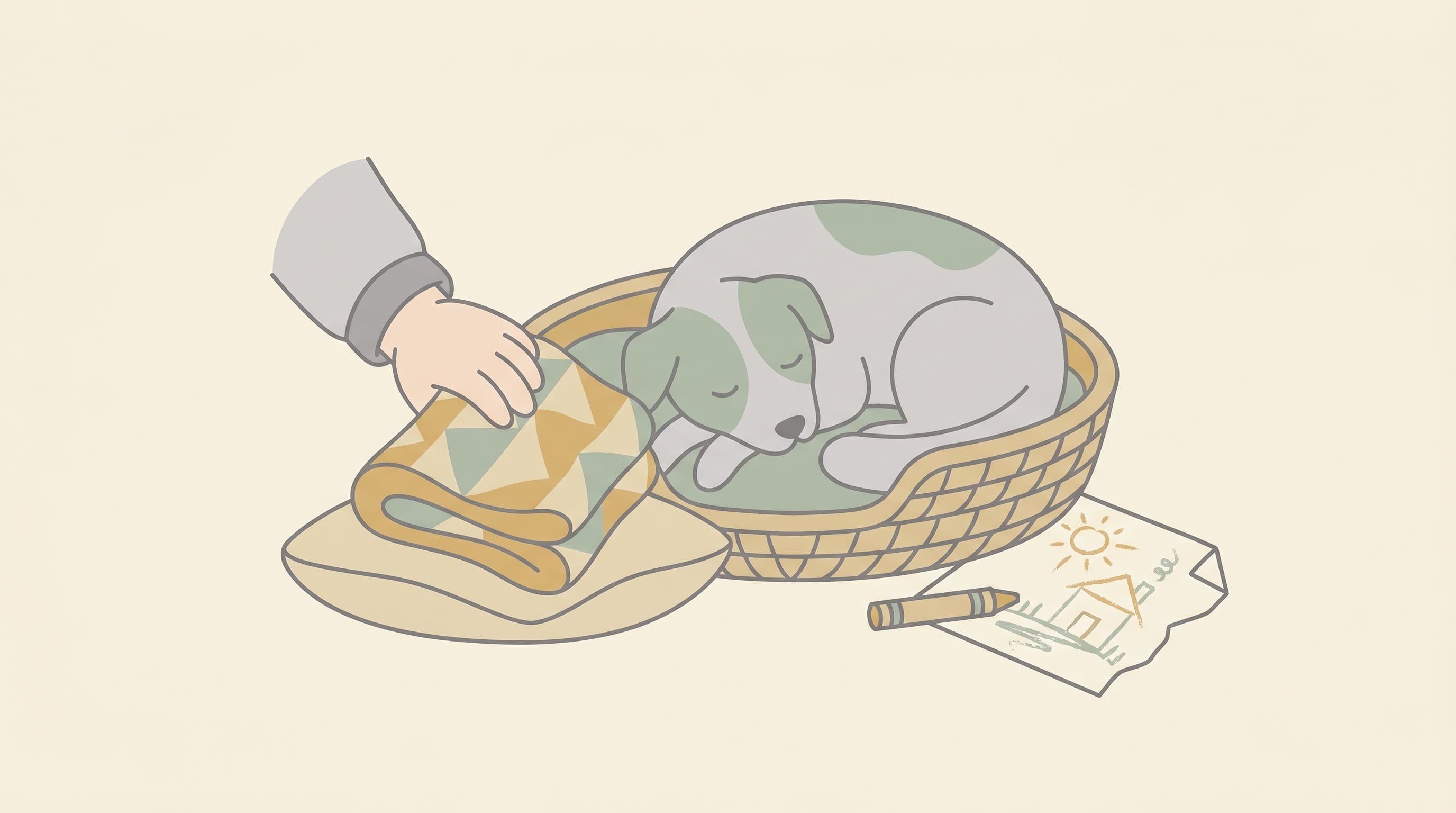
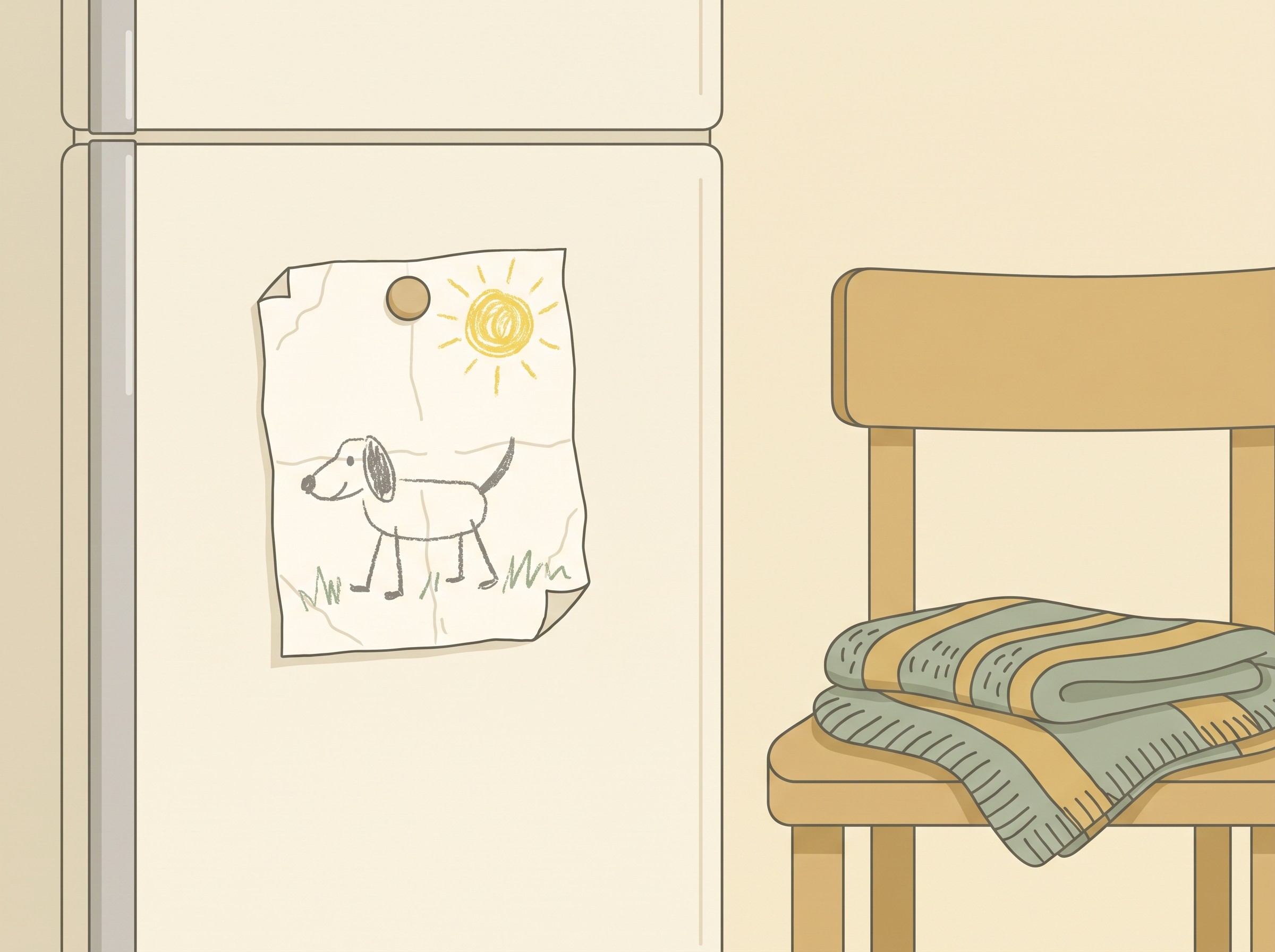
Here is the gentle middle path, and for a child who is too young, or who simply does not want to be present, it is often the best of all. A conscious goodbye does not require the procedure. Ohio State reminds us that children "need an opportunity to say goodbye and make the most of whatever time they may have left with their pet" (Ohio State Honoring the Bond, 2004-2008). That goodbye can happen at home, in the days or hours before the appointment: a child can sit with their pet in a favourite spot, choose the blanket she will be wrapped in, draw a picture to tuck beside her, or simply say what they want to say in their own words. None of it needs the clinic, and none of it needs the moment itself.
There is a second door, for afterwards. If your child is not in the room, you can gently ask whether they would like to see their pet once it is over: Ohio State's guidance is to "ask them if they want to see their pet afterward" and to "demonstrate that it is OK to talk with their pet and touch its body" (Ohio State Honoring the Bond, 2004-2008). For some children, a quiet moment with a pet who is clearly, peacefully gone is what finally lets them understand and begin to say goodbye; for others it is not what they want, and that too is fine. The fuller picture of saying goodbye consciously before the loss, for the whole family, sits in preparing the family when a pet is dying.
If they will be in the room: preparing them for what they will see and hear
If your child has chosen to be present, prepare them well. Children are literal, and a surprise haunts them. The very physical reflexes that can unsettle adults, the eyes not closing, a single reflex gasp, a small twitch, the bladder relaxing, can frighten a child far more if they are not expected (AVMA, 2020). The fix is simple: tell them, gently and in advance, what they may see.
The reassurance underneath all of it is that loss of consciousness comes first. Veterinary euthanasia is designed so that "loss of consciousness should precede loss of muscle movement", which means anything a child sees afterwards is happening in a body that is already deeply, peacefully asleep, not to a pet who is suffering (AVMA, 2020). In plain words a child can hold: their pet will get a sleepy injection first, then a special medicine that gently stops the heart; the pet will not feel anything at all; the eyes may stay open, because closing them is a muscle action that relaxes; and there may be a last breath or a small twitch afterwards, which is the body and not their pet. If you want to explain that last breath, a present child can be told that this kind of breathing "is caused by a reflex in the lower brainstem", that the breaths "are not under conscious control", and that "the pet is not conscious or aware at this stage, so there is no perception of panic or discomfort" (Lap of Love, n.d.).
Keep it short and steady. You do not need the full clinical account, and the complete, gentle, step-by-step description is owned by what actually happens when a pet is put to sleep, well worth reading yourself beforehand so your own steadiness can carry the room. Tell your child the room will be calm and quiet, and, above all, that they can leave at any moment and no one will mind in the slightest. Knowing the door is open is often what allows a child to stay.
Words that help, and words to leave behind
How you talk to a child about the procedure matters as much as whether they are in the room. Two principles carry it.
Start by retiring "put to sleep", especially with children. They are literal, and the sleep association can do real harm: Ohio State advises avoiding the phrase precisely because, "since we go to sleep nightly, associating this act with death creates anxiety and might lead to disruptions in sleeping routines", and warns that it "can also cause fear over surgery and anesthesia" (Ohio State Honoring the Bond, 2004-2008). Child Bereavement UK echoes it, advising the plain words "died" and "dead" rather than softer phrases such as "gone to sleep" or "lost", because a younger child may otherwise wonder whether they can wake the pet who has "gone to sleep", or grow anxious about others going to sleep (Child Bereavement UK, n.d.). The fuller teaching on euphemisms lives in preparing the family; here it is enough to apply it to the procedure itself.
Then, when you explain the procedure, be truthful, plain and developmentally simple. Ohio State offers a worked example worth adapting into the two-step injection your vet will describe: "Dr Smith will give Fluffy a shot filled with medicine that only works on animals. The shot will stop Fluffy's heart. When her heart stops, she won't be able to breathe on her own. She will not feel any pain" (Ohio State Honoring the Bond, 2004-2008).
Two short sentences belong here too, lightly, because both can quietly take root in a child at a clinic. The first heads off guilt: a child's magical thinking can lead them to believe a cross thought or an old wish caused this, so say plainly that it is no one's fault, that their "thoughts, feelings or words did not cause the death" (Ohio State Honoring the Bond, 2004-2008), in the spirit of the gentle line "it's okay if you got mad at Socks. Your thoughts didn't hurt him" (Ohio State Honoring the Bond, 2004-2008). The second protects their trust in healthcare: try not to blame the vet in front of children, because doing so risks leaving children to "develop fear of veterinarians and other health care givers" (Ohio State Honoring the Bond, 2004-2008). The fuller work of helping a child through guilt and grief afterwards is owned by helping children after losing a pet.
One more thing, gently. It is good for a child to see your genuine, measured grief: "let them see you upset and crying. By talking about sad feelings and crying, children learn that these emotions and behaviors are acceptable", with the small caveat to "explain that it is the pet's death that makes you sad", so a child does not quietly wonder if they are to blame (Ohio State Honoring the Bond, 2004-2008). A child should see a parent who is sad, not one they feel they must look after.
A word, too, on the goodbye that cannot wait. Sometimes a child is at school, or the decision is sudden, and there is no chance to gather everyone. Where it can be helped, Ohio State advises that "if at all possible, do not plan to euthanise a companion animal while a child is away from home" (Ohio State Honoring the Bond, 2004-2008), so a child is not robbed of the chance to say goodbye. But life does not always allow it, and if for medical reasons it cannot be prevented, the rule is simply to "be honest. Do not say that the companion animal ran away from home" (Ohio State Honoring the Bond, 2004-2008). A child told the truth, even a hard truth they were not present for, fares far better than one left to imagine what really happened.
Afterwards: a part to play
Whether or not a child was in the room, one of the kindest things you can offer afterwards is something active to do with feelings too big for words. Ohio State lists "drawing or painting pictures, compiling an album, scrapbook or memory box... writing or sharing memories, planting a shrub or tree", and gentle openings like "how about writing a letter or a story, or drawing a picture about the way you feel?" (Ohio State Honoring the Bond, 2004-2008). Child Bereavement UK similarly suggests keeping a memory box, making a scrapbook of memories, and helping a child write a goodbye letter to bury with their pet (Child Bereavement UK, n.d.).
A child can also share the practical goodbye: helping choose how the pet will be remembered, helping to bury or scatter ashes, or asking for a small keepsake. Many children will want a paw print, and it is entirely fine, not morbid at all, to ask your practice for one in advance; the small physical tokens you can ask for are gathered in paw prints, fur and keepsakes, and the wider ways a family can remember a pet together in ways to honour and remember your pet. Giving a child a hand in the remembering turns a loss that happened to them into something they helped to shape.
The lesson folded inside the goodbye
Whatever you decide, and whatever your child decides, the goodbye they get to shape, in the room or out of it, with a drawing or a paw print or a few quiet minutes on a favourite blanket, is one of the first times they will learn something most of us spend a lifetime relearning: that the animals we love can be let go of with tenderness rather than fear, and that love does not end when a life does. It is a lesson that will quietly steady them long after this particular goodbye.
You do not have to weigh any of it alone. Child Bereavement UK supports any adult helping a grieving child and has dedicated guidance on the death of a pet (free helpline 0800 02 888 40, Monday to Friday, 9am to 4.30pm); the well-known children's bereavement charity Winston's Wish is now part of Child Bereavement UK, the two having completed a merger into a single charity that keeps the Child Bereavement UK name (Child Bereavement UK, n.d.). For the family as a whole, the Blue Cross Pet Bereavement Support Service is free, open every day from 8.30am to 8.30pm, and can help families both before and after a loss (Blue Cross, n.d.). If yours is a cat, Cats Protection's Paws to Listen (0800 024 94 94, Monday to Friday, 9am to 5pm) is a free, confidential listening line staffed by trained volunteers (Cats Protection, n.d.), while Dogs Trust offers bereavement support for dog owners, with the reminder that you may grieve in your own way and at your own pace (Dogs Trust, n.d.). And if at any moment the weight feels too much to carry, the Samaritans are there on 116 123, free, any phone, any hour (Samaritans, n.d.). Whichever you reach for, you will find someone who understands that this is not "just" a pet, but the moment your child learns what it means to love something they cannot keep forever.
References
- American Veterinary Medical Association. (2020). AVMA Guidelines for the Euthanasia of Animals: 2020 Edition.
- Blue Cross (Pet Bereavement Support Service). (n.d.). Pet loss support; Pet loss support for children, missing my friend.
- Cats Protection. (n.d.). Paws to Listen grief support service.
- Child Bereavement UK. (n.d.). How to help a child grieving the death of a pet; Children's understanding of death at different ages; Child Bereavement UK and Winston's Wish have come together.
- Dogs Trust. (n.d.). Bereavement support.
- Lap of Love Veterinary Hospice. (n.d.). Agonal Breathing in Pets: What It Is, What It Means, and What To Do.
- McVety, D. (Lap of Love Veterinary Hospice). (n.d.). A Veterinarian's Perspective: Should my child be present for our pet's euthanasia? [PDF].
- The Ohio State University Veterinary Medical Center, Honoring the Bond program (Tousley, M. M.; adapted from Brandt, J., © 2004-2008). Helping Children Cope with the Serious Illness or Death of a Companion Animal [PDF].
- Samaritans. (n.d.). How we can help: Contact a Samaritan.
Free downloads
Companion worksheets to put what you've read into practice. Free PDFs, print at home.