

Helping Children After Losing a Pet
Alastair Greenway
BVM&S MRCVS
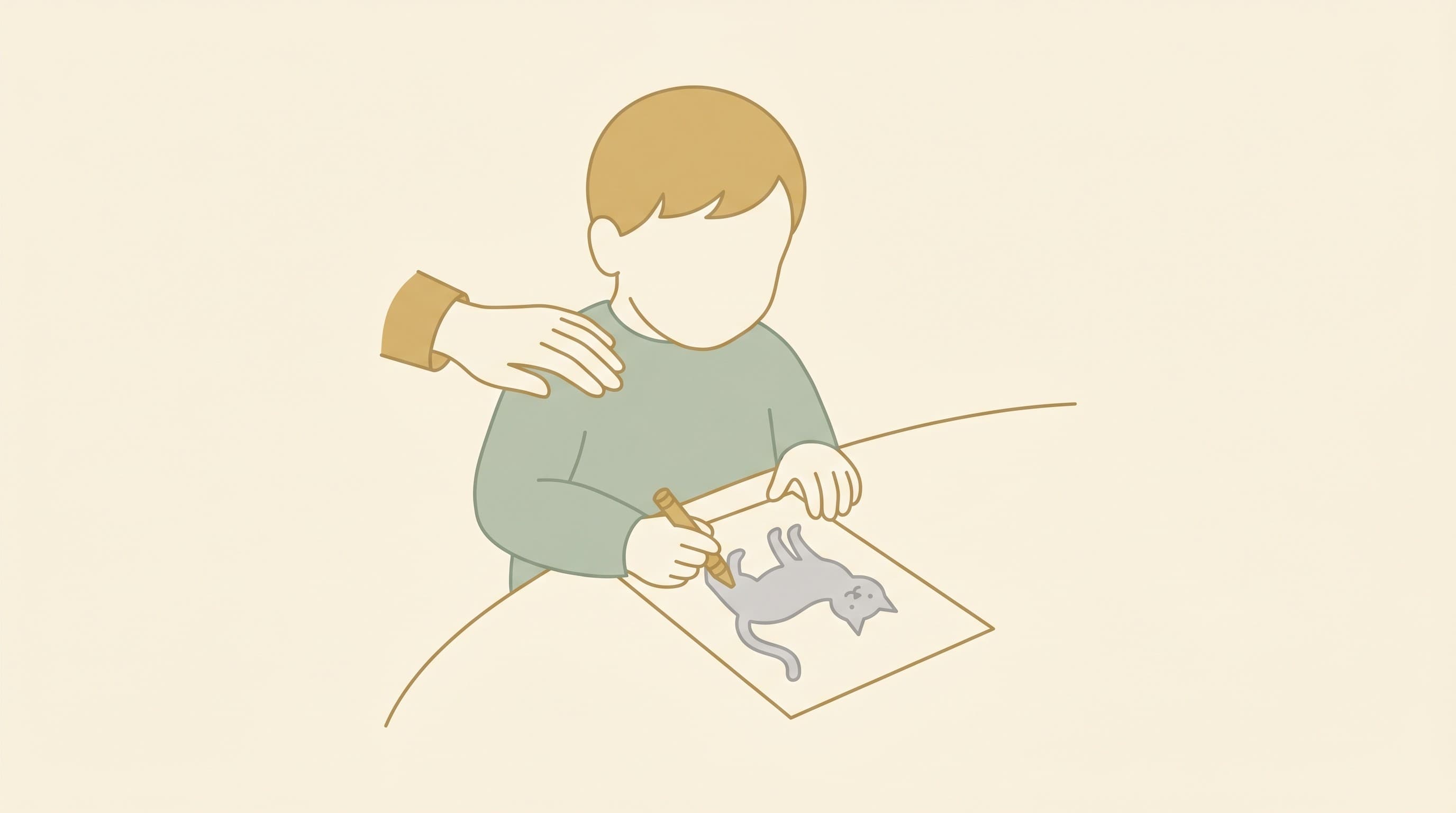
For many children, a pet is the first death they ever meet, and you are now the person who has to walk them through it while your own heart is in pieces. It shows up in all sorts of ways. A seven-year-old keeps asking when the cat is coming home. A toddler starts wetting the bed again. A teenager shrugs and goes back to their phone in a way that worries you more than tears would. Whatever shape grief is taking in your house this week, the most important thing is this: you do not have to have perfect words, and you will not damage your child by getting this slightly wrong. What children need after a loss is not a flawless explanation but a parent who is truthful, available and not pretending everything is fine. Being there matters far more than having all the answers (Child Mind Institute, n.d.).
This piece is about the days and weeks after a pet has died: how grief actually shows in a child, how to answer the hard questions once the worst has already happened, how to let a child take part in remembering, and when ordinary grief tips into something that needs extra help. The conversation before the loss, the fuller age-by-age map of what children understand about death and why euphemisms frighten them, belongs to its companion in preparing the family when a pet is dying, the place to start if you have not yet had that talk. Whether a child should be in the room at the moment of euthanasia is its own separate question, held in should children be there when a pet is put to sleep. Here I want to stay with the after.
First, a word for you
Before any guidance about the children, one note for the parent carrying this, because you are often closer to the edge than you will admit even to yourself. Steering a child through a pet's death while your own grief is raw is genuinely heavy, and there is no shame in finding it almost too much to hold. If the weight ever tips into a feeling that you cannot go on, please stop and ring the Samaritans on 116 123: free, from any phone, day or night, 365 days a year, and you do not have to be in crisis to call (Samaritans, n.d.). You are allowed to be a person who is hurting, not only the steady one managing everyone else's hurt. A child does not need a parent who never cries. They need one who is still here, and looking after the steady one is part of looking after the child.
A quick reminder: grief looks different at different ages
You cannot support a grieving child without a rough sense of how much they understand, but this is a quick map rather than the territory, and the fuller age-by-age version lives in preparing the family when a pet is dying. Hold these as gentle maps, not rules, because emotional age varies enormously and you know your own child better than any age band ever could.
A mature understanding of death has several parts that children acquire one at a time, not all at once: that it is permanent, that it is universal and happens to everyone, that the body stops working completely, and that it has a cause (Assadi, 2023; National Academies, 1984). Roughly under five, children have little grasp that death is permanent: they may keep asking where the pet is or when she is coming back, and because they think in concrete terms, soft or abstract phrases simply slide off them (Child Bereavement UK, n.d.; National Academies, 1984). Roughly five to nine, they increasingly understand that death is final, but may not yet feel it is universal, that it could one day happen to them or to you; they are intensely curious, ask blunt questions, and can still slip into magical thinking and self-blame (Assadi, 2023; National Academies, 1984). From roughly nine or ten upwards, children and teenagers broadly understand death as adults do, but older children and adolescents may be reluctant to show what they feel, holding back their grief for fear of seeming different or abnormal, so a teenager who looks unbothered may simply be grieving where you cannot see it (National Academies, 1984; Assadi, 2023).
The thread is the same throughout: take the child's lead, answer what they actually ask in small plain instalments, and let "I don't know" be a real and acceptable answer (Child Mind Institute, n.d.; Child Bereavement UK, n.d.).
How grief actually shows in a grieving child
This is the part that catches loving parents off guard and makes them think something is wrong when nothing is. Children's grief rarely looks like adult grief, and read through an adult lens it can be badly misjudged.
Grief comes in bursts, not a steady line. A child may sob inconsolably one minute and ask to go and play the next, and a parent watching can feel a small lurch of alarm, as though the child did not really care or is already "over it". They are not. After losing a loved one a child may go from crying one minute to playing the next, and the playing is not callousness, it is a defence that stops a child being overwhelmed by feelings too big to hold all at once (Child Mind Institute, n.d.; National Academies, 1984). Grief in a child works in waves with dry land in between, and the dry land is not denial. It is how they come up for air.
Children grieve through play. Closely related, and just as easy to misread, is that play is one of the main ways children process a death. Pre-schoolers may re-enact a death through play, and school-age children may show more aggressive or violent play as a grief response (Assadi, 2023). A child staging a toy funeral, or playing out the same scene again and again, is not being morbid. They are doing what an adult does when they tell the story of a loss over and over to anyone who will listen: working it through in the only language they have. Let the play happen, and join in gently if invited.
Regression is common, and usually temporary. Grief can knock a child back a developmental step or two. You may see bed-wetting return, thumb-sucking or baby talk reappear, new clinginess or separation anxiety, disturbed sleep or nightmares, tantrums, or a quiet withdrawal (Child Mind Institute, n.d.; Assadi, 2023; VITAS Healthcare, n.d.). This is not naughtiness and it is not something to correct: it is a child reaching for safety while the ground feels unsteady under them. The response that helps is the opposite of correction, extra reassurance, extra patience, and more closeness, not less, until the ground feels solid again.
A parent who knows that bursts, play and regression are normal grief is far less likely to misread their grieving child as a child with a problem, and far more likely to offer the quiet extra reassurance the behaviour is asking for.
The hard questions, answered after the loss
Children ask the questions adults are too frightened to voice, and they ask them bluntly, sometimes at the supermarket checkout, sometimes days later out of nowhere. Three come up again and again after a pet dies, and each deserves a steady, truthful answer.
"Is it my fault?" This is the one that most often goes unspoken, and the one I most want you to head off, because a child can carry it silently for a long time. Young children, and some school-age children, believe their own thoughts, wishes or behaviour can cause real events in the world, including death, a way of thinking sometimes called magical thinking; pre-adolescents may even read a death as a punishment (Assadi, 2023; National Academies, 1984; Palliative Care Network of Wisconsin, n.d.). A child who once shouted at the dog for chewing a toy, or shut the cat out of their room and, in a hot moment, wished it gone, can quietly conclude that the wish came true and they made the pet die. And they will usually not say so. So you have to say it first, plainly and more than once: nothing you did, nothing you said, nothing you thought and nothing you wished made the pet ill or made the pet die. (Preparing the family covers heading this off before a loss; here the same guilt often surfaces days later, unprompted, and the answer is the same.) Say it before they ask, and be ready to say it again.
"Will you die too? Will I die?" After a death, a child's mind naturally turns to the safety of the people left, and to themselves. After the death of someone close, children will quite naturally start to worry that the remaining caregivers will die too, and the same instinct fires after a pet dies (Child Mind Institute, n.d.; Palliative Care Network of Wisconsin, n.d.; Assadi, 2023). The truthful answer is also the reassuring one, and the trick is to be straight without making a promise you cannot keep. Yes, all living things die one day, that is true and a child can hold it, but you expect to be here to look after them for a very, very long time. What I would steer you away from is the tempting absolute, "I will never die", because a child who later discovers it was not true learns that the comforting things grown-ups say cannot be trusted, exactly when they most need to trust them. Truthful reassurance reassures for longer than a comforting fiction.
"Where is she now? Is she coming back?" Especially with younger children, you will answer this, and then answer it again, and then again, and it is tempting to think your first answer failed. It did not. Repeated questions are how a child digests something too large to swallow whole, returning to it for the reassurance that the story has not changed, not a sign that the explanation did not land (National Academies, 1984; Child Bereavement UK, n.d.; Child Mind Institute, n.d.). The one thing that helps here is consistency: keep using the same plain words the family has already chosen, and resist the urge, in the soft-hearted moment of a child's distress, to reach for a gentler-sounding phrase. Use clear, concrete language after the loss just as before it: "died", "dead", "death". Gently but directly using the words death, dead and died inside short, simple explanations is kinder than it sounds, because vague or euphemistic language tends to create more fear in children, not less (Assadi, 2023). The fuller teaching on why softeners like "put to sleep" or "gone away" backfire belongs to preparing the family; here it is enough to keep your words plain and the same each time.
Letting them take part in remembering
If there is a single most useful thing you can offer a grieving child, it is something active to do with feelings that are too big for words. Children cope better when they are included in the loss than when they are shut out of it to protect them, and being shut out usually backfires, leaving a child to fill the silence with fears worse than the truth (National Academies, 1984; Assadi, 2023; Blue Cross, n.d.). The key word, though, is offer. A genuine choice is itself protective: a child who wants to take part should be welcomed in, and a child who wants a little distance should never be made to feel they have let the pet down. Both responses are entirely normal.
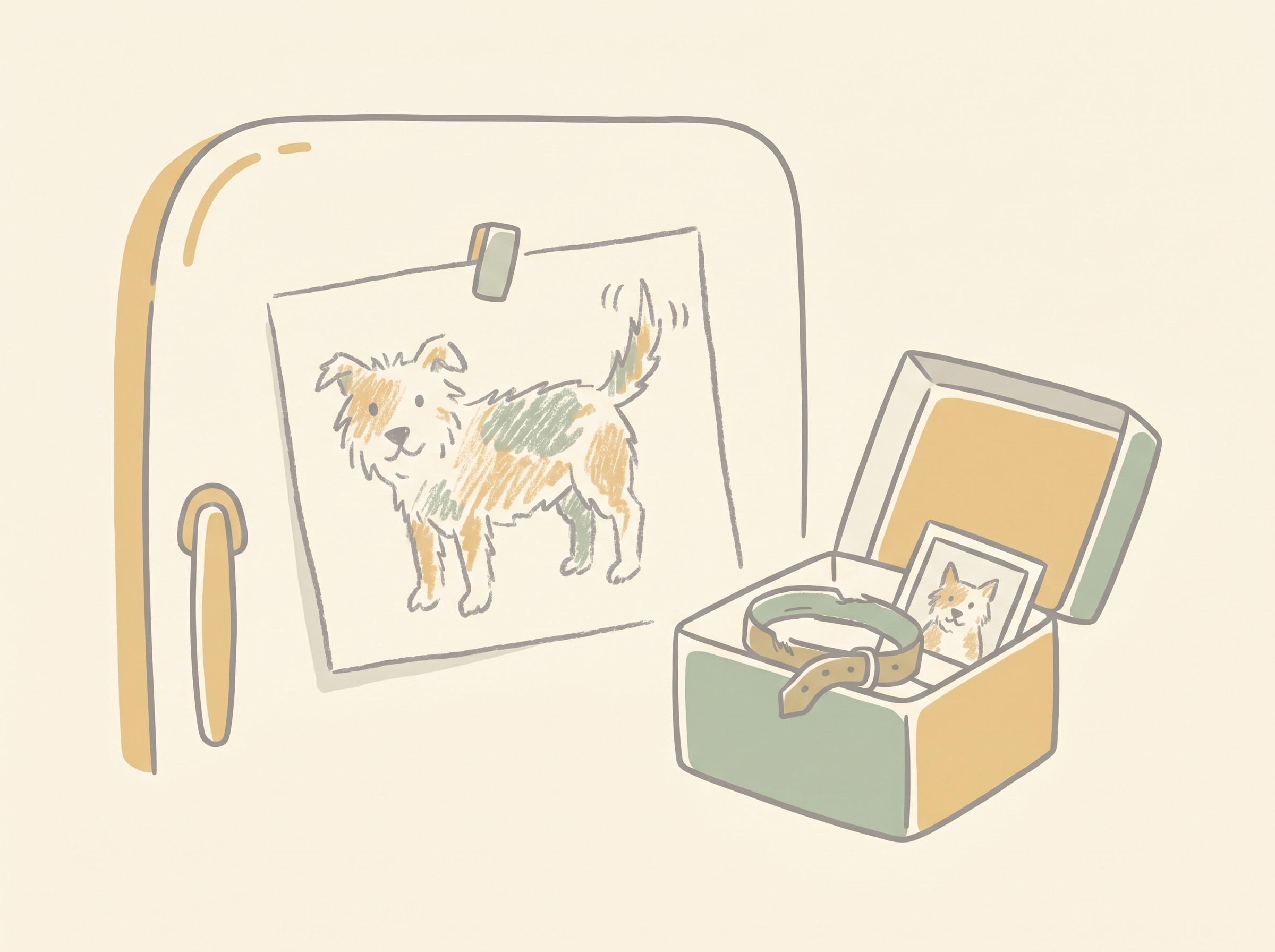
The activities that help are small, concrete and led by the child. Drawing a picture of the pet, writing a letter or a story to them, telling favourite stories together, making a memory box with a favourite toy, the collar, a photograph or a small tuft of fur, planting something in the garden, lighting a candle, or holding a tiny ceremony in the child's own words: all of these give grief somewhere to go (Assadi, 2023; Child Bereavement UK, n.d.; Blue Cross, n.d.). A child who buries their drawing with the pet, or chooses what goes into the memory box, is not being kept busy. They are being handed a way to say goodbye that does not depend on finding the right words, which children rarely have.
The goodbye that matters most to many children is the practical one. If the family is having a burial, or scattering ashes, a child can be offered a real role: choosing what goes in beside the pet, saying a few words, helping to plant a bulb where the ashes are scattered (Assadi, 2023; National Academies, 1984). This turns a loss that happened to them into something they helped to shape, and that small sense of agency is steadying. The grown-up logistics of cremation and burial, and the UK rules around them, are covered in aftercare: cremation and burial options; the in-the-moment keepsakes you can ask your practice for, a paw print or a clipping of fur, are gathered in paw prints, fur and keepsakes; and the wider menu of ways a whole family can honour and remember a pet over time lives in ways to honour and remember your pet. What is owned here is simply the principle: offer the child a part in the remembering, and let them take as much or as little of it as they want.
Let them see that grief is allowed
One quiet worry stops some parents grieving in front of their children: a fear that a child should be shielded from a sad parent. It is the opposite. When a child sees a parent grieve openly, they learn that sadness is normal, allowed, and survivable, which is one of the most useful things a first loss can teach. Showing your own measured grief, the feelings that do not overwhelm you or them, teaches a child that those feelings and the tears that come with them are acceptable (Child Mind Institute, n.d.; VCA Hospitals, n.d.). The aim is for a child to see a sad parent, not a parent they feel they have to look after, so it helps to gently name what the sadness is about, so a child does not quietly wonder whether they are the cause of it. The fuller picture of carrying your own grief through these first raw days, the empty bowl, the quiet house, is held for the adult in the first days: the empty bowl and the quiet house.
When to seek extra help
I want to be clear and calm about this, because the last thing a grieving parent needs is a checklist that makes ordinary grief look like a crisis. The great majority of children's grief, including the bursts of tears, the play, the regression and the endlessly repeated questions, is entirely normal and needs no professional intervention at all. Being available to your child matters more than having perfect answers, and most children, supported simply by a present and steady parent, find their way through (Child Mind Institute, n.d.).
There are, though, signs that a child may need more support than home can give, and it is worth knowing them so you can act without panicking. Consider reaching out when a child seems unusually upset and genuinely unable to cope, rather than grieving in waves with dry land in between; an exceptionally hard adjustment to a loss is sometimes what clinicians call an adjustment disorder, and it is worth speaking to your child's doctor if you feel your child is not finding their way through a loss in a healthy way (Child Mind Institute, n.d.). Other flags, by age, include regression that is deepening rather than easing over weeks, withdrawal from friends and activities that goes on rather than passing, a marked and sustained drop in school performance, intense and lasting anger or guilt, or persistent sleep and appetite changes (Assadi, 2023). In pre-adolescents and teenagers especially, take seriously any expression of not wanting to be alive, and seek help promptly (Assadi, 2023). None of these means you have failed your child. They mean grief has asked for more hands than one household holds, which is a normal thing for grief to do.
When you do reach for help, you are not short of doors. Your GP, the school's pastoral team and a child's teachers can all support a grieving family, and the named childhood-bereavement charities below exist for exactly this (Assadi, 2023).
The lesson folded inside the loss
One last thing to leave you holding, on an evening when you feel you are failing because you cannot make your child's sadness go away. You are not meant to make it go away. The way a family grieves its first loss together, openly, with tears allowed and the pet remembered out loud, quietly teaches a child something most of us spend a lifetime relearning: that love is survivable, that sadness shared is lighter than sadness hidden, and that the creatures we love can be let go of with tenderness rather than terror. The bumpy, bursting, question-filled grief in front of you this week is not a sign you are doing it wrong. It is a child learning to mourn in the safest possible place, beside a parent who stayed truthful, and that lesson will steady them long after this particular goodbye, the next time life asks them to lose something they love.
You do not have to carry it alone. Child Bereavement UK supports any adult helping a grieving child and has dedicated guidance on the death of a pet, on a free helpline 0800 02 888 40, Monday to Friday, 9am to 4.30pm (Child Bereavement UK, n.d.). The well-known children's charity Winston's Wish, which has now merged with Child Bereavement UK to form a single childhood-bereavement charity, still runs its own bereavement helpline on 08088 020 021, Monday to Friday, 8am to 8pm, and offers guidance for a child grieving the death of a pet (Winston's Wish, n.d.; Child Bereavement UK, n.d.). For the family as a whole, the Blue Cross Pet Bereavement Support Service is free, open every day from 8.30am to 8.30pm, and supports families both before and after a loss, with a resource written for children (Blue Cross, n.d.). If yours is a cat, Cats Protection's Paws to Listen (0800 024 94 94, Monday to Friday, 9am to 5pm) is a free, confidential listening line staffed by trained volunteers (Cats Protection, n.d.), while Dogs Trust offers bereavement support for dog owners, with the gentle reminder that you may grieve in your own way and at your own pace (Dogs Trust, n.d.). And the number to keep closest: if at any moment the weight feels like more than you can carry, ring the Samaritans on 116 123, free, any phone, any hour, and you do not have to be in crisis to call (Samaritans, n.d.). Whichever you reach for, you will find someone who understands that this is not "just" a pet, but the moment your child first learns what it means to love something they cannot keep forever.
References
- Assadi, F. (2023). Understanding the childhood grief: What should we tell the children? International Journal of Preventive Medicine, 14, 96.
- Blue Cross (Pet Bereavement Support Service). (n.d.). Pet loss support; Pet loss support for children, missing my friend.
- Cats Protection. (n.d.). Paws to Listen grief support service.
- Child Bereavement UK. (n.d.). How to help a child grieving the death of a pet; Children's understanding of death at different ages.
- Child Mind Institute. (n.d.). Helping children deal with grief.
- Dogs Trust. (n.d.). Bereavement support.
- National Research Council (US) / Institute of Medicine, Committee for the Study of Health Consequences of the Stress of Bereavement (Osterweis, M., Solomon, F., & Green, M., Eds.). (1984). Bereavement: Reactions, consequences, and care (Bereavement during childhood and adolescence). National Academies Press.
- Palliative Care Network of Wisconsin. (n.d.). Fast Fact: Grief in children and developmental concepts of death.
- Samaritans. (n.d.). How we can help: Contact a Samaritan.
- VCA Animal Hospitals. (n.d.). Children and pets: Grief following the loss of a dog.
- VITAS Healthcare. (n.d.). Children's developmental stages: Concepts of death and responses.
- Winston's Wish. (n.d.). How to help a child grieving the death of a pet; Supporting a bereaved child.
- </content>
- </invoke>