

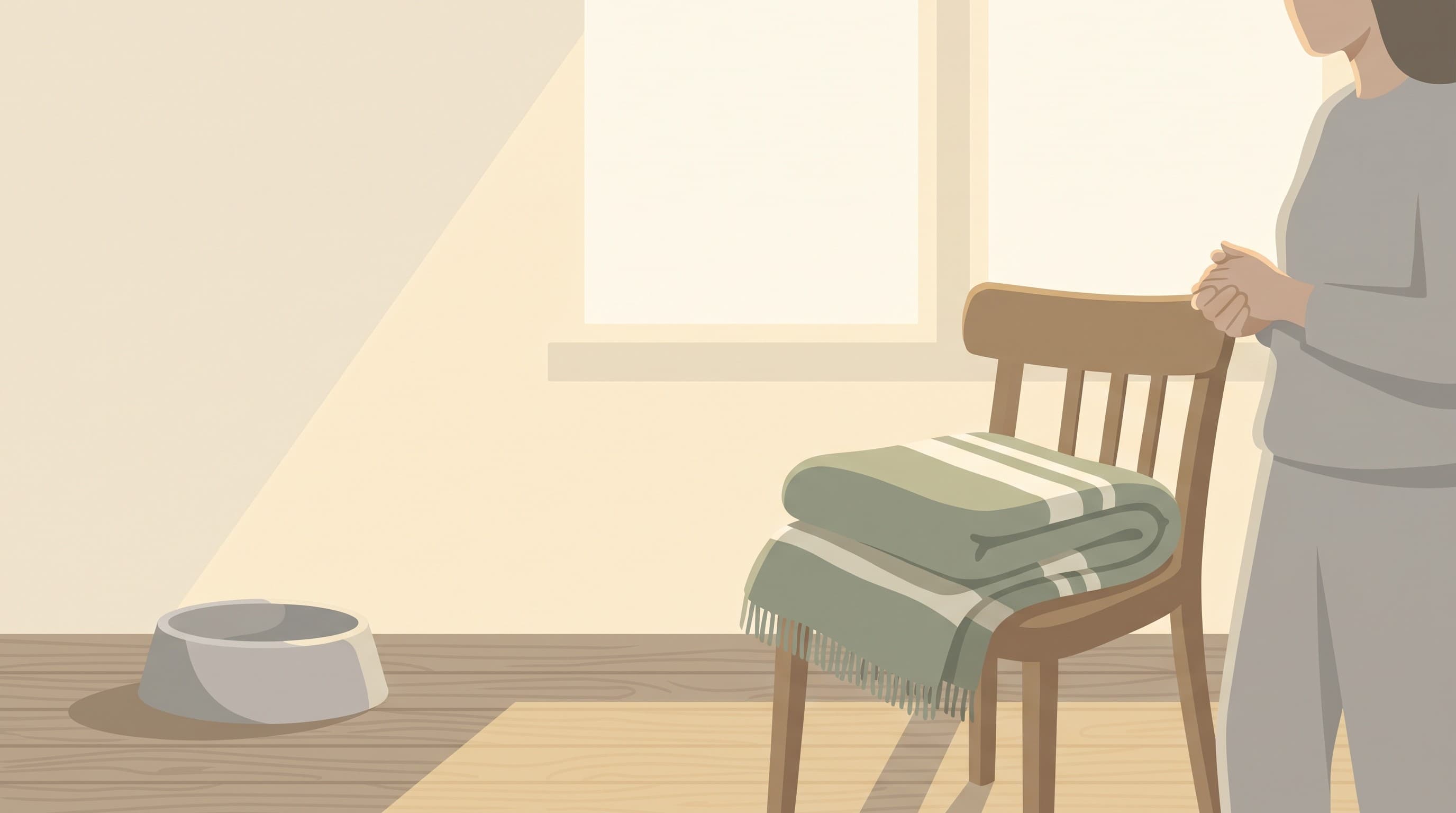
The First Days: The Empty Bowl and the Quiet House
Alastair Greenway
BVM&S MRCVS
The first morning is usually the one that undoes people. Not the appointment, not the long drive home with an empty collar in your pocket, but the ordinary morning after, when your body wakes into a routine that no longer has anything to do. Your hand reaches for the lead before your mind catches up. You listen for the click of claws on the floor, the thud onto the bed, the face that always appeared at the door the second you stirred. Then the silence arrives properly, and the house is the wrong kind of quiet. Maybe that is where you are, hours or days out and not quite believing it. There is nothing you have to do today, but there are a few small, practical mercies you can give your future self when you are able, and a lot of permission you are owed right now.
One number comes before anything else, because the first days and the small hours are exactly when the worst thoughts come. If you are reading this at 3am and the thought has crept in that you cannot go on, please ring Samaritans on 116 123. It is free from any phone, including pay-as-you-go with no credit, at any hour of any day of the year, and you do not have to be in crisis or "suicidal enough" to call: it is for anyone who has been struggling to cope and needs some extra support (Samaritans, n.d.). Losing a companion you built your days around is a real and recognised reason to reach out. The rest of this page will still be here afterwards.
Why the routine keeps ambushing you
The reaching for the lead, the second bowl you almost put down, the hand that drops to the side of the bed where the weight used to be: this is not you losing your grip. Grief is, in part, a process of relearning. Much of what we do around those we love runs on prediction and habit until it is automatic, and grieving requires the brain to update predictions of a loved one's presence given their permanent absence, which takes time and real-world experience, so until that updating happens the old behaviours keep firing (O'Connor & Seeley, 2022). The authors give the human example exactly: "It is a long time before a daughter stops picking up the phone to relay a funny incident to her deceased mother" (O'Connor & Seeley, 2022). For us it is the lead by the door, the 6am feed, the spot on the sofa your eyes go to before you remember. Every one of those small ambushes is the brain catching up, not you breaking.
It helps to know, this early, that grief comes in waves rather than a steady tide: functional and almost flat for an hour, then floored by something tiny, a tuft of fur behind a radiator, a stranger's dog that looks just like yours. That is normal in these first days. The longer arc of those waves, the dates that ambush you months on, has its own guide in grief has no timetable. And if part of what frightens you is that the sheer force of this seems disproportionate, that you should not be this undone over an animal, that fear has a proper answer in is it normal to grieve this much?. The short version: pet grief is real grief, and there is no correct dose of it.
The bowl, the bed, the toys: no rush, no rule
Start with the question almost everyone agonises over and nobody should: what do I do with their things? The bowl still by the back door, the bed in the corner, the basket of toys, the half-used bag of food.
There is no rule, and there is no rush. Whatever you do with their belongings, you do when you are ready, on your own timetable and nobody else's. UK bereavement guidance is consistent that everyone handles grief differently and there is no set process for grieving a pet, and that there is no right way to do any of this: you can do as much or as little as feels right to you (Cats Protection, n.d.; Dogs Trust, n.d.). Some people need the bed gone by nightfall because every glance is a fresh blow; others keep it exactly where it is for weeks because moving it feels like erasing them, or cannot bear to wash the blanket because it still smells of them and that smell is the last of them. Every one is normal, and none is the "right" way, because there is genuinely no right or wrong way to process your emotions and no fixed pace you are meant to keep (Dogs Trust, n.d.). If the bowl staying on the floor for now is what you need, let it stay there. It is not in the way of anything.
When, and only when, you are ready, one gentle option some owners find quietly comforting is to donate unopened food, unused bedding and in-date supplies to a local rescue or pet food bank, so something your pet would have used goes to an animal who needs it. Offer it to yourself as a possibility, never a duty. And when you reach the point of wanting to keep something of them close, a paw print, a lock of fur, a way to mark the love rather than just pack it away, that is its own gentler subject, held in paw prints, fur and keepsakes and ways to honour and remember your pet. It will be there when you are.
The small admin no one warns you about
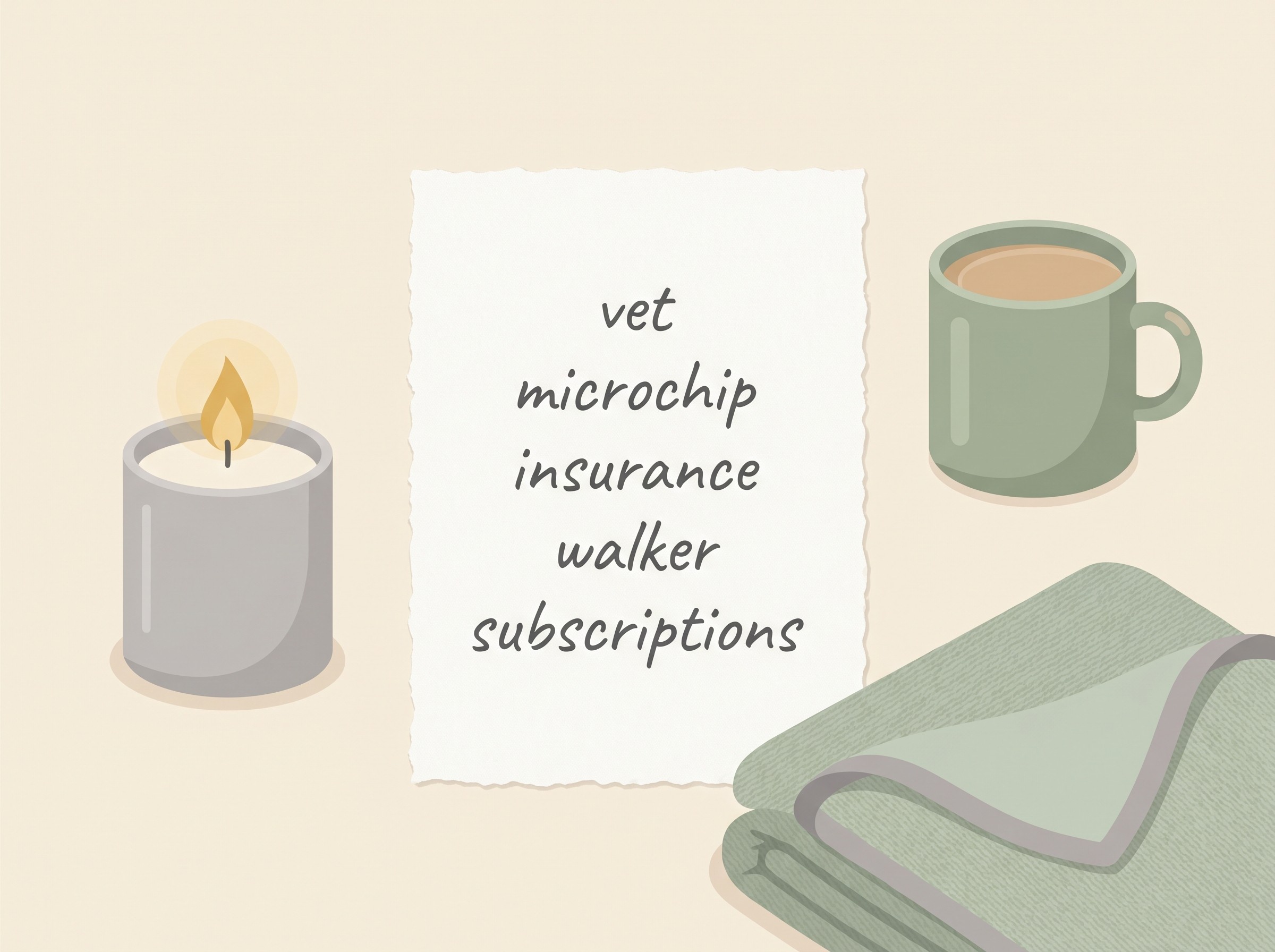
This is the part that catches people off guard: a scatter of practical jobs nobody mentions, each capable of ambushing you weeks later if left undone. Knowing they exist is half the kindness. Almost none of it is urgent, and most has no deadline at all. There is exactly one item with a clock on it, the insurance claim window, which I will flag clearly. Everything else can simply wait until you can face a phone call.
Tell the vet
When you feel able, telephone the practice. If you have not already settled it, they can talk you through what happens to your pet's body and the aftercare options, cremation (individual or communal) or burial, and the likely costs, and can usually arrange a cremation for you. It is worth knowing that deciding any of this in advance can spare you difficult choices at your most distressed, which is why your vet will happily go through the options and prices when you are ready (Cats Protection, n.d.). The full UK picture of all this has its own room in after they have gone: cremation, burial and the options; for now, just hold that there is no wrong choice and no need to rush, and that practices will usually keep ashes for several weeks until you feel able to collect them (Cats Protection, n.d.).
Two smaller things spare real future jolts. Ask them to note on your records that your pet has died, so the system stops sending vaccination boosters, health-check reminders or "we've missed you" prompts: a cheery note that your dog is due his annual jab, arriving three weeks after he died, is a small, avoidable cruelty, and the practice will not think it odd that you asked. And if your pet was on any repeat medication, you can return what is unused to the practice for safe disposal and ask them to stop any scheduled refills. Please do not keep leftover animal medicines at home "just in case" or pass them to another pet: many are dose-specific or species-specific, and human painkillers are dangerous to animals (paracetamol can be fatal to cats, and ibuprofen is toxic to both dogs and cats), so the safe route for anything left over is back to the vet.
Update the microchip database
If your pet was microchipped, it is worth letting the database know, so the record is closed. It is straightforward and usually free, normally done online: with Petlog, for instance, you log in, go to Manage Pets, select your pet and report the pet as deceased, after which the record is deactivated and no longer shows in your account (Petlog, n.d.). Other databases, such as identibase, have an equivalent "mark as passed away" step.
One important note, because misinformation circulates and the last thing you need is a false sense of obligation: there is no legal requirement to notify a microchip database when a pet dies. Microchipping itself is compulsory in the UK (dogs across England, Scotland and Wales since 2016, and cats in England since the law took effect on 10 June 2024), and the law requires registration details to be kept up to date while the animal is alive, but that duty, and the duty to record a change of keeper, is framed around living animals and imposes no death-notification duty on you (Defra/GOV.UK, n.d.; RCVS, n.d.). So treat it as a kind, tidy thing to do, not a legal must. The reason to bother is purely protective: a closed record means that if the chip is later scanned in error, or a renewal prompt is sent, you are not blindsided by a notice about a pet you have lost.
Sort the pet insurance (and do not miss the second part)
There are two things to do with a pet insurance policy, and owners routinely remember the first and miss the second.
The first is to cancel it. When a pet dies the policy comes to an end, but if you pay monthly the direct debit can keep running until you tell the insurer, so contact them (by phone, email or your online account) to confirm the cancellation and make sure you are not charged for cover you no longer need (Confused.com, n.d.).
The second, the one people miss, is that you may still be able to claim. You can usually still submit a claim for treatment your pet received before they died, and for the cost of the euthanasia itself, where the policy covers the underlying condition: most UK policies treat euthanasia not as a separate benefit but as part of the veterinary treatment for a covered illness or injury, so it is claimed much like any other treatment (Confused.com, n.d.; Vet Help Direct, 2024). Two caveats matter. There is often a time limit on submitting, commonly around 90 days but genuinely varying between insurers, so this is the one item on the whole list with a clock on it, worth checking your own policy wording sooner rather than later. And cover has limits: many policies cap what they pay towards euthanasia (a limit of around £100 is common) and most do not cover cremation or aftercare, because that is not a medical procedure, though some include a separate "death benefit" payout (Vet Help Direct, 2024). So check your own policy, claim what you are entitled to, and do not assume you have missed the chance, but do not leave it indefinitely. And if part of what weighs on you is the bill itself, asking about it is completely normal: by one UK insurer's claims data the average cost of euthanasia at a practice is around £143 for a dog and £123 for a cat (Animal Friends, 2024), though your own figure depends on your pet and your practice.
Cancel the bookings and the auto-deliveries
Anyone you pay to care for them, the dog walker, day-care, the sitter, the groomer, the training class, will have a standing booking it helps to cancel, sparing you both an awkward call later and the particular ache of a reminder about a slot your pet will not be keeping. You owe nobody the long story; "Sadly we lost [name] this week, so we'll need to cancel" is enough. Then sweep the subscriptions, the ambush most owners get caught by: repeat food deliveries, flea and worm plans, any pet-shop auto-ship, "health club" or practice-plan payments, and the insurance above. A box of their usual food landing on the doorstep the week after they have gone is a sharp, avoidable blow, and ten minutes now is a real mercy to yourself in a fortnight.
One regional footnote, so nobody worries needlessly: you do not need a dog licence in England, Scotland or Wales, so there is nothing to cancel, as licences were abolished across Great Britain in 1987 (UK Parliament, 1987). They remain a legal requirement only in Northern Ireland, currently £12.50 a year for a standard licence (reduced to £5 if your dog is neutered, you are over 65, or you receive certain benefits), so a Northern Irish owner may wish to let their council know (nidirect, n.d.). Everyone else can ignore this entirely.
Telling people, and weathering what they say
Telling people is its own small ordeal, and you get to choose how, when and whom. A text, a quiet word, a single message to a group chat so you do not have to say it twenty times: all of it is legitimate. You do not have to perform the news, or absorb other people's discomfort on top of your own; there is no right or wrong way to do this, just your own way and your own pace (Dogs Trust, n.d.).
I should warn you gently that some people, even kind ones, will say the wrong thing. "At least it wasn't a person." "Will you get another?" "It was only a cat." Most of the time this reflects their own awkwardness around death, not a true measure of what you have lost, and it can sting badly all the same when you are raw. If a careless comment winds you, you are not being over-sensitive: being told your grief does not count is its own particular wound. The fuller treatment of it, and the deeper unfairness of grief others refuse to recognise, is owned by it was just a pet: disenfranchised grief. For now: you are allowed to step away from the people who make it harder, and to lean on the ones who simply say "I'm so sorry, I know how much you loved them."
If there are children in the house, their grief has its own shape and needs more than a paragraph here. How to tell them, what they understand at different ages, and the language that helps rather than frightens, is all in helping children after losing a pet. And if you have another pet searching the house, calling, going off their food or shadowing you more than usual, that is real, and there is specific guidance on helping the companion left behind in do other pets grieve?.
Going back to work, and getting through ordinary life
A hard truth, said plainly so it does not blindside you: in the UK there is no legal right to time off for the death of a pet. The legal right to bereavement leave applies to the death of a dependant, and parental bereavement leave to the loss of a child, but a pet falls outside those, in the category of a non-dependant for which Acas states there is "no legal right to time off", while adding that employers "should be compassionate towards a person's individual situation" (Acas, n.d.). In practice many do offer discretionary compassionate leave, and where they do not, annual leave, unpaid leave or, if grief has genuinely floored you, sick leave may be options (CIPHR, n.d.). I tell you this not to add to the weight but so you are not shocked, and so you know that asking for a little understanding is perfectly reasonable.
And then there is going back at all. Some people need to return to routine quickly and find the structure holds them up; others cannot face it for days. Both are right, and both, as we have seen, are grief: returning to ordinary life is the restoration half of that healthy oscillation, not a betrayal or "moving on too fast", and needing a day where you sit with the empty bed and let it hurt is the loss half, not weakness (Stroebe & Schut, 1999). So let yourself feel it when it comes, and function when you can, often on the same day.
The bowl can stay on the floor
A few things are worth carrying out of this first week. The bowl can stay on the floor as long as you need it to; nobody is timing you, and there is no day by which their things must be gone. The small jobs, the vet, the microchip, the subscriptions, will wait until you can face them, all but the insurance claim window, the one worth not leaving forever. The waves will keep coming, and they are supposed to, this early. And when the house is this quiet, there are people who will pick up the phone, who do this every day, and who will not think your grief is foolish.
In the UK, Blue Cross Pet Loss Support (the Pet Bereavement Support Service) offers free, confidential support by phone, email or webchat from people trained specifically in pet loss, on freephone 0800 096 6606, open 8.30am to 8.30pm every day (Blue Cross, n.d.). The Ralph Site is a free, not-for-profit pet-loss website set up in 2011 by a veterinary surgeon after the loss of his own cat, with resources, online memorials and a community of people who understand exactly what you are feeling (The Ralph Site, n.d.). If you have lost a cat, Cats Protection's Paws to Listen runs a free grief line of trained volunteer listeners, on 0800 024 94 94, Monday to Friday, 9am to 5pm (Cats Protection, n.d.). And Dogs Trust offers its own bereavement support, with the decent guiding line that you should grieve in your own way and at your own pace (Dogs Trust, n.d.). For the fuller picture, including how to tell when grief might need professional help, our hub on where to turn when grief is overwhelming gathers it all in one place.
And keep closest the number from the top of this page: if at any point the grief tips into "I cannot go on", ring Samaritans on 116 123, free, any phone, day or night (Samaritans, n.d.). The morning after is the worst of it, and it does not stay this loud forever.
References
- Acas. (n.d.). Time off work for bereavement.
- Animal Friends. (2024). Costs to consider before the passing of your pet.
- Blue Cross. (n.d.). Pet Loss Support (Pet Bereavement Support Service).
- Cats Protection. (n.d.). Coping with the loss of a cat.
- CIPHR. (n.d.). Bereavement and compassionate leave: a guide for HR and employees.
- Confused.com. (n.d.). What to do when your pet dies.
- Department for Environment, Food & Rural Affairs (Defra) / GOV.UK. (n.d.). Get your dog or cat microchipped.
- Dogs Trust. (n.d.). Coping with the loss of your dog (bereavement support).
- nidirect. (n.d.). Dog licensing.
- O'Connor, M.-F., & Seeley, S. H. (2022). Grieving as a form of learning: Insights from neuroscience applied to grief and loss. Current Opinion in Psychology, 43, 317-322.
- Petlog. (n.d.). Help centre (reporting a pet as deceased).
- Royal College of Veterinary Surgeons (RCVS). (n.d.). Small animals and microchips (supporting guidance).
- Samaritans. (n.d.). Contact a Samaritan.
- Stroebe, M., & Schut, H. (1999). The dual process model of coping with bereavement: rationale and description. Death Studies, 23(3), 197-224.
- The Ralph Site. (n.d.). Support for pet loss.
- UK Parliament (Hansard). (1987, 14 December). Dog Licence. House of Commons.
- Vet Help Direct. (2024). Does pet insurance cover euthanasia and cremation?