

Do Other Pets Grieve? Helping the Companion Left Behind
Alastair Greenway
BVM&S MRCVS
There is a second animal in the house, and they have gone quiet. Maybe they are off their food, sleeping in odd places, or padding from room to room and pausing at a door as if waiting for someone. Maybe they have curled up small and will not be coaxed out, or have turned into your shadow. Whatever shape it has taken, you are watching the one left behind and wondering whether they understand what has happened, whether they are sad, and whether there is anything you can do.
Let me answer the spirit of your question straight away, then be candid about the science. Yes: the companion left behind is very often deeply affected by the death of an animal they lived with. This is the common, documented experience, not your imagination, and not you projecting your own grief onto a creature who feels nothing. Where I have to be careful is the word "grieve" itself. What the research consistently finds is that surviving pets change their behaviour after a companion dies, in ways that look very much like grief. Whether they understand death as we do, and feel mourning as an inner experience, is something no study has proved, and the people who ran the studies say so plainly (Uccheddu et al., 2022). I will come back to why that candour is freeing rather than cold. First, what we actually see.
Your other pet has changed, and you are not imagining it
The strongest reassurance I can give you is that this is well documented across two species and two continents, and the studies all point the same way. The largest dog survey asked 426 Italian owners who had lost one of two or more dogs how the survivor behaved, and around 86% reported negative behavioural changes in the dog left behind (Uccheddu et al., 2022). An Australia and New Zealand survey of 279 owners (159 dogs, 152 cats) found behaviour changed in the great majority of both species (Walker, Waran & Phillips, 2016). And a 2024 survey of 412 cat caregivers found that after a household companion died the surviving cats, on average, sought more attention, spent more time alone, appeared to look for the animal who had gone, ate less and slept more (Greene & Vonk, 2024). Three independent groups, two species, owners on opposite sides of the world, all describing the same picture. So if your pet has not been themselves since the loss, you are seeing something real that most households in this situation see too.
In dogs, the commonest changes are the human-recognisable ones: more attention-seeking (around two thirds of owners), playing less, reduced activity, sleeping more, becoming more fearful, eating less, and whining or barking more; many also seek out the favourite spot the dog who died used to occupy (Uccheddu et al., 2022; Walker, Waran & Phillips, 2016). To the owner, a grieving dog often reads as flat, needy, off their food and quietly lost.
Cats deserve their own paragraph, because their grief is quieter and easier to miss, and an owner can wrongly conclude their cat "doesn't care" when in fact the cat is doing what cats do, which is withdraw rather than cling. The surveys found most surviving cats became more affectionate, some clingy, many sought the dead companion's favourite spot, and a striking number changed their voice, calling more often or more loudly; others hid, searched the places the companion liked, ate less and played less (Walker, Waran & Phillips, 2016; Greene & Vonk, 2024). Cats Protection adds, importantly, that some cats show no signs at all, which is also normal and not a sign of indifference (Cats Protection, n.d.).
The searching is the hardest part to watch
Of all of it, one behaviour seems to land hardest on owners. Surviving pets very often look for the one who has gone. They return to the bed or windowsill the companion used, wait at the door, go to the spot where two bowls used to sit, sniff and circle the places the other slept. In the Australia and New Zealand study, around a third of dogs and cats sought out the deceased animal's favourite place, and most of the pets present with the body sniffed and investigated it (Walker, Waran & Phillips, 2016).
Let me be straight about why this one is so painful: the searching looks like hope. It looks like an animal still expecting their friend to come back, and watching that while you know they are not coming back is its own kind of awful. I cannot tell you what your pet is thinking, and I will not pretend to. What I can tell you is that this behaviour, in almost every case, settles over the following weeks. Hold on to that, without holding me to a date.
What the science actually shows: behaviour change, not proven grief, and it may be partly about you
Every group of researchers who has measured this is cautious about calling it grief, for good reasons. The dog study, despite its title, states in its own text that "even if we recognise the importance of these results, we still cannot confirm it was grief", warns that owners "may have a tendency to over-report" grief in their dogs, and suggests the survivor may be responding to the loss of a daily companion "more than their death per se" (Uccheddu et al., 2022). The Australia and New Zealand authors note the changes "may be a reflection of the grief that the owner is experiencing", and call for research "independent of owner interpretation" before anyone concludes this is mourning rather than an animal adjusting to a changed routine (Walker, Waran & Phillips, 2016). The 2024 cat study frames its findings the same way, as behaviour "consistent with what we would expect for grief" rather than proof of it, and its lead author has been candid that an owner may be reading their own sadness into the cat, or that the cat may even be responding to the grieving human (Greene & Vonk, 2024). The UK charities say it plainly: a surviving pet's behaviour can change because they are missing their friend, but also because they are picking up on their owner's sadness, or simply reacting to the upheaval in their routine (Dogs Trust, n.d.; Blue Cross, n.d.).
I know how that might land at first, as if I have just taken your pet's feelings away. I have not, and the truth here is genuinely kind. You do not have to settle the question of whether your pet "understands death" in order to do exactly the right thing for them. Whatever the precise mix, missing their friend, sensing your grief, or losing the shape of their day, the conclusion is identical: your pet is unsettled, and what an unsettled animal needs is steadiness, routine and gentle company. And there is a quiet gift tucked inside the emotional-contagion finding: if part of what your pet feels is your own sadness reflected back, then being gentle with yourself, and letting yourself grieve, is not separate from helping your pet. Your grief matters in its own right, which is the subject of is it normal to grieve this much, and looking after it turns out to be one of the things you can do for the animal still here.
How long it tends to last
You will want a timeline, and I can give you ranges as long as you do not read them as a countdown. In the dog study, owners reported the changes lasting less than two months in roughly three in ten dogs, two to six months in about another third, and longer than six months in around a quarter (Uccheddu et al., 2022). In the Australia and New Zealand survey, the typical duration was under six months for both species (Walker, Waran & Phillips, 2016). So the realistic version is this: most surviving pets settle within a few weeks to a few months, a minority take longer, and there is no right answer for how long it "should" take. A pet still struggling after a couple of months is within the documented range, though it is a reason to keep your vet in the loop, for reasons I come to below.
How to help: keep the routine steady, and be present without smothering
The most consistent advice across every source I trust is to hold the daily routine as close to normal as you can: same mealtimes, same walks, same bedtime, same food (this is not the moment to change the diet) (Dogs Trust, n.d.; Cats Protection, n.d.; VCA, n.d.). A destabilised animal is reassured by predictability more than anything else. One detail surprises people: do not rush to strip away the bedding and spots that belonged to the pet who died. It is natural to clear the reminders to spare yourself, but for the survivor, having familiar scents suddenly vanish on top of the loss can add to the upheaval and even cause panic (Dogs Trust, n.d.). Leaving the old bed where it is for a while does no harm. (When and how you deal with your own pet's bowl and toys, for your sake, is a different and very human question, held gently in the first days: the empty bowl and the quiet house.)
On attention, the internet's standard advice, "just give them more cuddles", is well meant but too simple. Calm company and a little more quality time genuinely help: gentle play, quiet fuss, a reward-based activity they enjoy (VCA, n.d.; Cats Protection, n.d.). But two cautions matter. For cats, Cats Protection warns against suddenly spending much more time than usual with a grieving cat, because "an increase in attention can be stressful and intense" on top of a loss they are already coping with (Cats Protection, n.d.). And as a general principle, if you lavish dramatic comfort on anxious behaviour the moment it appears, you can, without meaning to, reinforce the distress you were trying to soothe. So aim for steadiness rather than intensity: be present and reassuring, but try not to make a huge fuss of every whine or search, and try not to lurch between smothering and absence. For a flat, withdrawn pet, gentle engagement helps rebuild ordinary life, tempting a poor appetite with a favourite food, short positive play, a good sniffy walk, a little low-key enrichment (VCA, n.d.; Dogs Trust, n.d.). The aim is not to distract them out of a feeling, but to coax normal activity back, one ordinary thing at a time.
Should you let the survivor see or sniff the body?
This is the question owners agonise over, and I will be straight: the evidence is genuinely mixed, and nobody can promise you it helps. The Australia and New Zealand study found no difference in how survivors did afterwards between the animals that saw their companion's body and those that did not, although most who did see it sniffed and investigated it (Walker, Waran & Phillips, 2016). Cats Protection states plainly there are "no studies to suggest that this aids the grieving process", while allowing it if you are comfortable and there is no infection risk (Cats Protection, n.d.). Some veterinary sources suggest a brief, supervised goodbye may help a pet register the absence and reduce searching, but that is reasoned opinion, not proof (VCA, n.d.).
So here is how I would hold it. If circumstances allow and you would like to, for example after a planned home euthanasia where the body can stay a little while, you may let your other pet come close. Some owners feel it helps, and it rarely seems to harm. But the evidence does not show it changes the outcome, so there is no need to engineer it, and no need at all to feel guilty if it was not possible, whether the death was sudden, happened at the clinic, or you simply did not think of it. The one firm caveat is practical: not if your pet died of something contagious. Beyond that, this is a choice, never a duty.
Do not assume it is grief
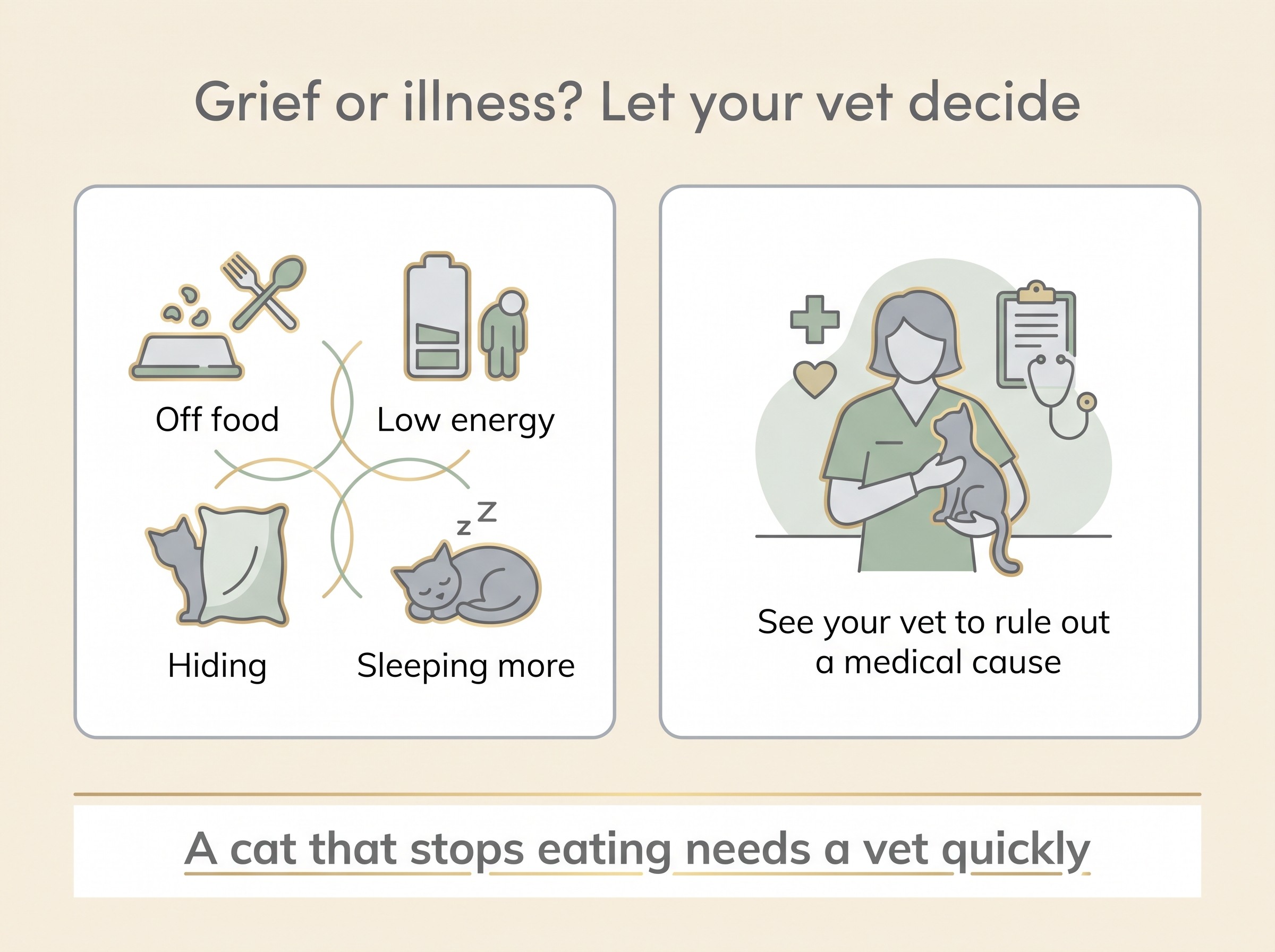
Now the clinical safety message. Do not assume that a change in your surviving pet is grief. A pet who goes off their food, becomes lethargic, starts hiding, loses weight or changes markedly needs to be seen by a vet to rule out illness, because from the outside, grief and serious disease look identical.
This is not overcaution. Appetite loss, low energy, hiding, weight loss and digestive upset are exactly the signs of a long list of treatable and serious conditions: kidney disease, heart disease, liver disease, an overactive thyroid, cancer, or pain somewhere (Dogs Trust, n.d.; VCA, n.d.). And a grieving household is exactly where a sick animal slips through the net, because everyone is sad, the quietness gets read as mourning, and nobody books the appointment. The charities are explicit that any sudden change should be checked, because it "could also indicate an underlying medical condition" (Dogs Trust, n.d.; Blue Cross, n.d.). So please do not wait it out. Let your vet examine them, for two reasons at once: to catch and treat anything physical, and to give you the peace of mind that what you are seeing really is grief and not something that needs fixing.
A cat that stops eating cannot wait
One part of that warning needs its own line, because of timing, and it applies to cats in particular. If your cat stops eating after the loss, do not treat it as grief that will pass. When a cat goes without food for even a couple of days, especially an overweight cat, the liver can be overwhelmed by the fat the body mobilises, and the cat can develop hepatic lipidosis, or fatty liver, a condition that is potentially fatal if not treated promptly (Cornell Feline Health Center, n.d.). Blue Cross gives owners the same rule in plain terms: if a cat goes off its food for two or more days, call the vet urgently because of the risk of liver damage (Blue Cross, n.d.). As one veterinary source puts it bluntly, cats and small dogs "cannot afford to miss meals" (VCA, n.d.). The rule is simple: if your cat will not eat for more than about 24 hours after a loss, call your vet. Do not assume it is mourning, and do not give it a few more days to see if appetite returns. This is the one place where I would ask you to be quietly urgent, and it is often a treatable situation when caught early, which is exactly why the timing matters.
Does the survivor need another pet? Not necessarily, and not yet
When the house has gone quiet, the instinct to fill the silence is powerful, and many owners reach quickly for a new animal to "fix" the survivor's loneliness. On the survivor's behalf, I would gently slow you down. A new pet might not help, and can make things harder in the short term, because your surviving animal is already destabilised and a stranger arriving is one more upheaval on top of the loss (Dogs Trust, n.d.; Blue Cross, n.d.). For cats this matters especially, because cats are a largely solitary species and many are perfectly content as the only cat in the home; a cat strongly bonded to the companion they lost will not necessarily welcome, and may resent, a new stranger (Cats Protection, n.d.; VCA, n.d.). If a new companion is right, it is usually right later, once the survivor has settled, and as a decision for the whole household rather than grief first aid.
That is the survivor's side of it. There is a much bigger, more human version of this question: your own readiness, the fear that getting another pet would be "replacing" the one you lost or somehow disloyal, the worry of measuring a newcomer against a ghost. That deserves more room than I can give it here, so it has its own candid piece in are we ready for another pet. When your question shifts from "does my survivor need a friend" to "are we ready, and would it be a betrayal", that is the page to read.
They are grieving the shape of their days
It helps to understand why even a pet who seemed merely tolerant of the other can still come apart. Animals who share a home share more than a roof: their own bonds, their own pecking order, their own habits, who sleeps where, who eats first, who starts the play. When one dies, the survivor loses not only a companion but the entire shape of their ordinary day. The research backs this up in a way I find quietly moving. In the dog study, it was the closeness of the bond that mattered: a friendly or parental relationship between the two dogs predicted more change in the survivor, while the sheer length of time they had lived together, interestingly, did not (Uccheddu et al., 2022). The 2024 cat study found that the quality of the relationship, how long the cats had lived together, and the time they spent doing things together all predicted how much the survivor changed (Greene & Vonk, 2024). Either way, the lesson is the same: it is the shared life that counts. So if your two never seemed especially devoted, only for the one left behind to be utterly lost now, that is not a contradiction. They shared a life, whatever it looked like from the outside, and a shared life is a hard thing to lose.
You and the animal who is left are grieving together
You are not separate in this. You are grieving, and watching your pet grieve doubles the weight. Be as gentle with yourself as you are being with them, and remember the thread running through all the science here: animals take their cue from us, so tending your own grief is part of helping your pet, not a distraction from it (Uccheddu et al., 2022; Walker, Waran & Phillips, 2016). If your own grief is the part that frightens you, is it normal to grieve this much was written for you, and if it is proving long rather than passing, grief has no timetable: waves, triggers and anniversaries sits with that gently.
So you do not need to settle the philosophy of whether your pet understands death to do right by them tonight. Keep the routine steady, leave the old bed where it is a while longer, be present without smothering, tempt the appetite back with small ordinary pleasures, and get a marked or worrying change checked by your vet rather than waiting on it. That is the kind thing under every interpretation of what your pet is feeling. And if the grief, theirs or your own, feels like more than you can carry alone, it is not making a fuss to ask for help. In the UK, Blue Cross Pet Loss Support, also known as the Pet Bereavement Support Service and running since 1994, offers free, confidential support by phone, email or webchat from people trained specifically in pet loss, on the freephone line 0800 096 6606, open 8.30am to 8.30pm every day (Blue Cross, n.d.). The Ralph Site is a free, not-for-profit pet-loss website founded in 2011 by a veterinary surgeon after the loss of his own cat, with guidance, online memorials and a community of people who understand (The Ralph Site, n.d.). If you have lost a cat, Cats Protection's Paws to Listen runs a free, confidential grief line staffed by trained volunteer listeners, a sympathetic ear rather than formal counselling, on 0800 024 94 94, Monday to Friday, 9am to 5pm, excluding bank holidays (Cats Protection, n.d.). And Dogs Trust offers its own bereavement support, with the decent guiding principle that you should grieve in your own way and at your own pace (Dogs Trust, n.d.). For more, including how to know when grief might need professional help, our hub on where to turn when grief is overwhelming gathers it together. And if at any point the weight tips into "I cannot go on", please ring Samaritans on 116 123, free from any phone, day or night; you do not have to be in crisis to call, only hurting.
You are caring for a grieving animal while grieving yourself, one of the harder things an owner is asked to do, and you are doing it well simply by sitting here trying to understand them. The one left behind very often finds their feet again, settling back into the rhythm of the house over the coming weeks, and so, in time, will you.
References
- Blue Cross. (n.d.). How pets cope with loss / How to help a grieving dog.
- Blue Cross. (n.d.). Pet Loss Support (Pet Bereavement Support Service).
- Cats Protection. (n.d.). Grief in surviving pets.
- Cats Protection. (n.d.). Paws to Listen grief support service.
- Cornell University College of Veterinary Medicine, Cornell Feline Health Center. (n.d.). Hepatic Lipidosis.
- Dogs Trust. (n.d.). Helping a dog cope with the loss of another pet (dog grief).
- Dogs Trust. (n.d.). Coping with the loss of your dog (bereavement support).
- Greene, B., & Vonk, J. (2024). Is companion animal loss cat-astrophic? Responses of domestic cats to the loss of another companion animal. Applied Animal Behaviour Science, 277, 106355.
- Samaritans. (n.d.). Contact a Samaritan.
- The Ralph Site. (n.d.). Support for pet loss.
- Uccheddu, S., Ronconi, L., Albertini, M., Coren, S., Da Graça Pereira, G., De Cataldo, L., Haverbeke, A., Mills, D. S., Pierantoni, L., Riemer, S., Testoni, I., & Pirrone, F. (2022). Domestic dogs (Canis familiaris) grieve over the loss of a conspecific. Scientific Reports, 12, 1920.
- VCA Animal Hospitals. (n.d.). Helping Your Grieving Pet.
- Walker, J. K., Waran, N. K., & Phillips, C. J. C. (2016). Owners' perceptions of their animal's behavioural response to the loss of an animal companion. Animals, 6(11), 68.