

Are We Ready for Another Pet?
Alastair Greenway
BVM&S MRCVS
This question usually arrives carrying two opposite weights at once. Some owners catch themselves, weeks or months after losing a dog or cat, glancing at a rescue page, and the wanting is followed straight away by a hot wave of shame, as though they had been caught betraying someone. Others sit on the far side of it: everyone around them keeps gently suggesting that a new pet would do them good, and the thought makes them want to close the door, because they cannot imagine ever loving another animal the way they loved the one who is gone. Plenty of people feel both of those things on the same day.
Whatever you are feeling about this, it is not the wrong thing to feel. The reader who is ready to love again soon and the reader who suspects they never will are both, equally, doing this right. There is no correct answer here and no schedule you are failing. None of what follows will tell you what to do. It is only here to lift the two weights, the betrayal you are afraid of and the timeline you think you must keep to, and to make the choice feel like yours again rather than something you are being judged on.
One thing first, because grief and the small hours so often arrive together. If at any point what you are carrying tips over into "I cannot do this, I cannot go on", please ring Samaritans now, on 116 123. It is free from any phone, day or night, every day of the year, and you do not have to be in crisis, or "suicidal enough", to call (Samaritans, n.d.). The loss of an animal you loved is a real and recognised reason to reach out. Most of what follows is gentle and forward-looking, but I would rather put that number in your hand now than tuck it away at the foot of the page.
Grief easing and being ready are not the same thing
Grief easing and being ready for another pet are two different things, and people fuse them constantly, to their own cost.
Every reputable source lands in the same place on timing, which is that there is no rule. The pet-loss specialists at Lap of Love put it plainly: the decision is "highly personal", and there are "no rules regarding getting a new pet" (Lap of Love, n.d.). The UK charities say much the same from the other side. The PDSA advises against rushing, because moving too fast "can also delay the healing process or even trigger other confusing emotions", and suggests waiting "until the whole family is ready and excited" (PDSA, n.d.); Dogs Trust echoes it, that the timing "has to be the right time for your whole family" (Dogs Trust, n.d.). Hold both halves of that, though, because "do not rush" is not the same as "you must wait a respectable length of time". Some people are ready within weeks. Some need months or years. Some, having loved one animal completely, choose never to share their life with another, and that is a whole and honourable answer too. Not one of those is wrong.
You do not have to have "finished" grieving to be ready, partly because finishing grieving is not really a thing that happens. Grief does not end so much as change shape. The UK bereavement charities are explicit about this: there is "no timeline for how long grief lasts", and the goal is not to "move on" but to "find a way to live with" the loss, so that gradually you have "more good days and fewer bad days" (Sue Ryder, n.d.). There is, as Cruse Bereavement Support consistently puts it, no right or wrong way to grieve and no set timetable for any of it (Cruse Bereavement Support, n.d.). So if you are waiting to stop missing them before you let yourself consider another animal, you may be waiting forever, and frightening yourself for nothing. Readiness does not look like the absence of sadness. You will very likely always miss them. Readiness is something quieter and quite separate, and we will come to what it actually feels like.
It can help to know the rough shape grief tends to take, not as a deadline but as gentle company. In a study of 174 bereaved dog and cat owners, 85.7% reported at least one grief symptom in the early days, falling to 35.1% at six months and 22.4% at a year, with the severity and length of grief "significantly correlated with the degree of attachment to the deceased pet" (Wrobel & Dye, 2003). That says two kind things at once. For most people the rawness genuinely does soften across the first year, which can be a quiet, real hope if you cannot currently imagine feeling differently. And a meaningful number are still carrying grief at a year, which is entirely normal, and the deeper the bond the longer it tends to take. If this animal was woven through every hour of your day, of course readiness is slower to arrive. So do not use a calendar to decide you "should" be ready by now, or to decide you have left it "too long". Neither figure exists. (If your real worry is that your grief itself is lasting too long or hitting too hard, that question is held with care in grief has no timetable and in is it normal to grieve this much?.)
The betrayal you are afraid of is actually a sign of love
Almost everyone who reaches this page feels some version of the same fear and assumes they are alone in it. The fear is that wanting another pet, or worse, enjoying one, would be a betrayal. That you would be cheating on the one who died. Editing them out. Proving the love was shallow after all, easily transferred, replaceable. If you have felt a flush of guilt at the first flicker of wanting, that is what this is, and you are in very ordinary company.
Loving again is not subtraction. The dominant framework in modern grief theory is called continuing bonds, and its central insight is that the relationship with the one you lost does not have to be severed for you to heal or to form new attachments; the bond simply changes shape and is carried forward, and keeping it does not block new love (Klass, Silverman & Nickman, 1996). Applied to pets, a systematic review of 35 studies found exactly this: owners commonly maintain a bond with a pet who has died, and new attachments can even "mitigate the effects of grieving by decreasing feelings of loneliness" (Hughes & Lewis Harkin, 2022). The love you have for the animal who is gone is not a finite cup that a new pet would drink from. As one emergency vet writes about adopting after a loss, it does not "disrespect the relationship, or memory, of a previous pet", because "the love is separate and has its own space"; your heart, she says, "just gets bigger" (Hoggan, 2023).
It is also worth knowing where a lot of this guilt is manufactured, because seeing the machinery helps you stop trusting it. Pet loss is what researchers call a disenfranchised grief: a grief that society quietly minimises, gives no rituals for, offers no bereavement leave for, and does not quite take seriously (Cordaro, 2012). When the world will not fully grant that your grief is real, it leaves you second-guessing all of your own feelings, including, cruelly, the feeling of wanting to love again. (That wider hurt, the "it was just a dog" of it all, is held in full in grief that others do not understand.) So let me give you the permission the world tends to withhold: wanting another pet does not mean you loved the last one any less. If anything it usually means the opposite. It means sharing your life with an animal was so good, so much a part of who you are, that you cannot imagine living any other way. That is not betrayal. That is the loudest possible compliment to the one who taught you it.
You cannot replace them, but you can love again
The American Veterinary Medical Association puts it almost word for word: you "can never replace the pet you lost", but "you can find another to share your life with" (AVMA, n.d.). The whole question turns on that distinction.
I like the way the veterinarian Dr Sarah Hoggan draws the line. You replace things, she says, like paper towels. You do not replace individuals. "Your pet was someone you loved; not something you ran out of" (Hoggan, 2023). A new animal is not a continuation of the old one and is not a stand-in for them. It is a separate relationship, in its own space, and it takes nothing away from the first. So the question that has been quietly torturing you, "can I really replace them?", is the wrong question, and the relief is that it was never the real one. You cannot replace them, and you would not want to. The real question, the gentler one, is this: is there room in my life to love another animal, as themselves?
One real caution: do not ask a new pet to fill a hole
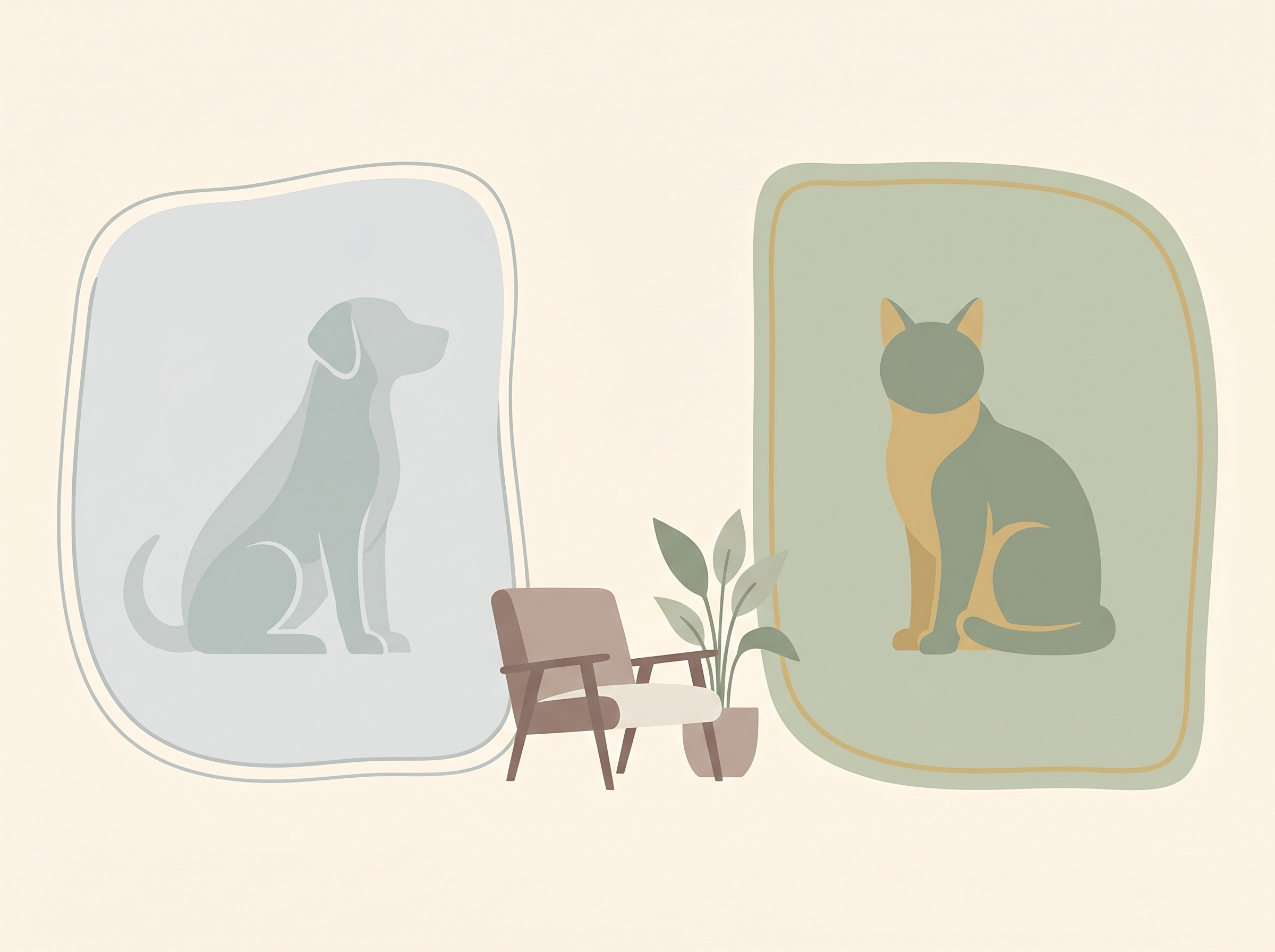
There are two ways a new pet can be set up to fail, and both come from love, not carelessness.
The first is bringing an animal in mainly to stop the pain. It is the most understandable impulse in the world, and it is also where the evidence is most sober. That systematic review found "no conclusive evidence" that getting a new pet reduces grief rather than simply delaying its onset (Hughes & Lewis Harkin, 2022). And the pet-loss specialists are clear that acquiring an animal "to try to immediately fill the void" risks "projecting negative feelings onto the new companion" (Lap of Love, n.d.). A new pet brought home as grief first aid lands in an unfair position: it is being asked to be a cure rather than allowed to be a creature. Grief counsellors who work with this every day describe the same trap from clinical experience, noting that bringing a new pet in very soon, one counsellor's example was three weeks, can crowd out the grieving you still need to do and actually make it harder to bond with the newcomer (Tousley, 2024).
The second is subtler, and it is about measuring the new one against the one you lost. The deepest evidence here comes, carefully, from the human "replacement child" literature, which documented that when a new individual is brought in specifically to substitute for one who died, and is quietly burdened with the lost one's qualities, it can harm both the relationship and the newcomer, who can never satisfy a longing meant for someone else (Cain & Cain, 1964). I offer that only as a careful parallel and want to be completely clear that a pet is not a child and the comparison is not about the size of the grief. It is purely about the psychology of replacing: a new individual asked to be a stand-in is set up to disappoint. The transferable truth is gentle and freeing. A new animal deserves to be themselves.
In practice, for the owners I talk to, this comes down to a few quiet things. Try not to choose the same breed and the same colour in the hope of getting "them" back, because it tends to be a disappointment and it is unfair to the new animal, who will be a completely different soul behind a familiar coat (AKC, 2021). Let the new pet have their own name where that helps you see them clearly, and expect, and try to welcome, an entirely different personality, because you will get one regardless (Lap of Love, n.d.). The goal is not to recreate the one you lost. It is to honour them by loving again, in a new shape.
What a new pet can and cannot do
A new pet can, in time, do a great deal. It can offer real companionship, ease the particular loneliness of a house that has gone quiet, and give grief somewhere kinder to go than round and round inside you. Many owners genuinely do find that opening their heart again helps, and that is not wishful thinking, it is in the research: new attachments can decrease feelings of loneliness and soften the edges of grieving (Hughes & Lewis Harkin, 2022). If the thought gives you even a flicker of warmth, you are allowed to follow it.
What a new pet cannot do, no matter how much you love it, is erase the grief, undo the loss, or be the one who died. A new pet is not a patch over a hole. It is a new and separate good thing, and it works best, for you and for them, when it is allowed to be exactly that, and nothing it was never meant to be.
Signs you may be ready, offered as questions, not a test
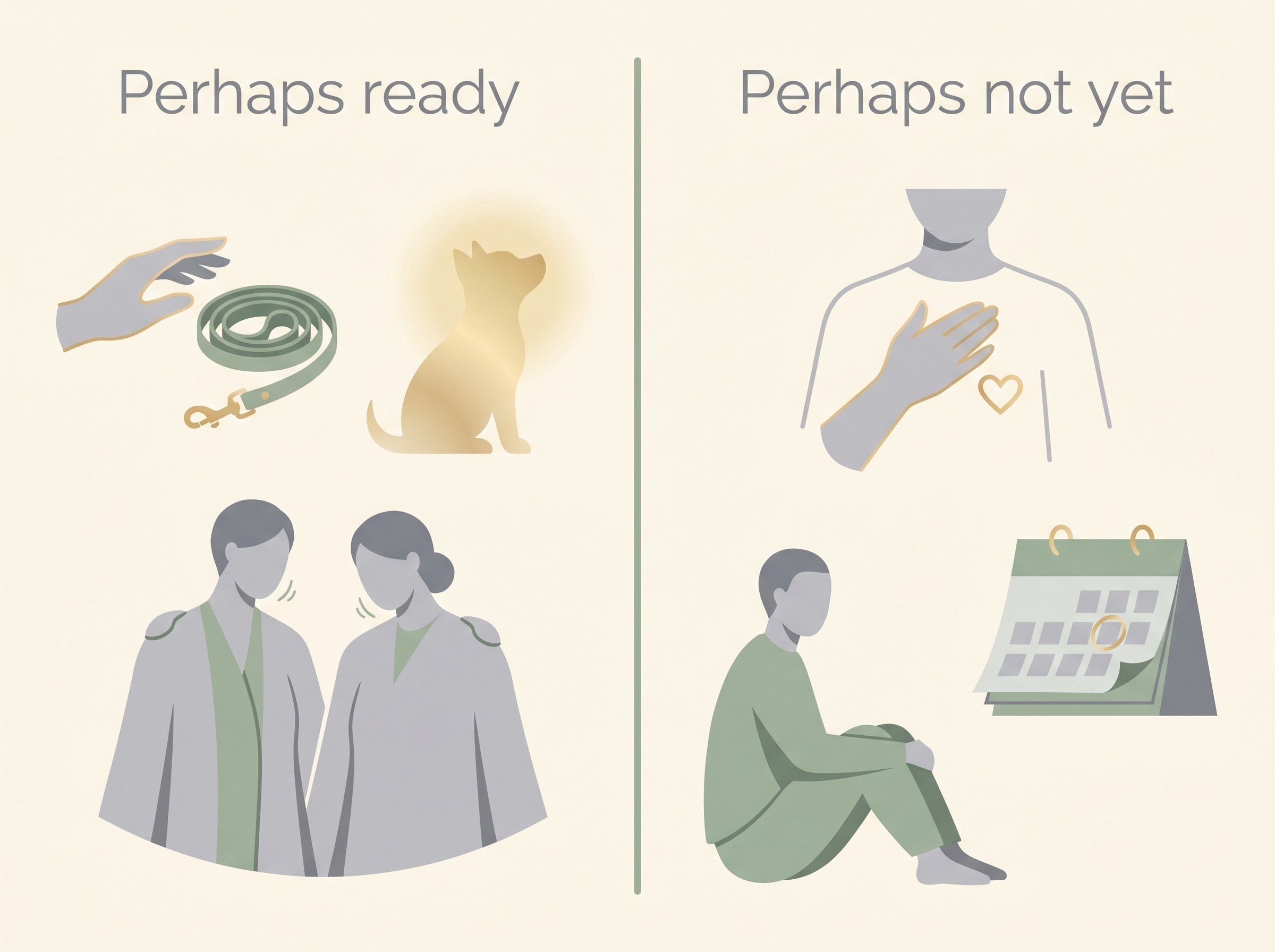
There is no readiness score to pass, and please do not treat what follows as one. These are gentle questions to sit with, not boxes to tick, and you can be a clear "yes" on some and a soft "not yet" on others and still be perfectly fine. You may be moving toward readiness when:
- You can think about the pet you lost and feel the warmth and the ache together, rather than only the ache. The specialists describe this as "a sense of peace" arriving alongside the sadness, the point at which you can hold your memories without being flattened by guilt (Lap of Love, n.d.).
- Your thoughts have started, on their own, to turn forwards rather than only back. You notice yourself imagining the life you could build with another animal: the walks, the daft games, the things you would teach them. Grief specialists describe this turn toward a future with a new companion as one of the gentler signals that readiness is arriving (AKC, 2021).
- You can notice another dog in the park, or a cat on a windowsill, with something other than pure pain. Curiosity, even a small smile, where there used to be only a flinch.
- Where it matters, the feeling is shared. Not just one person in the household longing while another is still raw.
What I want to underline is what readiness does not require. It does not require that you have stopped missing them, and it does not arrive as a magic certainty. I will not tell you that you will simply "know", because that lovely-sounding phrase leaves people who feel unsure convinced something is wrong with them. There may be no thunderclap. There may just be a slow, quiet turning, and a day you notice the door of your heart has drifted open a little. As one grief specialist puts it, "there's nothing wrong with getting a new pet right away, or waiting for months or years to love again" (AKC, 2021). Both ends of that are healthy.
Signs it may be too soon, held the same gentle way
These are not a verdict either. Not one of them is a permanent "no". Each is only a possible "perhaps not yet", offered as information to weigh, never a rule to obey. It may be worth waiting a little longer if:
- The main thing pulling you is to stop the pain or fill the silence, rather than a genuine pull toward a new animal in its own right. That is the "fill the void" risk we met above, and it tends to land the newcomer in an unfair role (Lap of Love, n.d.).
- You find yourself searching specifically for the same breed, the same colour, the same markings, hoping to get "them" back. That is usually a flag that you are looking for a replacement rather than a new relationship (AKC, 2021).
- Someone in the household is still raw and would experience a new arrival as their grief being brushed aside. This one has a clear professional anchor, and we will come to it.
- Your surviving pet is still visibly unsettled (more on the survivor's side of this just below).
The non-judgemental frame, all the way through: "too soon" is only true for you if it feels true to you. It is a sense to check in with, not a sentence anyone else gets to pass.
Thinking of the surviving pet, and the children
If you still have another animal at home, please know that a new companion is not automatic first aid for them, and may even be the opposite. Dogs Trust is clear that a new dog "might not help your surviving dog feel better", and that the change "could actually make them feel more uncomfortable" (Dogs Trust, n.d.). A grieving animal is already destabilised, and a stranger arriving is one more upheaval on top of a loss they did not understand; for cats especially, many are perfectly content as the only cat and may quietly resent a newcomer for months. It is usually better considered later, once the survivor has settled, and as a decision for the whole household. I will keep this short on purpose, because the survivor's whole side of this, whether they are grieving, whether they actually want a friend, and how to help them, is owned in full by do other pets grieve?. Here, just the readiness principle: not yet, not as a cure, and not without thinking of them.
The same whole-household logic holds, even more so, for children. The strongest anchor on this is the AVMA's, and it is worth taking to heart: bringing a new pet home before a grieving family member is ready can make that person "feel that you think the life of the deceased pet was unworthy of the grief that is still being felt", which is why, ideally, the family agrees together on the right time (AVMA, n.d.). The PDSA puts it more simply: wait until "the whole family is ready and excited" (PDSA, n.d.). Two gentle cautions follow. A new pet should never be presented to a child as a swap for the one who died, the same replacement trap we met earlier, only sharper for a young heart. And a child grieving their first pet may simply not be ready on the same clock as the adults, and that is allowed. The deeper work of supporting a grieving child has its own place on this site; here, it is enough to say the timing is a family decision, made together, and then to trust yourselves.
Lowering the stakes: you can explore readiness without committing
If you are somewhere in the uncertain middle, here is a freeing thought: you do not have to decide the whole thing at once. There are lighter ways to find out where you are.
Fostering is a recognised way to "test the water" (Lap of Love, n.d.). It lets you give a home to an animal who needs one while you discover whether your heart is ready, with no lifelong commitment attached. For some people, the most fitting way through turns out to be turning the love outward: adopting from a rescue, or giving a home to an older or harder-to-rehome animal that others overlook, as a way of honouring the pet they lost by making another animal's life better. (If memorialising and "honouring" is the thread you want to pull, the fuller menu of ways to do it lives in ways to honour and remember your pet.)
Practical readiness deserves a clear-eyed look too, separate from the emotional kind. A bouncing puppy or a climbing kitten is a very different undertaking from the settled senior you may just have nursed through their final chapter, and it is fair, not disloyal, to think clearly about your energy, your time, your circumstances, and the years of responsibility you would be taking on (AVMA, n.d.; Lap of Love, n.d.). Choosing the right kind of animal for the life you actually have now is part of loving them well. None of this is pressure. It is just permission, and a few quieter doors than the one big one.
Honouring them by loving again
A new pet is not a betrayal of the old one, and it is not a replacement for them. It is, at its best, a continuation of the very thing your lost pet gave you in the first place: a life shared with an animal. The bond you had with them does not end; it changes shape, and it can sit, quite peaceably, alongside a new one (Klass et al., 1996; Hughes & Lewis Harkin, 2022). For some people, the most fitting tribute to an animal who made their life better is, in time, to make another animal's life better. That is offered to you, never urged on you. If the answer is "not now", or "not ever", that is whole and good. And if the answer is, one ordinary morning, "yes", then what you are standing at is not a betrayal and not an ending. It is the first page of a new chapter, one that takes nothing at all from the last.
When and if that day comes, choosing and welcoming a new companion is its own beginning, with its own questions and its own joys, and there will be resources here to walk you through it gently. For tonight, there is nothing you have to decide. There is only the quiet relief, I hope, of knowing that whatever you feel about another pet, you are not failing anyone, least of all the one you lost.
You do not have to weigh this alone
Wanting support with any of this is not making a fuss over an animal, and it is not an overreaction. In the UK, Blue Cross Pet Loss Support, formerly the Pet Bereavement Support Service, offers free, confidential help from people trained specifically in pet loss, by phone, email or webchat; the freephone line is 0800 096 6606, open 8.30am to 8.30pm every day (Blue Cross, n.d.). The Ralph Site is a free, not-for-profit pet-loss website with resources, online memorials and a supportive community, founded by a vet after the loss of his own pet (The Ralph Site, n.d.). If you have lost a cat, Cats Protection's Paws to Listen runs a free, confidential grief line staffed by trained volunteer listeners, on 0800 024 94 94, Monday to Friday, 9am to 5pm, excluding bank holidays (Cats Protection, n.d.). And Dogs Trust offers gentle written bereavement guidance, with the simple, decent message to grieve in your own way and at your own pace (Dogs Trust, n.d.). The fuller directory of where to turn, including pet-bereavement counselling, lives in pet loss support: where to turn.
And the one number to keep closest, the one from the very top of this page: if at any point the grief tips into "I cannot go on", ring Samaritans on 116 123, free, day or night (Samaritans, n.d.). You do not have to be at the edge to call. You only have to be hurting.
References
- American Kennel Club (AKC). (2021). How to know when you're ready for another dog after your dog dies (quoting Dr Mary Gardner DVM and Brenda Brown MA FT).
- American Veterinary Medical Association (AVMA). (n.d.). Coping with the loss of a pet.
- Blue Cross. (n.d.). Pet Loss Support (formerly the Pet Bereavement Support Service).
- Cain, A. C., & Cain, B. S. (1964). On replacing a child. Journal of the American Academy of Child Psychiatry, 3(3), 443-456.
- Cats Protection. (n.d.). Paws to Listen grief support service.
- Cordaro, M. (2012). Pet loss and disenfranchised grief: Implications for mental health counseling practice. Journal of Mental Health Counseling, 34(4), 283-294.
- Cruse Bereavement Support. (n.d.). Understanding grief.
- Dogs Trust. (n.d.). Helping a dog cope with the loss of another pet (dog grief).
- Dogs Trust. (n.d.). Coping with the loss of your dog (bereavement support).
- Hoggan, S. (2023). Adopting a new pet after losing one (Fluent in Fur). Psychology Today.
- Hughes, B., & Lewis Harkin, B. (2022). The impact of continuing bonds between pet owners and their pets following the death of their pet: A systematic narrative synthesis. Omega (Westport), 90(4), 1666-1684.
- Klass, D., Silverman, P. R., & Nickman, S. L. (Eds.). (1996). Continuing Bonds: New Understandings of Grief. Taylor & Francis.
- Lap of Love. (n.d.). When is the right time for a new pet?
- PDSA. (n.d.). How to cope with the loss of a pet.
- Samaritans. (n.d.). Contact a Samaritan.
- Sue Ryder. (n.d.). How long does grief last?
- The Ralph Site. (n.d.). Support for pet loss.
- Tousley, M. (2024). Pet loss: When prolonged grief prevents bonding with another dog. Grief Healing.
- Wrobel, T. A., & Dye, A. L. (2003). Grieving pet death: Normative, gender, and attachment issues. Omega - Journal of Death and Dying, 47(4), 385-393.