Pet Loss Support: Where to Turn When Grief Is Overwhelming
Alastair Greenway
BVM&S MRCVS
If you are reading this in the small hours and a thought has crept in that you cannot go on, or that you might harm yourself, please stop here and ring the Samaritans on 116 123. It is free, from any phone, at any time, day or night, every day of the year, including pay-as-you-go mobiles, with no credit or call allowance needed (Samaritans). There is also a Welsh-language line on 0808 164 0123, open every evening from 7pm to 11pm, and the round-the-clock option remains 116 123 (Samaritans). You do not have to be in crisis, and you do not have to call yourself suicidal, to be allowed to phone them. They take calls about all sorts of concerns, because what looks like a small thing to one person can be huge to another, and bereavement is among the commonest reasons people get in touch (Samaritans). Losing a companion animal is a real and recognised reason to reach out: for some people, in some circumstances, this loss can tip into not wanting to go on, and that is a documented, understood thing, not a weakness or an overreaction (Van Buiten et al., 2025). So if that is where you are tonight, you are not being dramatic, and you are not making a fuss over an animal. You are a person in pain who deserves help right now, and it is one free phone call away. If you are in immediate danger, ring 999. The rest of this page will still be here afterwards.
I have put Samaritans above the pet charities deliberately. Grief for an animal can hit harder than people expect, partly because society offers it so little of the scaffolding that carries us through other losses. The American Veterinary Medical Association says it plainly: "your grief is normal, and the relationship you shared with your special friend needs to be mourned," and pet-loss grief can be harder precisely because "there are presently no universally accepted social mechanisms or rituals to facilitate resolution of an owner's grief," so that an owner's expression of grief "may be met with social disapproval" (AVMA). There is no funeral most people will attend, no bereavement leave, no casserole on the doorstep. That absence of structure is exactly why a grieving owner can fall further and faster than anyone around them realises, and why the safety net belongs at the top of the page. Let me add one balancing note so I do not frighten you. The relationship between pets and how we cope is complex and runs both ways, and for many people animals are protective, a source of companionship and a reason to keep going (Van Buiten et al., 2025). I am not telling you that you are in danger. I am telling you that if the worst thoughts do come, reaching for help is the sane response, and the number above is where to start.
You will not find me arguing here that pet grief is real grief, because it is, and the evidence for that lives in is it normal to grieve this much. This page assumes you already hurt, and its whole job is to be a map: who to call, what each service actually does and does not do, what bereavement counselling is and why wanting it is not an overreaction, where to find people who understand, how to help someone grieving a pet, and how to tell when grief has tipped into something that needs more than time. Take what you need and leave the rest.
Who to call, and what each service really offers
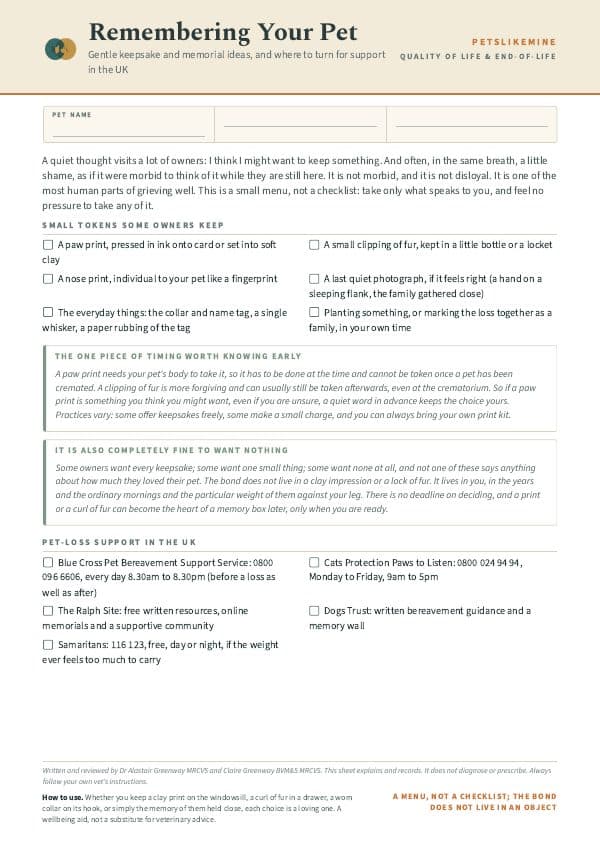
There is more help out there than most grieving owners know, and the services genuinely differ. Here is a frank guide to each one, limits included, so you knock on the right door rather than the nearest one.
Blue Cross Pet Loss Support is the one I point most people to first, and the one the rest of the profession tends to signpost to as well. It is a freephone line on 0800 096 6606, open 8.30am to 8.30pm every single day of the year, free and confidential, covering the whole of the UK including Northern Ireland (Blue Cross Pet Loss Support). It supports people coping with loss in all its forms, whether by death, by end of life, by the enforced separation of having to give a pet up, or by theft, and for any companion animal, not only cats and dogs (Blue Cross Pet Loss Support). If picking up the phone feels like too much, the same trained volunteers staff a webchat during those hours. One detail worth knowing if you are frightened to call: for confidentiality they do not let you leave a message, and everything you share is treated as confidential "unless you were to tell us anything that suggests that you or someone else was in danger" (Blue Cross). After the Samaritans, it is the single best general-purpose pet-loss listening line in the UK, especially if you have lost a dog.
The Ralph Site is a different kind of resource, and a lovely one. It is a UK not-for-profit, free to access, founded in 2011 by the veterinary surgeon Shailen Jasani, a small-animal emergency and critical-care specialist, after the loss of his own cat, Ralph (The Ralph Site). What it offers is not a phone line but a home: written resources on grief, on the euthanasia decision and on aftercare; the facility to create an online memorial; a public Facebook page and a private Facebook support group where you can sit among people who understand exactly what you are feeling; and a searchable directory of pet crematoria, cemeteries and bereavement counsellors across the country (The Ralph Site). I would be straight about what it is: a peer-support community and a signposting hub that links you to counsellors rather than providing therapy directly (The Ralph Site). For finding your people, and a pet-loss-aware counsellor near you, it is hard to beat.
Cats Protection's Paws to Listen matters, but I have to be precise about it so you are not sent to the wrong door. It is a freephone grief line on 0800 024 94 94, open Monday to Friday, 9am to 5pm (excluding Bank Holidays), with a call-back service if the lines are busy, staffed by trained volunteer listeners, free and confidential (Cats Protection, Paws to Listen). You can also reach them in writing by email at pawstolisten@cats.org.uk or through an online support form on the Cats Protection website (Cats Protection). There are two caveats. First, it is a listening service, not counselling: "while we are unable to offer counselling, we can provide you with a sympathetic ear at this difficult time" (Cats Protection). Second, it is framed specifically for people grieving a pet cat, whether a cat that has died, is nearing the end of its life, has been reluctantly rehomed, or has gone missing (Cats Protection). If you have lost a cat, it is a warm and knowledgeable place to turn. If you have lost a dog, or another animal, route to Blue Cross Pet Loss Support above instead.
Dogs Trust is worth including precisely so you do not waste a difficult phone call. It offers gentle written bereavement guidance and an in-memory page, along with sensible self-care advice: grieve at your own pace, spend time with people and talk about how you feel, keep eating and sleeping and doing the things you enjoy, and try not to isolate yourself (Dogs Trust). What it does not run, contrary to what you might assume, is its own pet-bereavement helpline. For a listening ear it signposts onward, in its own words: "if you are struggling and need further support, please get in contact with your GP, or if you need to speak to someone urgently then please contact Blue Cross' Pet Loss Support" (Dogs Trust). So treat Dogs Trust as a source of reassurance that points you onward, not as a number to ring in the night.
The Association for Pet Loss and Bereavement (APLB) is an online option worth knowing about, particularly if you are awake at odd hours. It is a US-based charity, free to join at its basic (Bronze) level, offering online chat rooms hosted by experienced, caring chat hosts and free webinars on topics including anticipatory grief, the grief that begins before a pet has died (APLB). The catch is the time zone: its scheduled sessions run on US Eastern Time, so an evening session there lands in the early hours here in the UK (APLB). That can actually suit a grieving owner who cannot sleep, but go in knowing the clock difference, and note that creating an online memorial there sits behind a paid tier rather than the free one. The AVMA independently recommends pet-loss support groups of exactly this kind, which speaks to their value (AVMA). Use the link for the current schedule, because session times do drift.
Seeing a counsellor about a pet is not an overreaction
Somewhere in all this, a quieter question often surfaces: am I really going to see a counsellor about a pet? I want to answer that one cleanly. Yes, you can, and no, it is not an overreaction.
Pet loss is recognised in the counselling literature as real grief, the kind that warrants the same care as any other bereavement, and the field's own guidance is that practitioners should treat it that way (Cordaro, 2012). The complicating factor that paper names is that pet grief is so often disenfranchised, grief that society does not fully acknowledge or give permission to mourn, which compounds the hurt and can leave people feeling they have no right to seek help (Cordaro, 2012). That is the very feeling I want to take off you here. The fuller story of being told "it was just a pet," and how to weather it, belongs to "it was just a pet": grief that others do not understand; for now, the point is simply this. Needing help to carry a loss is not weakness, and grieving a member of your family, which is what your animal was, is not something you have to apologise for or get over by a certain date.
A counsellor is not the only route, and you do not need a diagnosis to access support. The most common starting point in the UK is your GP, who can assess how you are doing and refer you on. The Blue Cross Pet Loss Support team and The Ralph Site directory can both point you towards counsellors who understand pet loss specifically, which spares you having to explain why this matters. And in some parts of England, adults can refer themselves directly to NHS Talking Therapies without going through a GP first; the exact routes differ across England, Scotland, Wales and Northern Ireland, so your GP or the services above are the surest place to ask. None of this is a sign that something has gone wrong with you. It is sensible care for a real wound.
Finding your people, including here
Some of the most effective support for pet loss does not come from professionals at all. It comes from other people who have lost an animal, precisely because they will not minimise it, will not flinch, and will not tell you it was just a dog. The AVMA makes this point directly: being with others who have lost a pet is an important source of support (AVMA). That is the whole logic of a peer community.
Several already mentioned above are exactly that: the private Facebook support group attached to The Ralph Site, and the moderated online chat rooms run by the APLB (The Ralph Site; APLB). I would add our own. The PetsLikeMine Rainbow Bridge community exists for this, a place to be among people walking the same road, to say their name, to share a photo, to be heard at 3am by someone who understands rather than someone waiting for you to cheer up. I mention it not as a sales pitch but because finding your people genuinely helps, and you may as well know we keep a space for it. The one caveat applies to every community, ours included: peer support is a balm, not a substitute for crisis help or professional care when those are what is needed (AVMA). If you are in danger, the phone numbers at the top of this page come first. A community is for the long, ordinary weight of grief, and at that it is quietly powerful.
Helping someone you love through it
Not everyone reading this is the one who is grieving. Some of you are the worried friend, the partner, the grown-up child, watching someone you love come apart over an animal and not knowing what to say. This part is for you, because the right words help and the wrong ones wound, and the difference is learnable.
The things that genuinely help are smaller than you might think (Blue Cross, What to say to someone who has lost a pet). Acknowledge the loss directly, by name: a short message that says you are so sorry about Bella does more than a paragraph that talks around it. Invite the happy memories rather than avoiding the subject, and let them talk and cry without trying to fix it, because there is nothing to fix, only to witness. Offer practical flexibility, a meal dropped round, a quiet day, a task taken off their hands, and follow their lead on timing. Most of all, do not be frightened of the grief: sitting with someone in it, saying little, is often the kindest thing on offer.
There are things to steer clear of, too, gently. Do not suggest getting another pet, however well meant; they will know when, or whether, they are ready, and the suggestion can land as though their animal were replaceable (Blue Cross). Do not minimise, with "it was only a cat" or "at least you had him for a good while," because the "at least" almost always stings. And do not impose a timeline. Everyone grieves differently and for different lengths, from weeks to months and, for some people, years, and there is no schedule a person is failing to keep (Blue Cross). One specific signpost: if the grieving person is also a parent trying to help a child through the loss, that is its own task, and helping children after losing a pet is written for exactly that.
When grief needs more help: the signs, held gently
If you are struggling, this is the part where you are most likely to see yourself, and I do not want it to read as a deadline or a verdict on how you "should" be feeling. So the most important thing first: most grief, however severe it feels right now, softens and changes over time on its own, without any formal treatment. This section is about the minority of people for whom it does not, and it is not a test you are passing or failing.
There is a recognised condition called prolonged grief disorder, now formally included in both of the main diagnostic systems clinicians use, the DSM-5-TR and the ICD-11 (Treml et al., 2024; American Psychiatric Association). At its core is a persistent, pervasive longing for, or preoccupation with, the one who has died, together with intense emotional pain, sadness, guilt, anger, numbness, difficulty accepting the loss, a feeling that life has become meaningless or that part of yourself has died, to a degree that significantly disrupts daily life and lasts well beyond what would be expected (American Psychiatric Association; Treml et al., 2024). Clinicians attach time thresholds to it, at least twelve months since the loss under the DSM-5-TR and at least six months under the ICD-11 (Treml et al., 2024), but I want to be very clear about what those numbers are and are not.
You do not have to wait twelve months, or six, or any threshold at all, before you are allowed to ask for help. Those figures are how clinicians decide when to name a specific condition. They are not a rule about when your pain becomes valid. If, weeks or months on, you genuinely cannot function, if the pain is not easing at all rather than slowly changing, or if you are having thoughts of not wanting to be here, that is a signal to reach out now, and help exists, whether through your GP, through talking therapies, or through the pet-loss services above. And because this is where the hardest thoughts sometimes surface, the reminder bears repeating: if you are having thoughts that you cannot go on, you do not need to wait for it to get worse. Ring the Samaritans on 116 123, free, day or night (Samaritans). For the waves and anniversaries and slow, uneven settling that are part of normal grieving rather than a sign anything is wrong, grief has no timetable: waves, triggers and anniversaries holds that story; the warning signs here are about something distinct, the rarer case where grief stops moving and needs a hand.
The numbers to keep close
The Samaritans are on 116 123, free, from any phone, day or night, every day of the year, and you do not have to be at the edge to call them (Samaritans). Blue Cross Pet Loss Support are on 0800 096 6606, open 8.30am to 8.30pm every day, free and confidential, and they will talk to you about any animal, lost in any way (Blue Cross Pet Loss Support). If you have lost a cat, Cats Protection's Paws to Listen are on 0800 024 94 94, Monday to Friday, 9am to 5pm (Cats Protection). Keep those somewhere you can find them at 3am, because that is when grief tends to come.
Reaching out to any of them is not a failure of coping, and it is not a betrayal of how much you loved your animal. Keep the numbers above somewhere you can find them at 3am, because that is when grief tends to come.
References
- American Psychiatric Association. (n.d.). Prolonged Grief Disorder.
- American Veterinary Medical Association (AVMA). (n.d.). Coping with the loss of a pet.
- Association for Pet Loss and Bereavement (APLB). (n.d.). Pet loss grief support.
- Blue Cross. (n.d.). Pet Loss Support.
- Blue Cross. (n.d.). What to say to someone who has lost a pet.
- Cats Protection. (n.d.). Paws to Listen grief support service.
- Cordaro, M. (2012). Pet loss and disenfranchised grief: Implications for mental health counseling practice. Journal of Mental Health Counseling, 34(4), 283-294.
- Dogs Trust. (n.d.). Bereavement support.
- Samaritans. (n.d.). Contact a Samaritan / Talk to us. · https://www.samaritans.org/how-we-can-help/contact-samaritan/welsh-language-phone-line/
- The Ralph Site. (n.d.). Support for pet loss.
- Treml, J., Linde, K., Brähler, E., & Kersting, A. (2024). Prolonged grief disorder in ICD-11 and DSM-5-TR: Differences in prevalence and diagnostic criteria. Frontiers in Psychiatry, 15, 1266132.
- Van Buiten, H., Turner, C., Gandenberger, J., Forkin, J., Taeckens, A., Morris, K. N., & Nieforth, L. O. (2025). Can pets prevent suicide? The impact of companion animals on suicidality: Scoping review and clinical recommendations. Healthcare (Basel).
Free downloads
Companion worksheets to put what you've read into practice. Free PDFs, print at home.