After They Have Gone: Cremation, Burial and the Options (UK)
Alastair Greenway
BVM&S MRCVS
One question tends to arrive at the worst possible moment, and it catches almost everyone off guard. You have just held your pet through the end, the room is still, and someone, gently and through no fault of their own, asks: "And had you thought about whether you'd like a burial or a cremation?" Often there is no leaflet, no price list, no time, just a kind face waiting for an answer you did not know was coming. Reading this beforehand is a quietly wise thing to do, so that the day, when it comes, can be only about goodbye and not about a clipboard.
The most important thing comes first. There is usually no rush. If your pet dies at the practice, or you bring them in, the vet can keep your pet's body safe for you in the meantime (PDSA), held in cold storage in a comfortable position (Cats Protection), while you go home and decide in your own time. You do not have to choose in the room. You can ask for a day. And the charities who do this work all say the same thing: settling it beforehand, when you can think, spares you a hard decision at the moment you are least able to make one. Planning in advance can save you from making difficult decisions when you are distressed, and it is worth discussing the options with your veterinary practice ahead of time (Cats Protection); most people, the PDSA notes, discuss cremation options and payment beforehand so they are able to focus on saying their goodbyes (PDSA). There is no wrong choice here, and I will not steer you toward one. I only want to tell you, plainly, what each option means, so that nothing you choose turns out to mean something other than you hoped.
Why a little information now matters so much
A real example shows what going in blind can cost. In its submission to the Competition and Markets Authority, the UK body for pet crematoria described a family who were told only that the practice could either return the pet to them or arrange cremation, with no written information, pricing, or details of the cremation provider provided at the time. When they changed their mind a few hours later, they found their pet had already been transferred to a cremation service, and getting their pet back required a long journey and payment of unexpected fees (APPCC submission to the CMA, 2025). I tell you that not to frighten you, but because it need not happen to anyone who has read one page in advance. The two protections are simple: know what the words mean before you are asked, and know that you are entitled to time and to a clear written price.
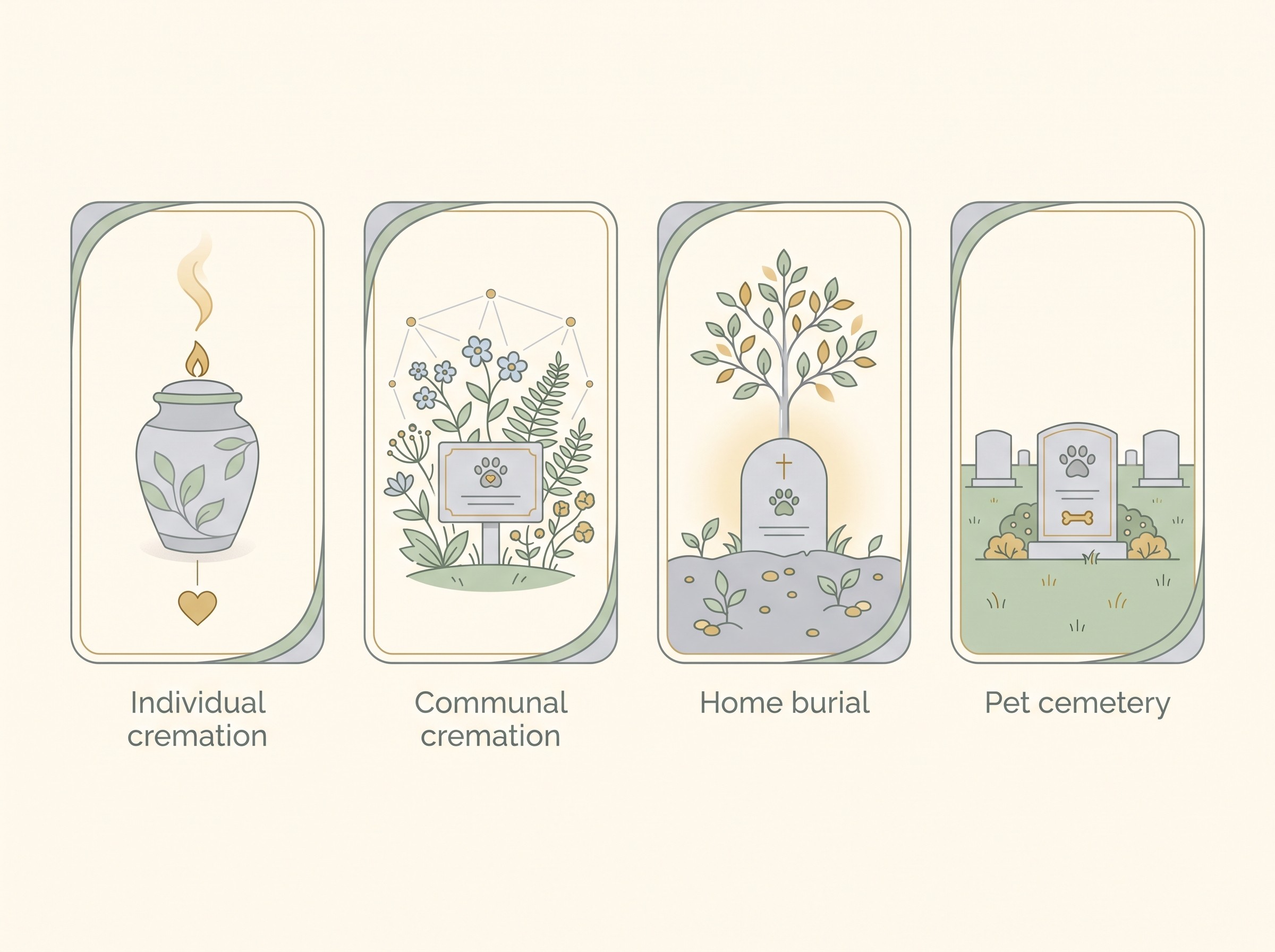
Cremation: what "individual" and "communal" actually mean
Most owners choose cremation, and there are two kinds. The names are not self-explanatory, which is precisely why they are worth understanding now rather than guessing in tears later.
An individual cremation (you may also see it called private or single) means your pet is cremated on its own in the chamber and the ashes carefully collected before the next cremation starts, so the ashes you receive are your pet's (APPCC). If having your pet's ashes back matters to you, this is the only option that guarantees it. The ashes are usually returned in a simple scatter tube or casket, with urns, caskets, jewellery and other keepsakes available at extra cost if you want them (Blue Cross; Cats Protection).
A communal cremation (sometimes group or routine) means several pets are cremated together, the ashes are not returned, and they are usually scattered or buried at the crematorium's own garden of remembrance or a licensed site (PDSA; Cats Protection). It costs less, and a great many people choose it on purpose. I want to be completely clear, because owners sometimes carry guilt they have no need to. Communal cremation is not the cheap option, and it is not the lesser one. It is a perfectly loving, perfectly valid choice, and it does not mean you loved your pet any less. Some people simply do not want ashes to keep, and that is just as fine as wanting them.
The part most pages skip
The nuance I would want a friend to know is this. What is sold as "individual" can mean different things at different providers. Some crematoria cremate truly singly. In some processes, pets are placed on an individual tray alongside other pets on separate trays (Cats Protection), which is a different thing, even if the ashes returned are still meant to be your pet's. The APPCC, the UK standards body, draws a clear line between a member's service, where cremation or burial is carried out with care and respect from start to finish, and operations run without that standard, where, to cut costs, the handling can be more akin to waste transportation (APPCC).
None of this is meant to make you anxious. It is meant to put one question in your hands, the question that protects you completely: ask your practice exactly what their "individual" cremation involves, and who actually carries it out. Any good practice will answer plainly. There is a simple shortcut to trust, too: look for a crematorium that is a member of the Association of Private Pet Cemeteries and Crematoria (APPCC), founded in April 1993 to set and maintain a code of conduct for companion animal facilities (APPCC). It describes its own standards as "the only ones that provide this distinction" between a dignified cremation and basic waste disposal, because the regulations otherwise treat such facilities as disposal sites rather than bereavement-care providers (APPCC). Under its consumer code, members must handle every pet with respect, dignity and care, hold the necessary planning permissions and the licences to transport, scatter or inter ashes, and submit to independent inspection by assessors with no connection to the pet-funeral trade (APPCC, Consumer Code of Practice). Whether you arrange it through your vet or directly, an APPCC-member crematorium is an easy way to know the handling meets an inspected standard.
Your rights, made concrete: the 2026 CMA reforms
There is genuinely good news for anyone reading this now, and it puts the power back in your hands. On 24 March 2026, the Competition and Markets Authority published the final report of its market investigation into veterinary services for household pets, concluding bluntly that too often, people are left in the dark about who owns their practice, treatment options and prices (CMA, 2026). Cremation was one of the areas it acted on, because the regulator found that where competition was weak, pet owners may be paying around £100 more for individual cremations than they would with strong price competition, and that what is sold as individual or communal can vary between providers in handling, storage, transport, the cremation process and where the ashes end up (CMA, 2026).
What this means for you is concrete. The CMA's remedies require practices to provide clear, upfront prices for all cremation options including any add-ons, and to offer the lower cost option of a communal cremation (CMA, 2026), with the legally binding orders due to be in place by 23 September 2026 (CMA, 2026). In plain terms: you are entitled to ask for a clear, written list of cremation prices, and you do not have to use the practice's default crematorium. If a price list is not offered, you can ask for one, and that is a reasonable, normal thing to ask. Some owners choose their own crematorium specifically because they want to be present at the cremation; if you do, remember to give your chosen pet crematorium company your vet's contact details (PDSA).
Home burial in the UK: the law, plainly
Plenty of people want to bury their pet at home, in the garden they shared, and in the UK you usually can. It is legal to bury small domestic pets such as a dog or cat on your own land, for example in your back garden, and you do not need permission to do so on land you own (GOV.UK). The law cares about the species: a "pet animal" here means one normally kept and nourished by people but not eaten, which plainly covers your dog or cat (Animal By-Products Regulations, via DEFRA guidance). The practical conditions are common-sense ones: you must own the land or have the landowner's explicit permission, so you cannot bury a pet in a rented garden or on common ground without consent.
When it comes to depth, aim generously, as sensible best practice rather than because the law sets a fixed figure for a dog or cat. The PDSA recommends "digging a deep grave (at least 4ft or 1m) to avoid your pet's remains being disturbed by other animals" (PDSA), and Cats Protection's owner-facing figure is in the same spirit, a grave at least 1.25 metres deep and three metres away from water sources, cables and pipes where possible (Cats Protection). So the rule of thumb is a deep grave, around a metre or more of soil on top, sited well away from water pipes, drains and cables, and it is worth checking what runs under your garden before you dig.
One point is worth correcting, because many websites get it wrong and frighten owners needlessly. The strict statutory distance rules you may read about, at least 50 metres from a well, borehole or spring used for drinking water, 30 metres from other springs or watercourses, 10 metres from a field drain, and the formal groundwater-pollution requirements, apply to larger pet animals such as horses, not to small domestic pets. For dogs and cats, the government states there are no minimum good practice groundwater protection requirements (GOV.UK). So please do not measure your garden against the horse rules. A deep grave and common sense about water is what matters for a dog or cat.
The one genuinely clinical thing to check first
There is a single, calm reason to have a quick word with your vet before a home burial, and it is worth understanding rather than fearing. A pet that has been put to sleep has been given a barbiturate anaesthetic, commonly pentobarbital, and this drug persists in the body for a long time after death. Remains containing it are potentially poisonous to scavenging wildlife and other animals if they are dug up and eaten, which is why euthanasia-solution labels require that the body be disposed of by deep burial, incineration or another secure method (Wells, Butterworth & Richards, 2020). This is exactly why the practical UK advice is that you usually can take the body home to bury, but you should check with your vet first, and in a few circumstances it is not possible, for example if your pet has recently had chemotherapy, or was suffering from a contagious disease (PDSA). So it comes down to one gentle sentence: because of the medicine used, a deep, secure grave matters, especially in a garden other animals can reach, and a quick word with your vet first is wise. That is all. It is a precaution, not an alarm.
One last quiet, practical thought owners often value: think about permanence. A burial spot stays with the house, so if you may move home one day, you leave it behind. Some people keep ashes instead for that reason, and others bury in a large planted pot so the memorial can move with them (Cats Protection). There is no right answer; it is simply worth a moment's thought now rather than a regret later.
Pet cemeteries
A licensed pet cemetery is the formal alternative when you want a marked, tended grave but not in your own garden. You buy a plot, often with the option of a marker or headstone, and the practice or your family arranges the interment. Be aware of the cost shape so it does not surprise you: a cemetery typically involves the purchase of the plot, an annual maintenance or rental fee and a coffin, and some even allow pets to be buried in close proximity to their owners (Cats Protection). The recurring fee is the part people sometimes do not expect, so it is worth asking about up front. As with cremation, an APPCC-member cemetery is the simple way to know the site is properly licensed, inspected and run to a dignified standard (APPCC, Consumer Code of Practice).
What it costs, without judgement
Realistic ballpark figures help, so here they are, and then the pressure can come off. In 2026, UK pet cremation broadly ranges from roughly £80 to £450, depending mainly on your pet's size and the type of service (UK 2026 provider data, composite). As rough anchors only: a communal cremation commonly sits in the region of £100 to £200, and an individual cremation in the region of £150 to £350 or more (so, very roughly, a cat around £100 communal or £195 individual, a small dog around £115 or £215, a large dog around £195 or £330 and up). Caskets, urns or jewellery add extra, often £45 to £120 or more, and collecting the body may add a fee, often £30 to £50 (UK 2026 provider data, composite). A pet cemetery is shaped differently again, the plot plus a recurring maintenance fee plus a coffin (Cats Protection), and home burial is essentially free, but permanent and tied to your land. Please treat all of these as broad ranges, not quotes; real prices vary by region and provider.
Two things matter more than the numbers. First, some practices add their own handling fee on top of the crematorium's price, which is exactly what the CMA's transparency reforms are designed to bring into the open (CMA, 2026), so it is entirely reasonable to ask what the practice's fee covers and to compare it against arranging a crematorium yourself. Second, and I mean this plainly: choosing the most affordable option is a normal, caring decision, and there is no "right" amount to spend on saying goodbye. Communal is not lesser. A simple return is not lesser. Wanting the ashes, and wanting nothing, are equally fine. Whatever fits your circumstances is the right choice, full stop.
As for timing, there is no rush at the other end either. After an individual cremation, ashes are broadly ready in about one to two weeks, though it varies by provider (Blue Cross). The crematorium will store them for some time, so you do not have to collect them the moment they are ready. Collecting the ashes can be a difficult thing to do, and it is perfectly fine to wait until you feel able, to send someone else, or to bring a friend with you (Cats Protection).
A gentle word on what comes next
Two doors open from the practical choice. If you would like a paw print, a clipping of fur, a nose print or a photo, you can ask the practice, ideally in advance, and ashes can later be made into keepsakes such as jewellery or glass; what is possible, and how to ask in the moment, is held in paw prints, fur and keepsakes. And what you do with the ashes, or how you mark your pet's life in the weeks ahead, whether scattering somewhere they loved, planting something, or a place to remember them, is its own tender question, gathered in ways to honour and remember your pet. For the goodbye itself and what you may see, that belongs to what happens during euthanasia; and if your loss was sudden, with no time to plan, know that aftercare and keepsakes can still be chosen even now, in when there is no time to prepare. If there is still some time left, making memories in a good last week may be a kinder place to be for now.
A last acknowledgement, because deciding any of this is heavy. If reading through these choices feels like too much right now, you are not alone, and you do not have to hold it by yourself. The Blue Cross Pet Bereavement Support Service has supported owners before, during and after a loss since 1994, by trained volunteers who have themselves lost a pet; it is free and confidential on 0800 096 6606, every day from 8:30am to 8:30pm (Blue Cross). And if the weight of all this ever tips into a feeling that you cannot cope at all, please reach out to the Samaritans, free, day or night, on 116 123. There is no shame in it, and people are there for exactly this.
References
- Association of Private Pet Cemeteries and Crematoria (APPCC). (n.d.). About the APPCC.
- Association of Private Pet Cemeteries and Crematoria (APPCC). (n.d.). APPCC Consumer Code of Conduct and Independent Inspection Scheme.
- Association of Private Pet Cemeteries and Crematoria (APPCC). (2025). Response to CMA Remedies Working Paper, Non-Confidential Version (submission to the CMA market investigation into veterinary services for household pets), K. Spurgeon, APPCC Director. Published via GOV.UK / assets.publishing.service.gov.uk.
- Blue Cross. (n.d.). Saying goodbye to your pet and Pet Bereavement Support Service (PBSS).
- Cats Protection. (n.d.). After death: taking care of your cat's body.
- Competition and Markets Authority (CMA). (2026). CMA concludes market investigation with major reforms to veterinary sector and Veterinary services for household pets: final decision report. GOV.UK, published 24 March 2026.
- DEFRA / Environment Agency / Animal and Plant Health Agency. (n.d.). Animal burials: prevent groundwater pollution and related animal by-products guidance. GOV.UK.
- PDSA. (n.d.). When it's time to say goodbye.
- Samaritans. (n.d.). Free, confidential support, 24 hours a day: call 116 123 (UK and ROI).
- UK pet cremation cost ranges, 2026 (composite of independent provider and insurer data: VetCost, "Pet Cremation Cost UK 2026"; My Pet's Ashes, "Cost of Pet Cremation in UK, 2026 Update"; ManyPets, "How much does it cost to get a dog or cat cremated?"). Accessed June 2026.
- Wells, K., Butterworth, A., & Richards, N. (2020). A review of secondary pentobarbital poisoning in scavenging wildlife, companion animals and captive carnivores. Journal of Veterinary Forensic Sciences, 1(1). Corroborated by the FDA Center for Veterinary Medicine (2003) pentobarbital euthanasia-solution label warning (disposal by "deep burial, incineration, or other method ... to prevent consumption of carcass material by scavenging wildlife") and PDSA / DEFRA-aligned UK home-burial guidance. Accessed June 2026.
Free downloads
Companion worksheets to put what you've read into practice. Free PDFs, print at home.