

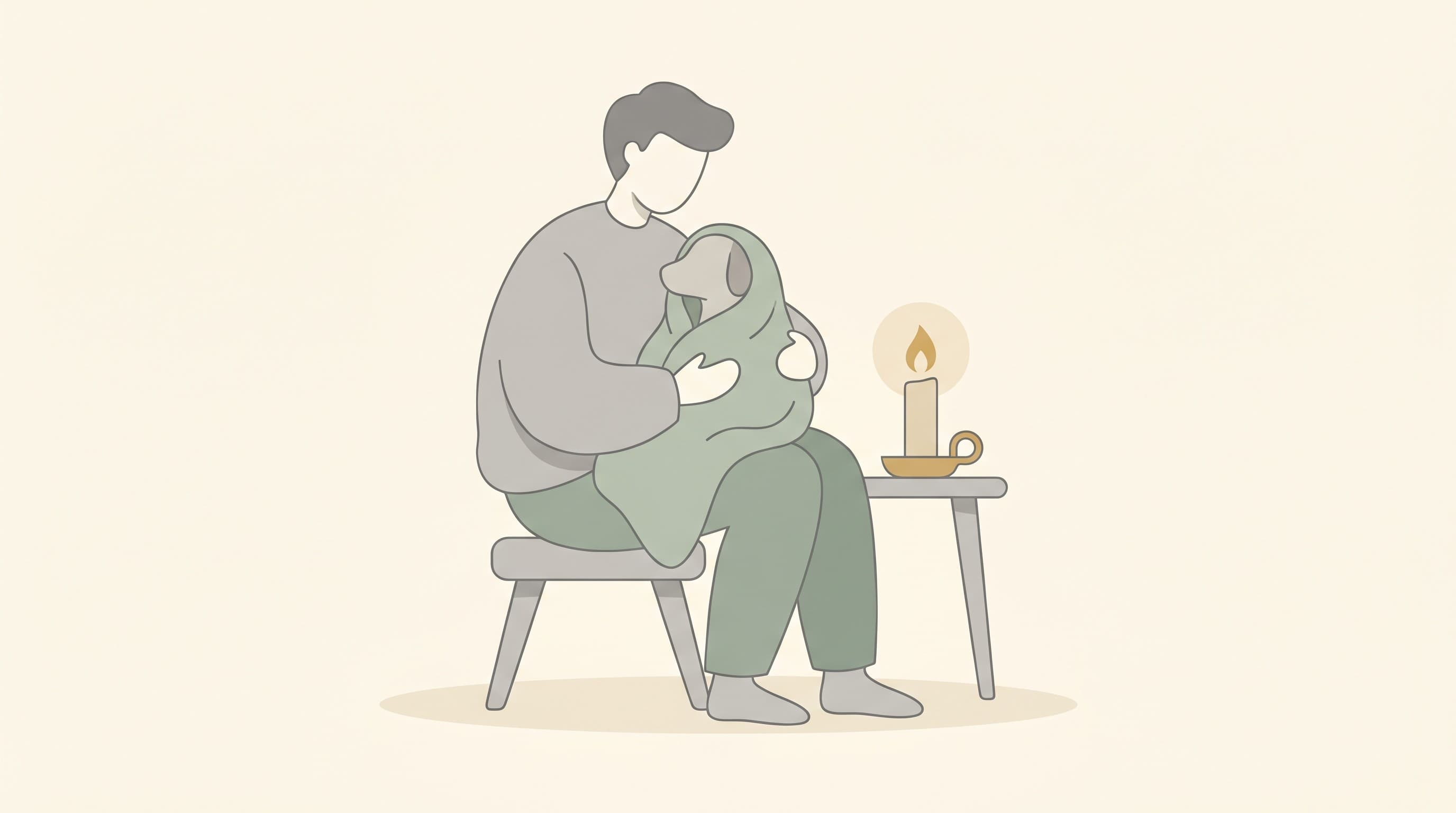
When There Was No Time to Prepare: The Emergency Decision
Alastair Greenway
BVM&S MRCVS
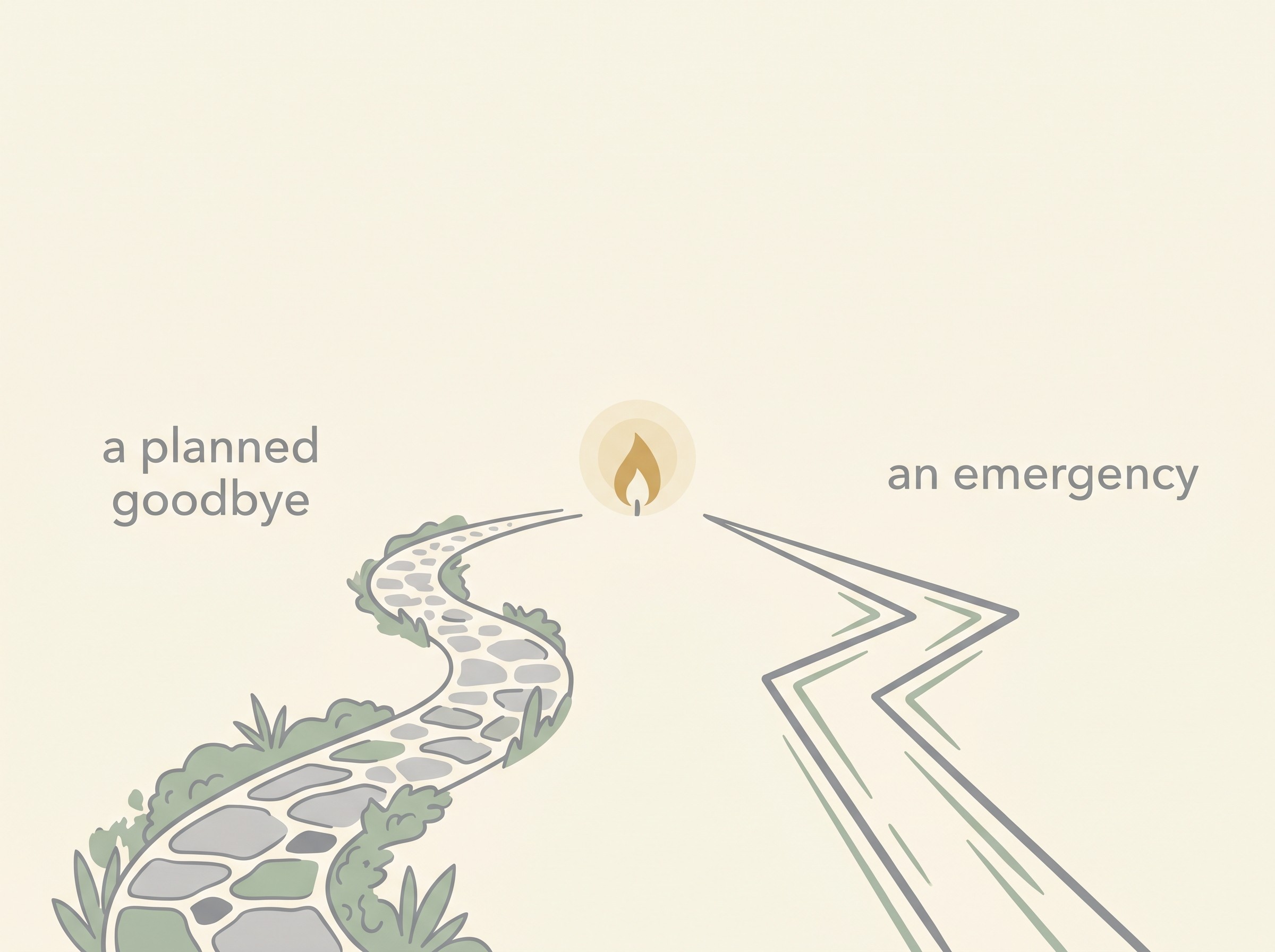
Some goodbyes give you weeks. This one gave you minutes. One moment a normal evening, the next a crisis you did not see coming, and a vet you had perhaps never met asking you to make the largest decision of your life in the time most of us take to choose what to have for dinner. No run-up, no second opinion, no quiet afternoon to sit with it. Just your pet in front of you, frightened or in pain, and a choice you would have given anything not to face.
A decision made in an emergency is no less valid, no less informed and no less loving than one made slowly over weeks. The clock being short does not make your goodbye smaller, or a lesser kind of love. Everything below is here to show you why, and to give back to you, gently, some of what the speed of it seems to have stolen.
One quiet, practical note, if your pet is still beside you and the crisis is still unfolding. The person to guide the clinical decision now is the vet with you, or your nearest out-of-hours emergency vet, and the kindest thing you can do is call them without delay. This page is for thinking afterwards, or alongside, not a substitute for the vet in the room.
An emergency decision is still a good death
It is natural to feel that because there was no time, something must have been done less well. The opposite is true: the standard a vet holds a goodbye to does not change because the clock was short. Euthanasia means "ending the life of an individual animal in a way that minimizes or eliminates pain and distress," and the vet's duty is "the use of humane techniques to induce the most rapid and painless and distress-free death possible" (AVMA, 2020). Notice what is not in those words: advance notice, a planned date, weeks to prepare. A goodbye given in an emergency, done with care, is still a good death by the only definition that matters. In UK terms it is put even more simply: the Royal College of Veterinary Surgeons defines euthanasia as "painless killing to relieve suffering" (RCVS, Chapter 8, clause 8.1).
There is a phrase in the AVMA's guidance that speaks straight to a crisis. The humane thing, it says, is to give a good death "when an animal no longer continues to enjoy good welfare ... or will shortly be overcome by negative states," because then "euthanasia relieves the animal's suffering, which is the desired outcome" (AVMA, 2020). That small clause, "or will shortly be overcome by negative states," is the heart of the emergency. It does not ask whether suffering has gone on for long. It recognises the moment when suffering is here, or moments away, and cannot be undone. In that moment, acting is the kindness.
Trusting the vet's read, even with no second opinion
The one thing an emergency truly takes from you is time: to think, to ask someone else, to sit with it before you answer. But it helps to know what the vet in front of you was doing in those minutes, because understanding it is one of the most settling things I know.
The calm you saw, even at speed, was not luck, and not corners cut because it was an emergency. The RCVS recognises that these situations are "often highly emotionally charged" and that in them "small actions and/or omissions can take on a disproportionate level of importance," which is exactly why it recommends that "all practice staff involved in euthanasia are fully trained and a planned, rehearsed and coordinated approach is taken" (RCVS, clause 8.1). The steadiness around you was a trained standard, the same one a team brings to a goodbye booked weeks ahead. And when a vet tells you the kindest thing is to let your pet go, they are lending you an unflinching reading of two things you could not assess through your fear: what your pet is feeling right now, and what the road ahead realistically is. That is not a verdict handed down. It is someone lending you their eyes when yours were full of tears. No one can make this decision for you, but you do not have to make it alone, and your vet will help you weigh it. In an emergency, "weigh it" compresses to minutes. The principle holds all the same.
One more thing, for the owner who feels they "did not even get to decide." UK guidance has a careful, safeguarded framework for the rare case where suffering allows no pause at all: "if, in the opinion of the veterinary surgeon, the animal's condition is such that it should, in its own interests, be destroyed without delay, the veterinary surgeon may need to act without the owner's consent," and such a decision "should be endorsed by a second veterinary surgeon not directly involved in the case" (RCVS, clause 8.13). Most owners do still make the call themselves, even at speed. But if it felt almost made for you by how fast it moved, that moment was held to a high duty of care, with a second pair of eyes built in. That is not being overridden. It is your pet being protected at the very edge of what medicine can do.
And one last fear here, because it haunts people and it should not. If cost was part of the picture, if the only alternative was heroic, expensive surgery with low odds you could neither face nor fund, you did not fail your pet. The RCVS is explicit that "the inability of an owner to pay for treatment should not prevent the provision of first aid and pain relief, which may include euthanasia" (RCVS, clause 8.8). A gentle, timely end is recognised as relief, not a lesser option you settled for.
Why some crises genuinely cannot be waited out
Underneath the guilt, almost always, sits one unbearable question: could I have done something, could we have waited, even an hour? For a true emergency, the answer is no, and knowing why can be its own mercy. The examples below are not a checklist to hold against your own pet, so please do not read them as one. They are simply the kinds of crisis vets see, offered so you can understand why there was no waiting it out.
Take a twisted stomach, what owners know as bloat or GDV, in dogs. The stomach fills with gas then rotates on itself, sealing both ends and cutting off its own blood supply. The American College of Veterinary Surgeons calls it "a rapidly progressive life-threatening condition of dogs that requires immediate medical attention" (ACVS, n.d.), and VCA describes it as "an immediate and life-threatening emergency" in which "immediate veterinary attention (within minutes to a few hours) is required to save the dog's life" (VCA, n.d.). Minutes to a few hours, not days. There was never a calm stretch in which a different choice could have been weighed.
Or a sudden collapse from bleeding inside the body. Some dogs are well one hour and collapsed the next because a mass on the spleen, often a cancer, has quietly burst and is bleeding into the belly. These tumours "behave uniquely with high and unpredictable risks of tumor bleeding, leading to a rapid decline in quality of life or sudden death," and a dog can be brought in already collapsed and in shock, with no warning anyone could have caught at home (Metropolitan Veterinary Associates, n.d.). A hidden problem can declare itself all at once. That is not something you missed. It is something that hides until the moment it does not.
For cats, there is a particular cruelty I want to name directly, because the owners who face it carry some of the heaviest guilt I see. A cat can suddenly drag its back legs and cry out because a clot, usually thrown from a diseased heart, has lodged where the main artery splits to the hind legs. Vets call it a saddle thrombus, or feline aortic thromboembolism. It causes "acute pain, paralysis and rhabdomyolysis in the affected limb(s)," and the "prognosis for cats with FATE has traditionally been considered poor" (Guillaumin, 2024). If you chose a fast goodbye for a cat in this crisis, hear this clearly. This condition "has been associated with euthanasia rates as high as 90%" (Guillaumin, 2024), not because those cats were given up on, but because the crisis is so sudden, painful and grave that a gentle, immediate end is the common and humane choice. You were in the company of most owners and most vets facing the same thing.
A road accident or other major trauma, a sudden untreatable crisis of breathing, a catastrophic decline overnight: these are the other shapes it can take, and the thread through all of them is the same. They give no notice and no comfortable pause. An owner who acted fast did not act rashly. They recognised an emergency for what it was.
When "more time" would only have meant more fear
I know the instinct, because every owner feels it. Can we try? Can we have one more day, one more hour? That instinct is love, and it deserves a gentle answer. Here is the truth hospice vets hold. A euthanasia decision "should not be about ending suffering that has already occurred, but about preventing any suffering in the first place" (Lap of Love, n.d.). A pet in an acute crisis is not only hurting, it is frightened, and "frankly, anxiety can be worse than pain to animals" (Lap of Love, n.d.). So in a true crisis the kindest currency was never "more time." It was less fear and less pain, now.
Think about what "more time" would actually have bought in a futile emergency. Not more good days, not more of the life you both loved, but more of the crisis, and the real risk of "an emergency, stress-filled, sufferable passing for your pet that may not be peaceful" (Lap of Love, n.d.). Your pet was already inside that emergency. By choosing a controlled, gentle end within it, you did the one thing that could stop it becoming a frightened, drawn-out death.
And two things are allowed to sit together, because they both belong to you. You can know, with your whole mind, that you made the right call. And you can grieve, fiercely, the calm goodbye you did not get: the slow last day, the favourite walk, the chance to brace. Wishing for the gentle parting you were robbed of does not unmake the rightness of what you chose. (If part of you is still turning over the timing itself, whether it was too soon or somehow too late, that worry has a home of its own in was it too soon, or too late?.) Hold them both.
You could not have prepared, and that is not a failure
This is the part that keeps people awake. Sudden loss specialises in self-blame. I should have noticed. I should have got there sooner. I should have known. If those sentences are circling tonight, please read the next few slowly.
One thing comes first, because shock and the small hours so often arrive together. If the self-blame has tipped past sorrow into something darker, if a part of you is thinking I cannot live with this or I cannot go on, please stop and ring the Samaritans on 116 123. It is free from any phone, at any hour of any day, and your call will not appear on the bill (Samaritans, n.d.). You do not have to be in crisis or feel "bad enough" to call. The sudden, traumatic loss of an animal you loved is a real and recognised reason to reach out. For support that understands pet loss specifically, the Blue Cross Pet Loss Support Service runs a free, confidential line on 0800 096 6606, open 8.30am to 8.30pm every day (Blue Cross, n.d.). The rest of this page will still be here afterwards.
Now, the guilt itself. Hear this plainly: it is unfair to feel guilty for "not noticing." As one bereavement resource puts it, "as much as one tries to ensure their pets' safety, unfortunately accidents do occur," and so "it is therefore unfair to feel guilty for 'not noticing'" (SPCA International, n.d.). Sudden loss also has a particular emotional fingerprint: "when a pet dies suddenly or unexpectedly or in an accident, it is often traumatic for the owner because emotions are compounded by feelings of anger and often guilt" (SPCA International, n.d.). That anger matters. Owners are often blindsided by how furious sudden loss makes them, at themselves, at the vet, at the sheer unfairness, and they think something is wrong with them for feeling it. There is not. Anger is part of this shape of grief.
And the guilt sits so heavily after an unplanned decision for a reason that has nothing to do with having done something wrong. Writing for the Society for the Advancement of Psychotherapy, two clinical psychologists note that "throughout the grief process, especially when associated with having to make an unexpected decision (euthanasia, accident, or abandonment), grieving pet owners place massive amounts of guilt upon themselves" (Schroeder & Clark, 2019). The crushing weight you feel is the predictable, documented response to a decision made without warning, not evidence that you failed. So let me separate the two things that have fused in your chest: feeling that you failed is not the same as having failed. The feeling is real. The failure is not.
The hardest, kindest thing I can say is this. There was no version of this where more vigilance would have changed the ending, because the crisis gave no notice to catch. Your love was never going to be measured by whether you spotted the unspottable. The longer work of making peace with the decision is held, with more room than I have here, in the guilt is normal.
The grief of a sudden loss has its own shape
Sudden loss does not feel like the grief people expect, and naming the difference is itself a comfort, because so many owners fear the strange shape of it means something is wrong with them. When a loss comes slowly, there is at least a chance to brace, so that by the end some of the weight has already been carried. A sudden loss gives none of that, so the bereavement often arrives in the wrong order. Shock and unreality come first: a strange numbness, a sense that this cannot really have happened. The full weight tends to land later, in waves you did not see coming, and you may find yourself replaying the last hour on a loop. None of that is grieving wrongly. It is what a loss that gave no warning does.
There is good evidence, from the study of human bereavement, that not seeing a loss coming makes grief heavier and longer. In a large, population-representative German study of 811 bereaved adults, "grief severity was higher after an unexpected death (20.4 +/- 8.9) than after an expected death (16.8 +/- 7.3)," and the unexpectedness of the loss was a significant predictor of prolonged, complicated grief, with those who experienced it as unexpected reporting "higher scores on every individual symptom" (Doering et al., 2022). That study was of people losing people, not of pet loss, so I offer it carefully, as a human parallel rather than a fact about pets. But the parallel is worth knowing: if this is hitting you harder than you ever expected, that is not weakness or a failure of proportion. It is what sudden loss does. The pet-loss literature agrees that an unplanned death tends to be experienced as traumatic and harder to move through (Schroeder & Clark, 2019).
So there is no right shape for this grief and no schedule it owes you. The disorientation, the numbness, the replaying, the late waves, are all recognised responses to a loss that gave no warning. The fuller work of grief, whether what you feel is normal and how much is too much, is held with much more care in is it normal to grieve this much, and a directory of where to turn for ongoing support sits in where to turn for pet-loss support. When you are ready, those are the next places to go. Not yet, if not yet. They will keep.
Even now, the gentleness is still yours
There is one more thing I badly want you to know, because it lifts a particular anguish sudden loss is so good at planting: the feeling that the emergency stole not just your pet but the goodbye itself. I did not even get to say goodbye properly. Please hear this. Almost everything you imagine the speed of it took from you is, in fact, still yours to claim, even now, even from inside a crisis. You only have to ask.
The time and the touch are still yours. Once the decision is made, there is usually no rush imposed by the emergency, and you can spend time with your pet, hold them and speak to them, before and after (PDSA, n.d.). You can ask for a moment alone with them, even in an emergency clinic at three in the morning, and a good team will give it without question. If it happened so fast that you did not get that moment in the room, you can still have it now.
The keepsakes are still yours, too. A paw print, in ink or pressed into clay, and a clipping of fur are routinely offered around a goodbye, and an emergency does not take them off the table, even after the fact. I will not run through the options here, because keepsakes: paw prints and fur clippings does that gently and in full. The one thing to carry is that the door to them is not closed just because the timing was not yours to choose. The aftercare is still yours to decide too, in your own time: cremation, shared or individual with the ashes returned to you, or burial, can all be arranged even when nothing was planned. An emergency does not force a rushed choice, and it is completely fine to take a little time, or to let the practice hold your pet while you decide. The options, the costs and the UK rules are laid out without pressure in aftercare: cremation and burial options in the UK.
One last reassurance, for the owner turning over whether they should have stayed in the room. Whether you were there at the end, stepped out because you could not bear it, or it happened too fast for there to be a choice at all, your pet was at peace and you did not fail them; the whole of that question is held with care in should I be there at the end. And if, in the days ahead, you need to understand what those last few minutes were really like for your pet, that is owned by what actually happens when a pet is put to sleep. The one thing worth knowing now is that the passing itself is the same gentle, fast, peaceful one whether planned weeks ahead or carried out in an emergency. The speed of the crisis around it did not make your pet's passing any less calm.
What your love actually looked like
Your love was never in catching the uncatchable. It was in something the speed could not touch: in how fast you would have done anything to keep them, and in the mercy you found when there was nothing left to do but spare them fear and pain. The last thing you ever gave your pet was a fast end to suffering, and in a frightening, futile crisis that is not a small gift. It is the largest one there is.
And the tenderness owed to a goodbye is still yours to claim: a hand resting on warm fur, a few quiet minutes whenever you ask for them, a paw print to keep, their ashes home on a shelf where the light falls. The emergency stole the warning. It did not get to steal any of that. Those things are still here for you, and so, for as long as you need it, is help: the Blue Cross Pet Loss Support line on 0800 096 6606, and, if the nights ever feel like more than you can hold, the Samaritans on 116 123, free, any hour, any day. You did right by them, fast, when it counted most. Let that be the thing you carry.
References
- American Veterinary Medical Association (AVMA). (2020). AVMA Guidelines for the Euthanasia of Animals: 2020 Edition. American Veterinary Medical Association.
- American College of Veterinary Surgeons (ACVS). (n.d.). Gastric Dilatation-Volvulus. ACVS Small Animal Topics.
- Blue Cross. (n.d.). Pet Loss Support (Pet Bereavement Support Service). Freephone 0800 096 6606, 8.30am-8.30pm every day. Blue Cross.
- Doering, B. K., Barke, A., Friehs, T., Komischke-Konnerup, K. B., Geulen, M. D., Rief, W., et al. (2022). Predictors of Prolonged Grief Disorder in a German Representative Population Sample: Unexpectedness of Bereavement Contributes to Grief Severity and Prolonged Grief Disorder. Frontiers in Psychiatry, 13, 853698.
- Guillaumin, J. (2024). Feline aortic thromboembolism: recent advances and future prospects. Journal of Feline Medicine and Surgery, 26(6), 1098612X241257878.
- Lap of Love Veterinary Hospice. (n.d.). How Will I Know It Is Time to Say Goodbye? Lap of Love.
- Metropolitan Veterinary Associates. (n.d.). Canine Splenic Hemangiosarcoma. Metropolitan Veterinary Associates.
- People's Dispensary for Sick Animals (PDSA). (n.d.). When it's time to say goodbye. PDSA.
- Royal College of Veterinary Surgeons (RCVS). (n.d.). Code of Professional Conduct for Veterinary Surgeons, Supporting Guidance, Chapter 8: Euthanasia of animals (clauses 8.1, 8.8, 8.13). RCVS.
- Samaritans. (n.d.). How we can help (free 24-hour listening line, 116 123). Samaritans.
- Schroeder, K., & Clark, S. (2019). Traumatic Pet Loss. Society for the Advancement of Psychotherapy, 8 December 2019.
- SPCA International. (n.d.). Coping with Loss: Euthanasia vs. Sudden Death or Illness. SPCA International.
- VCA Animal Hospitals. (n.d.). Bloat: Gastric Dilatation and Volvulus in Dogs. VCA Animal Hospitals.