Should I Be There at the End?
Alastair Greenway
BVM&S MRCVS
The hardest decision a pet owner ever faces is one you have made, or very nearly made. You thought that was the whole of it. And then, somewhere in the quiet of the night before, a second question crept in that you did not expect and cannot now put down: do I have to be in the room?
That question is keeping people awake all over the country tonight, and it pulls in two directions at once. One part of you cannot bear the thought of not being there, of your pet looking for you and finding a stranger's hands instead, of carrying the guilt of having stepped away at the very last. Another part of you is frightened: frightened you will break down and somehow make it harder, frightened of a final image you will never be able to unsee, frightened that you simply are not strong enough. Both of those fears are completely human, and neither makes you a bad owner.
There is no right answer here. There is no brave choice and no cowardly one. Your pet is at peace either way. What matters now is not where you are standing, but finding the version of this decision that you will be able to live with afterwards.
This article is only about presence. The decision itself, the "is it time" question, is a different and earlier conversation, and if you are still weighing it, how will I know when it is time holds it gently. What actually happens during the procedure, moment by moment, belongs to what actually happens when a pet is put to sleep, and it is worth reading. Here, I want to answer only the question that is keeping you up: should I be there?
What actually shapes how you cope is not where you stand
Let me start with the piece of evidence that lifts the most weight, because it is not the one most people expect.
When researchers have looked at what tends to leave owners with lasting, complicated grief after a pet's death, the answer is consistent, and it is not whether they were in the room. In a 2025 study of 123 bereaved owners, the intensity of grief was linked to feeling excluded from the euthanasia decision by the vet, to regret over the timing (a sense of having let go too soon), and to guilt; and guilt was measurably lower where owners felt the veterinary team had responded to their emotional needs (Silva et al., 2025). An earlier landmark study of 177 bereaved owners found that around 30% experienced severe grief, and the strongest predictors were the strength of the bond, attitudes toward euthanasia, the sense of whether society took the loss seriously, and the support of the veterinary team (Adams et al., 2000). Notice what is on those lists and what is not. What tends to haunt people is feeling rushed, shut out or unsure of the timing, and feeling unsupported. Being present, or absent, at the final moment does not appear as the thing that drives the grief.
I find this enormously freeing, and I hope you will too. If you have been part of this decision, if you understand the why, and if you feel as settled about the timing as anyone in your position can feel, then you have already done the part that matters most for how you will cope in the months ahead. Whether you stand beside the table for the last minute is a separate, smaller and entirely personal choice. It does not undo the larger thing you have already got right.
What "being there at the end" actually means for your pet
To choose well, it helps to understand what your pet can and cannot experience in those final minutes, because the picture in most people's heads is not quite the reality.
In modern practice, euthanasia is almost never a single injection out of the blue. Your pet is usually given a sedative or anaesthetic first, and is allowed to drift into a deep, calm sleep before anything else happens. The principle that governs everything is that loss of consciousness comes first: by the time the final injection is given, the pet is already unaware of its surroundings (AVMA, 2020). The feline end-of-life guidance puts the standard plainly, that with good sedation the patient should be completely unaware of their surroundings and unresponsive to all stimuli before the final step (AAFP, accessed 2026), and the principle holds equally for dogs. The PDSA describes the pet peacefully falling unconscious within a few seconds (PDSA, accessed 2026).
The full detail of all of this belongs to what actually happens when a pet is put to sleep, and I would gently steer you there rather than dwell on it. But the one fact you need for this decision is this: the part of the process your pet can still feel, the part where your voice and your hand genuinely reach them, is the settling and the drifting off, not the final injection. By then they are asleep. This single fact sits underneath both choices that follow, and it is what makes either one all right.
Why staying can be the right thing for you
For many owners, being there is a comfort, and helps them afterwards. There is nothing soft-headed in that. To stay is to hold your pet, to stroke them, to talk to them, to be the last thing they hear, and for a great many people that is exactly how they want to spend the final minutes (Lap of Love, accessed 2026). A familiar voice and a gentle touch are a real kindness to the pet, too, while they can still feel them, because calm handling and a known presence tend to settle an animal in their last conscious moments (AVMA, 2020). At home, an owner can simply hold their pet's paw, in their pet's own favourite spot, for the whole of it (Cloud9 Vets, accessed 2026).
If part of you wants to stay but is held back by the fear that witnessing it will scar you, there is genuinely reassuring evidence to set against that fear. In a study of 236 bereaved owners, attending the euthanasia was not associated with higher rates of complicated grief or post-traumatic stress, and the researchers suggested that, for those who want it, being present may even help with grieving; those who were not present, by contrast, reported more feelings of regret than those who attended (Adrian & Stitt, 2019). I want to be careful about how to read that, because it is a single cross-sectional study of one group of owners, and it describes a pattern, not a law. What it means for you is simply this: being there is very unlikely to be the trauma you may be dreading, and if something in you wants to stay, the evidence quietly says you are unlikely to wish you had not. That is a reason to feel safe choosing to stay. It is not a verdict on anyone who chooses to leave.
For those who cannot face it
This deserves exactly the same warmth, because it is what owners who step out most need to hear, and what the world is quietest about.
Some people genuinely cannot be in the room, and choosing not to be is a legitimate, loving decision, not a failure of love or nerve. The Association for Pet Loss and Bereavement puts it as plainly as I could wish: if your level of distress is too great, it may be best for you, your pet and the rest of your family if you are not there for the euthanasia, and there is no shame in that choice (APLB, accessed 2026). The PDSA is just as direct, that whether to be present is completely up to you, that it is important not to feel guilty if you cannot be there, and that a good vet should not pressure you either way (PDSA, accessed 2026).
The reassurance that makes this choice safe to make is the one we have already met: your pet is sedated, asleep and unaware. They will not know you have stepped out. They will not feel abandoned, because to feel abandoned they would have to know you had gone, and they are already in a deep, comfortable sleep (AAFP, accessed 2026; PDSA, accessed 2026). Stepping out of the room is not leaving them alone in any sense your pet can experience. Please let that land, if you are the owner who needs it: there is no last second in which they search the room for you and do not find you. That is a fear, and a powerful one, but it is not what happens.
And your pet is never alone, or unheld. In UK practice the pet is held gently by one of the nurses throughout (PDSA, accessed 2026), and the gentle handling and quiet talking that go with it are themselves a kindness, because careful handling and a calm voice tend to settle an animal in its final conscious moments (AVMA, 2020). This is not improvised. The profession's own guidance treats euthanasia as an event that is often highly charged, where small things take on great importance, and recommends that everyone involved is fully trained and that the approach is planned, rehearsed and coordinated (RCVS, accessed 2026). The tenderness shown to a pet whose owner has stepped out is given precisely because the team knows the owner is not there to give it. It is a deliberate, trained, professional standard of care, and the emotional support woven around it is real and intentional, not an afterthought (Morris, 2012).
There is one more reason some people choose to stay away, and it deserves to be named without judgement: trauma from witnessing a death is real, and is a fair reason to protect yourself, particularly if a previous loss left you with memories you know you could not carry again. The distress that follows a pet's death can last for months or even years, and it goes largely unacknowledged, so that people suffer without support, and at its most severe it can tip into serious depression and even suicidal thoughts (Pierce, 2013). You are allowed to know yourself. You are allowed to decide that there is an image you could not live with, and to spare yourself it. That is not weakness. It is the same self-knowledge that lets a person decide what they can and cannot bear at a human deathbed.
If the dread you are feeling, or the talk of trauma here, touches something heavier in you, please do not carry it by yourself. The Samaritans are there free, day or night, on 116 123, and pet loss is a real and recognised reason to reach out. For support specifically around saying goodbye to a pet, in the run-up as much as afterwards, the Blue Cross Pet Bereavement Support Service is free on 0800 096 6606, open 8.30am to 8.30pm every day, staffed by trained volunteers who understand this exact kind of grief.
There is no right choice, and no brave one
Let me state this as flatly as I can, because so much of the unspoken pressure runs the other way. Staying is not braver. Leaving is not weaker. Both are acts of love, shaped by who you are and what you are able to carry, and the difference between them says nothing about how much you loved your pet.
The only genuinely wrong choice is one made in panic, in the moment, that you then have to live with. That is exactly why thinking it through calmly now, tonight, while you can still reason, is such a gift to your future self. And here is a more useful question to ask yourself than the one most people reach for. Not "what would a good owner do?", because both answers are what a good owner does. Ask instead: which version of this day will I be able to live with afterwards? Sit with that, honestly. The answer is different for different people, and whichever way it points for you, it is right.
A middle path many people do not know exists
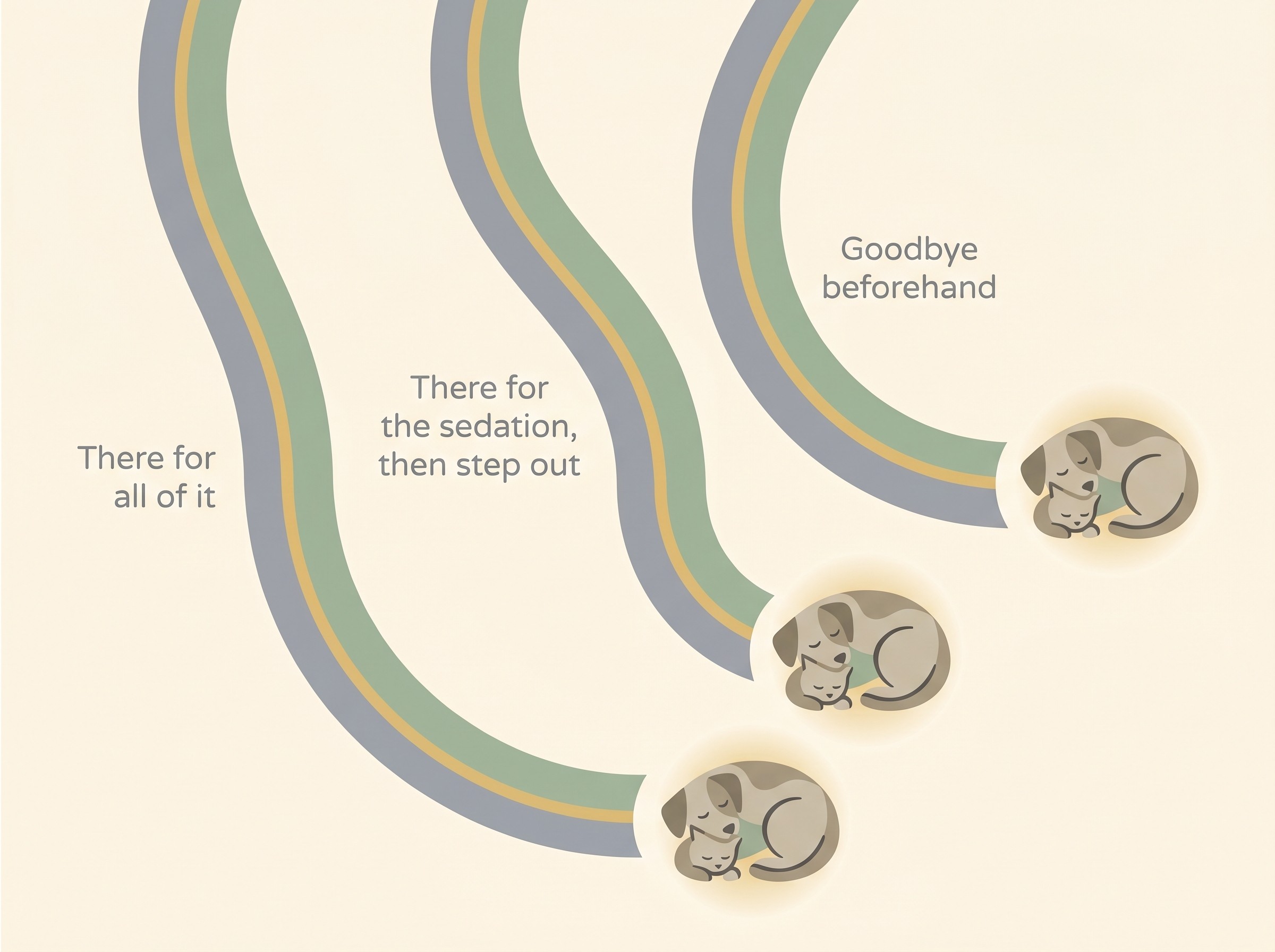
Most owners do not realise that this is not a single yes-or-no door. There is a middle path, and for a great many people it turns out to be exactly the right one.
You can be there for the sedation, holding your pet and speaking to them as they drift gently to sleep in your arms, and then step out before the final injection. Because your pet is already asleep and unaware by that point, an owner who leaves then has been present for every single moment their pet could feel (AAFP, accessed 2026; PDSA, accessed 2026). You will have given them your voice and your hands for the whole of the part they can experience, and spared yourself the part you are afraid of. That is not a fudge or a half-measure. For the pet, it is complete.
There are other gentle variations, and your practice will know them all. You can say a long, unhurried goodbye beforehand and then leave. You can say goodbye beforehand and ask to come back in afterwards to sit with them quietly. If you choose to come back, you can ask for your pet's eyes to be gently closed before you return, so that your last sight of them is a peaceful one (APLB, accessed 2026). And you can change your mind in the moment, in either direction: if you planned to stay and find when it comes to it that you cannot, it is completely all right to step out (PDSA, accessed 2026); if you planned to leave and find you want to stay, that is fine too. Just tell the vet beforehand that you might, and they will make whichever it turns out to be feel easy and unhurried.
A little gentle scaffolding
A few small, practical things make this softer, and then I will leave the logistics where they belong.
Tell the practice your wishes in advance, so that no one has to ask you a hard question in the moment and you do not have to make this decision with your hand already on the door. Whatever you choose, try not to be alone afterwards if you can possibly help it: have someone with you, and ideally someone who can drive you, because you will not be in a fit state to drive yourself. The fuller question of where to say goodbye, at home or at the clinic, and all that surrounds it, lives in at home or at the clinic. And if there are children in your family, whether they should be present is its own separate decision, with its own careful guidance, in should children be there when a pet is put to sleep. It is not the same question as yours, and it deserves its own thought.
What you are really giving them
Here is where I would leave you, the night before, with the question finally set down.
Whatever you choose, the last and largest thing you give your pet is not your physical presence at a clinical moment they will sleep through. It is a goodbye made in tenderness rather than in panic. It is a hand or a voice during the part they can still feel, if that is what you choose, or a team's practised gentleness if it is not, and either way a calm that they can sense while they are still aware. And it is this: a decision you reached carefully, in love, by the kitchen table, instead of one wrenched out of you in fright at the door. That version, the calm one, the one you chose rather than the one panic chose for you, is the one you will find easiest to carry in the long mornings afterwards.
Your pet is at peace either way. Now choose the way that lets you find yours.
If the weight of all this feels like more than you can carry, you do not have to carry it alone. The Samaritans are there free, day or night, on 116 123. The Blue Cross Pet Bereavement Support Service offers free, confidential support around losing a pet, before and after, on 0800 096 6606 (8.30am to 8.30pm, every day) or by email at pbssmail@bluecross.org.uk. For cat owners, Cats Protection Paws to Listen is on 0800 024 9494, and The Ralph Site (theralphsite.com) offers a wider online community of people who understand exactly this kind of loss.
References
- Adams, C. L., Bonnett, B. N., & Meek, A. H. (2000). Predictors of owner response to companion animal death in 177 clients from 14 practices in Ontario. Journal of the American Veterinary Medical Association, 217(9), 1303-1309.
- Adrian, J. A. L., & Stitt, A. (2019). There for You: Attending Pet Euthanasia and Whether this Relates to Complicated Grief and Post-Traumatic Stress Disorder. Anthrozoös, 32(5), 701-713.
- American Association of Feline Practitioners (AAFP). (accessed 2026). End of Life Educational Toolkit: The Euthanasia Process. catvets.com.
- American Veterinary Medical Association (AVMA). (2020). AVMA Guidelines for the Euthanasia of Animals: 2020 Edition. American Veterinary Medical Association.
- Association for Pet Loss and Bereavement (APLB). (accessed 2026). Understanding Euthanasia. aplb.org.
- Blue Cross Pet Bereavement Support Service (PBSS). (accessed 2026). Pet bereavement and pet loss support. Freephone 0800 096 6606, every day 8.30am to 8.30pm; email pbssmail@bluecross.org.uk.
- Cloud9 Vets. (accessed 2026). At-home pet euthanasia: dog and cat euthanasia. cloud9vets.co.uk.
- Lap of Love. (accessed 2026). What to Expect During In-Home Pet Euthanasia. lapoflove.com.
- Morris, P. (2012). Managing Pet Owners' Guilt and Grief in Veterinary Euthanasia Encounters. Journal of Contemporary Ethnography, 41(3), 337-365.
- PDSA. (accessed 2026). When it's time to say goodbye. pdsa.org.uk.
- Pierce, J. (2013, October 15). Animal Euthanasia and Traumatic Stress. Psychology Today.
- Royal College of Veterinary Surgeons (RCVS). (accessed 2026). Code of Professional Conduct for Veterinary Surgeons, Supporting Guidance, Chapter 8: Euthanasia of animals. rcvs.org.uk.
- Silva, M. V., Santos, R. R., & Barbosa, M. (2025). Euthanasia and prolonged grief: A cross-sectional study with bereaved pet owners. Journal of Veterinary Behavior: Clinical Applications and Research, 79, 60-67.
Free downloads
Companion worksheets to put what you've read into practice. Free PDFs, print at home.