Measuring Quality of Life: The HHHHHMM Scale, and How to Use It
Alastair Greenway
BVM&S MRCVS
The feeling moves too much to look at, and that is the cruellest part of watching a pet you love decline. Some mornings you are almost sure. By the afternoon, when they lift their head for you or finish their dinner, you are sure of the opposite. The question of whether their life is still good will not sit still long enough to look at, and the not-knowing is exhausting in itself. What most owners want at this point is not a verdict. It is something to hold: a way to turn an unbearable, shifting feeling into something you can actually look at, week to week, and bring to your vet.
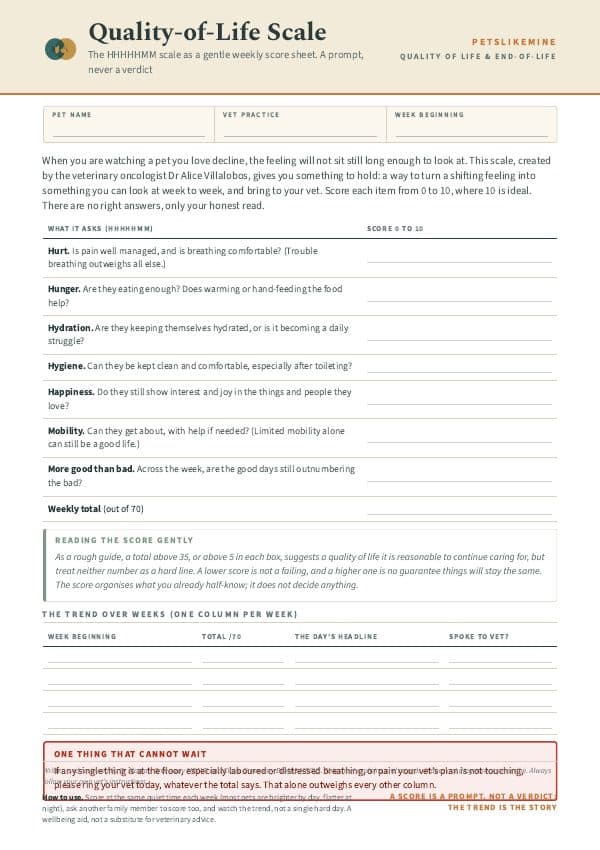
That is exactly what a quality-of-life scale is for. The one used most across the profession is the HHHHHMM scale, created by the veterinary oncologist Dr Alice Villalobos, and this page is about how to use it well, dimension by dimension, for your own cat or dog. A score is a prompt, not a verdict. It does not decide anything. It organises what you already half-know and gives you and your vet something concrete to talk about. No one can make this decision for you, but you do not have to make it alone, and your vet will help you weigh it. The decision itself, the wider "how will I know," is its own conversation in how will I know when it is time; here I just want to hand you the tool.
Where the scale comes from, and why that matters
The provenance matters, because it tells you the tool is trustworthy rather than something assembled on a blog. Dr Villalobos first published the idea in 2004, in a column titled "Quality of Life Scale Helps Make Final Call," then built the scored table version for her textbook Canine and Feline Geriatric Oncology: Honoring the Human-Animal Bond (Blackwell, 2007), and it was later revised for the 2011 palliative-care and hospice guidelines of the International Veterinary Academy of Pain Management (Villalobos, 2004/2007). She designed it for her "Pawspice" programme, a quality-of-life approach to terminally ill pets that begins at diagnosis and transitions into hospice as the end nears, and the opening line of the scale names its purpose plainly: caregivers can use it "to determine the success of Pawspice care" (Villalobos, 2004/2007). In other words, it was built as a working tool for owners and vets together, to check whether comfort care is doing its job, not as a green light or a red light.
It is also more than a popular handout. When researchers in Italy formally tested its psychometrics in 314 owners (295 of whom completed the scale), all seven dimensions loaded significantly and internal consistency was acceptable, and the authors concluded it is "an accessible and easy-to-understand tool for assessing the QoL of terminal animals" that can help owners avoid regret and guilt afterwards (Testoni et al., 2023). It is fair to say it has been validated in one sample; it is not fair to say it has been "proven" in the sense of a clinical-outcome trial, and the statistical fit was good only after two technical adjustments (Testoni et al., 2023). But for a frightened owner who wants to know this is a real instrument rather than something invented, that is the reassurance: it holds up.
The seven dimensions, in plain terms
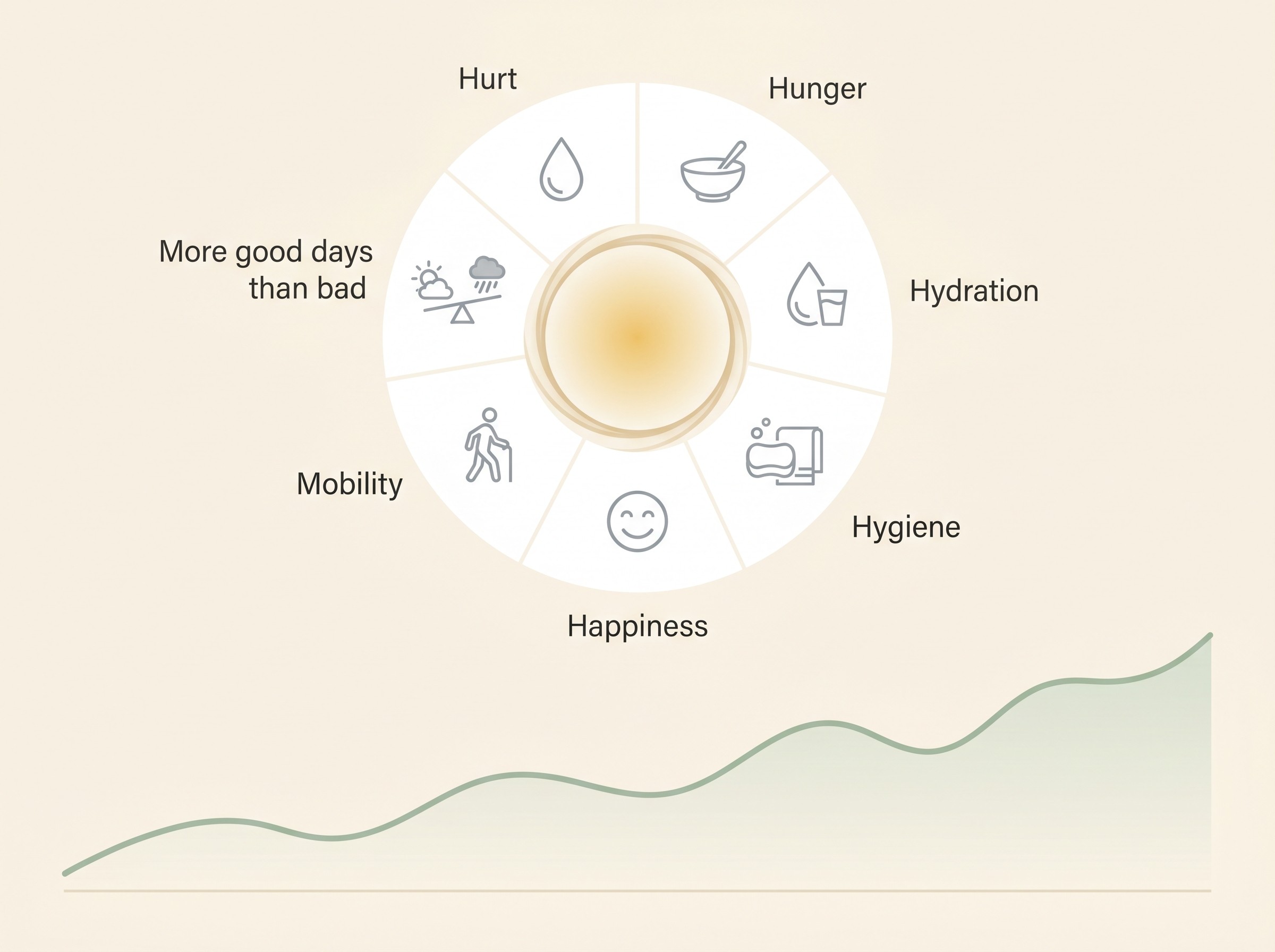
HHHHHMM is an acronym for the seven things it asks you to look at: Hurt, Hunger, Hydration, Hygiene, Happiness, Mobility, and More good days than bad (Villalobos, 2004/2007). You score each one from 0 to 10, with 10 being ideal, and the original document takes a total over 35 (out of 70) as representing an acceptable quality of life to continue with hospice care (Villalobos, 2004/2007). You will see slight variations in reputable places: VCA, for instance, paraphrases the range as "1 to 10, with 10 being the best" and adds the working rule of thumb that "a score above 5 in each category, or an overall score greater than 35, suggests that the dog's quality of life is acceptable" (VCA, n.d.). Treat 0 to 10 as the original and "above 5 per category" as a useful informal check, and treat neither number as a hard line. Let me take the seven in turn, with the actual things the scale asks, translated into what they look like across a kitchen and a cat tree.
Hurt comes first, and deliberately so. The scale asks whether pain is well managed, whether the pet can breathe properly, and whether oxygen support is needed, and it states outright that "trouble breathing outweighs all concerns" (Villalobos, 2004/2007). Hold onto that: laboured or distressed breathing is weighted above everything else here, and is a reason to phone the vet today regardless of any total. Pain is harder, because cats and many dogs are masters at hiding it. The deep work of spotting masked pain, including the validated Feline Grimace Scale for cats, belongs to spotting pain in a pet who hides it, and it is worth reading; here, just score frankly whether the pain plan your vet has given you is genuinely working.
Hunger asks whether the pet is eating enough, whether hand-feeding helps, and whether a feeding tube is needed (Villalobos, 2004/2007). For a dog, the signal is often turning down food they would once have mugged you for. For a cat, it can be subtler: sitting at the bowl but not eating, or eating only if you warm the food and offer it from your hand. The eating and drinking changes of the final weeks, and when to stop pushing food, are owned by appetite, hydration and the final weeks; here you are simply marking where things stand.
Hydration asks whether the pet is dehydrated, and notes that for pets not drinking enough, vets can supplement with fluids given under the skin at home (Villalobos, 2004/2007). I will not teach that technique here, partly because your vet should show you on your own pet, and the practicalities live in the appetite-and-hydration piece above. Score it simply: are they keeping themselves hydrated, or is it becoming a daily struggle?
Hygiene asks whether the pet can be kept clean, particularly after toileting, and whether pressure sores are being prevented with soft bedding and clean wounds (Villalobos, 2004/2007). This dimension carries a quiet emotional weight, because dignity matters to us on their behalf. For a cat, watch the coat: a once-fastidious cat with a greasy, matted, ungroomed look is telling you something, because grooming is one of the first things a cat lets go when it feels unwell. For a dog, the signal is often soiling they can no longer move away from.
Happiness asks whether the pet still expresses joy and interest, whether it responds to family and toys, whether it seems depressed, lonely, anxious, bored or afraid, and whether its bed can be moved closer to family activity (Villalobos, 2004/2007). This is the "interest in life" dimension, and the trick is to ground it in the specific things this animal loves. Not "is she happy" in the abstract, but: does she still pad to the window for the school run, still headbutt you at six for dinner, still thump her tail when her person comes through the door?
Mobility asks whether the pet can get up unaided, whether it needs human or mechanical help such as a cart, whether it still feels like a walk, and whether it is having seizures or stumbling (Villalobos, 2004/2007). The scale adds a caveat I want to quote exactly, because it lifts a real fear: "an animal with limited mobility yet still alert, happy and responsive can have a good quality of life as long as caregivers are committed to helping their pet" (Villalobos, 2004/2007). Losing mobility is not, by itself, the end. There is also a species nuance here that genuinely matters and that a raw number can hide. A large dog who can no longer stand or be lifted runs into hygiene and pressure-sore problems fast, so for a big dog mobility carries real downstream weight. A cat lives in a much smaller world, so a cat can lose a great deal of mobility and still potter, eat and keep clean. Do not let a single low mobility score read the same way for a cat as it would for a giant-breed dog.
More good days than bad is the seventh dimension and the one that ties the rest together. The scale puts it plainly: "when bad days outnumber good days, quality of life might be too compromised," and when a healthy bond with the family is no longer possible, the caregiver should be made aware that the end is near (Villalobos, 2004/2007). This is the integrating question, and watching it properly, with a calendar, a marble jar, lines drawn in the sand while you are still calm, is a whole method in itself. I am introducing it here as the seventh dimension and then handing the tracking method over to more good days than bad: tracking the trend, which is where it is taught in full.
A score is a prompt, not a verdict
I said it at the top, and I am saying it again here because this is where it lands. The number does not decide. Its stated job is to help you "determine the success of Pawspice care" and to help owners and vets "work together to maintain a healthy human-animal bond" (Villalobos, 2004/2007; VCA, n.d.), not to issue a ruling. The veterinary hospice service Lap of Love puts the whole thing into a single sentence I would have every owner pin up: "the scale helps organize your thoughts, not make decisions for you" (Lap of Love, n.d.). And they add a line that I think quietly heals a lot of guilt: "a lower score does not mean you've failed your pet, and a higher score does not mean things will stay the same forever" (Lap of Love, n.d.). So please do not score your pet one evening, arrive at 33, and feel that a door has closed. A score below a threshold, or one dimension scoring at the floor, is a prompt to pick up the phone, not an instruction. No one can make this decision for you, but you do not have to make it alone, and your vet will help you weigh it.
When love holds the pen, score honestly
Here is the hard truth about every owner-facing quality-of-life scale, HHHHHMM included: it is an observer-reported tool, filled in by the person who loves the animal most, so it inevitably carries a subjective read of behaviour. A 2022 scoping review of nine such tools for dogs and cats found that, although aspects of reliability and validity had been examined for most of them, "none were validated across all measures," and described quality of life itself as a "challenging concept to define due to its multi-faceted and subjective nature" (Fulmer, Laven & Hill, 2022). I am not telling you that to make you distrust the scale. I am telling you because it is precisely why the following structure beats relying on your gut, and why a little method protects you from your own love.
The bias runs in both directions, and both are deeply human. Some of us under-score out of hope, reading every good hour as proof that things are fine. Others over-score out of exhaustion and dread, so worn down that we cannot see the good days still there. The fix is not willpower, it is structure, and there are two simple, evidence-grounded techniques you can use tonight, both drawn from the Lap of Love printable sheet.
The first: ask someone who sees your pet less often to score too, and compare. Lap of Love's own guidance is to "request multiple members of the family complete the scale; compare observations" (Lap of Love, n.d.). The person who lives with the decline every day is the very person to whom gradual change is invisible. A relative who visits monthly, or a friend who has not seen your dog since the summer, will often catch in a moment what daily proximity has hidden from you. If your scores and theirs diverge sharply, that gap is itself useful information, and how to handle genuine disagreement, whether between family members or with your vet, is owned by when the family or the vet sees it differently.
The second: take periodic photos or short videos, and compare them against earlier weeks. The sheet suggests you "take periodic photos of your pet to help you remember their physical appearance" (Lap of Love, n.d.). A clip from three months ago is an unsentimental witness. It does not flatter and it does not catastrophise; it simply shows you how your pet moved, ate and held themselves then, against how they do now, and that comparison cuts through the fog of daily adjustment better than memory ever can.
Score on a rhythm, because one day lies
A single day is a poor witness, in either direction, which is why the most useful thing the scale gives you is not one number but a series of them. Lap of Love's cadence guidance is sensible and gentle: for a stable senior pet, "a quick daily check-in plus a weekly quality-of-life scale score is a helpful rhythm"; if things start to worsen, "score daily for 7 to 14 days to see trends clearly"; and throughout, "focus on the pattern across days, not a single score" (Lap of Love, n.d.). Weekly is the natural rhythm to start with. One more practical detail from the printable sheet: most pets are brighter by day and flatter at night, so the advice is to note these daily fluctuations, and in their own words, "most pets tend to do better during the day and worse at night" (Lap of Love, n.d.). The simple fix is to pick a consistent time, the same slot each week, and stick to it, so a single rough evening does not skew the whole picture. The full method of reading that pattern, the good-day calendar, the marble jar, the lines you set in advance, all of it lives in tracking the trend.
When one bad dimension outweighs a good total
The total is a helpful summary, but it can lull you, so hold one principle alongside it: a single severe dimension can outweigh several good ones. The Hurt section says it directly about breathing ("trouble breathing outweighs all concerns"), and the same logic applies to pain that medication is not touching (Villalobos, 2004/2007). A pet can score well on hunger, hygiene and happiness and still be suffering badly if it cannot breathe comfortably or is in pain you cannot control. The wider welfare principle behind this is that good welfare means an animal that not only functions but actually feels well, rather than one that merely ticks boxes (AVMA, 2020). So if any single dimension is sitting at the floor, especially breathing or uncontrolled pain, that alone is a reason to ring your vet, whatever the total says.
When the wording feels too clinical: other scales point the same way
HHHHHMM is the canonical scale, but it is not the only good one, and naming the alternatives is a kindness rather than a confusion. If its language feels too clinical to answer at 11pm, the JOURNEYS scale (Dr Katie Hilst, also published as Kathryn Willett) covers very similar ground in warmer, owner-facing words: J for Jumping or mobility, O for Ouch or pain, U for Uncertainty and understanding (the factors affecting you), R for Respiration, N for Neatness or hygiene, E for Eating and drinking, Y for You, and S for Social ability (Willett, 2014/2023). Each row is scored to 10, so a total of 80 is "a happy, healthy pet" and a total of 8 is "a pet that is suffering," and the author frames it gently: "there are no hard and fast rules, although in general a higher score is better," and "please use this as a starting place to explore your pet's quality of life, and address your concerns with your veterinarian" (Willett, 2014/2023). The Lap of Love scale is a third option, built around four domains and scored the other way round, so that a lower total means better quality of life rather than higher (Lap of Love, n.d.); if you use more than one, do not blur their numbers together. The takeaway is simple: pick the one whose wording you can actually answer when you are tired and frightened. They all point the same way.
One feature these scales share gives quiet permission you may need: the best of them score you, too. JOURNEYS deliberately includes "U, Uncertainty and Understanding (factors that affect YOU)" and a standalone "Y, You" (Willett, 2014/2023). Lap of Love pairs its pet scale with a separate "Pet Family Concerns" sheet that asks about your worries: whether your pet is suffering, the fear of them dying alone, not knowing the right time, the effect on other animals and people in the home, and your own capacity to cope and to give nursing care (Lap of Love, n.d.). Your exhaustion, your fear and your circumstances are not selfish intrusions on the decision; the leading scales say plainly that they are a legitimate part of the picture. The fuller weight of that, the guilt, the relief, the financial reality, none of it shameful, is held with care in the guilt is normal.
Making it doable today
None of this works if it stays theoretical, so the point is to start, lightly, tonight. The quickest way is our in-app Quality-of-Life Check, a low-friction HHHHHMM snapshot you can run in a couple of minutes; a printable QoL sheet does exactly the same job on paper if you would rather hold a pen. And if you want to watch the trend over weeks rather than judge a single bad day, that is part of what we built Sightline for. Sightline (sightline.vet), a separate ConciergeVet tool, runs a short adaptive weekly assessment with a quality-of-life focus mode built around exactly these frameworks, tracks a single composite score over time so you can see the trend rather than judge a single bad day, and produces a Sightline Report PDF you can bring to your vet. A written log, or our printable QoL sheet, does much the same job, so do not feel pushed towards anything: use whatever you will actually keep up.
Whichever you choose, the gift of the scale was never a number. It is a shared language. A few candid scores at the same time each week, a relative's second opinion when yours feels clouded, a photo from last month for company, and the picture stops being a feeling that changes by the hour and becomes something you can read. So the next conversation with your vet starts from something real instead of from panic, and what you are reading together is the trend, not a single hard day. When you are ready to turn those weekly scores into a pattern you can act on, tracking the trend is the next step, and the recurring truth holds all the way through it: no one can make this decision for you, but you do not have to make it alone, and your vet will help you weigh it.
References
- AVMA. (2020). AVMA Guidelines for the Euthanasia of Animals: 2020 Edition. American Veterinary Medical Association.
- Fulmer, A. E., Laven, L. J., & Hill, K. E. (2022). Quality of life measurement in dogs and cats: a scoping review of generic tools. Animals, 12(3), 400.
- Lap of Love Veterinary Hospice. (n.d.). Lap of Love Pet Quality-of-Life Scale (printable sheet, 2024 edition) and How do I use Lap of Love's Quality-of-Life Scale? (usage page). · https://info.lapoflove.com/how-do-i-use-lap-of-loves-quality-of-life-scale
- Testoni, I., De Vincenzo, C., Campigli, M., Caregnato Manzatti, A., Ronconi, L., & Uccheddu, S. (2023). Validation of the HHHHHMM scale in the Italian context: assessing pets' quality of life and qualitatively exploring owners' grief. Animals, 13(6), 1049.
- VCA Animal Hospitals. (n.d.). Quality of Life at the End of Life for Your Dog.
- Villalobos, A. E. (2004/2007). Quality of Life Scale (The HHHHHMM Scale). Originally "Quality of Life Scale Helps Make Final Call", Oncology Outlook, Veterinary Practice News, September 2004; scale format created for Canine and Feline Geriatric Oncology: Honoring the Human-Animal Bond, Blackwell Publishing, 2007; revised for the IVAPM 2011 Palliative Care and Hospice Guidelines.
- Willett, K. (Hilst, K.). (2014/2023). J-O-U-R-N-E-Y-S: A Quality of Life Scale for Pets. © 2014, 2023 Kathryn Willett (also published as Dr Katie Hilst, DVM). Hosted copy: International Association for Animal Hospice and Palliative Care.
Free downloads
Companion worksheets to put what you've read into practice. Free PDFs, print at home.