When the Family or the Vet Sees It Differently
Alastair Greenway
BVM&S MRCVS
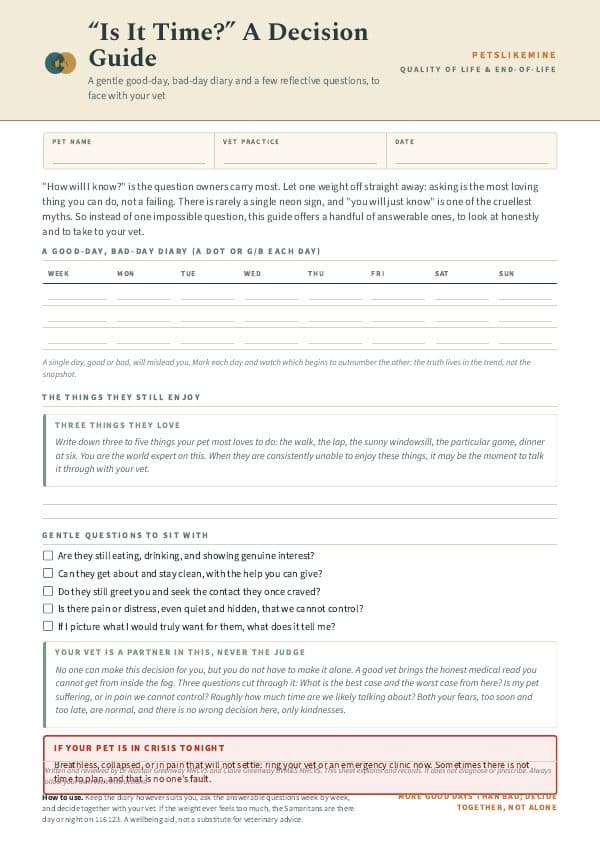
Most of these pages are written for one frightened owner standing over a beloved animal. This one is different. Here you are that owner, but you are standing inside a frightened, grieving, divided family, and very often feeling alone in there too. Your husband thinks it is time and you are not ready. Your wife cannot bear to let go, and you watch the nights and think someone has to say it. A grown-up child phones from another city and cannot believe you would "give up". You do the hands-on nursing while a relative drops in at the weekend, sees the dog rally for ten minutes of fuss, and goes home reassured. Or it is your own vet who seems to be reading the situation differently from how you feel it in your bones.
Whichever of those you are living tonight, here is the first thing, and I mean it as fact, not comfort. The person you are at odds with is not your opponent. They love the same animal you do, and they are grieving too. A divided household is not a sign that someone loves your pet less, or is being cruel, weak or unreasonable. It is what happens when several people who all love the same animal see different parts of the same picture, and grieve at different speeds. This page will not take a side on whether it is time, because no one truthfully can from the outside. What it can do is take some of the heat out, give you a shared language, point you to a neutral broker, and a path to a decision you can all, eventually, live with, including what to do when, despite everything, you genuinely cannot agree.
Why loving people land in different places
Once you see why this happens, the other person stops looking unreasonable and starts looking human. People disagree about whether it is time not because one is right and one is wrong, but because they are genuinely seeing different things.
Start with the simplest reason: different windows onto the same animal. The person doing the daily nursing sees the whole day, the medication that gets spat out, the accidents on the kitchen floor, the long struggle to stand, the food left untouched, the bad nights. The family member who is out at work, or who visits at weekends, sees something quite different: the pet rallies for a familiar face, wags or purrs for ten minutes, and concludes, in good faith, that there is plenty of time left (Healing Touch Pet Care, n.d.). Neither is lying. They are describing different hours of the same animal's day.
Then there is grief itself, which colours what each person can bear to look at. Ohio State's guidance for families puts it directly: "even members of the same household may have differing opinions of a pet's quality of life, and that these opinions may be colored by each family member's anticipatory grief process" (Ohio State, Honoring the Bond, 2024). Denial is a recognised, protective early response to a grave prognosis, more likely when the decline has been sudden than when it has come on slowly over months and an owner is more "emotionally braced" for bad news (Texas A&M VMTH, n.d.). So the relative who insists "she's fine, look, she ate this morning" may not be denying the facts so much as not yet able to stand inside them. That is grief, not obstruction.
Experience matters too. Someone facing their first pet death may simply have no reference point for what the end of a life looks like, and may not recognise significant decline when it is in front of them (Healing Touch Pet Care, n.d.); families who have walked this road before often reach the decision sooner, not because they care less, but because they recognise the signs (Lap of Love, n.d.). And even with exactly the same information, people grieve at different rates. The literature is clear that "the order, duration, and extent of the stages of grief vary greatly," that for some it is overpowering and for others mild, and that for some it begins at once while for others it takes far longer to start (Texas A&M VMTH, n.d.).
Nobody here is necessarily wrong. They are standing in different places, looking through different windows, at different stages of the same grief.
Holding fresh eyes and the carer's knowledge together
Here is a tool that cuts both ways, and it must be handled with care. Ohio State's guidance: "you may want to ask someone who sees your pet less frequently, since your pet's gradual decline in health, mobility or comfort may be more obvious to them," and comparing photos or videos from before the illness does the same job, an unsentimental witness to how much has changed (Ohio State, Honoring the Bond, 2024). When you are with an animal every day, a slow decline hides in plain sight: you adjust to each small loss as it happens, so the cumulative change becomes invisible to you while a relative who hasn't visited in two months is quietly shocked.
But this point sits in deliberate tension with the next, and you have to hold both. The fresh-eyes tool is for clearer seeing, not for recruiting allies to outvote the primary carer. Because the carer holds information no one else does: how the nights really go, how much is truly being eaten when no one is watching, how long it now takes to get up, where the pain lives, the moment the once-fastidious cat stopped grooming and started hiding. Lap of Love puts the authority plainly: "you know your pet better than anyone, including your veterinarian" (Lap of Love, n.d.). When a family cannot reach a clean consensus, one honourable and common resolution is precisely that the others come to trust and defer to the carer's daily observations (Healing Touch Pet Care, n.d.).
So both things are true at once. The carer can be too close to see the slow slide clearly, which is why fresh eyes help; and the carer's lived, daily knowledge is authoritative, and is not to be overruled by someone who drops in for an hour and catches the good ten minutes. Neither perspective is the whole truth, and both are data. Hold that balance and you have already drawn most of the poison out of the disagreement.
Your vet as honest broker, never the tie-breaker
When a household is stuck, the instinct is to find someone to settle it, often the vet. So let me be precise about what your vet can and cannot do. A family at an impasse can ask for a quality-of-life consultation: a shared, professional baseline of objective observations about comfort, pain and physical function, so the conversation starts from the same medical facts rather than from competing fears (AVMA, 2020; Healing Touch Pet Care, n.d.). But the role is bounded. As Ohio State puts it, "even though your veterinarian cannot make the euthanasia decision for you, they will be able to give you an honest medical perspective about your pet's current condition and comfort" (Ohio State, Honoring the Bond, 2024). The vet's job, in Lap of Love's words, is "to help a family make this difficult decision," not to make it for them (Lap of Love, n.d.).
There are three questions a divided family can put to the vet together, in the same room, so everyone hears the same answer at once: the best and worst case for whatever options remain; the vet's candid perception of any pain or suffering the pet may be experiencing; and an estimate of life expectancy (Ohio State, Honoring the Bond, 2024). "In the same room" is the point. The vet is a neutral source of medical reality for all of you, not an authority for whichever side gets to them first. Do not go to be backed up against your family; go, together, to hear the same truth. No one can make this decision for you, but you do not have to make it alone, and your vet will help you weigh it. The wider framework for the decision itself lives in how will I know when it is time.
It helps to understand the vet's own limits, too, because the disagreement sometimes gets displaced onto the practice: "I asked and the vet won't do it," or, just as painful, "the vet thinks we should and we're not ready." In the UK, the vet's proper role is to make sure you can give informed consent, having weighed the reasonable options including euthanasia, with the significance and main risks explained, and the decision then rests on your informed wishes (RCVS, Code of Professional Conduct). But a vet is not a vending machine: no veterinary surgeon is obliged to end the life of a healthy animal, and where in conscience a vet cannot accede to a request, the Code requires them to recognise the extreme sensitivity of the situation and make sympathetic efforts to direct you to another vet and other sources of advice (RCVS, Code of Professional Conduct). Take that as reassurance, not a loophole: you are never trapped with a single opinion, and a vet who declines is bound to help you find another perspective. What anchors this decision, in the end, is the animal's welfare and the medical reality, not who argues hardest.
The children's voices, heard but not burdened
Children who love the pet deserve to be heard and, where they wish it, included. Ohio State's own list of questions explicitly invites a family to consider whether "there are friends or family members who are close to my pet and would like to be included in this decision" (Ohio State, Honoring the Bond, 2024), which legitimises bringing the wider circle in. But there is a discipline here I will not soften: a child's view is part of the conversation, and a child must never be made the deciding vote. No child should be left feeling that they "chose" to let the pet die, or "chose" to make them wait. That is a weight no child should carry. So include them, listen to them, but keep the decision in adult hands. How to actually talk to a child about a dying pet, the words to use, what suits which age, and a conscious goodbye, is owned by preparing the family and children when a pet is dying; and if the question reaches whether a child should be present at the end, that is its own careful piece, should children be present at euthanasia.
When money runs underneath the disagreement
Disagreement is often tangled up with money, and pretending otherwise helps no one. One family member wants to pursue more treatment; another knows, quietly and miserably, that the household cannot sustain it; and the guilt and resentment between those two positions can be brutal. I will name it without taking a side. Money is a legitimate and human part of these decisions. Everyone has limits. A decision shaped by what a family can realistically afford is not cruelty, and the person who raises it is not heartless. The guilt that rides alongside all of this, the cost, the fear of "giving up," the relief that feels forbidden, has a whole piece of its own in the guilt is normal. The house rule applies straight across the board, so I will state it plainly: no judgement on the person who is not ready, on the one who thinks it is time, on the one who cannot face being in the room, or on the one worrying about cost. Each of them loves the animal. Each is afraid of a different thing.
When the strain becomes too much to carry
I need to pause here, because a primary carer can be far closer to breaking than they will ever admit. Carrying the hands-on nursing of a dying animal, your own anticipatory grief, and a household that cannot agree, all at once, is one of the heaviest things a person can hold. If you are that person, and you have reached a point where you feel you cannot go on, please talk to someone now. The Samaritans are there on 116 123, free from any phone, day or night, 365 days a year, and you do not have to be in crisis, or suicidal, to call (Samaritans, n.d.). Reaching out is not weakness, and it is not letting your family down. It is how people get through things this hard.
What "agreement" can actually look like
"Everyone must agree" is a high and sometimes impossible bar, and chasing it can do more harm than the disagreement itself. In practice, agreement comes in more than one shape, and all are legitimate (Healing Touch Pet Care, n.d.; Lap of Love, n.d.). Sometimes a family reaches genuine consensus, everyone arriving, in their own time, at the same place. Sometimes they reach an understanding in which the others come to trust and defer to the carer's daily knowledge. And sometimes they agree, together, to wait, and to set a clear marker for when they will look at it again. Any of those is a decision a family can make peace with.
Two things make it easier, and both are about timing. The first is deciding early, before a crisis forces your hand. Ohio State recommends starting to think about these questions early, "when your mind may be more clear," because "decisions may seem forced or pressured if you wait until there is a crisis" (Ohio State, Honoring the Bond, 2024). A family that has talked calmly before they are standing in an emergency at midnight is far less likely to be torn apart by it. The second is keeping an objective shared record, so no one is arguing from a single snapshot: when the whole family looks at the same tracked trend over weeks rather than each defending the one day they happened to witness, "you only saw a good hour" and "you only saw a bad day" both lose their force. That is part of what we built Sightline (sightline.vet) for. Sightline, a separate ConciergeVet tool, runs a short adaptive weekly assessment with a quality-of-life focus mode built around exactly these frameworks, tracks a single composite score over time so the family can see the trend rather than judge one moment, and produces a Sightline Report PDF you can all bring to the vet together. A written log, or our printable QoL sheet, does much the same job.
If you genuinely cannot agree
If you have tried all of that and you are still deadlocked, I will not leave you with nothing. Here are some real options, offered as options, never instructions.
Go back to the medical facts, together. When opinion is stuck, a shared vet consultation re-anchors everyone in the same reality of comfort, pain and prognosis (AVMA, 2020; Ohio State, Honoring the Bond, 2024). Some findings carry disproportionate weight and can cut through a stalemate when nothing else will. Ohio State names two: unrelenting pain and extreme difficulty breathing "should weigh heavily in the euthanasia decision" and "constitute very poor quality of life, regardless of other factors" (Ohio State, Honoring the Bond, 2024), which fits the wider welfare picture that severe, unrelieved suffering is exactly what euthanasia exists to prevent (AVMA, 2020). A single one of the seven dimensions at the floor, severe pain even when much else still looks fine, is a reason to phone the vet, whatever anyone's overall impression (Ohio State, Honoring the Bond, 2024).
Set a shared line in the sand. Rather than arguing about today, agree together, while calm, on the specific change that would mean it is time: the day she can no longer get up on her own, the day he stops eating altogether, the third bad day in a row. This turns an open-ended standoff into a trigger you have all signed up to in advance, so that when it comes, the decision is already half made and made together. The method for setting and tracking that marker belongs to tracking the trend, not the day.
Keep the pet, not the argument, at the centre. The question was never "who is right." It is "what does our animal need from us now." The one thing no one wants, on any side, is for the pet to suffer needlessly, and returning the conversation, gently and repeatedly, to the animal's actual experience rather than to each person's readiness is very often what breaks the deadlock, because it is the one thing you all already agree on.
Get support for the family, not only the pet. If the disagreement is straining your relationships beyond the decision itself, it is entirely reasonable to bring in a third party: your veterinary team, a veterinary social worker where one is available, a counsellor, or a pet-bereavement line that will listen to all of you. That is not failure. Conflict at the deathbed of a loved family member, which is what this is, is one of the heaviest things a household ever carries.
A family that disagrees is a family that loves
The disagreement is not proof that one of you cares less. It is proof that you are both grieving the same impending loss, in your own way and at your own pace. The goal was never to win the argument. It is to reach a decision the whole family can eventually make peace with, and the surest way there is to keep doing the one thing in your power: return the conversation, again and again, to what your animal needs from you now, with your vet alongside to read the medical reality with you.
If the strain is real, and in a divided household it usually is, please reach out, and do it now rather than after, because support before a loss is not too soon. The Blue Cross Pet Bereavement Support Service (0800 096 6606, 8.30am to 8.30pm every day, free and confidential) supports anticipated loss, before the death as well as after, and will hear a whole grieving household, not just one person (Blue Cross, n.d.). Cats Protection's Paws to Listen (0800 024 94 94, Monday to Friday 9am to 5pm) explicitly supports owners whose cat is nearing the end of life, including the anticipatory grief that begins before a cat has gone (Cats Protection, n.d.). Dogs Trust offers bereavement support too, with the gentle reminder that "there is no right or wrong way to process your emotions" (Dogs Trust, n.d.), and The Ralph Site (theralphsite.com) is a warm, non-judgemental community and resource for anyone facing the loss of a pet (The Ralph Site, n.d.). If children have been pulled into the disagreement, Child Bereavement UK (0800 02 888 40) can help any adult support a grieving child, including through the loss of a pet (Child Bereavement UK, n.d.). And if at any point the weight of it tips into feeling you cannot go on, the Samaritans are there day or night on 116 123 (Samaritans, n.d.). The full directory, and where to turn if grief becomes overwhelming, is gathered in pet loss support: where to turn. Reaching out while your family is still struggling to agree is not premature. It is exactly the right time, and no one has to weigh this alone.
References
- AVMA. (2020). AVMA Guidelines for the Euthanasia of Animals: 2020 Edition. American Veterinary Medical Association.
- Blue Cross. (n.d.). Pet Bereavement Support Service. Blue Cross (UK).
- Cats Protection. (n.d.). Paws to Listen grief support service and Coping with the loss of a cat. Cats Protection (UK). and https://www.cats.org.uk/help-and-advice/getting-a-cat/coping-with-the-loss-of-a-cat
- Child Bereavement UK. (n.d.). Helpline (0800 02 888 40). Child Bereavement UK.
- Dogs Trust. (n.d.). Bereavement support. Dogs Trust (UK).
- Healing Touch Pet Care. (n.d.). When Family Members Disagree About Pet Euthanasia.
- Lap of Love Veterinary Hospice. (n.d.). How Will I Know It's Time?
- Ohio State University Veterinary Medical Center, Honoring the Bond Program. (2024). How Will I Know? Assessing Quality of Life and Making Difficult Decisions for Your Pet (rev. March 2024).
- Royal College of Veterinary Surgeons. (n.d.). Code of Professional Conduct for Veterinary Surgeons: Euthanasia of Animals (supporting guidance).
- Royal College of Veterinary Surgeons. (n.d.). Code of Professional Conduct for Veterinary Surgeons: Communication and Consent (supporting guidance).
- Samaritans. (n.d.). How we can help / Contact us (116 123).
- Texas A&M University Veterinary Medical Teaching Hospital. (n.d.). Grieving (Small Animal Oncology).
- The Ralph Site. (n.d.). The Ralph Site: non-profit pet loss support.
- Villalobos, A. E. (2004/2007). Quality of Life Scale (The HHHHHMM Scale). Originally "Quality of Life Scale Helps Make Final Call," Oncology Outlook, Veterinary Practice News, September 2004; revised in Canine and Feline Geriatric Oncology: Honoring the Human-Animal Bond, Blackwell Publishing, 2007.
Free downloads
Companion worksheets to put what you've read into practice. Free PDFs, print at home.