

Feline cognitive dysfunction: the old cat who yowls and forgets
Alastair Greenway
BVM&S MRCVS
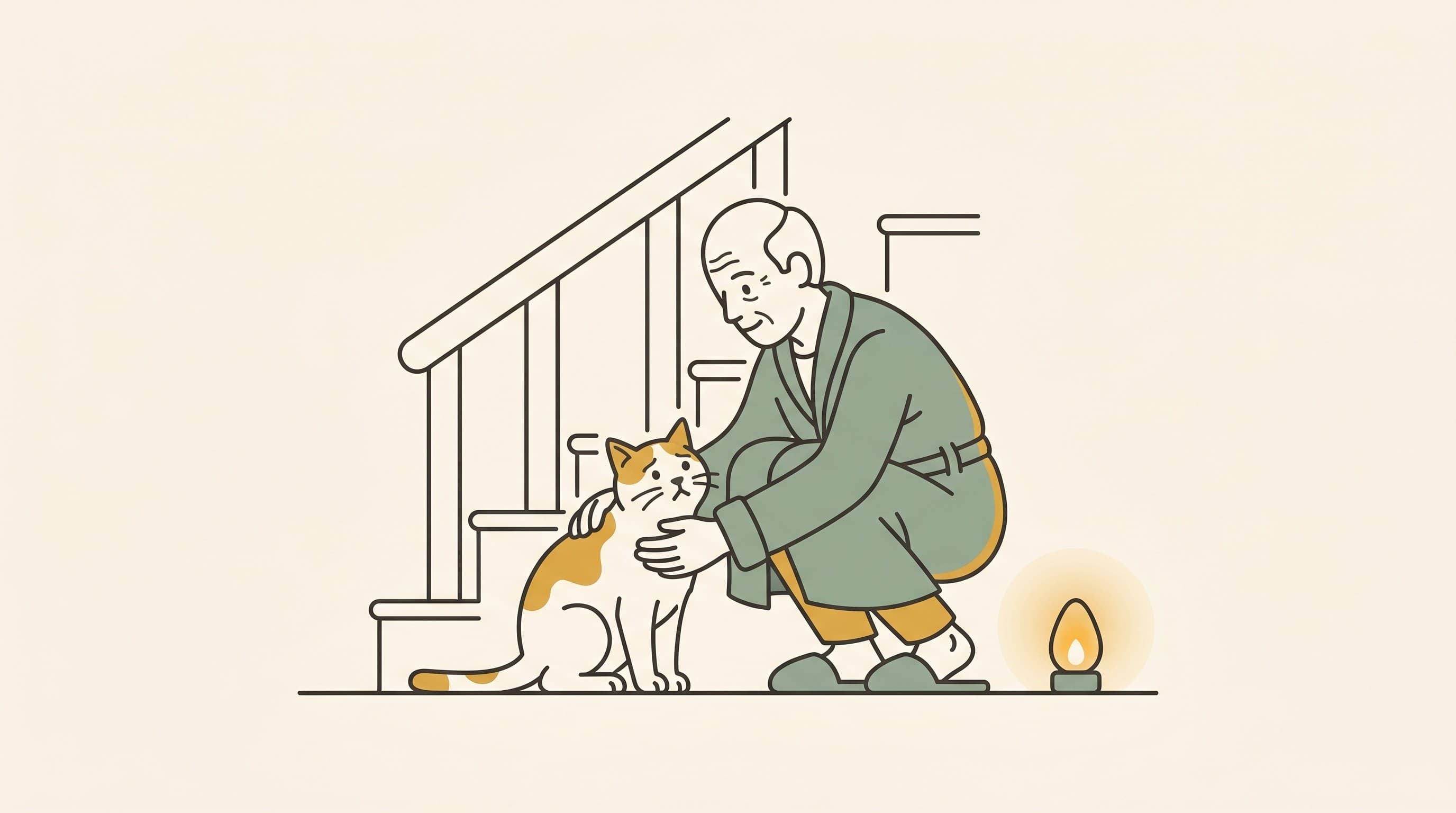
It usually starts in the small hours. A long, flat, oddly toneless yowl from the bottom of the stairs at three in the morning, from a cat who has lived with you for fifteen years and never once needed to announce herself like this. You go down. She is standing in a room she has slept in for a decade, staring at the wall, or at you, as if she cannot quite place either. You settle her, you go back to bed, and forty minutes later it begins again.
That cluster of behaviours is real, and it has a cause. The yowling, the staring, the misses just outside the litter tray, the way she seems to forget where things are tend to arrive together, and in an older cat they often mean that the years are catching up with her mind as well as her body. Plenty of people are padding downstairs at 3am to comfort a confused old cat, and you are not failing her by being one of them. This article is about that: what is happening, what has to be ruled out first because so much of it is treatable, and what actually helps her, and you, get through the nights.
What is happening to her mind
When a cat's memory and sharpness fade with age, vets call it feline cognitive dysfunction, sometimes described more plainly as feline dementia. That is the clinical name, and it is worth knowing once so you can use it with your vet. After that, it is kinder and more accurate to just think of it as an ageing mind getting cloudier, because that is what it is.
And it is a genuine, physical change, not your cat being stubborn or "difficult" in her old age. The brains of affected cats accumulate the same kinds of deposits, beta-amyloid plaques and abnormal tau, that are seen in people with Alzheimer's disease, which is why researchers now describe the ageing cat as one of the closest natural models we have of human dementia (Sordo and Gunn-Moore, Veterinary Record, 2021). The behaviour you are seeing is downstream of real changes in an ageing brain. She is not giving you a hard time. She is having a hard time.
It is also common, and far more common than most owners realise. Older work by Moffat and Landsberg, reported in the veterinary reviews above, found behavioural signs consistent with a declining mind in around 28% of cats aged 11 to 14, rising to roughly half of all cats aged 15 and over. Half. By the time a cat reaches her mid-teens, a cloudier mind is closer to the rule than the exception, even though hardly anyone talks about it.
How it shows up in a cat
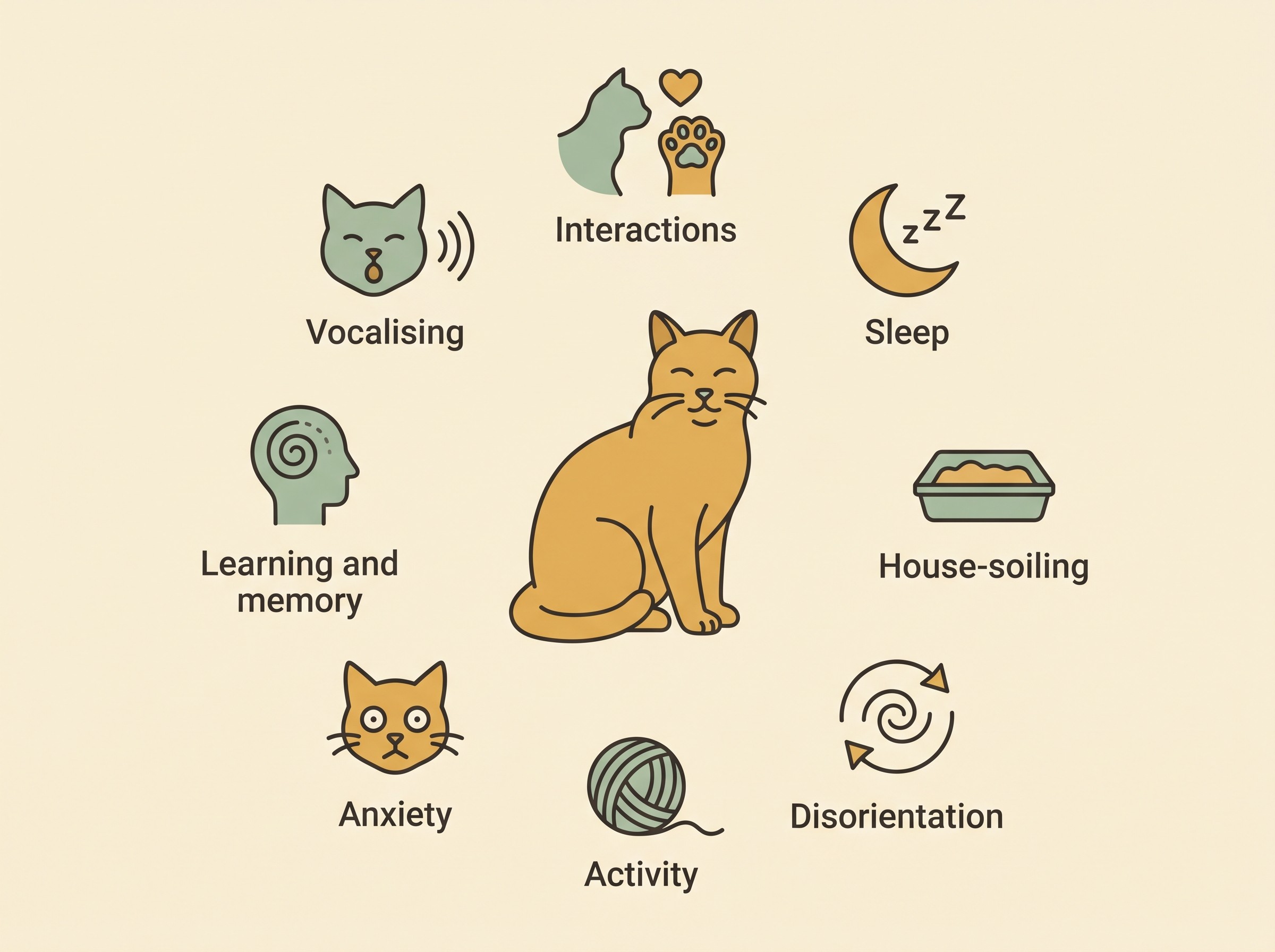
Dogs and cats lose their sharpness in broadly similar ways, but cats do it quietly and on their own terms, which is exactly why it gets missed. Vets sometimes use the checklist VISHDAAL to keep track of the signs, and in plain English it covers:
- Vocalising: the loud, often night-time yowl, frequently disoriented, frequently for no reason you can find. This is the single most common sign owners notice.
- Interactions changing: a cat who was aloof becoming clingy, or a lap cat retreating; new irritability when handled.
- Sleep flipping: more sleep in the day, more restlessness, pacing and waking at night. Her body clock has come loose.
- House-soiling: misses just outside the tray, or going somewhere she never would have before.
- Disorientation: getting "stuck" in corners, staring at walls, going to the hinge side of a door, seeming briefly lost in a familiar room.
- Activity changes: less play, less grooming, less interest, or aimless wandering.
- Anxiety: more easily startled, more clingy, less settled.
- Learning and memory: forgetting routines, names, where the food lives.
When owners of confused older cats were surveyed, the signs lined up almost exactly with the 3am picture so many people describe: inappropriate vocalising was reported in 40% of affected cats, restlessness at night in 31%, a change in how much they sought attention in 29%, and house-soiling in 26% (MacQuiddy et al., Journal of Feline Medicine and Surgery, 2022). If you recognise your cat in two or three of those, you are reading the right article.
Why almost nobody mentions it to the vet
An ageing feline mind hides in plain sight, and that is the quiet tragedy of it. The changes are gradual and undramatic, and they look so much like "she's just getting old" that owners rarely think to raise them. In the same survey, when owners were specifically asked about these behaviours, around three quarters of them reported at least one. But left to volunteer the information themselves, only about one in eight did (MacQuiddy et al., 2022). The signs were there. They simply went unsaid, filed under old age and never brought to the one person who could help.
So the most useful thing you can do, before anything else, is to start writing it down and then say it out loud at the next appointment. Note when the yowling happens, how the nights are going, where the accidents are, the moments she seems lost. You can log all of this in the Senior Wellness Check, where the Mind / Sharpness part is built for exactly these changes: it turns a vague "she's not quite herself" into a record your vet can actually read, and it shows you whether things are holding steady or slowly drifting. A pattern on a page is worth far more in the consulting room than a worried memory, and it is the difference between "she's old" and a proper conversation.
First, rule out the look-alikes
A cloudier mind is what doctors call a diagnosis of exclusion. That means it is the answer you reach only after you have ruled out everything else that can make an old cat yowl at night, forget her litter training, hide, pace or seem lost (MacQuiddy et al., 2022; Landsberg et al., Journal of Feline Medicine and Surgery, 2010). And the list of look-alikes is long, which is the hopeful part, because several of them are very treatable. Some of what looks like confusion may simply be fixable.
The conditions your vet will want to exclude include, among others:
- An overactive thyroid (hyperthyroidism). Classic in older cats, and a textbook cause of night-time yowling, restlessness and weight loss. This is exactly the kind of thing that masquerades as dementia and turns out to be manageable. It lives in our Hormone Health space.
- High blood pressure (hypertension). Often secondary to thyroid or kidney disease, it can cause vocalising and, frighteningly, sudden blindness, which itself causes disorientation. A simple blood-pressure check can catch it.
- Pain, usually from arthritis. Cats are masters at hiding it. A cat who is sore getting in and out of a high-sided tray will toilet beside it; a cat who hurts may become withdrawn or snappy and look "senile" when she is simply in pain. The Arthritis space and the Mobility Check are there for this.
- Kidney disease or diabetes. Both cause increased thirst and urination, which means more trips to the tray, more accidents and more night-time activity. See the Kidney (CKD) space and the Diabetes space.
- Fading sight or hearing. A cat who cannot see or hear well will bump, freeze, get lost and call out into the dark. That is sensory loss, not memory loss, and it is handled differently. See Vision and Eye Health.
- Dental pain and other illness. Sore teeth put a cat off her food and out of sorts.
- Disease inside the brain itself, such as a tumour, which a vet will consider if the picture is unusual or fast-moving.
One red flag deserves its own line, because it is the one people most often wave away. Weight loss in an older cat is never just old age. If your yowling, confused cat is also getting lighter, that is a reason to see the vet sooner rather than later, not a symptom of dementia to be accepted. Hyperthyroidism, kidney disease, diabetes, dental disease, gut problems and cancer all cause weight loss in senior cats, and all of them deserve a look. Please do not let "she's just old" be the thing that stops you booking the appointment.
The exclusion work-up is exactly what a good senior check is built around: a thorough physical exam, blood and urine tests, a blood-pressure reading and a thyroid test (total T4), with kidney markers like SDMA, run ideally twice a year because a year is a long time in an old cat's life. This is the standard of care set out in the 2021 AAFP Feline Senior Care Guidelines and the 2023 AAHA Senior Care Guidelines. Walking in with your tracked notes and asking directly, "could any of this be her mind, and what do we need to rule out first?" is the single best move you can make.
What genuinely helps, day and night
Once the treatable look-alikes have been chased down, and even while that work is going on, there is a great deal you can do at home to make her world feel smaller, safer and more predictable. A cloudy mind copes best with a life it does not have to figure out anew each day.
Keep everything the same, and keep it easy to reach. Routine calms a cat who has lost her internal map. Feed at the same times, keep her resources in the same places, and resist rearranging the furniture. Then make those resources effortless: food, water and a warm, soft bed within easy reach on every level she uses, so she never has to navigate far or climb to meet a basic need.
Sort the litter trays out first. More trays, in more places, with low sides she can step into without effort, ideally one on every floor. So many "accidents" in an old cat are not confusion at all but a sore, stiff body failing to reach a single high-walled tray in time. The Cornell Feline Health Center specifically recommends conveniently placed, low-sided trays and ramps where stairs or jumps have become a struggle.
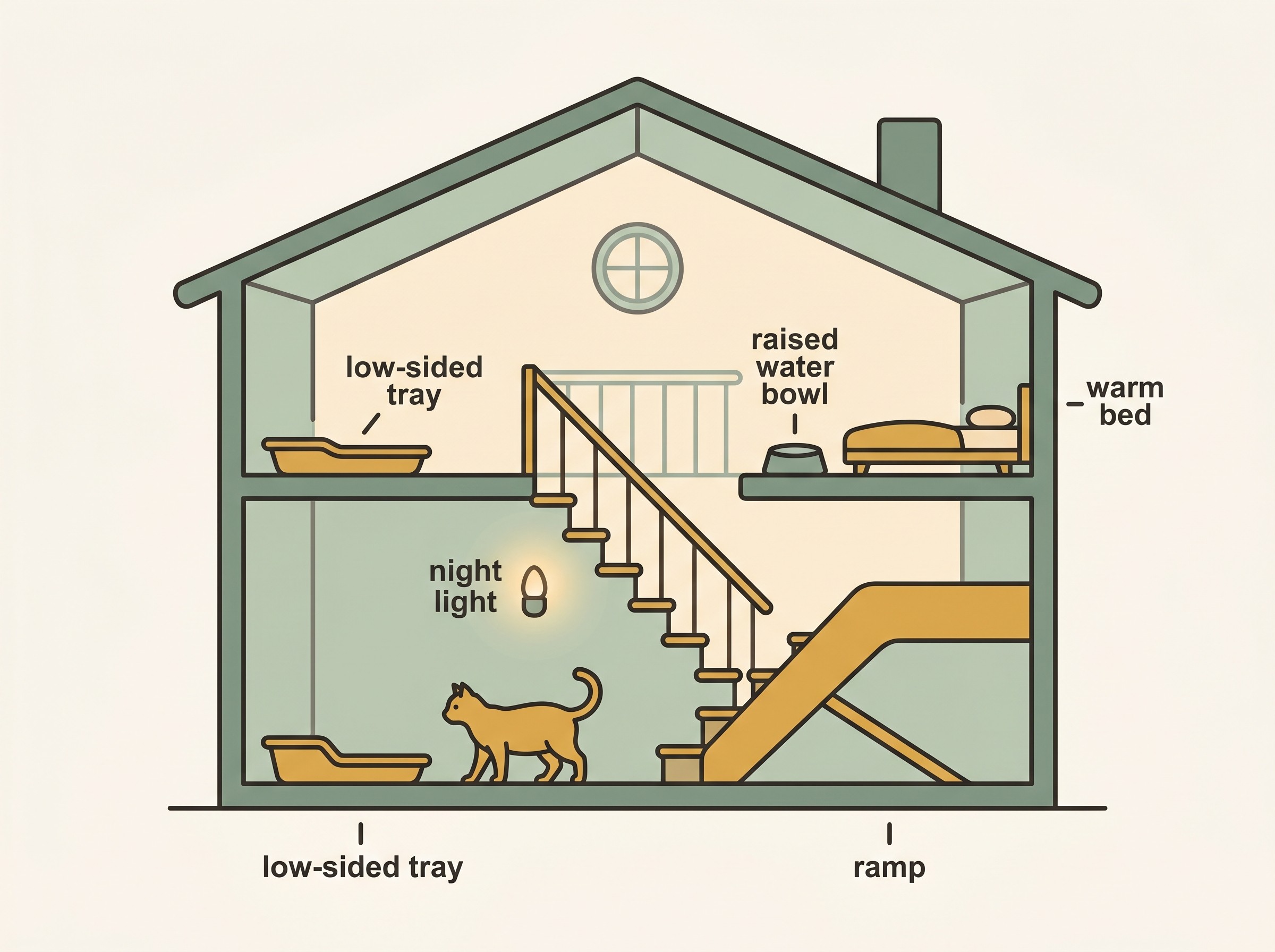
Light the nights. A confused cat in a dark, silent house has nothing to anchor to, which is part of why the yowling so often comes after midnight. Soft night lights along her usual routes, and the reassurance of knowing where you are, can take the edge off the disorientation that drives the calling.
Answer the yowl with calm, not frustration. This is hard at 3am on no sleep, and it is worth understanding why she is calling. When owners of confused, vocalising cats were asked what seemed to be behind it, the two leading reasons were disorientation (40.5%) and simple attention-seeking (40.5%), followed by wanting a resource such as food (16.2%), with pain a smaller share at 2.7% (Černá et al., Animals, 2020). So most of the time she is lost or she wants you, not in agony, though pain is always worth excluding. A quiet light, a calm voice, a gentle settle, and sometimes a small late meal can do more than you would think.
Offer gentle engagement, not overload. A little daytime play, a food puzzle she can manage, a sunny window perch, anything that keeps her mind and body softly ticking over, can help, as long as it is low-key. Tire her gently in the day; do not bombard a fragile mind.
Some of this overlaps heavily with managing the broken nights that exhaust owners most, and we go deeper into that in The 3am pet: managing night-waking and sundowning. You do not have to solve this alone in the dark, either: plenty of people are awake at the same hour with the same cat, and the senior pets community is full of owners swapping what worked for the night yowl, the soiling and the sheer tiredness of it.
Diet, supplements and medicines: a straight word
You will quickly find diets and supplements marketed for an ageing brain, and some of the thinking behind them is sound. Cognitive-support diets tend to be richer in antioxidants, omega-3 fatty acids (DHA and EPA) and sometimes medium-chain triglycerides as an alternative brain fuel, and the Cornell Feline Health Center suggests a diet rich in vitamin E and antioxidants. The caveat is that the evidence for these helping cats specifically is much thinner than it is for dogs (Sordo and Gunn-Moore, 2021). They are reasonable to try with your vet; just hold realistic expectations.
There is one warning here that matters more than any potential benefit, so please read it carefully. Never give your cat a supplement formulated for dogs. The popular dog brain supplement Aktivait contains alpha-lipoic acid, and alpha-lipoic acid is genuinely toxic to cats: studies found it roughly ten times more poisonous to cats than to people, dogs or rats, causing liver damage at doses dogs tolerate easily (Hill et al., Journal of Animal Physiology and Animal Nutrition, 2004), and real-world poisonings in cats have been documented (alpha-lipoic acid toxicosis case series, 2022). There is a separate cat-specific formulation made without it. As a flat rule for any older cat: a supplement is only safe if it is made for cats, and even then, run it past your vet first. We cover the wider help-versus-hype question across species in Treatments and supplements for an ageing mind.
On prescription medicines, there is no drug licensed in the UK to treat a cat's failing mind, and none that cures it. Vets sometimes reach for selegiline (also called l-deprenyl), which is used in dogs and is occasionally tried off-licence in cats; the benefit tends to be modest and variable, and it slows decline rather than reversing it (Landsberg et al., 2010). It matters that selegiline interacts dangerously with several other medicines, including some antidepressants and certain painkillers, where the combination can trigger a serious reaction called serotonin syndrome, so your vet needs the full list of everything your cat takes before prescribing it. This is firmly a vet decision, and there are no doses in this article on purpose: the right choice depends entirely on your individual cat and what else she is being treated for.
The harder nights, and the bigger picture
Caring for a cat whose mind is slipping is uniquely tiring, and not only because of the lost sleep. There is a quieter grief in it too: you are watching a personality you have loved for years become someone slightly different, and you are doing it on broken nights. That night-time yowling is genuinely distressing to live with, and the researchers who study it say so plainly, noting both the toll the disturbed sleep takes on owners and the worry of seeing a much-loved cat confused (Černá et al., 2020). If you are exhausted and a little heartbroken, that is not weakness. That is what loving an old cat through this looks like, and you are allowed to find it hard. We wrote "You're not a bad owner": caring for the carer for exactly the night you feel you have nothing left.
It helps to remember that a cloudier mind, managed well, is something a cat can live alongside comfortably for a good while. The goal is not to fix her memory; it is to keep her days easy, safe and full of the small good things, the sunny patch, the gentle stroke, the familiar meal, while you manage the harder edges. Judging that over time, rather than on one bad night, is how you keep a clear, kind picture of how she is really doing: a tracked ledger of good days and harder days, built quietly in the Senior Wellness Check, tells you far more than memory does, because the bad nights loom large and the good afternoons fade. We walk through that in Tracking quality of life: good days, bad days and the bigger picture.
And if, somewhere down the road, you find yourself starting to think about what comes later, know that those thoughts are a form of love, not disloyalty. When the time comes to weigh it, gently and without pressure, the Rainbow Bridge space holds that conversation with the care it deserves. This space is not about goodbyes. It is about helping her thrive in the time she has, cloudy mind and all.
The tools for spotting these changes are finally catching up, too. A new owner-completable feline cognitive questionnaire, the E-CAT, was published in 2025 and is showing early promise at picking up a cat's mental changes and relating them to her wider health and comfort, though it still needs more validation before it becomes routine (Sordo et al., Journal of Veterinary Behavior, 2025). For years the confused old cat was the orphan of senior care, dismissed as "just old age." That is changing, and you noticing, writing it down and asking the question is exactly how it should.
This week, do these three things
If you do nothing else, take the next three steps:
- Start the Senior Wellness Check and its Mind / Sharpness section tonight, and log the yowling, the nights, the accidents and the lost moments as they happen, so you walk into the vet with a pattern, not a worry.
- Book a senior work-up and ask the exclusion question: a full exam plus bloods, urine, blood pressure and a thyroid test, with the direct ask, "could any of this be her mind, and what do we rule out first?" Flag any weight loss specifically.
- Make her world small and easy before bed: a low-sided litter tray on every floor, soft night lights along her routes, food, water and a warm bed within easy reach, and a calm answer waiting for the 3am call.
None of this brings back the cat who never needed the lights on. But it makes the nights gentler for her, and for you, and it turns "she's just getting old" into something you are actually, kindly, doing something about.
Free downloads
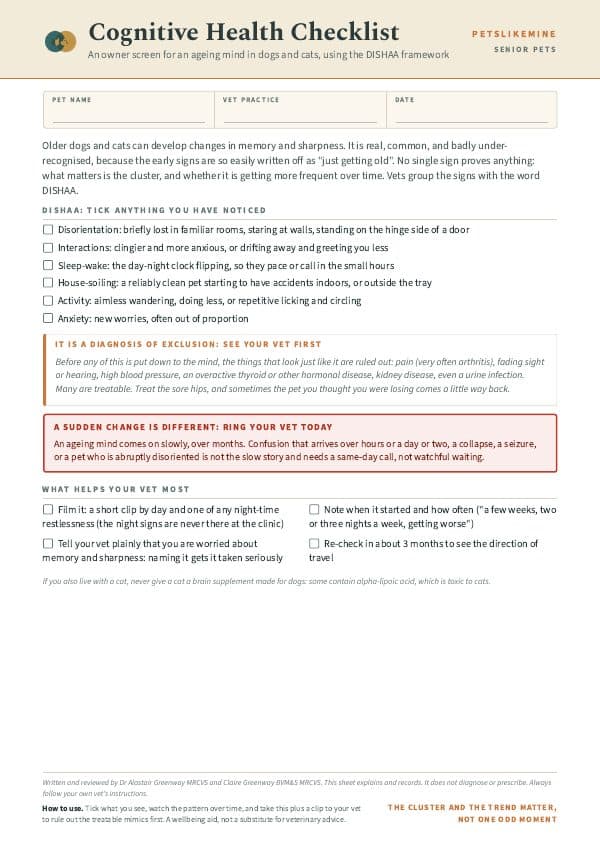
Companion worksheets to put what you've read into practice. Free PDFs, print at home.
Sister tool · Sightline
Track quality of life over time
Sightline, a separate ConciergeVet tool, runs a short adaptive weekly assessment with a quality-of-life focus mode built around exactly these frameworks, tracks a single composite score over time so you can see the trend rather than judge a single bad day, and produces a Sightline Report PDF you can bring to your vet.
A written log, or our printable quality-of-life sheet, does much the same job.
See how Sightline tracks quality of lifeKeep track of how your pet is doing
The owners who cope best are the ones who notice changes early. A simple health log shows you what is working, and what is not, before the next vet visit.
Start tracking, freeYou're not doing this alone
Compare treatment journeys and talk to owners managing senior pets. Free to join.
Join PetsLikeMine