

Treatments and supplements for an ageing mind: help vs hype
Alastair Greenway
BVM&S MRCVS
Search "brain support" for an old dog or cat and you will find chews, "senior cognitive" diets, "neuro" capsules and confident promises, every one of them carrying a happy grey-muzzled pet on the packet. There is no easy way to tell the real thing from the hopeful marketing, and that is usually where an owner starts: you have noticed your old friend slowing down in the mind as well as the body, a bit more lost, a bit more awake at night, a bit less themselves, and you have gone looking for help.
We will sort the diets, supplements and prescription medicines sold for an ageing mind into what genuinely has evidence behind it, what is plausible but thin, and what is mostly a nice story, for dogs and cats both. We will use the clinical name, cognitive dysfunction (canine or feline, sometimes called dog or cat dementia), once so you recognise it at the vet, then mostly talk, as the rest of this space does, about your pet's memory and sharpness and the changes in their Mind. One promise up front: nobody is being sold anything here.
First, rule out the impostors
A confused, restless, accident-prone older pet is not automatically a case for a brain supplement. A fading mind is a diagnosis of exclusion: it is only the right answer once the things that look exactly like it have been ruled out. Reaching for a "cognitive" capsule before that step can quietly delay the diagnosis your pet actually needs.
The impostors are very treatable, and they are common:
- Pain. Arthritis and other senior pain hide as personality change, restlessness and a reluctance to settle, in cats as much as dogs. Pain is probably the most over-looked cause of all. If stiffness or slowing is anywhere in the picture, start with our Arthritis and joint health space and the Mobility Check.
- Fading senses. A pet who cannot see the room or hear you approach looks disoriented and startles easily, which is easy to mistake for confusion. See Vision and eye health.
- High blood pressure and hormone problems. An overactive thyroid in cats, and high blood pressure in either species, quietly change behaviour and energy and are simple to check. See Hormone health.
- Kidney disease, diabetes or a urine infection. Increased thirst and night toileting can masquerade as cognitive night-waking, and an indoor accident can simply be a full, leaking bladder. See kidney disease and diabetes.
In cats specifically, the vet will want to exclude hyperthyroidism, high blood pressure, kidney disease and arthritis pain first, because all of them can make an old cat yowl, wander and toilet in the wrong place. And one harder rule sits over everything below: a supplement is never the answer to a red flag. New weight loss, a new or rising thirst, a change in appetite or a sudden shift in behaviour are signs to get checked, not signs to medicate over the counter. Our piece on whether it is pain, age or disease walks through that fork, and weight loss in an older pet is its own article because it is never "just old age".
So the genuine first treatment for an ageing mind is often not on any shelf: it is finding and fixing the real, treatable thing underneath. With that done, here is how to read everything else.
Reading a "brain support" claim without getting fooled
Three rules will protect you from most of the hype.
Watch your own hope. The biggest trap in this field is the caregiver placebo effect: when we desperately want our old friend to improve, we genuinely see improvement that careful, blinded studies often cannot find. This is not a failing in you. It is exactly why you should track the change carefully rather than trusting the feeling.
Read the verb. "Supports", "maintains" and "promotes" are marketing words, allowed precisely because they do not claim to treat anything. "Treats" and "cures" are claims that have to be earned, and for an ageing mind almost nothing earns "cures". The realistic ceiling for the best options here is that they may slow or ease the changes, not reverse them.
Read the evidence, not just the claim. Most brain products are backed by small trials, often run or sponsored by the company selling the product, and frequently not properly randomised or blinded. The named supplement trials below ran with as few as nine dogs in one and forty-four in another. That does not make them worthless, but "one study showed" is a long way from "this works". When vets themselves were surveyed, most felt current strategies were only slightly (around 57%) or moderately (around 35%) effective. Modest and variable is the real picture. Anyone promising more is selling.
Feeding the ageing brain: the strongest evidence
If anything in this space has earned its place, it is diet, and the reason makes mechanistic sense. As the brain ages it gets worse at using its usual fuel, glucose, with reduced cerebral glucose use seen in dogs from around six years old. A hungry, under-fuelled brain works less well. The idea behind cognitive diets is to hand the brain a second fuel it can still use, and to defend its cells from the wear of ageing.
Medium-chain triglycerides (MCTs) and ketones. This is the strongest single thread of evidence in the whole topic. The liver turns MCTs (a particular type of fat, often from coconut) into ketones, an alternative brain fuel that ageing neurons can burn when glucose runs short. In a controlled study, aged dogs fed a diet supplemented with 5.5% MCT performed significantly better on cognitive tests than control dogs, and showed raised blood levels of the ketone beta-hydroxybutyrate, and the benefit grew on the harder tasks. Diets built on this idea, such as Purina Pro Plan NeuroCare (also sold as the "Bright Mind" formulation), have shown improvement across all six categories of the DISHAA cognitive signs compared with a control diet.
Antioxidants plus enrichment. The other strong thread is that diet works best alongside a busy mind. A landmark two-year study found that an antioxidant-enriched diet (the basis of Hill's Prescription Diet b/d) slowed the rate of cognitive decline, with the greatest effect when it was combined with behavioural enrichment. Food and mental stimulation together beat either alone, and both beat any capsule taken in isolation. The enrichment side is covered in depth in our day-and-night plan for cognitive dysfunction.
And for cats? Here we have to be sharper, because cats are not small dogs and the research is thinner. There is no diet licensed specifically for feline cognitive decline. The principles that carry over are the same antioxidant and omega-3 support: vets recommend a diet rich in vitamin E and antioxidants for older cats, and the feline literature lists antioxidant and MCT-containing diets among the management options, with a general senior or skin-and-joint diet sometimes used off-label for its omega-3 content. This matters because feline cognitive dysfunction is common and badly under-recognised: vocalising at night, restlessness and disorientation are among the most reported changes. Our feline cognitive dysfunction article covers the old cat who yowls and forgets in full.
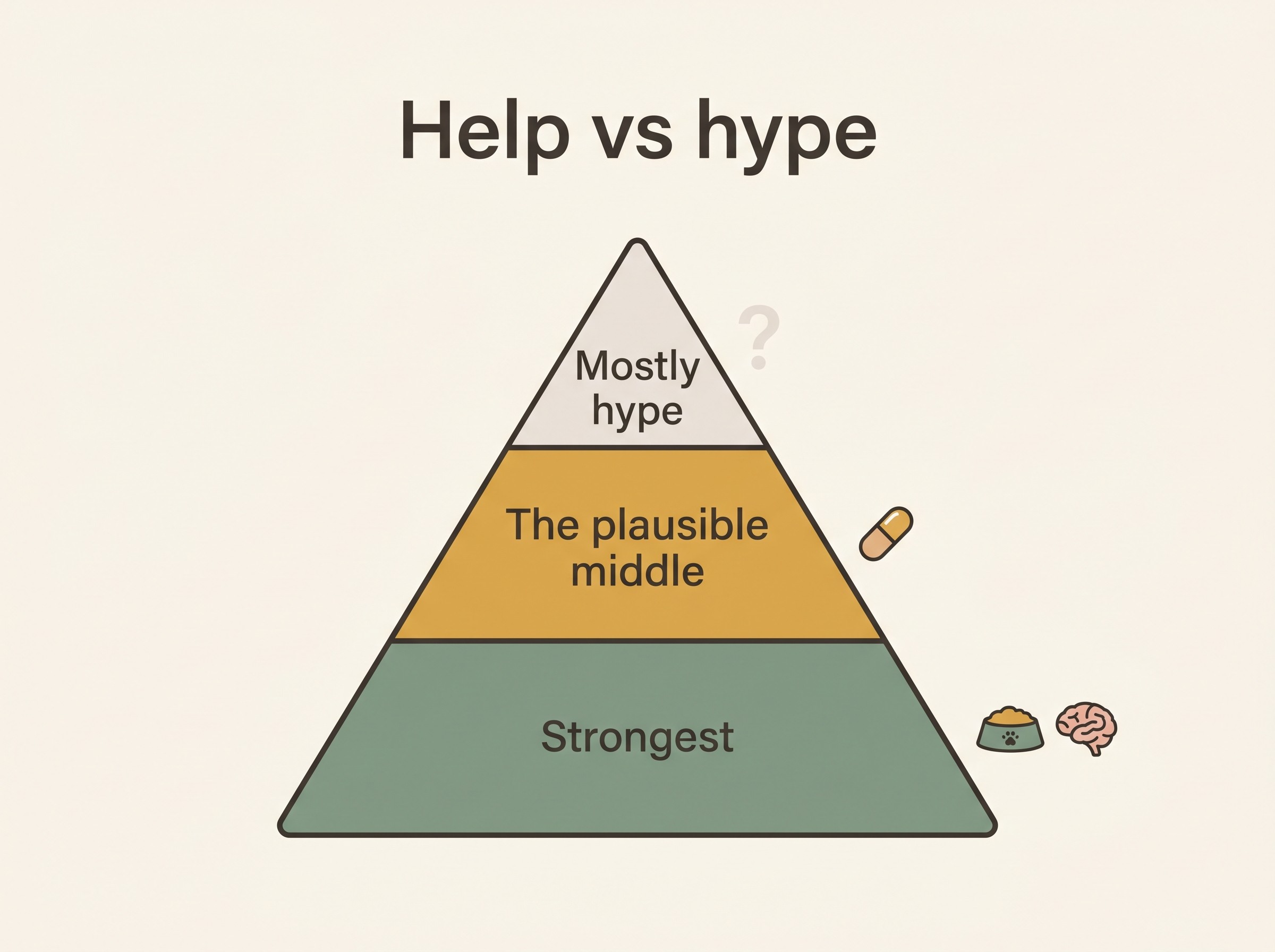
Supplements: the plausible middle
These are the named products you will actually see recommended, with their evidence framed plainly. None is a cure. All have small trial bases. Several are worth a careful try with your vet, judged on the trend, not the marketing.
- S-adenosylmethionine (SAMe), sold as Novifit or Denosyl. A compound that boosts the body's own antioxidant, glutathione, and is among the more commonly recommended options, used by around a third of surveyed vets. A practical detail that catches people out: SAMe is absorbed best on an empty stomach, about an hour before food.
- Senilife. A blend of phosphatidylserine, standardised Ginkgo biloba, vitamin E and vitamin B6. In an open-label pilot, dogs showed marked improvement in cognitive signs, though that study was small and unblinded, so read it as encouraging rather than proven.
- Aktivait. A multi-ingredient supplement (omega-3 DHA and EPA, N-acetylcysteine, vitamins C and E, L-carnitine, coenzyme Q10, phosphatidylserine and, in the dog version, alpha-lipoic acid). A placebo-controlled trial found more improvement than placebo on some measures but not others. See the cat safety box below, because this one is important.
- Apoaequorin (Neutricks). A calcium-buffering protein; aged laboratory beagles given it were better able to complete a discrimination-learning task. Interesting, early, and not a reason to expect transformation.
For cats, the same general family is used, including a cat-specific Aktivait, SAMe and Senilife, again with thin evidence and the firm advice to choose with your vet rather than guessing off a website.
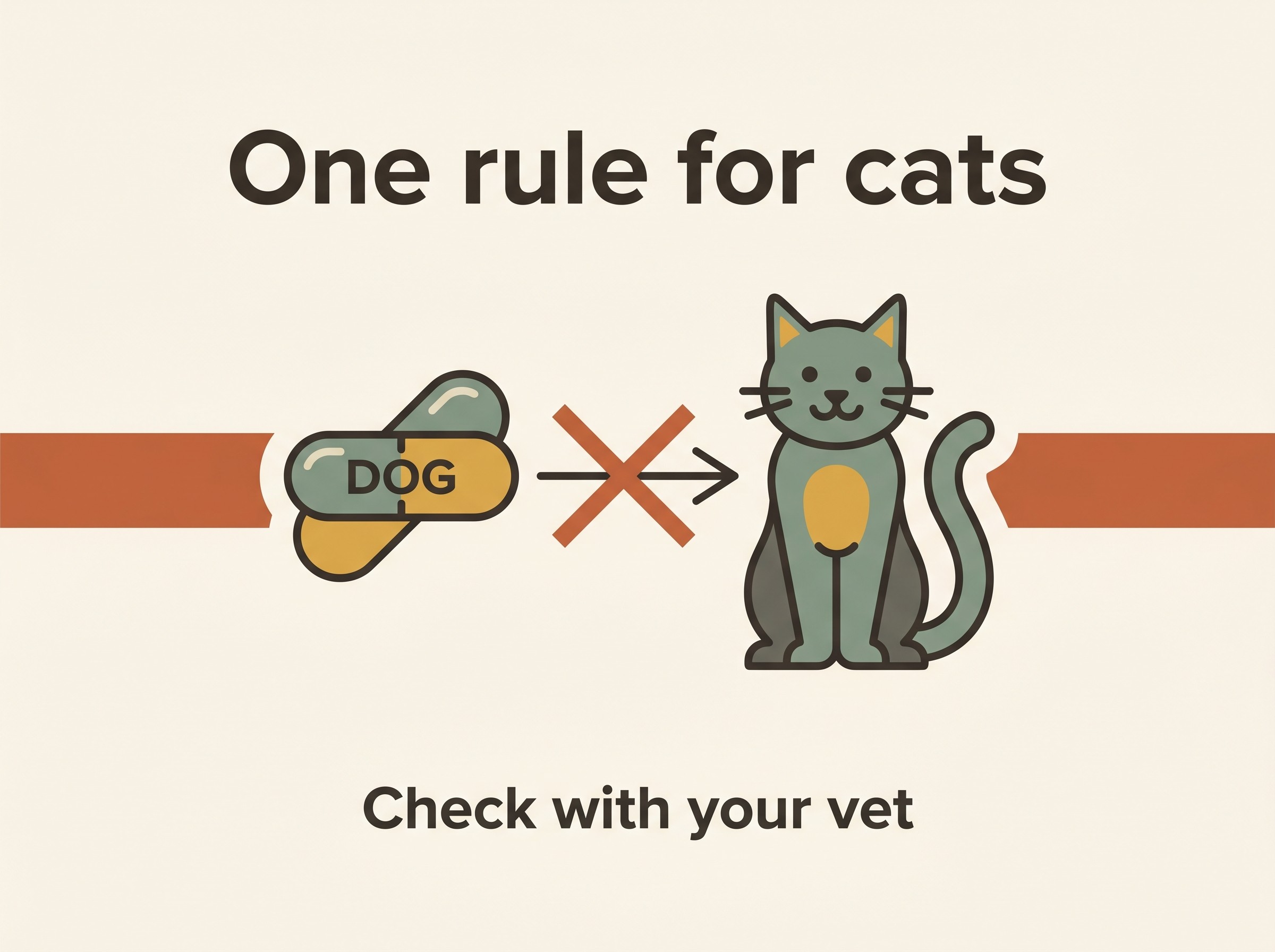
The cat rule that matters more than any product. The dog formulation of Aktivait contains alpha-lipoic acid, and alpha-lipoic acid is roughly ten times more toxic to cats than to people, dogs or rats, with a maximum tolerated dose in cats below 30 mg/kg. Cats poisoned by it can show low blood sugar, drooling, vomiting, wobbliness, tremors and seizures. A feline-specific version of Aktivait, without alpha-lipoic acid, exists and is the only one safe to use in cats, although its benefit has not yet been formally tested. The wider rule is simple and lifesaving: never give a cat a product made for dogs without checking with your vet first. Cats process many things differently, and this is one where the difference can be fatal.
Prescription medicines for an ageing mind
Two medicines come up for an ageing mind. Both are vet-prescribed, both are openly modest, and both have caveats your vet will weigh.
Selegiline (Anipryl, also called l-deprenyl). The medicine most often recommended by vets, by around two-thirds in one survey, and licensed for canine cognitive dysfunction in some countries. It is a selective MAO-B inhibitor that raises dopamine and reduces free-radical damage in the brain. Two things to hold onto. First, it manages signs rather than curing the disease, and can take four to twelve weeks to show whether it is helping, so give it a fair run. Second, the safety point your vet will care about most: because it changes brain chemistry it must not be combined with a long list of other drugs, including other MAO inhibitors, the parasite product amitraz, opioids, certain blood-pressure and behaviour drugs, tricyclic antidepressants and SSRIs such as fluoxetine, as the combination risks a dangerous reaction. The intervals matter too: at least 14 days should pass between stopping an SSRI or tricyclic and starting selegiline, and at least 6 weeks for fluoxetine because it lingers in the body. This is exactly why your vet needs your pet's full medication list. In cats it is used off-label and unlicensed, with benefit reported only anecdotally.
Propentofylline (Vivitonin). A separate medicine, licensed in the UK for "dullness" and lethargy in older dogs, which works as a vasodilator, improving blood flow to the brain and heart. It is sometimes tried for the flat, withdrawn old dog. As with selegiline, the framing is modest, variable benefit, and in cats it is off-label.
This article names no doses, and that is deliberate. The dose, the frequency and whether to use any of these at all are decisions for your vet, who is the only one who can weigh them against your pet's other conditions and medicines. This is doubly true for an older pet on several treatments at once. If yours already takes an anxiety medicine, a painkiller or anything for the heart or kidneys, that selegiline interaction list is not theoretical, so keep a single up-to-date medication list and ask the interaction question every time something new is suggested. Our guide to juggling senior medications safely is built around exactly that habit.
What nobody is selling: it is the combination
No single capsule fixes an ageing mind. The owners and pets who do best are not the ones who found the perfect product, but the ones who do several modest things together: treat the real problems underneath, feed the brain with a sensible cognitive or antioxidant diet, keep the mind gently busy with daylight, sniffing and easy enrichment, and add a supplement or a prescription medicine only where it earns its place, all coordinated with the vet. The evidence points the same way the guidelines do: a multimodal approach started early, not a magic bullet found late.
If you are doing all of this and still exhausted, especially by the broken nights that come with a fading mind, that is not a sign you have chosen the wrong product. It is the single best-documented hardship of this condition, and you deserve support with it. Our piece on the 3am pet and night-waking is the practical companion, and you are very welcome in our senior pets community, where owners walking the same road compare what has actually helped, off-label experiments and all.
Knowing whether it is actually working
The only fair way to know whether a diet change, a supplement or a medicine is helping your pet's mind is to measure before and after, and judge by the trend rather than the hope. Take a clear baseline of your pet's Mind / Sharpness with the Senior Wellness Check before you change anything, give the new thing a fair trial of around four to eight weeks (most of these options need weeks, not days), and look again. A score that genuinely improves or holds steady is worth continuing. A score that keeps sliding despite a product is telling you something the packaging never will, and it is exactly the kind of clear picture your vet needs to see at the next visit.
So, before you spend a penny on a "brain support" anything, work down this short list:
- Book the vet check first, to rule out the treatable impostors (pain, fading senses, blood pressure, thyroid, kidney, diabetes, infection). The real fix is often here.
- Baseline the Mind / Sharpness score in the Senior Wellness Check, so you have a true "before".
- Agree one or two evidence-led changes with your vet, not five at once: most often a cognitive or antioxidant diet plus enrichment, with a supplement or prescription added only where it fits, and always the feline formulation for a cat.
- Review the trend at four to eight weeks, keep what genuinely helps, drop what does not, and take the chart to your vet.
And when the day comes that you are no longer chasing improvement, just protecting comfort and good days, that is its own kind of right answer, not a failure of any product. Our space on making the most of the time you have left is there gently for whenever that day arrives, but for most pets it is a long way off, and a fair, measured try at the steps above is a good place to begin tonight.
Free downloads
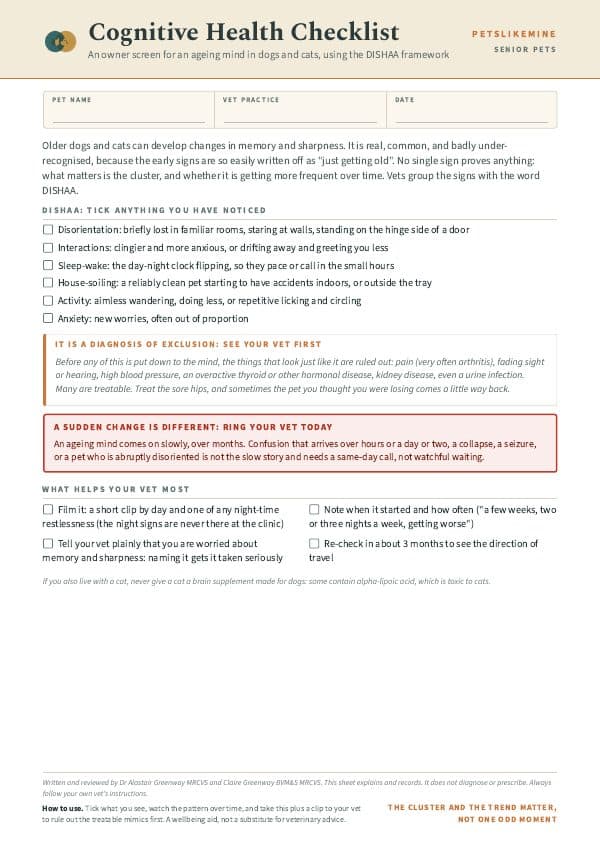
Companion worksheets to put what you've read into practice. Free PDFs, print at home.
Sister tool · Sightline
Track quality of life over time
Sightline, a separate ConciergeVet tool, runs a short adaptive weekly assessment with a quality-of-life focus mode built around exactly these frameworks, tracks a single composite score over time so you can see the trend rather than judge a single bad day, and produces a Sightline Report PDF you can bring to your vet.
A written log, or our printable quality-of-life sheet, does much the same job.
See how Sightline tracks quality of lifeKeep track of how your pet is doing
The owners who cope best are the ones who notice changes early. A simple health log shows you what is working, and what is not, before the next vet visit.
Start tracking, freeYou're not doing this alone
Compare treatment journeys and talk to owners managing senior pets. Free to join.
Join PetsLikeMine