

The 3am pet: managing night-waking and sundowning
Alastair Greenway
BVM&S MRCVS
Of all the things that go wrong with an ageing pet's mind, the broken night is the one owners find hardest. When researchers asked owners of dogs with an ageing mind what wore them down most, the disrupted nights came out at the top of the list, ahead of every other behaviour. Maybe your old dog is pacing the landing, or standing in a dark corner panting at nothing, or letting out that thin, lost cry that goes straight through you. Maybe your elderly cat is yowling at the bottom of the stairs, loud and insistent, as if she has forgotten where she is. You get up, check the water and the tray, sit with them until they settle, then lie awake bracing for the next time.
So if the nights have wrung you out, know that this is the single best-documented hardship of the whole condition. Your exhaustion is not a sign you are failing at it. It is the most predictable thing in the world, and you are very far from alone in it.
This article is about the nights. We will walk through why the body clock breaks in an ageing pet, the medical problems to rule out before you blame the mind at all, and a concrete plan to make 3am gentler. It is written for dogs and cats together, because they break much the same way and you help them much the same way, with a few species differences flagged as we go. (For the wider, whole-condition picture, see Living with canine cognitive dysfunction and the first signs to watch for.)
Why the night comes apart
Healthy sleep runs on an internal clock: a small cluster of cells deep in the brain keeps roughly 24-hour time, leaning heavily on daylight and on melatonin, the hormone the body releases as the light fades to say night has come. In an ageing brain that clock loosens its grip. Neurons are lost, the same kind of protein deposits seen in ageing human brains build up, and melatonin signalling weakens, so the tidy rhythm of "asleep at night, awake by day" comes apart. When it comes apart far enough, day and night swap over: your pet dozes through the daylight hours, then surfaces in the small hours wired, restless and disoriented, in a dark house that no longer makes sense. You will sometimes hear this called sundowning, a word borrowed from human dementia for the way confusion worsens as the light goes. It is not a separate disease, just a name for the bad hours clustering at night.
This is not vague, either. When researchers ran overnight sleep studies on senior dogs alongside cognitive testing, the dogs with higher dementia scores genuinely slept worse: less time in deep (NREM) and dream (REM) sleep, longer to fall asleep, and more of the night awake. The restlessness you are seeing is real, measurable damage to the machinery of sleep, not your pet being difficult.
In dogs, vets call this underlying change canine cognitive dysfunction, or CCD (you will also hear "canine dementia"); in cats it is feline cognitive dysfunction. We will use those clinical terms once so you recognise them at the vet, and then mostly talk, as the rest of this space does, about your pet's memory and sharpness, their ageing Mind, and the body clock slipping. It is common. In cats, a large owner survey found that among older cats showing signs of cognitive change, restlessness at night affected almost a third, and altered vocalising, the night yowl so many owners describe, was the single most reported sign (the feline cognitive dysfunction guide covers the old cat's cloudier mind in full). In dogs the signs rise steeply with age, yet only around 1.9% are ever formally diagnosed. Far more pets live this than ever get named, so you noticing it is the system working, not failing.
First, rule out the things that look exactly like it
A restless, vocal, accident-prone old pet at 3am is not automatically a cognitive case. Night-waking is a diagnosis of exclusion: the ageing mind is blamed only once the treatable impostors have been ruled out with an exam, blood and urine tests and blood pressure, never from the night behaviour alone. Several of the things that wake an old animal in the dark are very fixable, so before you settle on "it's her mind going," your vet will want to look for:
- Pain, the great impostor. Arthritis and other senior aches are worst after lying still, so a dog or cat who cannot get comfortable will get up, shift, pace and cry in the night. Pain hides as restlessness far more often than owners realise, and it is eminently treatable. If stiffness or reluctance on stairs is anywhere in the picture, start with our Arthritis space and the Mobility Check; telling sore from senile is the subject of Is it pain, age, or disease?.
- A full bladder, and new thirst. Many a "cognitive" night-waking is simply a bladder that will not last until morning. Increased thirst and night toileting are classic early signs of kidney disease and diabetes, and a pet drinking more must go more, often at 3am. New thirst in an older pet is its own red flag worth a vet visit and a simple urine and blood test: see kidney disease and diabetes, and our thirst-and-wee tracker to show your vet the pattern.
- High blood pressure and thyroid trouble, especially in cats. This one is load-bearing for cat owners. The night yowl that feels so like dementia is, in cats, very often something else: night-time vocalising is relatively common in cats with an overactive thyroid or high blood pressure, both common in older cats, both checkable and treatable. An ageing cat who suddenly cries the house down earns a thyroid blood test and a blood pressure reading before anyone reaches for the word dementia. See Hormone health.
- Failing sight and hearing. A pet who cannot see the room or hear you coming is genuinely lost and easily startled in the dark, which looks just like confusion. Fading senses have their own gentle fixes: see Vision and eye health.
- Other illness, and rarely brain disease. Less commonly, a growth or other neurological problem shows up as night change, which is part of why a proper assessment beats a guess in the dark.
If your pet has arrived here from our Behaviour space, this is exactly the right path: behaviour work's first job is to rule out the medical causes, and disoriented night-waking in an old animal is precisely what it routes this way once they are excluded. Please do not quietly decide your old friend is "just senile" and stop there. Get the vet check first.
With that done, here is the plan, and the single most useful thing to grasp is that you fix the night largely from the daytime.
Fixing the night from the daytime
The broken sleep-wake cycle resets far more from the bright end of the day than the dark end. A pet who sleeps all day has no sleep left to spend at night, so the most powerful night-time medicine you have is a fuller, brighter, more engaged day. The vet guidance is blunt and effective: if night waking is a problem, increase daytime activity and reduce disturbance in the evening.
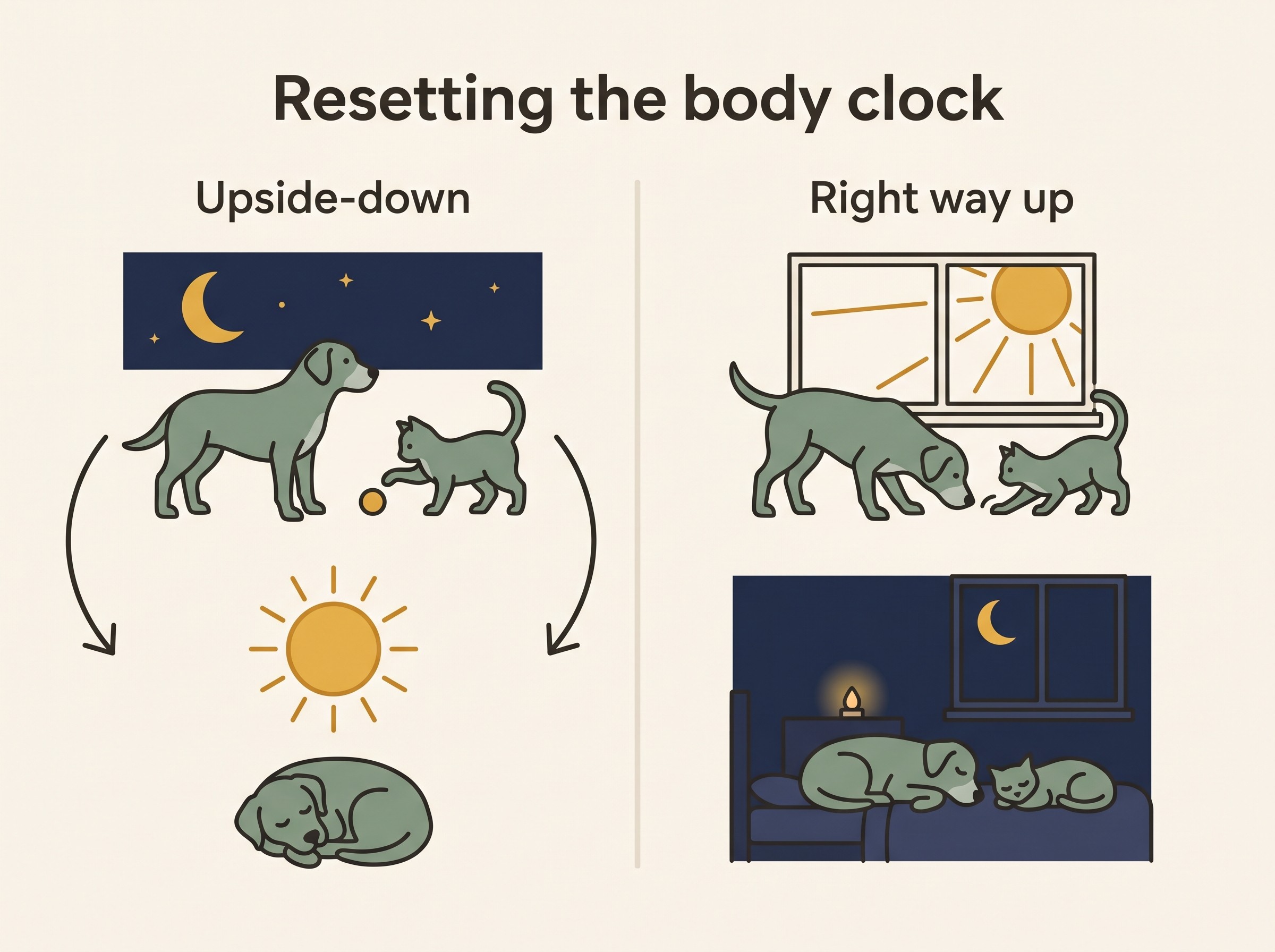
- Flood the day with daylight. Get them near windows, out in the garden, on gentle outings while it is light. Daylight is the strongest single signal the body clock has, and a pet who spends the day in a dim, quiet house has nothing telling its brain that night is different.
- Keep them gently busy. For a dog, several short sniffy walks beat one long march; scent is the last great pleasure of an old dog and the easiest mental exercise there is. For a cat, a few short play sessions with a wand toy, a food puzzle, a new cardboard box or a windowsill bird-watching spot. Environmental enrichment helps maintain brain health, and a pleasantly tired pet sleeps better. Pitch it so they succeed: small easy wins, not frustration.
- Discourage the long afternoon coma, gently. A quiet interaction, a little meal or a short late-afternoon potter can stop the daytime sleep running so deep that the night comes alive. Shift the balance; do not wage war on naps.
- Keep the day boringly predictable. Same meals, same walks, same rhythm: a regular routine reduces the anxiety that feeds night-waking, because a confused brain has less to get lost in. This is not the season for a house move or rearranging the furniture.
Building a gentler 3am
You cannot give a confused brain back its certainty, but you can build a night so safe and predictable that your pet needs less of it. Think of it as scaffolding around a mind that wobbles in the dark.
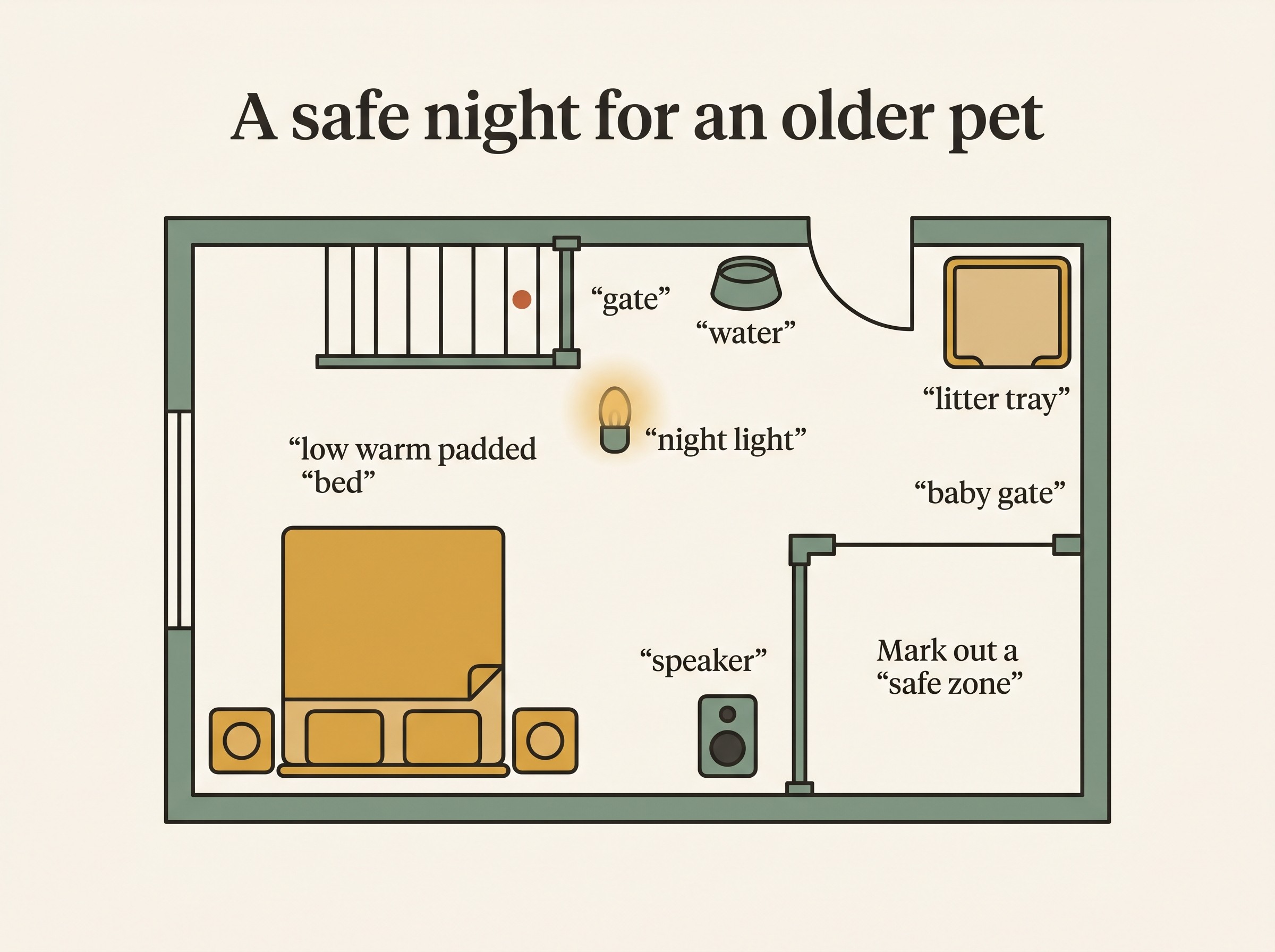
- Last toilet, late and unhurried (and a clean tray for cats). A final calm trip into the garden as late as you can manage means a full bladder is not what wakes your dog. For a cat, keep a clean, low-sided litter tray within a few steps of where she sleeps, because an old cat will not trek across a dark house to reach one.
- Dark, but not disorienting. A dim night light in the room and along the route to the garden or tray helps a pet whose eyes and confidence are not what they were: calm dark for sleep, with just enough soft light that they are not lost. Avoid flicking on bright overhead lights when they wake, which only jolts the clock.
- A small, warm, safe space. Many older pets settle far better in a cosy, contained, draught-free area than loose in a big house where they can pace, get wedged behind furniture or find the stairs in the dark. A pen, a closed door or a baby gate across a hazard is kindness, not a cage. Keep the resting area protected and consistent, warm and easy to climb into, in the same spot every night. Old joints and old minds both crave warmth and sameness.
- Soft, steady sound. Quiet white noise, a low radio or calm music soothes a pet who startles at every creak and smooths over the small noises that wake a light, anxious sleeper.
- The same settle ritual, every night. A few minutes of calm contact in the same order, a quiet word, a slow stroke, lights down, sound on, tells a frightened, hazy brain that this is the safe part of the day. Keep the evening calm: wind down, do not rev up. And on the nights they surface anyway, quiet reassurance and a gentle guide back to bed beats frustration; they are not punishing you, they are lost, and you are the thing that makes sense.
When medication can help
Sometimes the routine and the environment are not enough on their own, and that is not a failure of effort. There is no cure for an ageing mind, but the right medication, chosen with your vet, can sometimes slow the slide, calm the nights and buy genuinely good months. None of these is something to start or dose yourself; each is a conversation with your vet, who needs your pet's full medication list first.
- Selegiline (you may see it as Anipryl or l-deprenyl) is the drug specifically licensed for canine cognitive dysfunction, and in trials it improved sleep patterns, house-training and activity compared with placebo. The benefit is real but variable: think slowing and softening, not reversal. It carries one catch your vet will check for. Selegiline is an MAO-B inhibitor, and combined with other drugs that raise serotonin, such as the antidepressants fluoxetine or clomipramine, mirtazapine, the painkiller tramadol or the parasite product amitraz, it can cause a dangerous reaction called serotonin syndrome. That is why your vet needs the full list, and why a washout gap is often left when switching from one of those drugs. As one veterinary pharmacy puts it, selegiline is "a piece of the puzzle, not the whole solution."
- Propentofylline (Vivitonin) is a separate, UK-licensed option, a vasodilator used to lift dullness and low demeanour in older dogs. It is reached for commonly in UK practice and sits alongside the rest of the plan, not instead of it. Its benefit, too, is modest and variable.
- Anxiolytics and other options. Where night-time anxiety is a big part of the picture, vets sometimes use anti-anxiety medicines (for cats, fluoxetine is one). Some owners ask about melatonin for the broken sleep cycle; it is sometimes used, but it is a conversation with your vet rather than something to reach for off the shelf, with dose and suitability theirs to judge.
One safety point that matters even here: if you have a cat, never share a dog's brain supplement or product with it. The dog formulation of supplements like Aktivait contains alpha-lipoic acid, and cats are roughly ten times more sensitive to it, so a dog product can poison them. Cats need their own formulation, and the rule holds: never give a cat a dog product without checking. The clear-eyed comparison of what helps an ageing mind versus what is hopeful marketing is in Treatments and supplements for an ageing mind.
Keep a record of the nights
When you are this tired, memory is a poor witness. You will swear this week was worse, or quietly hope it was better, and neither may be true. A simple, dated record beats recollection every time, and on a hard morning it shows you the good nights you would otherwise forget.
Use the Senior Wellness Check to log your pet's Mind / Sharpness alongside their Vitality every week or two, and note how the nights are going. It does three things at once. It catches change early, when recognition matters most and management works better. It turns "she seems more unsettled lately" into a clear, vet-ready picture, the kind of evidence that helps your vet decide what to rule out and what to try. And on the days you feel like you are getting nowhere, it shows you the calmer nights among the hard ones. That same "good days, and good nights" ledger is the heart of tracking quality of life.
You are not failing, and you are not alone
It would be wrong to pretend the nights always become easy. An ageing mind is progressive, and over months the plan tilts gradually from fixing towards comforting. But progressive does not mean fast, and it does not mean grim. With the bright days, the safe nights and the right help from your vet, a great many old dogs and cats have a long, comfortable, deeply loved stretch ahead, and many a 3am settles into something the two of you can live with.
And please hear this as plainly as the first part: the exhaustion you are carrying is real, it is measured, and it does not make you a bad owner. Owners of pets with an ageing mind carry a heavier load than owners of healthy old pets, and broken sleep is one of the biggest reasons. You are allowed to be worn thin, to ask for help, to share the night shifts, and to tell your vet you are not coping with the nights as much as you tell them about your pet. The carer's own wellbeing is the whole subject of "You are not a bad owner": caring for the carer, and the people who most understand a 3am kitchen, because they have stood in their own, are in the senior pets community.
You may also be grieving a little already, mourning the sharp, sure animal your pet used to be while you reassure the hazier one in the dark. That ache is normal, it has a name, anticipatory grief, and it is not disloyalty or giving up. When the bigger questions come, including the hardest one of all, they are held with care in the Rainbow Bridge space. This article is about the nights you are in now, and making them kinder.
Tonight, you can:
- Book a vet check before you blame the mind. Ask them to rule out pain, a urine or kidney problem, diabetes, and (for cats especially) thyroid trouble and blood pressure, and take your pet's full medication list with you, particularly before any new drug.
- Set the night up: a late toilet trip or a clean low-sided tray, a dim night light on the route, a warm bed in a small safe space away from the stairs, and soft steady sound.
- Plan a brighter, busier day tomorrow: daylight, a couple of short sniffy walks or play sessions, and a gentle late-afternoon potter, to reset the clock from the daytime up.
- Start a Senior Wellness Check so you can watch your pet's Mind and Vitality, and the pattern of the nights, instead of relying on a tired memory.
- Say hello in the senior pets community. The people there have been awake at 3am too, and they will tell you, truthfully, that you are doing a good job.
Free downloads
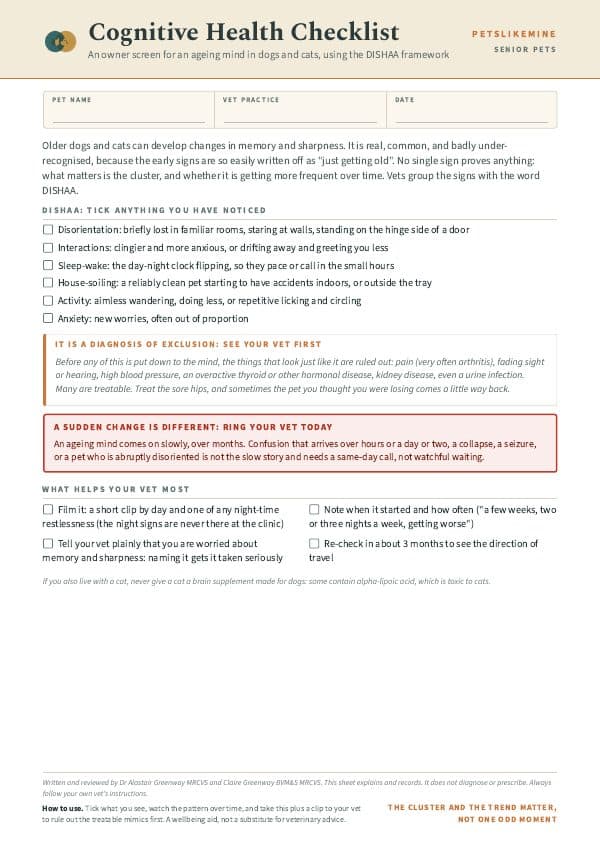
Companion worksheets to put what you've read into practice. Free PDFs, print at home.
Sister tool · Sightline
Track quality of life over time
Sightline, a separate ConciergeVet tool, runs a short adaptive weekly assessment with a quality-of-life focus mode built around exactly these frameworks, tracks a single composite score over time so you can see the trend rather than judge a single bad day, and produces a Sightline Report PDF you can bring to your vet.
A written log, or our printable quality-of-life sheet, does much the same job.
See how Sightline tracks quality of lifeKeep track of how your pet is doing
The owners who cope best are the ones who notice changes early. A simple health log shows you what is working, and what is not, before the next vet visit.
Start tracking, freeYou're not doing this alone
Compare treatment journeys and talk to owners managing senior pets. Free to join.
Join PetsLikeMine