

Hearing and sight loss in older pets: helping fading senses
Alastair Greenway
BVM&S MRCVS
You call her in from the garden and she does not turn round. You ring the doorbell yourself, almost as a test, and he sleeps through it the way he never used to. He pauses at the top of the stairs he used to fly down, or plants a paw squarely in the water bowl he has known for a decade. So you find yourself wondering, quietly, whether he is going senile, or whether she has simply decided to stop listening.
Here is the first and most reassuring thing to know. A great deal of this is fading senses, not a fading mind, and not stubbornness. As dogs and cats get older, their hearing and their sight very commonly dim, usually slowly and painlessly. And the second reassurance is just as true: animals live wonderfully full lives with poor hearing or sight, because their world was never built on those senses the way ours is. A dog leads with its nose; a cat navigates by smell, whisker and the memory of a home it knows by heart. Lose one sense gently and the others quietly take up the slack.
That is the kind, ordinary version of this story. Two things, though, must never be filed under "just old age." Sudden sight loss is an emergency. And a cloudy eye, or a pet who seems suddenly confused, always earns a proper look from your vet, because the harmless version and the serious version look almost identical from the sofa.
He's not ignoring you: when the hearing goes
Age-related hearing loss is one of the most common changes in older pets, and one of the most misread. In dogs it tends to creep in from around eight to ten years of age, as the delicate machinery of the inner ear slowly wears: a sensorineural decline that vets call presbycusis (ter Haar, WSAVA 2011; Strain, on the aetiology and prevalence of deafness in dogs and cats). It is gradual and painless, and because it settles in evenly across both ears, your dog cannot tell you it is happening. So the signs arrive disguised as personality:
- He sleeps through the doorbell, the kettle, the rustle of the lead that used to bring him running.
- He "ignores" his recall, especially when his back is turned or he is engrossed in a smell.
- He startles when touched from behind, sometimes with a snap that is not like him.
- He barks more, or louder, as if he cannot hear his own voice (he cannot, quite).
- He sleeps more deeply and is harder to rouse.
"He's gone deaf in his old age" is a symptom, not a character flaw. He is not blanking you. He genuinely cannot hear you. Once that lands, the frustration drains away, and you can work with him instead of feeling let down.
You can run a simple home check. When your dog is relaxed and facing away, with no chance of feeling your footsteps through the floor, try a sound he would normally respond to: a clap, a squeaky toy, jangling keys. No turn, no ear-flick, nothing, repeated a few times? That points towards hearing loss rather than selective attention. It is not a diagnosis, but it is worth mentioning to your vet, who can look in the ears to rule out the treatable culprits that masquerade as age, like a plug of wax, an ear infection or a polyp, and arrange an objective hearing test (a BAER, which measures the brain's response to sound) if the picture is unclear (Frontiers in Veterinary Science, 2024). That distinction matters, because a wax plug or an infection can be fixed, while presbycusis cannot, and you would rather not write off a curable ear as old age.
Cats lose their hearing too, and hide it even better. Feline hearing loss is common in cats over about ten, and so gradual, and so well papered over by a cat's formidable sense of smell, that many owners only notice it once it is well advanced. The tells are quieter than in dogs: a cat who used to appear at the first whisper of the food cupboard now waits to smell it; a meow that has grown noticeably louder; a cat startled, and occasionally cross, when you appear beside a deep sleeper she did not hear coming.
Living safely with a deaf pet
The biggest practical issue with deafness is not the silence, it is safety, and it splits into two jobs.
The first is getting their attention without a fright. A deaf animal woken by a sudden hand can snap purely on reflex, and that startle response is a common reason a deaf pet bites someone it loves (Whole Dog Journal). The fix is to swap sound for vibration and sight. Stamp on the floor as you approach, so they feel you coming and a sleeping pet feels your tread before your hand. Flick a light on and off, or sweep a torch beam along the floor, as a "look at me" cue. Many deaf dogs learn hand signals beautifully, often faster than you expect, because they are already watching your body for clues (AKC). It is well worth teaching children, including visiting ones, to stamp gently and wait for the dog to look before they touch.
The second job is the outside world. A dog who cannot hear a car, a bike, or you shouting a warning stays on a lead near roads, full stop, with a long-line for freedom in open space. A deaf cat is far safer kept indoors or to a secure garden. Neither needs a smaller life. They just need you to be their ears at the edges.
Reading a cloudy eye: when the sight goes
Eyes are where owners most often spot a change, usually a haze creeping across the lens, and this is where it pays most to know what you are looking at, because two completely different things look almost the same and call for opposite responses.
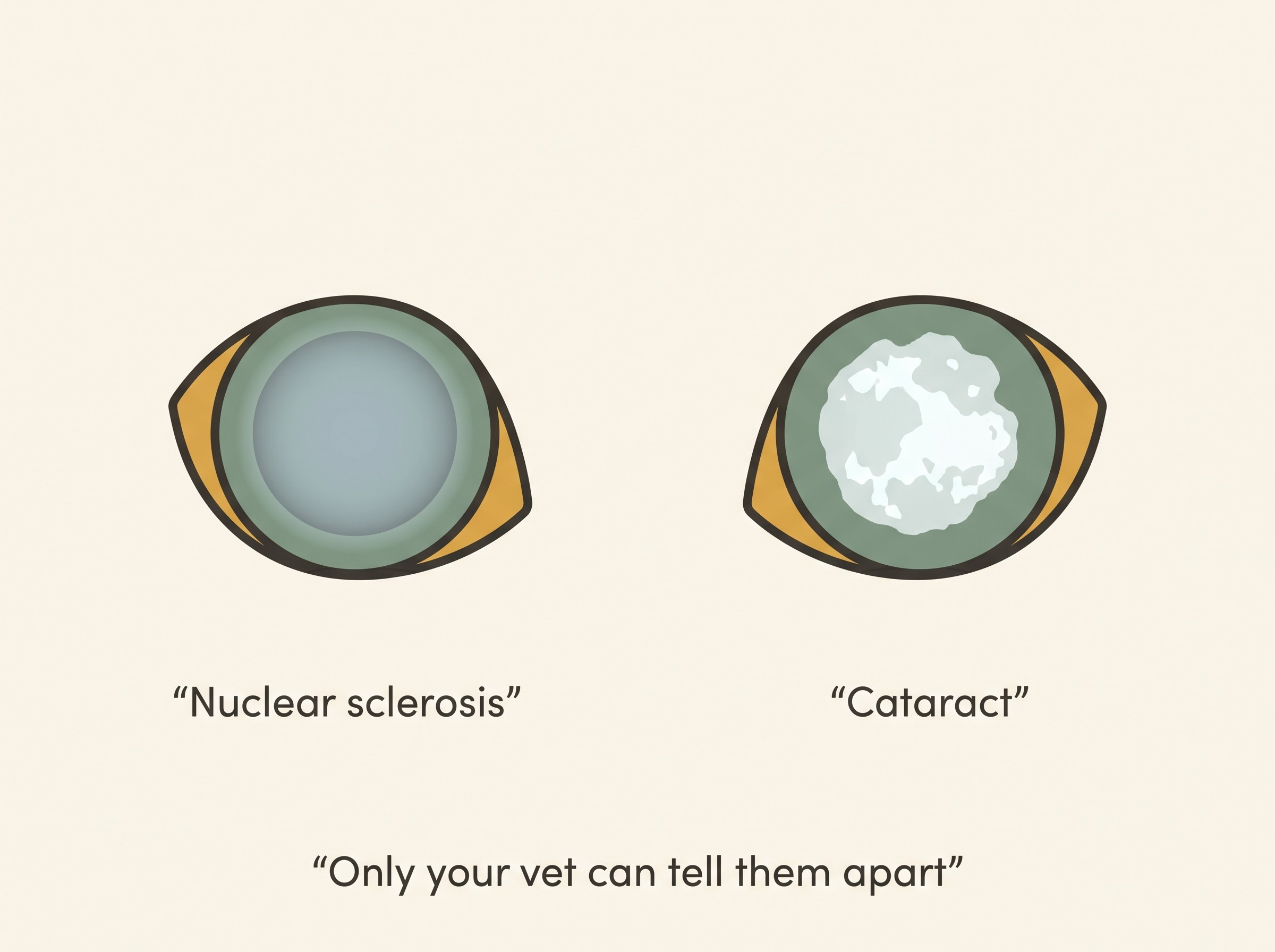
The common, gentle one is nuclear sclerosis (also called lenticular sclerosis). From around eight to ten, the lens slowly compresses with age and takes on an even, pearly, grey-blue haze, the same in both eyes (ACVO). It looks dramatic in a certain light, but it is essentially the normal stiffening of an ageing lens, and it does not significantly affect vision: it "will not make dogs blind," and your dog may simply lose a little of his sharpness for fine detail (Cornell Riney Canine Health Center). This is the reassuring diagnosis, and needs nothing but a mention at the next check.
The one that needs action is a cataract. A cataract is a true opacity within the lens, more white than blue, often uneven like a chip of crushed ice, and unlike sclerosis it genuinely blocks light and can lead to blindness (Clinician's Brief). It carries its own risks too: as it matures it can inflame the eye (lens-induced uveitis) and tip it into glaucoma, which is painful and sight-threatening, so a cataract is not something to simply watch (Cornell).
There is one link here worth knowing above all the rest, and that is diabetes. Around 75 to 80% of diabetic dogs develop cataracts within the first year of diagnosis, regardless of how well the diabetes is controlled, and they can come on fast (Cornell). If your older dog is diabetic, or drinking and weeing more than usual, a newly cloudy eye is a reason to ring your vet, not wait; the wider picture is in our diabetes space. Cataracts occur in cats too, though far less often than in dogs.
The practical bottom line: you cannot reliably tell sclerosis from a cataract by looking, and neither can we from a description over the phone. The distinction is made on a proper eye examination (ACVO). So a new haze is not an emergency, but it is a "book the next check and let us look" job. And if your vet does diagnose a cataract, do not assume your pet is "too old" to do anything: for the right candidate, surgery is a real option, and the decision rests on overall health, not age alone (Cornell). Our Vision and Eye Health space walks through cataracts and the surgery conversation in full.
Sudden sight loss: the one that cannot wait
Everything above is the slow, manageable kind of change. This is the exception.
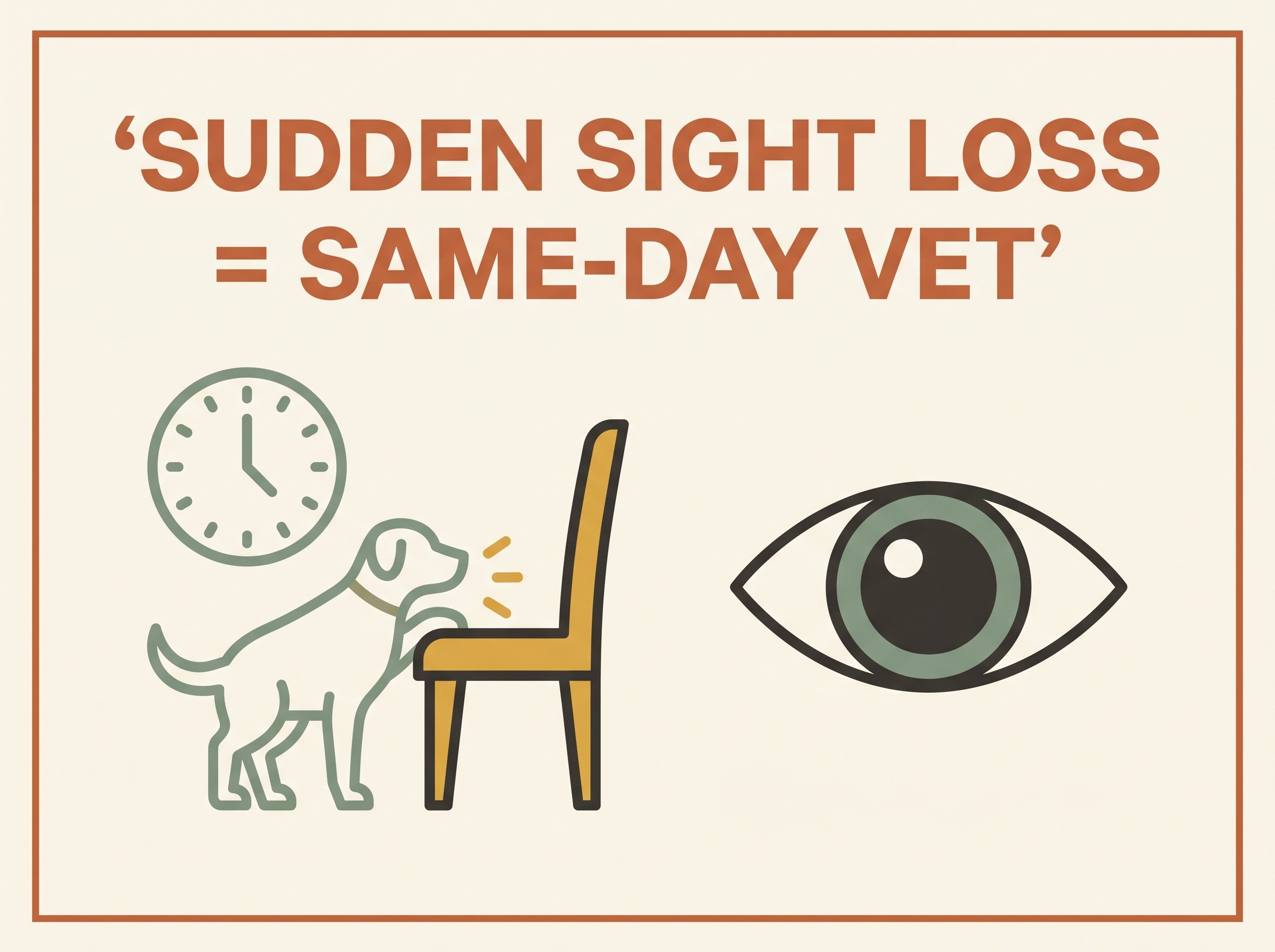
Sudden sight loss is a same-day veterinary emergency. If your pet has gone from seeing to bumping into furniture over hours or a day or two, freezing in the middle of a room, suddenly clingy and unsure, with pupils that look wide and stay wide even in bright light, contact your vet straight away. Some sudden blindness can be reversed, but only if it is treated very quickly (Cornell; Purina UK).
In an older cat, treat sudden blindness as high blood pressure until proven otherwise. Feline hypertension very often shows itself first as a cat that has abruptly gone blind, because raised pressure detaches or bleeds behind the retina (Clinician's Brief). And it almost never travels alone: at least 60% of hypertensive cats have chronic kidney disease, and around 20% of cats with an overactive thyroid are hypertensive too (Cornell). This is exactly why a sudden change in an old cat's sight is never "just her eyes": it is often the visible tip of a kidney or thyroid problem that has been quietly building, the same conditions behind the weight loss and increased thirst in why weight loss is never just old age. The hopeful part is that if the blood pressure is brought down fast enough, the retina can sometimes reattach and some sight return, though many cats are left permanently blind, which is precisely why speed matters (Cornell). The full feline picture is in our kidney space and hormone space, and the single best preventive move is having your older cat's blood pressure checked as part of their senior workup.
Dogs have their own pattern of sudden blindness. One cause is SARDS (sudden acquired retinal degeneration syndrome), which strikes middle-aged and older dogs, more often females, taking their sight over hours to days and, sadly, permanently (Colorado State University; VCA). It is poorly understood, the retina can look normal at first, and it is diagnosed with a specialist test of retinal function (an ERG). It often turns up alongside hormonal changes such as Cushing's disease, so it is part of a wider check, not an isolated eye event. There is no cure for SARDS itself, but there is real comfort in the follow-up: in one study, around 80% of owners reported their dog had a moderate to excellent quality of life afterwards (CSU). Dogs who lose their sight do not, on the whole, lose their lives. They reorganise around their nose and get on.
If you are ever unsure, our short eye emergency check will help you decide whether this is a today problem, but when sudden blindness is on the table the safe default is always to phone the vet now.
When fading senses look like a fading mind
There is one overlap worth naming, because it trips up so many loving owners. A pet who cannot see or hear well behaves a lot like a pet whose mind is ageing: bumping about, lost in a familiar room, not coming when called, pacing or vocalising at night, not recognising you for a second. The two are genuinely hard to tell apart, and often travel together.
This is why the ageing mind, what vets call cognitive dysfunction and what your pet's tracker calls Mind / Sharpness, is always a diagnosis of exclusion: a good vet rules out sight and hearing loss, pain, and conditions like high blood pressure or thyroid disease before settling on it (Vetlexicon). Sometimes "he's getting confused" really is the early ageing mind, its own gentle story covered in first signs of an ageing mind in dogs. But sometimes it is simply a dog who can no longer hear you in the next room, or a cat who cannot see the step she used to take in her stride. Getting that order right matters, because a deaf or partially sighted pet who is also assumed to be "losing it" can be written off twice over, when half the problem might be addressable. It sits inside the bigger question this stage keeps returning to: reading the slowdown of an older pet clearly rather than guessing.
Helping fading senses at home
Whatever the cause, the day-to-day playbook for a pet whose senses are dimming is much the same, and it is gentler than you might fear. The guiding idea is that you become the stability their senses no longer provide.
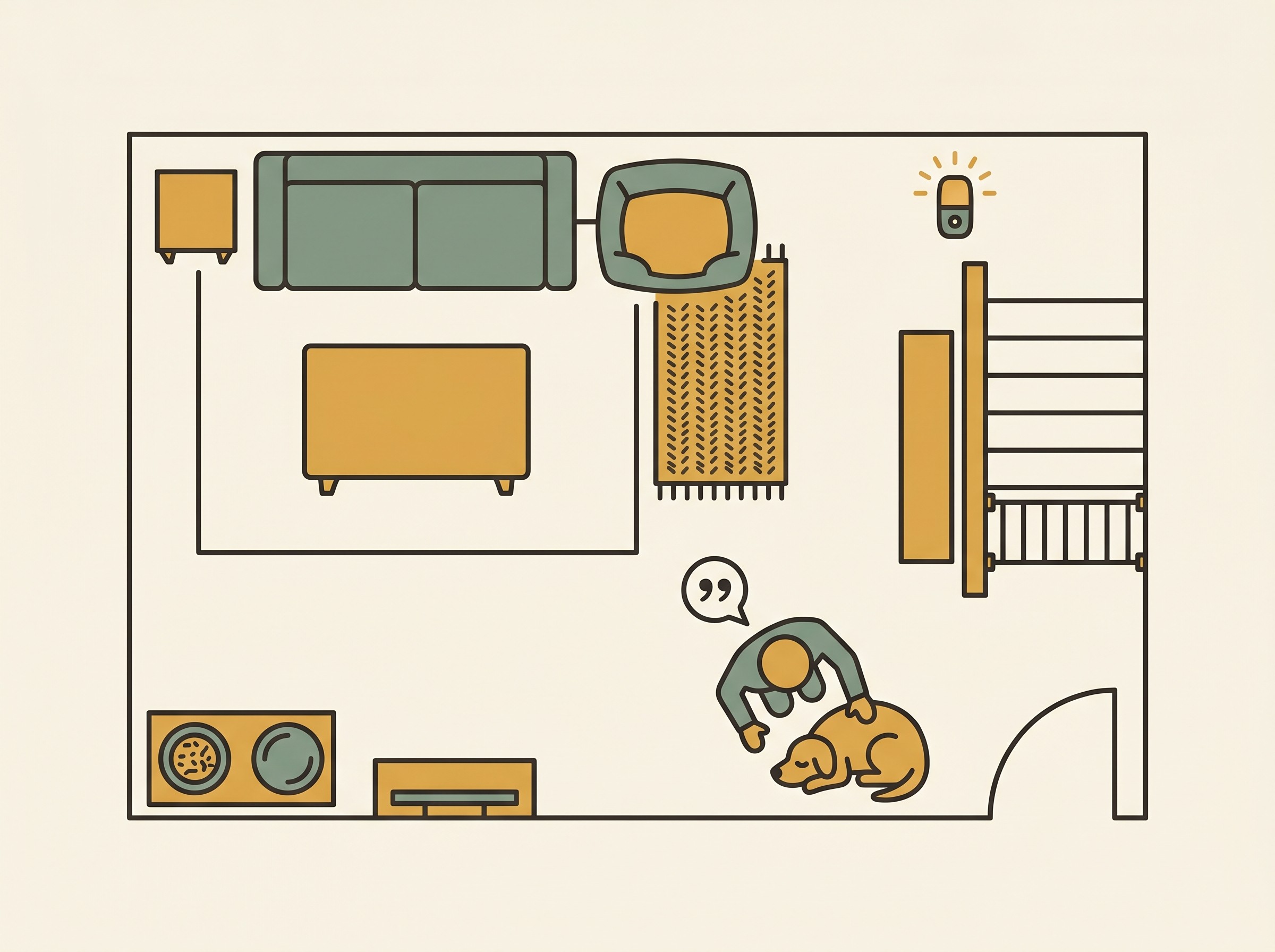
- Keep the world in the same place. A blind or partially sighted pet maps the house from memory, so leave furniture, beds, food, water and the litter tray exactly where they are (Purina UK). This is the single kindest thing you can do, and the most easily undone by tidying without thinking. Now is not the time to redecorate.
- Announce yourself. Speak before you touch a pet who cannot see you coming, and stamp or tap the floor for one who cannot hear you (Purina UK; Whole Dog Journal).
- Use landmarks they can smell and feel. A rug by the bed, a textured mat at the foot of the stairs, a dab of consistent scent near a hazard: these become signposts a pet with poor sight learns fast. And never trim a cat's whiskers, which are part of how she now feels her way.
- Light the way for tired eyes. A pet with failing but not absent sight often manages in daylight and struggles at dusk, so plug-in night lights along their routes and by the stairs make a real difference.
- Block the genuine dangers. Stair gates, fenced-off ponds and pools, supervised balconies, a lead near roads. You are not shrinking their world, just removing the few things in it that can hurt them.
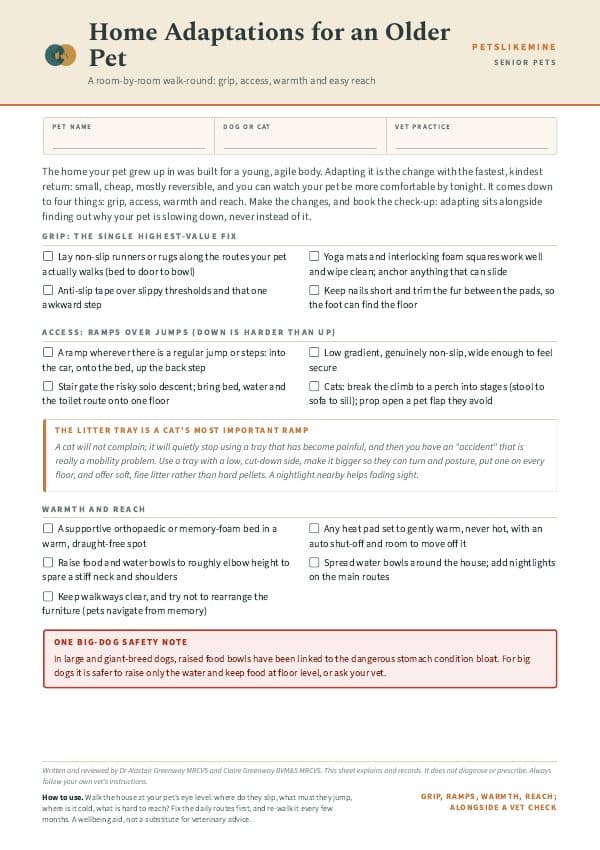
Our guide to adapting the home for an older pet goes further on ramps, grip and warmth, all of which help a pet navigating by less sight and sound. And because caring for a pet whose senses are fading can feel isolating, the senior community is full of owners who have been exactly where you are, swapping the small wins: the torch-cue that finally worked, the night light that ended the 3am stumbles.
What to do this week
Two clear actions, depending on what you are seeing.
If the change was sudden, especially sudden sight loss, treat it as today's job and phone your vet, because the chance of saving vision shrinks by the day, and in an older cat it may be the first sign of a kidney, thyroid or blood-pressure problem that needs treating anyway.
If the change has been gradual, a slowly cloudier eye, a dog who has stopped hearing you, do not panic, but do not let it drift either. Note when it started and how it is progressing in your pet's Senior Wellness Check, under Vitality and Mind / Sharpness, so the pattern is in front of you and your vet rather than left to memory, and ask for an eye and ear check, plus a blood pressure reading for an older cat, at the next appointment. Our vision check helps you put a rough number on how your pet is coping over time.
And hold on to this: fading senses are not a fading life. With a home that stays put, a bit of light, and you as their eyes and ears at the edges, most older dogs and cats go on living happily long after they stop seeing or hearing the world the way they used to. This is firmly part of the long, good plateau of an old animal thriving, not the far horizon of the time left together, and your pet, already busy navigating by nose, would tell you the same if she could hear you ask.
Free downloads
Companion worksheets to put what you've read into practice. Free PDFs, print at home.
Sister tool · Sightline
Track quality of life over time
Sightline, a separate ConciergeVet tool, runs a short adaptive weekly assessment with a quality-of-life focus mode built around exactly these frameworks, tracks a single composite score over time so you can see the trend rather than judge a single bad day, and produces a Sightline Report PDF you can bring to your vet.
A written log, or our printable quality-of-life sheet, does much the same job.
See how Sightline tracks quality of lifeKeep track of how your pet is doing
The owners who cope best are the ones who notice changes early. A simple health log shows you what is working, and what is not, before the next vet visit.
Start tracking, freeYou're not doing this alone
Compare treatment journeys and talk to owners managing senior pets. Free to join.
Join PetsLikeMine