

Making your home work for an older pet: ramps, grip, warmth, access
Alastair Greenway
BVM&S MRCVS
The home your pet has lived in for years was, without anyone deciding it, built for a young animal. The leap onto the sofa, the dash down the stairs, the high-sided litter tray in the corner of the bathroom, the kitchen floor polished to a shine: all of it was easy once, and you stopped seeing it as anything at all. Then one day the jump becomes a hesitation, the stairs become a careful descent, and you find your old friend standing at the bottom of something that used to be nothing, working out whether it is worth it.
Here is the rare article where the fix is something you can do today and see working by tonight. Of everything in these later years, adapting the home is the change with the fastest, kindest return. It comes down to four things: grip under the feet, access to the places that matter, warmth for stiff joints, and reach to food, water and the litter tray. None of it is expensive, almost all of it is reversible, and together it can hand back a surprising amount of independence and dignity.
One rule before any of it, though, and please hold onto it. Adapting the home is comfort care that sits alongside finding out why your pet is slowing down, never instead of it. A ramp eases the strain on a sore hip; it does not treat the sore hip. Slowing down is a symptom, not a diagnosis, and most of what looks like "just getting old" is treatable pain or illness underneath (is it pain, age, or disease?). So make the changes below, and book the check-up. The two work best as a pair.
Grip: the single highest-value fix in the house
If you do only one thing after reading this, lay down some grip. Smooth floors are the most underestimated hazard in a home with an older pet, and the reasoning is worth understanding because it changes how seriously you take it.
A dog's paw pads are not the grippy things we imagine. As the team at Canine Arthritis Management put it, the pads "are hard and tough, not grippy," and with the fur that grows between them they "become like slippery socks." On wood, laminate or tile, an older pet whose muscles have thinned and whose balance is no longer sharp is skating. And every slip, every scrabble where the back legs splay, "traumatises less flexible inflamed joints and pull[s] compromised muscles, ligaments and tendons out of their normal range." It hurts, and worse, the fear of it teaches a pet to move less, which is its own slow harm.
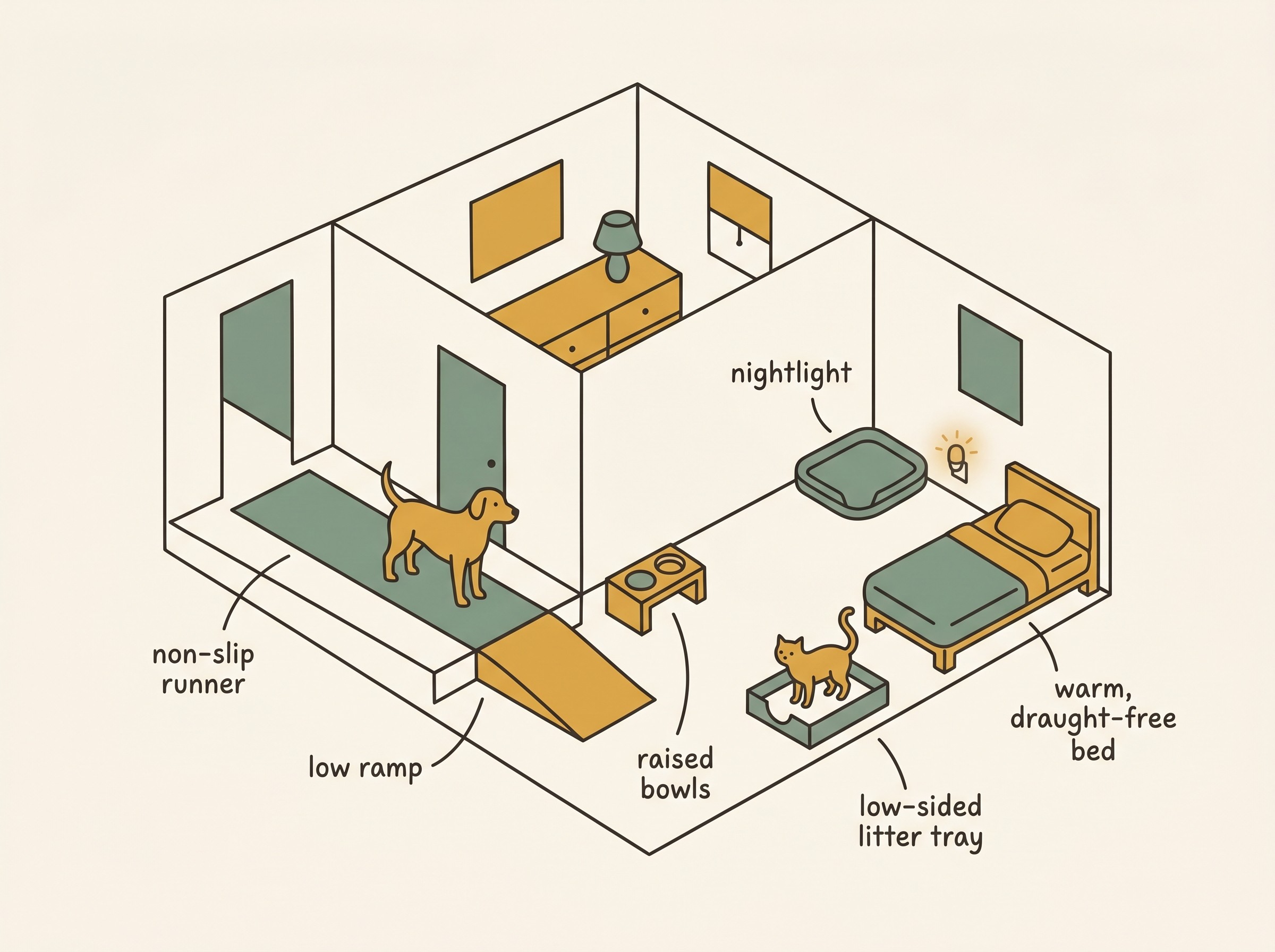
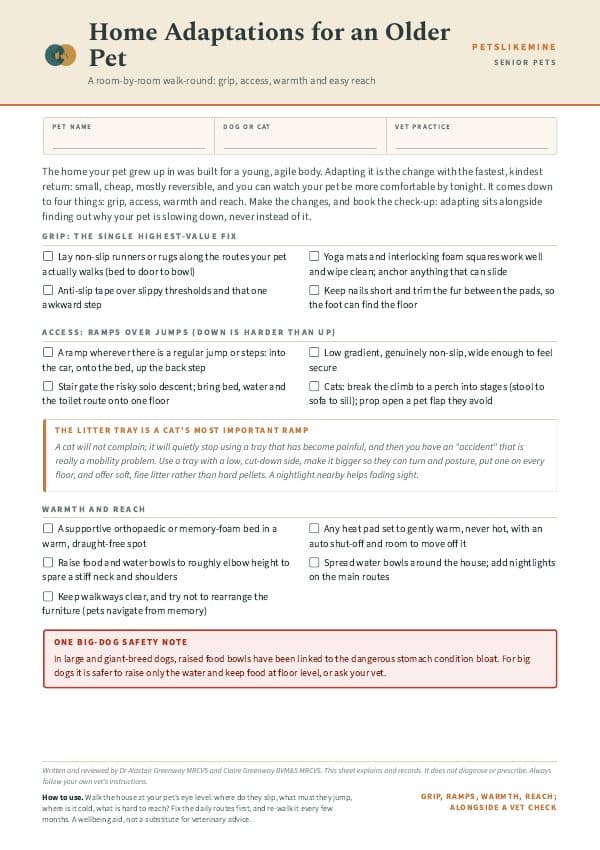
The fix is gloriously low-tech. Lay runners and rugs along the routes your pet actually walks, the desert tracks worn between the bed, the door, the food bowl and the sofa, rather than carpeting the whole house. Choose anything with a non-slip backing, or anchor it with grip tape underneath so it cannot slide out from under them. Yoga mats and interlocking foam squares work brilliantly and wipe clean. Run a strip of anti-slip tape over the threshold and that one slippy step by the back door. The whole 2023 AAHA Senior Care Guidelines, the gold-standard for looking after older pets, list exactly this among the home modifications vets should be recommending: "use of rugs or yoga mats to provide better footing," toe grips, "and appropriate beds." This is not making-do. This is the recommended standard of care.
Two finishing touches. Keep the nails short, because long claws stop the pad making proper contact and force the toes into an awkward, strained position; trimmed nails simply grip better (VCA). And trim the tufts of fur between the pads so the foot can find the floor.
Cats need grip too, in their own way. A cat launching to a worktop or landing from a chair onto a polished floor is taking the same risk, so a small rug at a favourite take-off and landing spot earns its place. And there is a feline grip problem owners rarely think of: the litter itself. Hard, wood-pellet litters can be genuinely uncomfortable to stand on for a cat with sore paws and stiff joints, and many older cats come to prefer a soft, fine, sand-like litter underfoot. If your cat has started perching on the very edge of the tray or hovering rather than settling, the surface may simply hurt.
Taking the jumps out of the day
The second lever is access, and the key fact behind it is that stiff, ageing joints hate impact most of all. A controlled walk up a gentle slope is far kinder than the jarring thud of a jump, and jumping down is harder on the joints than jumping up, because the whole bodyweight lands through legs that have to absorb it. So the goal is to take the impact out of the day.
For dogs, that means a ramp wherever there is a regular jump or a flight of steps: into the car, onto the bed if they still sleep up with you, up the back step into the garden. A ramp beats steps for a sore or wobbly pet because there is no lifting of the leg at all, just a steady walk; choose one with a low gradient, a genuinely non-slip surface and enough width that your pet feels secure rather than balanced on a plank. A car ramp, as VCA notes, makes journeys bearable again by "eliminating stress on the back and leg joints." Where stairs are the problem, the simplest answer is often to take them out of the equation: a stair gate to stop the risky solo descent, and the things your pet needs most, bed, water, a toileting route, brought down onto one floor. When you do need to help, a supportive "help 'em up" harness lets you take some weight without hauling on a collar. One small thing worth watching: a cat or dog flap can quietly become an obstacle, because squeezing through "may bump painful joints and tissue," so prop it open or rethink it if your pet has started avoiding it.
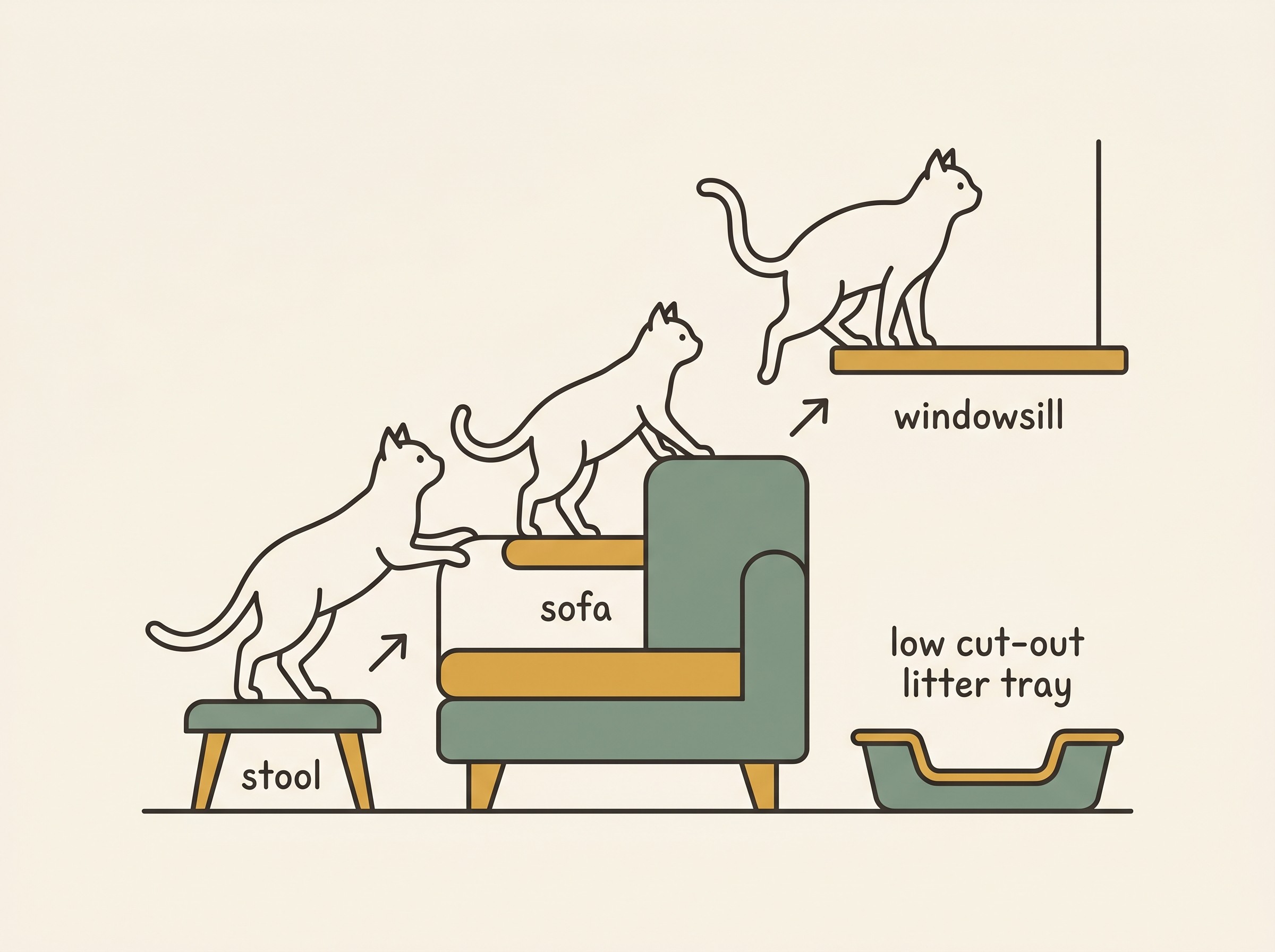
Cats live in a vertical world, and that is the whole point of the feline version of this. A cat has not "gone off" the windowsill or stopped loving the top of the wardrobe; very often they simply cannot get up there any more, and the loss of those high, safe vantage points matters enormously to a cat's sense of security. The kind solution is not to give up on the heights but to break the climb into stages: a footstool beside the sofa, the sofa beside the sill, so a single impossible leap becomes a staircase of small, manageable steps. Cornell's advice is to "create box steps, ramps, or purchase pet stairs that allow him to safely reach a special spot on his own," with firm, carpeted footing so there is no slip at the top (Loving Care for Older Cats). The independence of getting there themselves is part of the gift.
The litter tray is a cat's most important ramp
If there is one adaptation that changes a senior cat's life, it is the litter tray, because a cat will not complain, will not limp dramatically, and will instead just quietly stop using a tray that has become painful, and then you have an "accident" problem that is really a mobility problem. Cornell is direct about it: "Cats with painful arthritis may have difficulty gaining access to a litter box, especially if negotiating stairs is required. Even climbing into the box may be painful for such cats," and they recommend a box "with low sides or a cut-out to allow easy access."
So make the tray effortless. A low entry your cat barely has to step over, or a cut-down doorway in one side, removes the hip-and-knee flex that hurts a stiff cat. Make the tray itself bigger, so an older cat can turn and posture without bracing against the walls. Put one on every floor, so reaching a toilet never means a flight of stairs, and keep to the old rule of one tray per cat plus one spare, spaced out rather than lined up together. Soft, sandy litter is gentler underfoot than hard pellets, and a nightlight nearby helps a cat with fading sight find it in the dark. None of this is indulgence; it is the difference between a cat who toilets with dignity and one who is slowly written off as "dirty in their old age" when the truth is that the journey simply got too hard.
Dogs deserve the same thought outdoors. An easy, hazard-free route to the spot where your dog toilets matters, because a dog needs stable footing to posture comfortably; a ramp over the back step, a grippy path rather than a slick wet one, and good lighting after dark all help an older dog keep going where they have always gone.
Warmth, the comfort lever owners most often forget
Cold makes stiff joints stiffer and sore bodies sorer, and older pets feel the cold more than they used to. A thinner coat, less of the fat and muscle that used to insulate them, and slower circulation to the edges all mean an ageing dog or cat struggles to hold their warmth (why older cats get cold). Warmth works the other way too: gentle heat eases stiffness by improving circulation around a sore joint and relaxing the muscle around it, which is exactly why your own aches feel better in a warm bath.
The foundation is a good bed in the right place. It wants to be in a warm, draught-free spot, with a mattress that is, in Canine Arthritis Management's nice phrase, "both supportive and conforming," firm enough to take the weight off a bony hip yet soft enough to mould around it. An orthopaedic or memory-foam bed is well worth it for a pet who spends more of the day lying down. VCA's advice for an arthritic dog is simply to "keep your dog with OA warm and dry." Cats will do half the work for you, seeking out the warmest patch of sun or radiator in the house, so notice where they choose and make that spot soft and safe.
If you add direct heat, do it carefully. Use a pet-safe heat pad or bed with an automatic shut-off and a chew-resistant cord, set it to gently warm rather than hot, and always leave room for your pet to move off it. That last point matters more for an older animal than people realise: a frail cat with dulled senses "might not notice when a heated bed gets too hot" and may not move away, so the bed must never reach a temperature that could harm a pet who stays put. Warm, not hot, with an exit, is the rule.
Reach, light and the everyday details
A handful of small touches round it off. Raising the food and water bowls to roughly elbow height spares an older pet, especially one stiff through the neck and shoulders, from leaning heavily down to eat (Canine Arthritis Management). One caution worth flagging: in large and giant-breed dogs, raised feeding bowls have been linked to a higher risk of the dangerous stomach condition bloat (gastric dilatation-volvulus), so for big dogs it is safer to raise only the water and keep food at floor level, or to ask your vet. Spread water bowls around the house too, so a drink is never far away, which matters all the more for a thirsty pet drinking heavily because of kidney disease or another condition that deserves its own attention (thirst that warrants a vet).
Then there is the dimming-sight, foggy-evening side of ageing. Keep walkways clear of the shoes, wires and curled-up rug edges that trip a less sure-footed pet, and try hard not to rearrange the furniture, because dogs and cats navigate a familiar home from memory, and a moved sofa or a shifted coffee table can genuinely disorient a pet whose eyes or mind are no longer filling in the gaps. A few small nightlights along the main routes and by the water and litter help enormously, both for failing sight and for the older pet who wakes confused in the small hours. There is much more on these changes in helping fading senses and, where the confusion is part of an ageing mind, in our cognition guides.
A quick but important aside while you are noticing all this. If your pet has suddenly lost weight, gone off the raised bowl they were managing fine with last month, or changed in a way that feels faster than slow ageing should, that is not a furniture problem and no amount of adapting will fix it. Weight loss in an older pet is never "just old age," and it earns a vet visit promptly (here is why).
Make it a plan, not a shopping spree
You do not need a houseful of gadgets. The best version of this is a slow walk around your home at your pet's eye level, asking of each room: where do they slip, what do they have to jump, where is it cold, and what is now hard to reach? Fix the daily routes first, the bed-to-door-to-bowl triangle they travel a dozen times a day, and leave the rare journeys for later. Cheap, small and reversible beats one expensive contraption almost every time.
This is also where tracking earns its keep. Run a Senior Wellness Check and let the Vitality and mobility scores tell you which lever to pull first, then re-check in a few weeks to see the adaptation working, often before you would have trusted your own memory of how they were. (The Mobility Check digs deeper into the joints behind most of this, and the Arthritis space is there to treat the soreness rather than just tolerate it.) And because every house and every pet is different, the senior pets community is full of owners who have solved the exact problem you are looking at, from the cat who would only use one specific tray to the dog who finally took to a ramp.
Re-walk the house every few months, because the needs keep gently shifting, and that is not a sad thing. It is you, quietly, keeping the home one step ahead of the ageing, so that it goes on holding your old friend comfortably and with dignity right through the good long plateau of later life, and, when the road eventually gets harder, into the time you will want to have spent well (cherishing the time you have).
Tonight, you can: lay one non-slip runner on the route your pet walks most; move their bed somewhere warm and draught-free; lower the litter tray or cut down one side; and put a nightlight by the water. Four small things, and a more comfortable pet by morning.
Free downloads
Companion worksheets to put what you've read into practice. Free PDFs, print at home.
Sister tool · Sightline
Track quality of life over time
Sightline, a separate ConciergeVet tool, runs a short adaptive weekly assessment with a quality-of-life focus mode built around exactly these frameworks, tracks a single composite score over time so you can see the trend rather than judge a single bad day, and produces a Sightline Report PDF you can bring to your vet.
A written log, or our printable quality-of-life sheet, does much the same job.
See how Sightline tracks quality of lifeKeep track of how your pet is doing
The owners who cope best are the ones who notice changes early. A simple health log shows you what is working, and what is not, before the next vet visit.
Start tracking, freeYou're not doing this alone
Compare treatment journeys and talk to owners managing senior pets. Free to join.
Join PetsLikeMine