

The fearful pet: helping an anxious dog or cat feel safe
Alastair Greenway
BVM&S MRCVS
Some pets meet the world braced for the worst. There's the dog that flinches at the doorbell, paces when the light fades, and will not settle until everyone is home. There's the cat that lives behind the sofa and only really comes out at night. There's the rescue with no history, who hits the deck at a raised hand you would never raise. Living alongside a frightened animal is quietly exhausting, and it comes with a particular kind of helplessness, because the thing you most want to do, reach out and comfort them, often seems to bounce straight off. The good news, and it is real, is that fear is one of the most workable problems in the whole of behaviour. A frightened brain is not a fixed one.
It is about generalised fear and anxiety: the broadly worried dog or cat, including the under-socialised and the rescued, rather than one specific trigger. We will look at what fear actually looks like across both species, where it comes from, and the four foundations that help almost any anxious animal feel safer. The technique for working on a particular fear, and the help for the commonest specific one, the vet, each have their own articles, and we will hand you there. What sits underneath all of it is the same, so we start here.
Fear, anxiety and phobia: what the words mean
It helps to be precise, because the words get used loosely. Fear is the normal, adaptive response to a real and present threat: the appropriate alarm when something genuinely frightening is happening. Anxiety is the anticipation of a threat that may or may not come, the apprehensive bracing for something that has not happened yet and might not. A phobia is a fear that has grown out of all proportion to the actual danger, intense and persistent, and generalised anxiety is when that apprehension is no longer tied to one trigger but colours everything. These are the standard veterinary-behaviour definitions, and the distinction matters, because the pacing, restless, can-never-quite-relax pet is usually living in anxiety, not reacting to a single fright.
None of this is rare. In a large study of nearly fourteen thousand pet dogs, more than seven in ten showed at least one highly problematic anxiety-related behaviour, with noise sensitivity the single commonest at around a third of dogs and general fearfulness close behind (Salonen et al., 2020). If your dog is frightened of the world, your dog is in very ordinary company, and the size of that figure is worth holding onto on the hard days. It is common, it is recognised, and it is treated all the time.
The deeper point is that anxiety is a brain state, not a fixed trait, and brain states can shift. In one striking study, dogs with separation-related problems were shown to carry a measurable pessimistic bias, a tendency to expect the worst from an ambiguous situation, and as they were treated their responses moved back towards those of untroubled dogs (Karagiannis et al., 2015). That is the hopeful science under everything that follows. You are not trying to argue your pet out of a personality. You are helping a frightened brain learn that the world is safer than it currently believes, and a frightened brain can genuinely come to believe it.
Where the fear comes from
Fearfulness usually has more than one root, and it is rarely anyone's fault. Part of it is built in. The same large study found clear differences between breeds, which tells us there is a genuine genetic contribution to how fearful a given dog is likely to be (Salonen et al., 2020). Some animals simply arrive more cautious, wired to startle more easily, and no amount of doing everything right will turn a naturally sensitive soul into a bombproof one.
But genetics is only the loaded gun, and experience pulls the trigger. The strongest single predictor of a fearful adult dog is inadequate socialisation in puppyhood, alongside factors like urban living, less daily activity and small body size (Puurunen et al., 2020). The early window when a puppy or kitten learns that novelty is safe is brief and precious, and an animal that missed it, the farm-bred pup, the kitten raised without people, the import with an unknown start, often grows into an adult who finds ordinary life genuinely alarming. That is not damage you caused, and importantly it is not a life sentence. The catch-up plan for the animal who missed its window is its own subject, covered in socialisation done right.
Then there is the rescue with no story at all, and the single traumatic event that taught a once-confident pet to fear one thing or many. And there is one root that hides in plain sight and that we, as vets, are unusually placed to flag: pain. A frightened animal that has become frightened recently, or an older pet whose nerves seem to be fraying, may be hurting. Pain induces a more pessimistic, irritable frame of mind, and in one review of referred behaviour cases a conservative estimate was that around a third involved an underlying painful condition, with the true figure in some caseloads put far higher (Mills et al., 2020). This is why the first move for any new or worsening fearfulness is not a training plan but a veterinary check, and why we built the behaviour check tool to help you judge how urgently to go. The full medical rule-out lives at is it behaviour or is it medical?; start there if the fear is new.
How fear shows up in dogs and cats
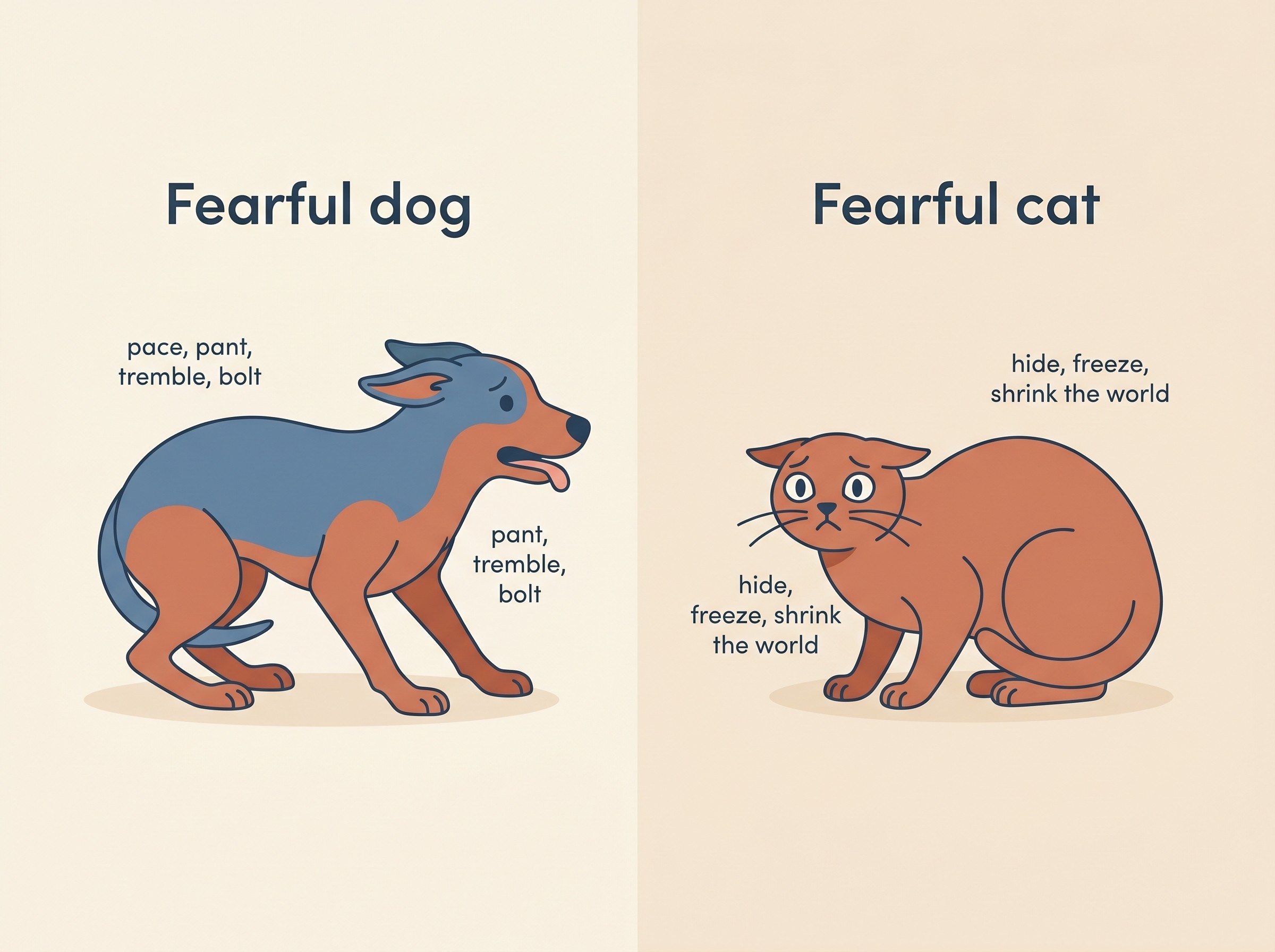
Dog fear tends to be loud enough to notice, eventually. A frightened dog may pace, pant when it is not hot, tremble, bark or whine, cling to you or bolt from you, refuse food, lower its body and tuck its tail, or hide. Some freeze; some flee; some, cornered with no other option, growl, snap or bite. That last route is worth stating plainly, because fear is the commonest reason a pet becomes aggressive: an animal that feels trapped and cannot escape may go through you to make the frightening thing stop. The signals that precede it are quiet and easy to miss, which is exactly why learning to read them early is so protective, and our guide to reading your pet's body language teaches the sequence in full.
Cat fear is quieter still, and that is precisely why it is so often missed and mistaken for a cat simply "being aloof". A frightened cat hides, eats less, stops using the litter tray, over-grooms a patch of belly bare, freezes flat against the floor, or sits with dilated pupils and a face that has gone tense and still. There is rarely a dramatic moment to alert you; there is just a cat that has slowly shrunk its world. The help they need is concrete and well evidenced, and we come to it next.
Four foundations every anxious animal stands on
Before any technique, four things form the ground every anxious animal stands on. Get these right and a great deal of fear eases on its own; skip them and no clever protocol will hold.
Start with safety: a refuge they can always reach. Every fearful pet needs a place it can retreat to and never be followed, cornered or dragged out of. For dogs this is a quiet bed, a covered crate left always open, a room away from the front door. For cats it is genuinely fundamental: providing a safe place is the first of the recognised pillars of a healthy feline environment (Ellis et al., 2013), and the evidence is unusually clear. In a controlled trial, newly arrived shelter cats given a simple hiding box were measurably less stressed in their first week than cats without one (Vinke et al., 2014). A cardboard box on its side, a covered bed, a high shelf: the refuge is not a luxury, it is treatment. A fear and anxiety body-language guide and a safe-space setup sheet are there to print when they are ready.
Next comes predictability. Anxiety feeds on the unpredictable, and a routine your pet can rely on, meals, walks, quiet times arriving at roughly the same points, lowers the background hum of apprehension. For cats this runs deep: positive, consistent and predictable interaction with people is itself one of those core feline pillars (Ellis et al., 2013). Predictable handling, letting a cat come to you rather than scooping it up, signposting what is about to happen, all of it tells a worried animal that its world has rules and can be trusted. The deeper feline framework lives at feline stress, FIC and enrichment.
Third comes choice and control. This is the foundation owners most often overlook, and it may be the most powerful. Being able to choose, to opt in or out, to approach or retreat, is itself protective of welfare. The evidence here is genuinely surprising: across species, animals will work for the mere opportunity to make a choice even when choosing brings them no extra reward, which tells us that having a say is valued in its own right (Englund & Cronin, 2023). The flip side is the lesson too. The same review traces how a loss of control corrodes welfare, from the elevated stress hormones seen in animals denied control over a noise to the shut-down state of learned helplessness, so an animal that cannot escape or influence what happens to it fares worse than one that can (Englund & Cronin, 2023). So you never force a fearful pet. You let it decide whether to come and say hello, whether to be stroked, whether to leave. Every time it gets to choose, its sense that the world is manageable grows.
And the rule that underpins all of it: never punish fear. Telling off, scolding or correcting a frightened animal does not make it braver; it adds you to the list of things to be afraid of, and it can make the fear worse. The veterinary position is unambiguous that reward-based methods are the appropriate approach and that aversive ones risk fear, anxiety and a damaged relationship with no advantage in effectiveness (AVSAB, 2021). The full case sits at how animals actually learn; here the rule is simple and absolute.
It is worth retiring one persistent myth right here, because it stops so many owners doing the kind thing. You will be told that comforting a frightened pet "reinforces" the fear. It does not. Fear is an emotion, not a trick performed for a reward, and you cannot reinforce an emotion by being kind to the animal feeling it. This is not merely reassuring theory: in a survey of more than twelve hundred dogs with firework fear, simply interacting with and comforting the dog during the noise showed no link at all to fear getting worse, while actively pairing the noise with treats and play, which is comforting taken a step further, was among the most effective approaches of all (Riemer, 2020). Soothing words, a calm lap, a favourite treat in a scary moment either help or do nothing; they do not deepen the fear. So comfort your pet. The seasonal version of this, for fireworks night specifically, is covered at your firework night plan.
Building confidence, and when to reach for more
The foundations make an animal feel safer; building confidence is how you actually shrink the fear over time, and it follows one principle. You expose the animal to the frightening thing only at a level mild enough that it stays under threshold, calm and able to think, and you pair that exposure with something genuinely good, so the trigger slowly comes to predict pleasant things rather than danger. What you never do is force a frightened animal over its threshold, flooding it with the full-strength fear in the hope it "gets used to it", because that route tends to sensitise rather than settle, and can tip an animal into shutdown. Done well this is the single most effective tool in fear work, and the step-by-step, how to build the ladder and read the threshold, is the whole of desensitisation and counter-conditioning.
Alongside that confidence work sit the adjuncts. Routine and enrichment that let a pet use its brain and body in natural ways build resilience, and the wider enrichment picture lives at boredom and enrichment. Calming aids and pheromones, the plug-in diffusers and the rest, can take a little off the top for some animals; we grade the evidence for each at calming aids, pheromones and supplements rather than overselling them here. The single most common specific fear most owners meet, the vet and the carrier, has its own dedicated plan at fear of the vet and cooperative care, and it is the place many readers should go next.
And sometimes, for a truly anxious animal, the kind and effective choice is medication, prescribed by your vet to make the behaviour work possible rather than to replace it. This is not giving up, and the science makes the point well: in those separation-distressed dogs, it was medication alongside behaviour work that shifted the underlying pessimistic brain state back towards normal, letting the animal actually learn (Karagiannis et al., 2015). A brain drowning in fear cannot take in new, calmer lessons; lowering the fear lets the lessons land. We keep the drug detail where it belongs, at medication for separation anxiety for the daily options and event medication that works for the situational ones, so talk to your vet about whether and which.
Last, the thing most worth saying to anyone living with a frightened pet: this takes weeks and months, not days, and the reality is that progress is rarely a straight line. The popular "three days, three weeks, three months" rule of thumb that circulates in rescue circles is a folk guide, not a measured fact, and it can set up unfair expectations, because the evidence on newly adopted dogs is sobering rather than rosy. When researchers followed adopted shelter dogs across their first six months, separation-related upset and attention-seeking did tend to ease as the dogs attached, but generalised fear of strangers, of other dogs and of the wider world did not reliably fall over that window on its own (Bohland et al., 2023). The lesson is not that fear cannot improve, because the confidence work above genuinely shifts it; the lesson is that it usually will not melt away with time alone, and that an active plan, patiently applied, is what does the work. If the fear is severe, generalised, or tipping towards aggression, that is not failure, it is the point to bring in a qualified behaviourist, and the next thing to do is book the vet check that starts the whole plan off.
References
- Salonen M, Sulkama S, Mikkola S, et al. Prevalence, comorbidity, and breed differences in canine anxiety in 13,700 Finnish pet dogs. Scientific Reports, 2020;10:2962.
- Karagiannis CI, Burman OHP, Mills DS. Dogs with separation-related problems show a "less pessimistic" cognitive bias during treatment with fluoxetine (Reconcile) and a behaviour modification plan. BMC Veterinary Research, 2015;11:80.
- Puurunen J, Hakanen E, Salonen MK, et al. Inadequate socialisation, inactivity, and urban living environment are associated with social fearfulness in pet dogs. Scientific Reports, 2020;10:3527.
- Mills DS, Demontigny-Bedard I, Gruen M, et al. Pain and problem behavior in cats and dogs. Animals, 2020;10(2):318.
- Ellis SLH, Rodan I, Carney HC, et al. AAFP and ISFM feline environmental needs guidelines. Journal of Feline Medicine and Surgery, 2013;15(3):219-230.
- Vinke CM, Godijn LM, van der Leij WJR. Will a hiding box provide stress reduction for shelter cats? Applied Animal Behaviour Science, 2014;160:86-93.
- Englund MD, Cronin KA. Choice, control, and animal welfare: definitions and essential inquiries to advance animal welfare science. Frontiers in Veterinary Science, 2023;10:1250251.
- American Veterinary Society of Animal Behavior (AVSAB). AVSAB Position Statement on Humane Dog Training, 2021.
- Riemer S. Effectiveness of treatments for firework fears in dogs. Journal of Veterinary Behavior, 2020;37:61-70.
- Bohland BC, Lord LK, Howell TJ, et al. Shelter dog behavior after adoption: using the C-BARQ to track dog behavior changes through the first six months after adoption. PLOS ONE, 2023;18(8):e0289356.
Keep track of how your pet is doing
The owners who cope best are the ones who notice changes early. A simple health log shows you what is working, and what is not, before the next vet visit.
Start tracking, freeYou're not doing this alone
Compare treatment journeys and talk to owners managing behaviour & anxiety. Free to join.
Join PetsLikeMine