

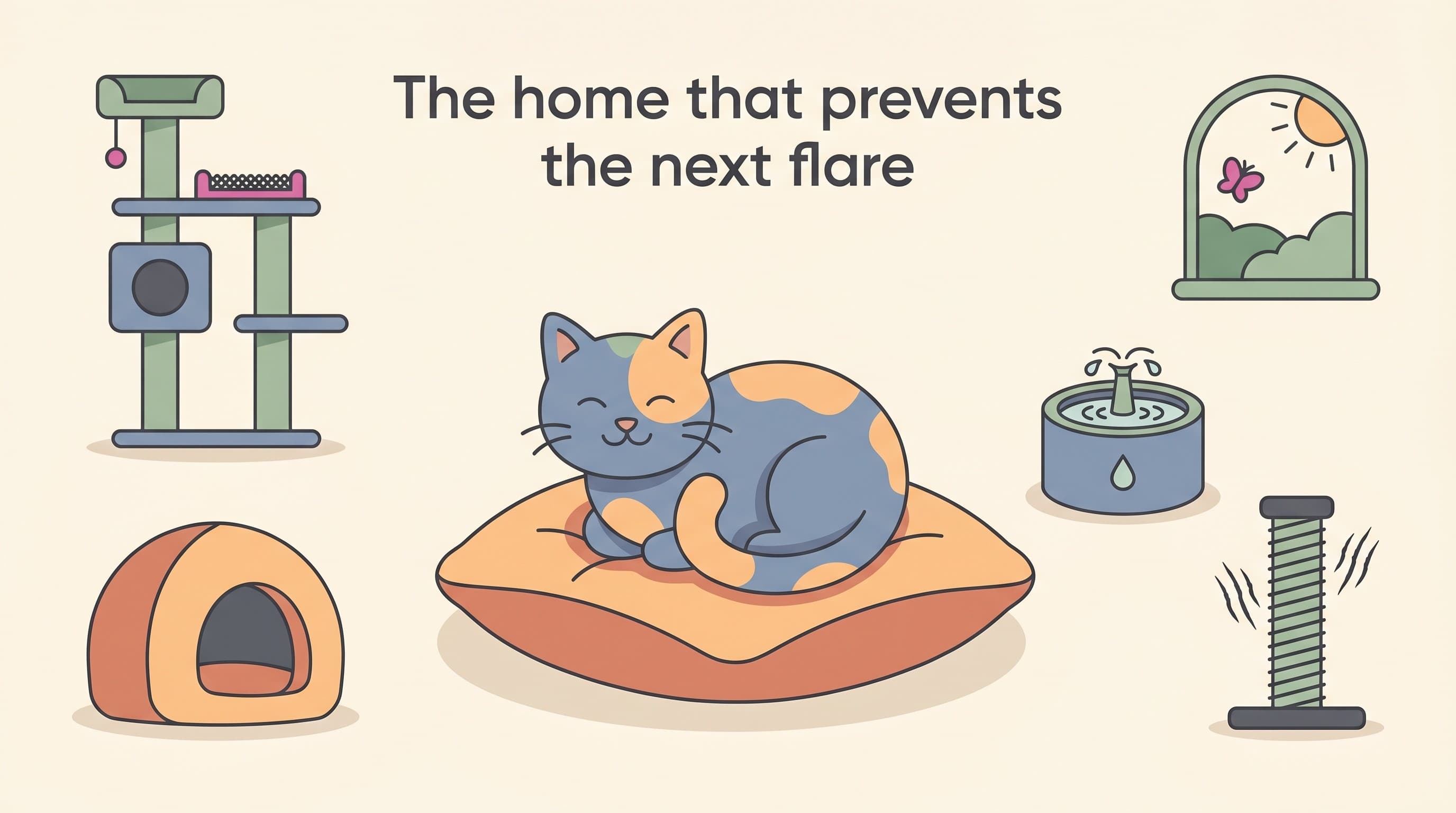
Stress, FIC and the indoor cat: the enrichment that prevents relapse
Alastair Greenway
BVM&S MRCVS
A cat with feline idiopathic cystitis is usually handed two explanations that sound like they cancel each other out. One vet calls it a bladder problem. Another calls it a stress problem. Both descriptions are correct, and it is the second one that actually decides what your cat's future looks like. This article is about the part of that future you hold in your hands: the home you can build so the next flare never turns up.
It helps to be honest about expectations from the outset. Many acute FIC flares settle on their own within roughly five to ten days, with or without treatment (He et al., 2022). That single fact explains a great deal of bad advice, because owners and product marketers alike tend to credit whatever happened to be given while the flare was already fading. Enrichment is not a cure for the cystitis your cat has today. It is the thing with the best evidence behind it for preventing the cystitis your cat would otherwise have next month. So if you have landed here mid-flare, the order of business is medical first, then this. Let me explain why, then build you the plan.
A bladder problem that begins in the nervous system
FIC is the single most common reason a cat under ten ends up at the vet with lower urinary tract signs, accounting for somewhere around 55 to 67 per cent of these cases, and it is a diagnosis of exclusion, reached only after stones, infection and other causes have been ruled out (He et al., 2022). That rule-out genuinely matters and it is not the job of this article. The medical work-up, and the one emergency you must never miss, belong to our guide on why a cat peeing outside the tray needs illness ruled out first. Read it before you read on if your cat has not yet been checked.
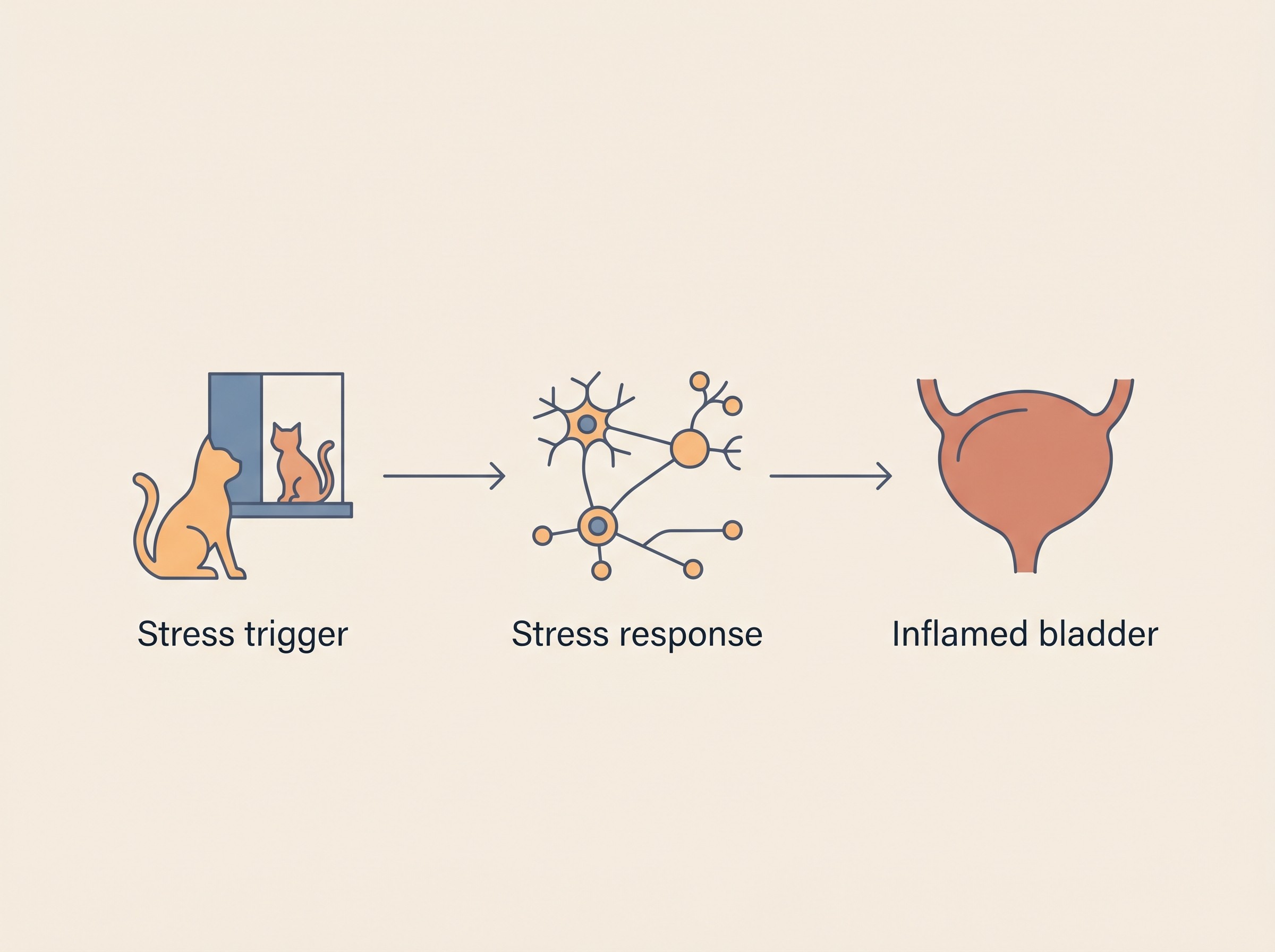
In cats with FIC the stress response is wired differently. The sympathetic nervous system, the fight-or-flight side, runs ahead of the usual stress hormone cortisol, producing what researchers describe as an uncoupling of sympathetic activity from the normal hormonal axis, with exaggerated release of stress chemicals and a blunted cortisol response (He et al., 2022). When affected cats and healthy cats are put under the same stressor, the FIC cats pour out significantly more of these catecholamines at every time point, while their urinary cortisol marker does not rise to match, which the researchers read as a dissociation between the two stress systems (Westropp, Kass & Buffington, 2006). The downstream effect of all that sympathetic drive is a bladder lining that becomes more permeable and nerves that fire more readily, which is how a stress signal turns into a sore bladder. First flares and later ones alike are typically set off by something the cat experiences as threatening: a house move, a new pet, a change in routine, conflict with another cat (He et al., 2022).
This is why the field increasingly talks about Pandora syndrome rather than just cystitis. The vet researcher Tony Buffington proposed the name deliberately to stop us blaming any one organ, because the trouble often does not start in the bladder at all (Buffington, 2018). It describes a whole-cat picture: an animal sensitised by early-life adversity and chronic stress, whose distress shows up wherever it shows up. The broader signature is a cluster of so-called sickness behaviours: vomiting, soft stools or diarrhoea, no eliminations in 24 hours, going outside the tray, eating less, lethargy and not grooming (Buffington, 2018). If your cat does several of these when the household is unsettled, you are not imagining a pattern. You are watching the same stress system that inflames the bladder.
Indoor life is not the villain, under-enrichment is
It is tempting to conclude that indoor cats are simply bored and ill by definition, and to feel guilty for keeping yours in. That is not what the evidence says, and the guilt is unhelpful. Welfare indoors depends almost entirely on how well the cat's environmental and social needs are met, not on the number of walls. The caveat worth stating is that the indoor-cat literature leans heavily on shelter and laboratory studies with comparatively little direct evidence from ordinary homes, so confident claims are not warranted in either direction (Foreman-Worsley & Farnworth, 2019). The fair reading is this: four walls are fine when the inside of them is rich, predictable and gives the cat a sense of control. The problem is under-enrichment, not indoor living, and that is a problem you can fix without ever opening the front door.
The fix has a name and a research base. Multimodal environmental modification, usually shortened to MEMO, is recommended as first-line therapy for FIC, generally before any medication, and the encouraging finding is how broadly it seems to work: nearly all of these cats respond to MEMO with resolution of both the cystitis and the comorbid signs (Buffington, 2018). The relapse-prevention evidence is the part you came for. In a study following 46 indoor cats with FIC for ten months, environmental modification produced significant reductions not only in lower urinary tract signs but also in fearfulness, nervousness and respiratory signs (Buffington et al., 2006). That is the prize: fewer flares, and a calmer, less frightened cat as a bonus.
A word on the strength of that evidence. The 46-cat study was observational, single-armed and relied on owner reports, which makes it strong enough to anchor "MEMO reduces recurrence" but short of a blinded randomised trial. A 2025 systematic review of FIC management put numbers to that: of 22 studies, only two assessed environmental modification, and while the evidence for MEMO was judged encouraging, the overall lack of high-quality studies means clinicians have to stay critical of the literature (Macleod et al., 2025). That same review concluded that MEMO, alongside a therapeutic urinary diet with raised moisture content, currently has the strongest evidence of anything we offer for FIC and should be considered the primary approach (Macleod et al., 2025). So treat the framework below as well-reasoned consensus supported by real but limited trial data. It is the best we have, the downside is essentially nil, and the upside for your cat is considerable.
Five pillars, and what each one means at home
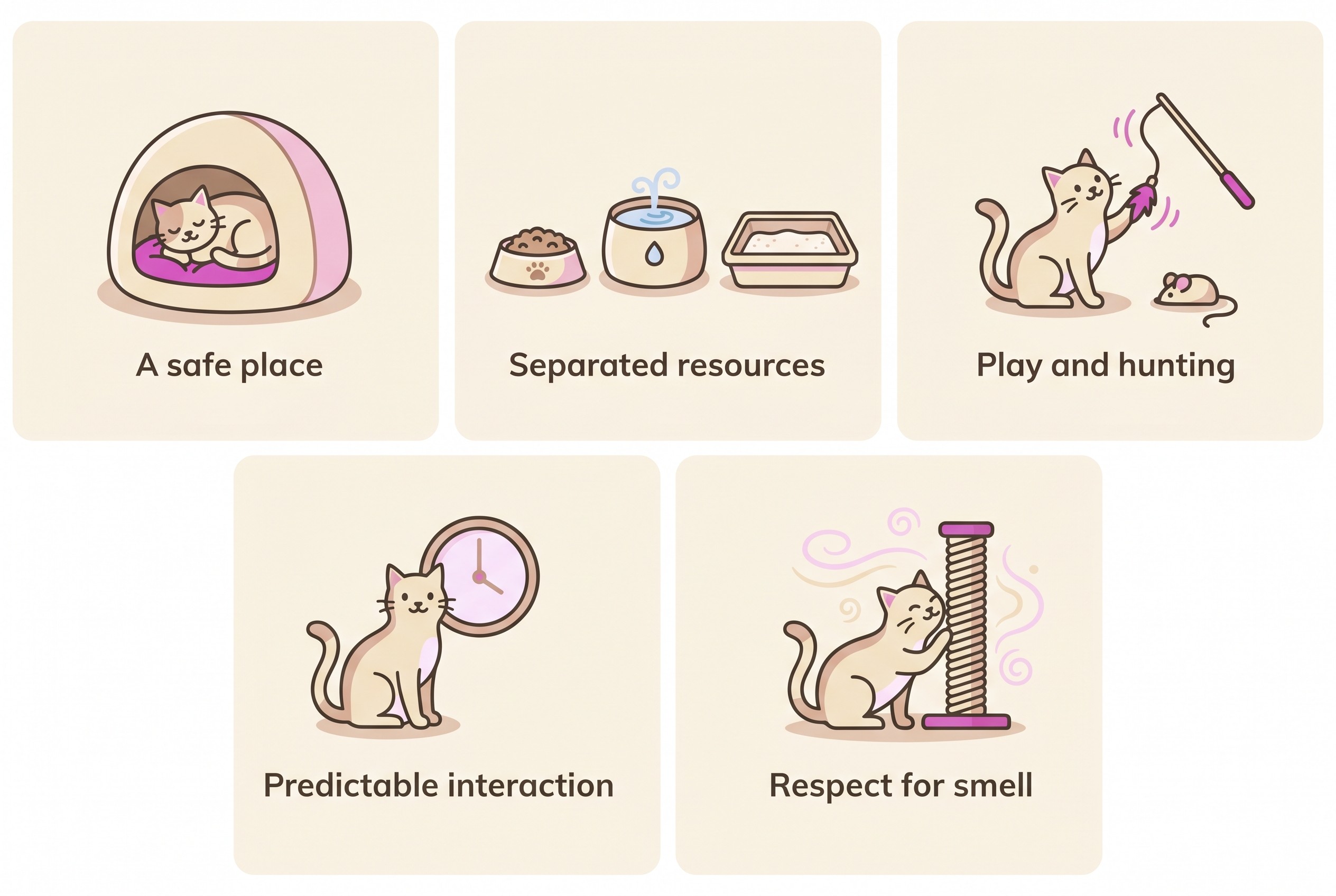
The consensus framework for a healthy feline environment is the AAFP and ISFM set of five pillars, designed explicitly to reduce stress, stress-related disease and unwanted behaviour (Ellis et al., 2013). They are worth knowing properly, because they are also, independently, the backbone of house-soiling management: the AAFP and ISFM house-soiling guidelines give just two universal interventions for every case, optimise the tray and meet the five pillars (Carney et al., 2014). Get these right and you are treating the cause, not the symptom.
Pillar one, a safe place. Every cat needs a private, secure retreat it can get to whenever it wants, ideally raised, where it can watch the world without being approached (Ellis et al., 2013). A cardboard box on a shelf counts. The point is that the cat, not you, decides when it is unavailable.
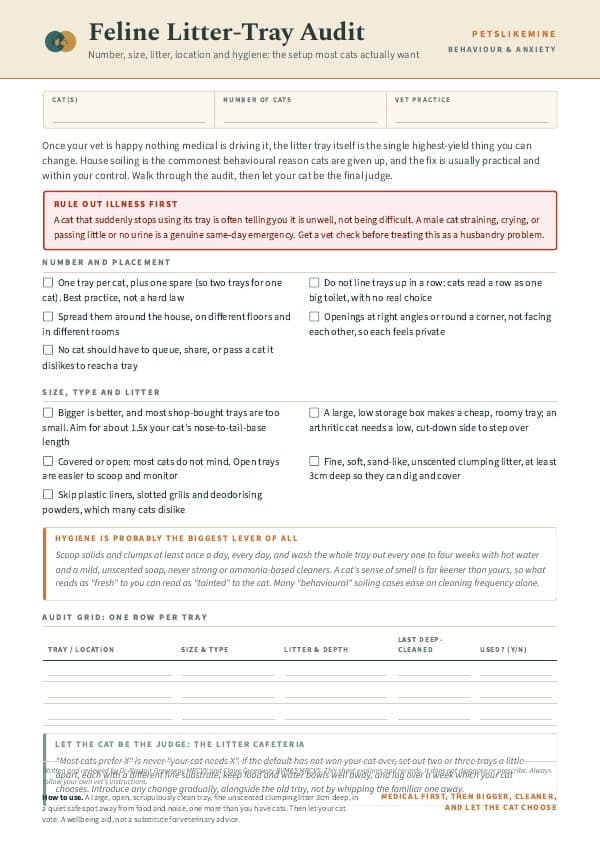
Pillar two, multiple and separated key resources: food, water, toileting, scratching, play and resting or sleeping areas (Ellis et al., 2013). This is where the familiar "one per cat plus one" rule comes from, as many of each resource as you have cats, plus a spare, in genuinely separate locations rather than lined up in a row. That rule applies to litter trays too, but the practical detail of tray number, type, litter and siting deserves its own audit, which lives in our litter-tray audit guide. Set the principle here, fix the trays there.
Pillar three, the chance to play and hunt. Cats are built to stalk, chase and capture, and they need a daily outlet for it (Ellis et al., 2013). More on the how below.
Pillar four, consistent and predictable interaction on the cat's terms. The evidence-based version of affection is the one the cat starts and can end, short, frequent, predictable contact rather than being scooped up when you fancy it (Ellis et al., 2013).
Pillar five, respect for the cat's sense of smell. This is the one owners most often trample. Cats map their territory in scent, so do not scrub away facial-rubbing marks, do not deep-clean the whole house at once, and keep strong cleaners, air fresheners and diffusers away from your cat's core resources (Ellis et al., 2013). A territory that suddenly smells alien is, to a cat, a territory that is no longer safe.
Turning the pillars into a daily routine
Frameworks are easy to nod at and hard to live with. Here is how the pillars become things you actually do.
Make your cat hunt for at least some of its food. Food puzzles and foraging feeders are not a gimmick. The published case experience is encouraging: introducing them has been linked with weight loss, fewer aggressive flare-ups between cats, gradually easing fear-related behaviour, less constant meowing for food, and even individual cases of inappropriate urination tied to FIC and Pandora syndrome going into lasting remission once foraging was introduced (Dantas et al., 2016). Those are reported cases rather than a controlled trial, so hold them as promising rather than guaranteed, but the direction is clear and the risk is nil. Start easy so your cat wins, a few biscuits in an egg box or a treat ball, then build difficulty as it gets the idea. Pair that with short, daily interactive play that lets the sequence complete: let the wand toy be stalked, chased, caught and then "killed" with a few pieces of food, rather than twitched endlessly until your cat gives up frustrated.
Build upwards. Vertical space, shelves, the top of a wardrobe, a cat tree by a window, multiplies the usable territory and gives a nervous cat the high, safe vantage point that pillar one is really about. Keep the daily rhythm predictable, because for a cat with a stress system that does not switch off cleanly, predictability is itself a kind of medicine: regular feeding and play times lower the background hum of uncertainty. And go gently on the smell front during any upheaval: when you must clean a soiled spot, treat that spot, not the whole room.
For general enrichment theory across both species, what enrichment is, why choice and foraging matter, our boredom and enrichment guide covers the cross-species picture and I will not duplicate it here. What is feline-specific is everything above: the hunting drive, the scent map, the need for separated resources and escape routes.
Multi-cat tension, overgrooming and the products people ask about
Where there is more than one cat, conflict is one of the most powerful FIC triggers there is, and cats who live with others are particularly prone to flares when the tension between them persists (He et al., 2022). The reason the "plus one" resource rule matters so much in these homes is that it lets cats avoid each other at the tray, the bowl and the high perch without ever having to negotiate. That separation idea is shared territory, but the real work of easing inter-cat tension, reading the silent stand-offs, time-sharing the space, slow reintroductions, belongs to our easing inter-cat conflict guide, which goes far deeper than I can here.
Stress in cats does not only land on the bladder. A cat that suddenly overgrooms a bald stripe along its belly may be telling you the same thing the cystitis does, although overgrooming has important itchy, medical causes that must be ruled out first, which is why it has its own article on feline overgrooming and psychogenic alopecia. If you see both signs in the same unsettled household, that is the stress system talking through two organs at once.
On products: the synthetic feline facial pheromone, sold as Feliway, is commonly suggested as an adjunct, and you will see it recommended for both cystitis and marking. Be cautious about leaning on it, though, because the same 2025 review that backed environmental modification found little evidence to support feline facial pheromone for FIC (Macleod et al., 2025). Whether it earns its place at all, and what the trials actually show, is weighed up in our calming aids and pheromones guide rather than here. For severe, refractory cases your vet may also discuss medication, but no drug is licensed specifically for FIC in the UK and any prescribing and dosing is firmly a veterinary decision, so I will leave that conversation to them. Enrichment comes first because it is what the evidence puts first.
The flare you must never wait out
One non-negotiable before I send you off to build all this. A male cat that is straining, crying, going to the tray again and again, or producing little or no urine may have a blocked urethra, and that is a genuine emergency: a complete obstruction can prove fatal within a day or two as toxins and potassium build up in the blood. This is never a "let me get the enrichment right first" situation. If you see it, you ring the vet now. Our behaviour-check tool will help you confirm when signs cross into needing same-day veterinary care, but if a male cat cannot pass urine, do not pause to check anything, go straight to your vet.
For everything short of that, the work ahead is genuinely hopeful, and it is yours to do. Start with one change this week, the food puzzle is the easiest win and has some of the most encouraging behavioural reports behind it, then add the trays, the vertical space and the predictable play over the coming fortnight. Keep a simple note of flares so you can see the pattern thin out over months, which is the timescale on which this works. Print the litter-tray audit and an FIC enrichment plan to keep yourself on track. You will not cure today's cystitis with a wand toy, but you are building the one thing that genuinely lowers the odds of the next one, a home that lets an anxious cat feel safe.
References
- He C, Fan K, Hao Z, et al. Prevalence, Risk Factors, Pathophysiology, Potential Biomarkers and Management of Feline Idiopathic Cystitis: An Update Review. Frontiers in Veterinary Science, 2022; 9:900847.
- Westropp JL, Kass PH, Buffington CAT. Evaluation of the effects of stress in cats with idiopathic cystitis. American Journal of Veterinary Research, 2006; 67(4):731-736.
- Buffington CAT, Westropp JL, Chew DJ. Pandora Syndrome in Cats: Diagnosis and Treatment. Today's Veterinary Practice, 2018; 8(5):84-91.
- Foreman-Worsley R, Farnworth MJ. A systematic review of social and environmental factors and their implications for indoor cat welfare. Applied Animal Behaviour Science, 2019; 220:104841.
- Buffington CAT, Westropp JL, Chew DJ, Bolus RR. Clinical evaluation of multimodal environmental modification (MEMO) in the management of cats with idiopathic cystitis. Journal of Feline Medicine and Surgery, 2006; 8(4):261-268.
- Macleod E, Laven R, Laven L, Hill K. Understanding the current evidence base for the commonly recommended management strategies for recurrent feline idiopathic cystitis: a systematic review. New Zealand Veterinary Journal, 2025; 73(4):233-245.
- Ellis SLH, Rodan I, Carney HC, et al. AAFP and ISFM Feline Environmental Needs Guidelines. Journal of Feline Medicine and Surgery, 2013; 15(3):219-230.
- Carney HC, Sadek TP, Curtis TM, et al. AAFP and ISFM Guidelines for Diagnosing and Solving House-Soiling Behavior in Cats. Journal of Feline Medicine and Surgery, 2014; 16(7):579-598.
- Dantas LM, Delgado MM, Johnson I, Buffington CAT. Food puzzles for cats: Feeding for physical and emotional wellbeing. Journal of Feline Medicine and Surgery, 2016; 18(9):723-732.
Free downloads
Companion worksheets to put what you've read into practice. Free PDFs, print at home.
Keep track of how your pet is doing
The owners who cope best are the ones who notice changes early. A simple health log shows you what is working, and what is not, before the next vet visit.
Start tracking, freeYou're not doing this alone
Compare treatment journeys and talk to owners managing behaviour & anxiety. Free to join.
Join PetsLikeMine