

Cat peeing outside the tray: the first thing to rule out is illness
Alastair Greenway
BVM&S MRCVS
A previously clean cat starts weeing on the carpet, the bath mat, the bed, or just beside the tray, and most owners read it the same way: a quiet, sinking frustration, and the assumption that the cat is making a point. A protest, a strop because you went away for the weekend, plain bad manners. Let me take that reading off the table, because it is almost always wrong and it sends people down exactly the wrong path. Cats do not toilet in the wrong place out of spite. House soiling is a signal that something is off, and a surprising amount of the time that something is medical (Carney et al., 2014).
So before this becomes a behaviour problem in your mind, it needs to become a health question. This article is about a cat squatting and passing urine, often a normal-sized or larger puddle, on a horizontal surface in the wrong place. That is different from spraying, which is a marking behaviour with its own causes and fixes, and which we cover separately in our guide to spraying versus squatting. Here, the job is to rule out illness first, to recognise the one scenario that is a genuine emergency, and only then to move on to the practical fixes.
Why "naughty" is almost always the wrong first thought
The professional guidance deliberately uses the neutral term "house soiling" precisely because it implies no wrongdoing by the cat (Carney et al., 2014). It is one of the most common feline behaviour complaints vets see, and a leading reason cats are relinquished to shelters, which is a tragedy when so many cases have a treatable root (Carney et al., 2014). The cat is not making a point. It is telling you that the tray hurts to use, or that weeing itself hurts, or that it is producing far more urine than one tray can cope with, or that it is stressed in a way that has inflamed its bladder.
That is also why punishment has no place here and actively makes things worse. Smacking, shouting, rubbing a cat's nose in it, or shutting it away does not reduce soiling. It increases the cat's stress, which is frequently the very thing driving the problem, and it can produce fear and fear-related aggression while damaging your relationship with your cat (Carney et al., 2014). The soiling is information, not insubordination, and your first call is to your vet, not to a spray bottle.
There is a wider version of this same logic, the idea that any sudden change in behaviour deserves a health check before anything else, and we lay that out in full in is it behaviour or is it medical. If you would like a quick steer on whether what you are seeing warrants a vet visit, our behaviour check tool will walk you through it.
The emergency you must not miss: a male cat who cannot wee
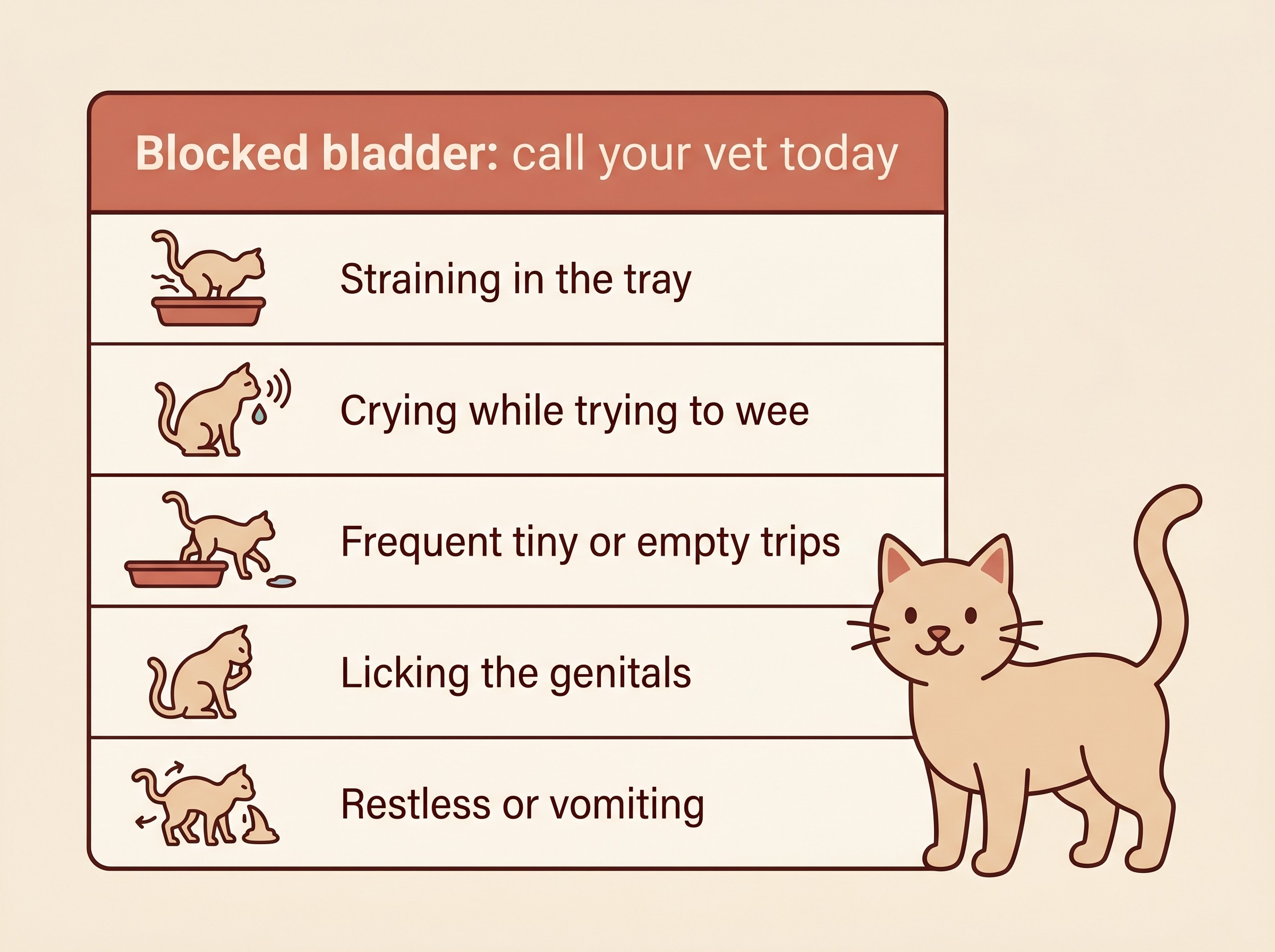
Before anything else, learn this one pattern, because getting it wrong costs lives. A cat, and especially a neutered male cat, who is straining in the tray, crying or yowling while trying to go, making frequent tiny trips with little or nothing to show for it, repeatedly licking at his genitals, or growing restless, off his food, or starting to vomit, may have a blocked bladder. This is a urethral obstruction, and it is a same-day, drop-everything emergency.
Here is why it is so urgent. When the urethra is blocked, urine and the waste it carries cannot leave the body and the kidneys back up. Within a day or two this builds up dangerous levels of toxins in the blood and, critically, raises blood potassium enough to disturb the heart's rhythm and, untreated, stop the heart altogether (Jones et al., 2022). Left unrelieved, an obstruction is typically fatal within a few days. It overwhelmingly strikes male cats for one reason of plumbing: their urethra is long and narrow, so it blocks far more readily than a female's shorter, wider one. That anatomy shows in the figures, with the large majority of cats presenting obstructed being male (Gerber et al., 2005).
The danger here is almost always delay, and the delay almost always comes from a misread. Owners see the straining, assume constipation or the behaviour problem they were already worried about, and decide to give it until morning. Please do not. The reassuring half of this is that with prompt treatment the outlook is genuinely good. Even in a study that deliberately looked at the sickest blocked cats, those whose potassium was already dangerously high, four in five survived to go home (Jones et al., 2022). The cats that do badly are overwhelmingly the ones who arrive too late. A straining, distressed cat of either sex warrants an urgent phone call, but a male cat who cannot pass urine needs to be in front of a vet now.
Big medical causes, and why each one makes a cat soil
Set the emergency aside, and there is still a list of medical conditions that the guidelines tell vets to work through before treating soiling as behavioural (Carney et al., 2014). It is worth understanding them, because each causes soiling by a different route, and several are far more likely in the older cat that owners are quickest to call "naughty".
Topping that list is feline idiopathic cystitis, or FIC, the single most common cause of feline lower urinary tract trouble. In a study of European cats presenting with lower urinary tract signs, no specific cause could be found in well over half of them, with bladder stones, urethral plugs and urinary infections making up most of the rest (Gerber et al., 2005). FIC means a painful, inflamed bladder with no stone, crystal or infection to explain it, and the modern understanding of it matters: it is not just a grumpy bladder but part of a whole-cat stress disorder, sometimes called Pandora syndrome, rooted in an over-sensitive stress response and often in early-life adversity (Buffington et al., 2014). A cat with FIC wees little and often, sometimes with blood, and sometimes outside the tray because it now associates the tray with pain. We cover FIC, stress and the enrichment that prevents it coming back in detail in stress, FIC and the indoor cat.
Bladder stones and crystals work similarly, irritating the bladder lining and making weeing painful and urgent, and they can also be what tips a male cat into obstruction. Then there are the diseases that cause soiling not through pain but through volume: chronic kidney disease, diabetes and an overactive thyroid all make a cat produce far more urine, so it overruns a single tray, has to go more often, or cannot always make it in time (Carney et al., 2014). These same three conditions also make a urinary infection more likely, which is why a true urinary tract infection, genuinely uncommon in a young, healthy cat, becomes much more relevant in an older one (Mayer-Roenne et al., 2007). If your soiling cat is middle-aged or older, that is a strong reason to think medical first.
One cause gets missed more than any other and deserves singling out: arthritis. Joint disease is extraordinarily common in older cats, found on x-ray in the majority of cats over six (Slingerland et al., 2011) and in the great majority of cats over twelve (Hardie et al., 2002). A cat in pain struggles to climb into a high-sided tray, or to balance and posture once inside it, and may simply pick an easier, lower spot on the floor (Carney et al., 2014). So an older cat weeing just outside the tray, or on a low surface near it, is very often telling you that it hurts, not that it is being difficult. The practical fix, a low-entry tray it can step into, belongs to our litter-tray audit; the point here is that new soiling in an older cat should make you think pain, and book a vet.
"He got better on his own, so it was nothing"
This is one of the most understandable traps. Most non-obstructive FIC flares settle within about a week whether or not they are treated, which makes it tempting to conclude the episode was trivial (Forrester & Towell, 2015). The catch is twofold. First, these episodes recur, and a substantial proportion of affected cats have another within the year, so a quiet spell is a lull, not a cure (Forrester & Towell, 2015). Second, and more seriously, a male cat whose signs settle this time can block next time, and the next episode could be the dangerous one.
So a self-resolving episode still earns a vet visit, both to confirm what it was and to put a prevention plan in place. The science has its limits here, too. FIC remains a diagnosis of exclusion, what is left once stones, infection and other diseases have been ruled out, and its causes are still not fully understood (Buffington et al., 2014). That is exactly why the work-up matters, and why "it cleared up by itself" is not the all-clear it feels like.
How your vet works it out, and what happens next
A house-soiling work-up is methodical, and knowing its shape helps you push for the right tests rather than leaving with a behaviour label that was never earned. The guidelines ask for a thorough physical examination of every soiling cat, including a check of the joints and a basic neurological look, precisely so that the arthritic and the painful cat are not missed (Carney et al., 2014). Alongside that, the core of it is a urine test, ideally a sample collected directly from the bladder and often sent for culture to check for infection, plus blood tests to screen for kidney disease, diabetes and thyroid trouble, and imaging such as x-rays or an ultrasound scan to look for stones (Carney et al., 2014; Mayer-Roenne et al., 2007). It is not one test but a short sequence, and none of it is something you can do or interpret at home: the value of the visit is the structured ruling-out that turns a vague problem into a specific, treatable diagnosis.
One caveat your vet will hold in mind: treating the medical cause does not always switch the soiling off on its own, because once a cat has learned that a particular corner is a reliable, comfortable toilet, that habit can outlast the illness that started it (Carney et al., 2014). So the medical and the practical strands run together rather than one strictly after the other, and the next move once your vet has cleared or treated the medical side is to get the environment right.
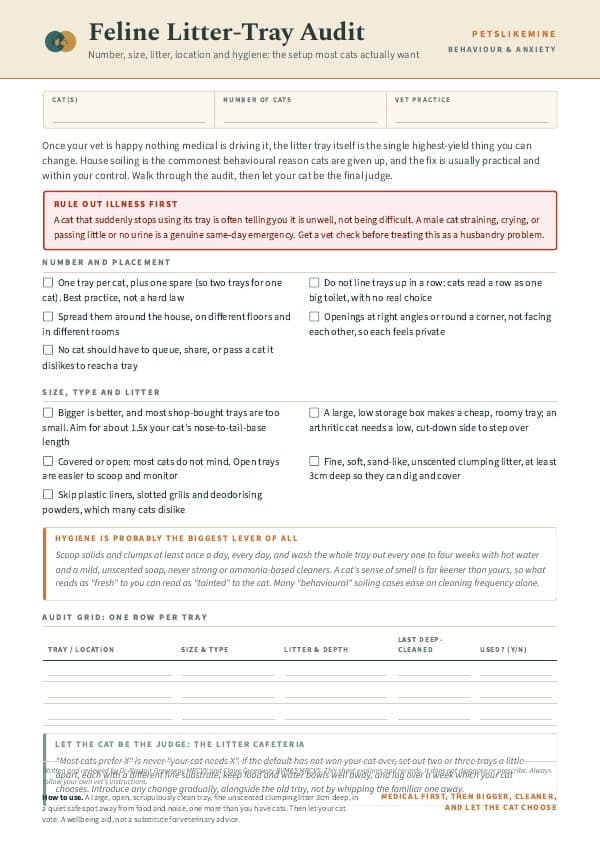
That practical work is where most soiling is finally solved, and it has two halves. The first is the litter setup itself, the number of trays, their size and type, the litter, the location and how often they are cleaned, all of which our litter-tray audit lays out in full, including the low-entry tray for the arthritic cat. The second is reducing the stress that feeds FIC, since affected cats are essentially sensitive individuals reacting to a provocative or lacking environment, and experimental stress reliably drives the bladder inflammation in cats prone to it (Westropp et al., 2006). The encouraging part is that getting the environment right genuinely helps: cats with FIC managed with a thorough enrichment programme had fewer recurrences of urinary signs and became measurably less fearful and nervous over the following months (Buffington et al., 2006). That evidence is mostly observational rather than from large controlled trials, so it is a strong, sensible plan rather than a guaranteed cure (Buffington et al., 2006). Where the stress is coming from another cat in the house, our guide to easing inter-cat tension is the place to go.
When you reach the cleaning-up stage, one quick note that pays off: ordinary and especially ammonia-smelling cleaners leave a scent that, to a cat, says "toilet here", inviting a repeat in the same spot, which is why an enzymatic cleaner made to break down urine is the right choice (Carney et al., 2014). The full reasoning, and the marking side of things, sits in our spraying versus squatting guide.
So if your cat has started weeing outside the tray, resist the urge to manage it as misbehaviour. Watch first for the emergency pattern in a male cat and act on it instantly if you see it. Otherwise, book a vet visit and ask for the urine test and, in an older cat, the blood screen and a proper look at the joints. Get the diagnosis, then fix the tray and the stress. Almost every soiling cat can be helped, and the kindest, fastest route to that is to start by asking what is wrong, not who is to blame.
References
- Carney HC, Sadek TP, Curtis TM, Halls V, Heath S, Hutchison P, Mundschenk K, Westropp JL. AAFP and ISFM Guidelines for Diagnosing and Solving House-Soiling Behavior in Cats. Journal of Feline Medicine and Surgery, 2014;16(7):579-598.
- Jones JM, Burkitt-Creedon JM, Epstein SE. Treatment strategies for hyperkalemia secondary to urethral obstruction in 50 male cats: 2002-2017. Journal of Feline Medicine and Surgery, 2022;24(12):e580-e587.
- Gerber B, Boretti FS, Kley S, Laluha P, Müller C, Sieber N, Unterer S, Wenger M, Flückiger M, Glaus T, Reusch CE. Evaluation of clinical signs and causes of lower urinary tract disease in European cats. Journal of Small Animal Practice, 2005;46(12):571-577.
- Buffington CAT, Westropp JL, Chew DJ. From FUS to Pandora syndrome: where are we, how did we get here, and where to now? Journal of Feline Medicine and Surgery, 2014;16(5):385-394.
- Mayer-Roenne B, Goldstein RE, Erb HN. Urinary tract infections in cats with hyperthyroidism, diabetes mellitus and chronic kidney disease. Journal of Feline Medicine and Surgery, 2007;9(2):124-132.
- Slingerland LI, Hazewinkel HAW, Meij BP, Picavet P, Voorhout G. Cross-sectional study of the prevalence and clinical features of osteoarthritis in 100 cats. The Veterinary Journal, 2011;187(3):304-309.
- Hardie EM, Roe SC, Martin FR. Radiographic evidence of degenerative joint disease in geriatric cats: 100 cases (1994-1997). Journal of the American Veterinary Medical Association, 2002;220(5):628-632.
- Forrester SD, Towell TL. Feline idiopathic cystitis. Veterinary Clinics of North America: Small Animal Practice, 2015;45(4):783-806.
- Westropp JL, Kass PH, Buffington CAT. Evaluation of the effects of stress in cats with idiopathic cystitis. American Journal of Veterinary Research, 2006;67(4):731-736.
- Buffington CAT, Westropp JL, Chew DJ, Bolus RR. Clinical evaluation of multimodal environmental modification (MEMO) in the management of cats with idiopathic cystitis. Journal of Feline Medicine and Surgery, 2006;8(4):261-268.
Free downloads
Companion worksheets to put what you've read into practice. Free PDFs, print at home.
Keep track of how your pet is doing
The owners who cope best are the ones who notice changes early. A simple health log shows you what is working, and what is not, before the next vet visit.
Start tracking, freeYou're not doing this alone
Compare treatment journeys and talk to owners managing behaviour & anxiety. Free to join.
Join PetsLikeMine