

Spraying vs squatting: marking is a different problem with a different fix
Alastair Greenway
BVM&S MRCVS
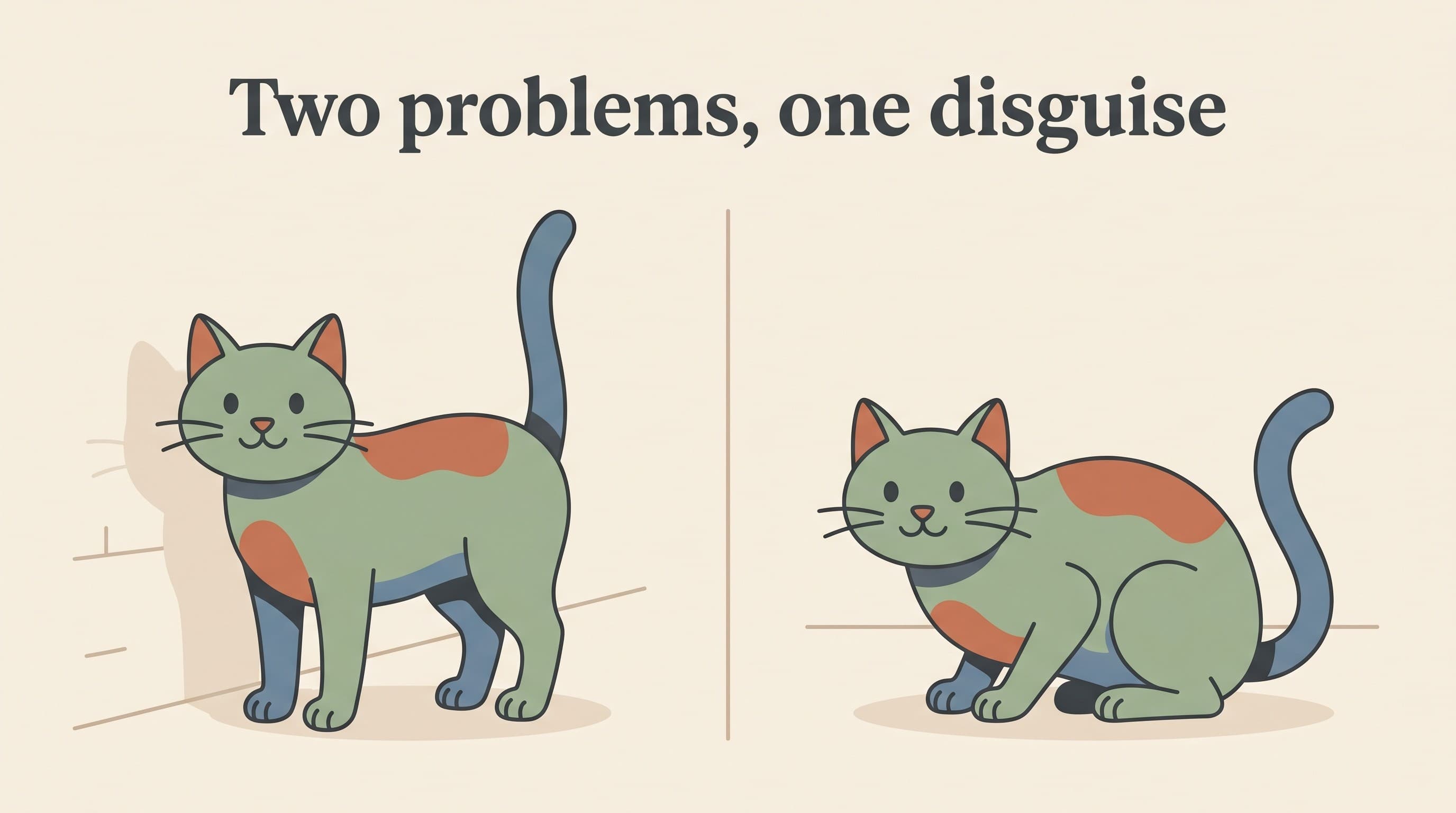
When a cat starts putting urine where it should not, almost everyone reaches for the same explanation: the litter tray. They scoop more often, buy a new box, switch the litter, maybe shut the cat in a smaller room, and they wait for it to work. Sometimes it does. Often, though, the problem carries on regardless, because what looks like one behaviour is actually two completely different things wearing the same outward disguise. One is a toileting problem, where the cat genuinely needs somewhere better or is unwell. The other is marking, where a perfectly healthy cat is leaving a message, and no amount of tray-fiddling will touch it.
Getting these two apart is not a fine academic distinction. It is the whole ballgame, because the fixes diverge almost completely. And it is not obvious even to professionals: in one study of 70 veterinarians, almost a third did not seem to correctly distinguish urine marking from inappropriate urination, and those who did make the distinction went on to recommend the right treatment significantly more often (Bergman et al., 2002). If trained vets blur the two, it is no wonder owners do. So before you change a thing, the job is to work out which problem you actually have. The cat's posture, more than anything else, will tell you.
Read the posture, not just the puddle
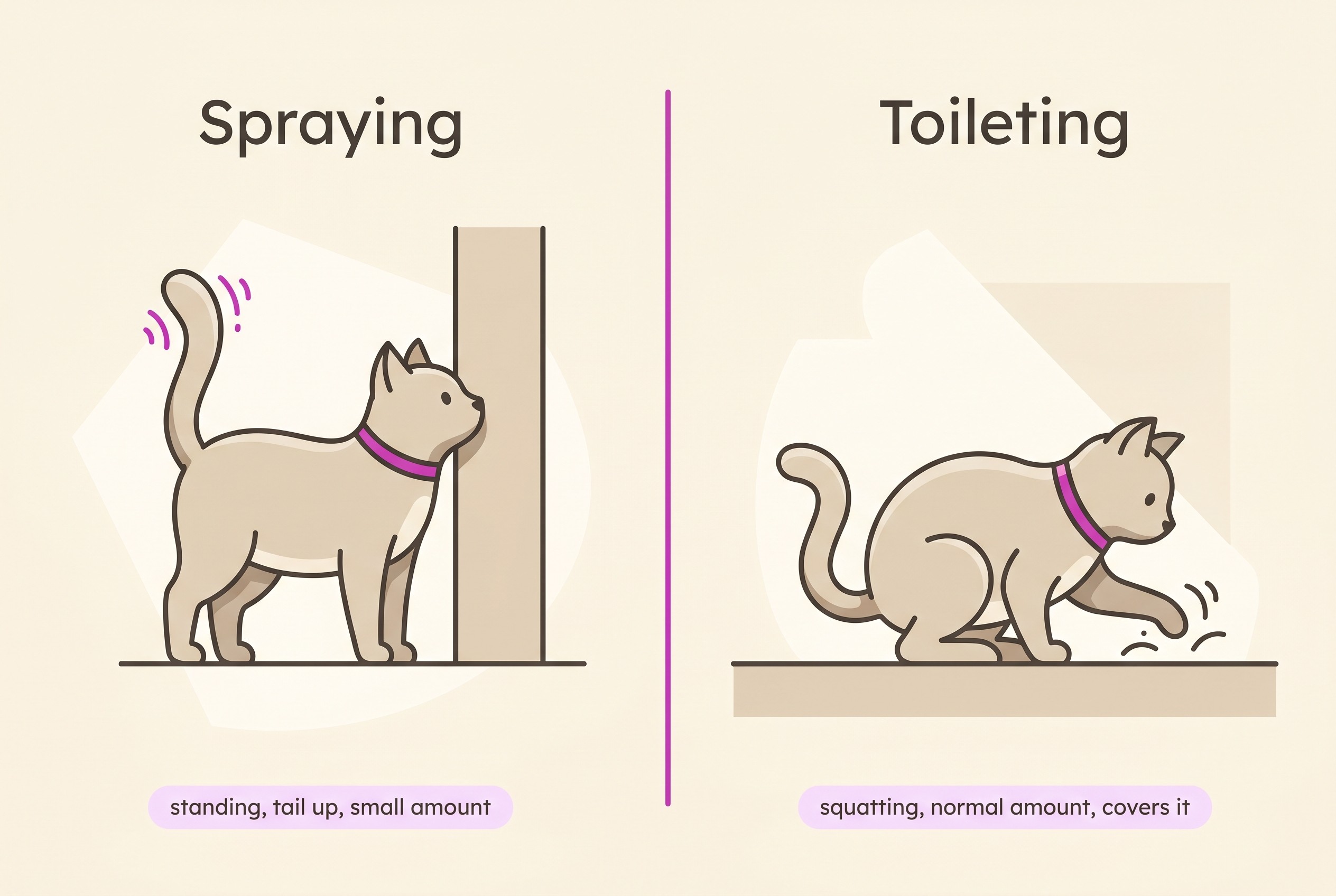
The single most reliable clue is how the cat stands when it goes. A cat that is spraying (marking) stands with its tail up and quivering, often backed up to a vertical surface, and releases a small jet of urine (Carney et al., 2014). It does not crouch, and it makes no attempt to dig or cover afterwards. A cat that is toileting in the wrong place squats down on a horizontal surface, passes a normal or larger volume, and often scratches around as if to bury it, the same way it digs in a litter box before eliminating (Carney et al., 2014). That difference in body language reflects a difference in purpose, and once you have seen it you cannot unsee it.
You will read a lot of advice that says marking is always on vertical surfaces and toileting is always on the floor. That is mostly true, and it is a useful rule of thumb, but it is not absolute, and leaning on surface alone will occasionally mislead you. Some cats may occasionally squat and mark on a horizontal surface, so a small amount of urine found flat on the carpet is not automatically a tray problem (Carney et al., 2014). This is why posture and context beat surface every time. Watch how the cat holds itself, and look at where the marks land: marking tends to target socially meaningful spots, such as doorways, windows, a new bag or piece of furniture, the cat flap, and sometimes the owner's bed, rather than a random quiet corner.
One more clue, on its own, comes close to settling it. A marking cat is usually still using its litter tray completely normally for everything else. As the feline house-soiling guidelines put it, the cat may continue to void normal amounts of urine in the litter box at normal intervals while marking outside of it (Carney et al., 2014). So if your cat is reliably weeing in the tray AND leaving small sprayed deposits up the walls, you are almost certainly dealing with marking, not a tray that has somehow become unacceptable.
Clear the medical gate first
Whichever pattern you are seeing, there is a non-negotiable first step, and it applies even to textbook marking: rule out medical disease. Any unwell cat can change its toileting behaviour, and the pain and discomfort of feline idiopathic cystitis (a stress-linked bladder condition) can cause a cat to house-soil, so a behavioural label should only ever come after a proper veterinary work-up (Carney et al., 2014). The overlap is more than coincidental: because idiopathic cystitis is itself driven by stress, the very same pressures that make a cat mark can also inflame its bladder, and the two can sit side by side in the same cat.
One scenario is a genuine emergency and deserves a line of its own. A male cat that is straining to pass urine, crying in the tray, going in and out repeatedly, or producing little or nothing can be blocked, which is life-threatening within a day. That is an immediate, same-day veterinary call, not something to watch over a weekend. The full medical list, the work-up your vet will run, and that obstruction emergency all belong to our companion article on the medical causes of a cat peeing outside the tray, the first thing to rule out is illness, so head there for the detail. If you are unsure whether what you are seeing needs a vet today, our behaviour check tool will help you triage the urgency, and it flags the male-cat-straining warning specifically. Clear the medical gate first. Everything below assumes you have.
When it is squatting: medicine first, then the tray
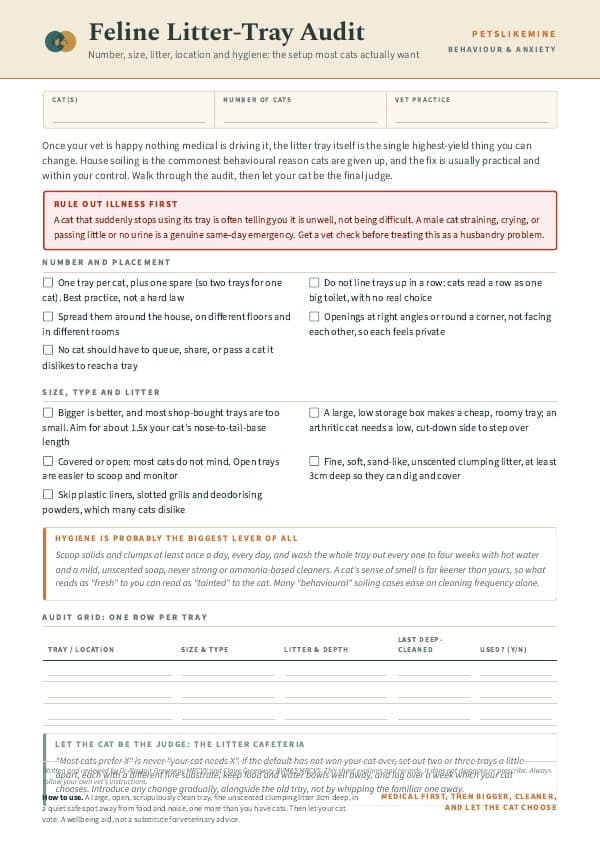
Once illness is excluded, a squatting, normal-volume, horizontal-surface problem is a toileting problem, and the lever is the litter setup, not the cat's emotional life. This is where the more familiar advice genuinely does apply: the number of trays, their size and type, the litter and its depth, where they are placed, how often they are cleaned, and whether an older or arthritic cat can actually climb into them. All of that has a real evidence base and a real payoff, and it is owned in full by our litter-tray audit. If your cat is squatting, that is your next stop after the vet, and I will not duplicate it here. The reverse matters just as much: pour your energy into scrubbing trays for a cat that is actually marking and you will get nowhere, because the tray was never the point.
When it is marking: your cat is talking, not misbehaving
Marking is not a toileting failure and it is not spite, revenge, or your cat "being dirty." It is a normal feline communication behaviour, a way of depositing scent that says something about territory and identity. It tips over into a problem only because of where your cat is doing it, inside your home. What drives it is emotional: arousal, insecurity, social conflict, and change in the cat's world, and importantly, reducing that fear and anxiety reduces the marking (Carney et al., 2014). The wider emotional framework behind this, how fear and frustration and conflict shape behaviour, is covered in our piece on why pets behave the way they do, if you want the full lens.
So what sets a cat off? The commonest trigger owners identify is friction with other cats, whether housemates or the cats they can see outside: agonistic interactions with other cats, inside or outside the home, are the single most reported cause of marking (Pryor et al., 2001). The risk factors point the same way: in that study, male cats and cats from multi-cat households were significantly over-represented among markers compared with the general pet cat population (Pryor et al., 2001). A new cat next door sitting on your wall, a newcomer in the home, a house move, building work, a change in routine, even a new piece of furniture carrying unfamiliar smells: any of these can be enough. If two or more of your own cats are not getting along, that tension is very often the engine, and easing it is the real treatment. The subtle signs of inter-cat conflict and how to defuse them are owned by our article on cats that do not get along, and the broader environmental-needs framework that stops the stress recurring lives in our guide to feline stress, FIC and enrichment. Reducing the social pressure is not a nice-to-have alongside the marking plan. For many cats it is the plan.
Neutering helps, but it does not always finish the job
It is worth dealing with neutering head-on, because it is both genuinely powerful and widely misunderstood. In intact adult male cats, castration produces a clear effect: in the classic survey, spraying declined rapidly after the operation in around three-quarters of cats, with a further group tailing off more gradually (Hart & Barrett, 1973). If you have an entire male who is spraying, neutering is the foundational first move and frequently solves it on its own.
What neutering does not do is guarantee a cat will never mark again. The house-soiling guidelines put the residual rate at roughly 10% of neutered males and about 4% of neutered females still marking (Carney et al., 2014). So an already-neutered cat that marks is not abnormal or broken, and it is not a sign the neutering "failed." It simply means that for this cat, hormones were never the whole story, and the stress-reduction approach is what is needed. Do not let anyone tell you a neutered cat "shouldn't" be spraying and must therefore be doing it out of badness: a meaningful minority of neutered cats mark, and they respond to the same plan as any other marker.
A marking plan that works: lower the stress, clean it right, reach for the right tools
Treating marking is a multi-part job, and the order matters. The leading edge is environmental and social management, reducing the triggers, because that is what addresses the cause rather than the symptom. Environmental-management procedures have been shown to reduce marking frequency overall, with females that marked heavily proving especially likely to respond (Pryor et al., 2001). In practice that means blocking the sight of outdoor cats at the windows your cat patrols, easing tension between housemates, giving each cat its own separated resources, and restoring predictability after a change. The how-to for the social side sits in the inter-cat conflict and feline stress articles, so lean on those.
Cleaning is not an afterthought, it is part of the treatment, and the method is specific. Cat urine contains uric-acid components that form poorly soluble crystals, bind to surfaces, and tend to smell again when the humidity rises, which is why a spot can seem clean and then reactivate on a damp day. Enzymatic cleaners break those compounds down, which is the whole point. Ammonia-based cleaners do the opposite: they smell like urine to a cat and effectively invite it back to re-mark the same spot, so the guidelines say to avoid them (Carney et al., 2014). The protocol the guidelines describe is to scrub the area with a roughly 10% solution of a biological (enzyme-based) washing powder, then go over it with surgical spirit, which is isopropyl alcohol (Carney et al., 2014). One safety note of my own: never reach for bleach on a urine-soaked spot, and never mix bleach with ammonia or urine, because urine contains ammonia and the combination can release dangerous chloramine gas, and in any case bleach does not remove the uric-acid residue that draws the cat back. Enzymatic is the answer.
Then there is the synthetic feline facial pheromone, sold in the UK as Feliway Classic, which mimics the friendly facial scent cats deposit when they rub. The evidence is positive but modest. A small double-blind, placebo-controlled trial found that spraying fell significantly in the treated group after four weeks, with no equivalent fall in the placebo group, though the study was small, just 22 cats (Mills & Mills, 2001). An open trial of 36 cases reported around 37% of cats stopping completely and a further 40% cutting their marking by at least half by week four (Ogata & Takeuchi, 2001). One caveat worth knowing from that same trial: where there was active aggression between cats, marking stayed stubbornly high and the pheromone helped less (Ogata & Takeuchi, 2001), which only underlines that fixing the underlying conflict comes first. So Feliway is a reasonable adjunct that can take the edge off, not a guaranteed cure, and the fair reading across the trials is that it reliably helps reduce marking more than it reliably stops it. The full evidence on pheromones and the other over-the-counter calming products is graded in our guide to calming aids, pheromones and supplements.
Still marking? Medication exists, and it works
If you have cleared the medical causes, eased the social tension, cleaned thoroughly, and added a pheromone diffuser, and your cat is still marking, you have not run out of road. This is the point at which vet-prescribed medication earns its place, and the evidence behind it is genuinely good. In a randomised, placebo-controlled trial of 67 spraying cats, every dose of clomipramine significantly reduced the frequency of spraying compared with placebo (King et al., 2004), and a separate placebo-controlled trial of fluoxetine cut spraying from roughly nine episodes a week at baseline down to almost none, while the placebo group barely changed (Pryor, Hart, Cliff & Bain, 2001). A longer follow-up found clomipramine and fluoxetine about equally effective, and that staying on treatment for longer improved the result (Hart et al., 2005). These are not sedatives that knock a cat out; they lower the underlying anxiety so the behaviour can settle, and in these trials they worked best alongside environmental management, not instead of it.
Two points worth being straight about. First, in the UK these drugs are off-licence for feline marking. Clomipramine is licensed here as Clomicalm but for a canine problem (separation-related disorders in dogs), and fluoxetine's veterinary licence (Reconcile) is likewise for dogs, so using either for a spraying cat is a considered, vet-led, off-label decision, never something to source or dose yourself. Second, medication is a tool for the persistent cases and works hand in hand with the management above, not as a shortcut that lets you skip it. The detail of how these daily anti-anxiety medications are chosen, started and monitored is covered in our medication articles rather than dosed here. The takeaway for now is simply that an effective, evidence-backed option exists when the foundations are not enough, so a stubbornly marking cat is a treatable cat.
Most of all, work out whether you have a squatter or a sprayer, because that one distinction routes you down two different roads. If it is squatting, the vet and then the litter-tray audit are your path. If it is marking, the real lever is almost always the tension your cat is feeling, so the most useful thing you can do next is read cats that do not get along and start gently lowering the social temperature at home.
References
- Bergman L, Hart BL, Bain M, Cliff K. Evaluation of urine marking by cats as a model for understanding veterinary diagnostic and treatment approaches and client attitudes. Journal of the American Veterinary Medical Association, 2002;221(9):1282-1286.
- Carney HC, Sadek TP, Curtis TM, Halls V, Heath S, Hutchison P, Mundschenk K, Westropp JL. AAFP and ISFM Guidelines for Diagnosing and Solving House-Soiling Behavior in Cats. Journal of Feline Medicine and Surgery, 2014;16(7):579-598.
- Pryor PA, Hart BL, Bain MJ, Cliff KD. Causes of urine marking in cats and effects of environmental management on frequency of marking. Journal of the American Veterinary Medical Association, 2001;219(12):1709-1713.
- Hart BL, Barrett RE. Effects of castration on fighting, roaming, and urine spraying in adult male cats. Journal of the American Veterinary Medical Association, 1973;163(3):290-292.
- Mills DS, Mills CB. Evaluation of a novel method for delivering a synthetic analogue of feline facial pheromone to control urine spraying by cats. Veterinary Record, 2001;149(7):197-199.
- Ogata N, Takeuchi Y. Clinical trial of a feline pheromone analogue for feline urine marking. Journal of Veterinary Medical Science, 2001;63(2):157-161.
- King JN, Steffan J, Heath SE, Simpson BS, Crowell-Davis SL, Harrington LJM, Weiss A-B, Seewald W. Determination of the dosage of clomipramine for the treatment of urine spraying in cats. Journal of the American Veterinary Medical Association, 2004;225(6):881-887.
- Pryor PA, Hart BL, Cliff KD, Bain MJ. Effects of a selective serotonin reuptake inhibitor on urine spraying behavior in cats. Journal of the American Veterinary Medical Association, 2001;219(11):1557-1561.
- Hart BL, Cliff KD, Tynes VV, Bergman L. Control of urine marking by use of long-term treatment with fluoxetine or clomipramine in cats. Journal of the American Veterinary Medical Association, 2005;226(3):378-382.
Free downloads
Companion worksheets to put what you've read into practice. Free PDFs, print at home.
Keep track of how your pet is doing
The owners who cope best are the ones who notice changes early. A simple health log shows you what is working, and what is not, before the next vet visit.
Start tracking, freeYou're not doing this alone
Compare treatment journeys and talk to owners managing behaviour & anxiety. Free to join.
Join PetsLikeMine