

Why your pet does this: fear, frustration and the emotions behind behaviour
Alastair Greenway
BVM&S MRCVS
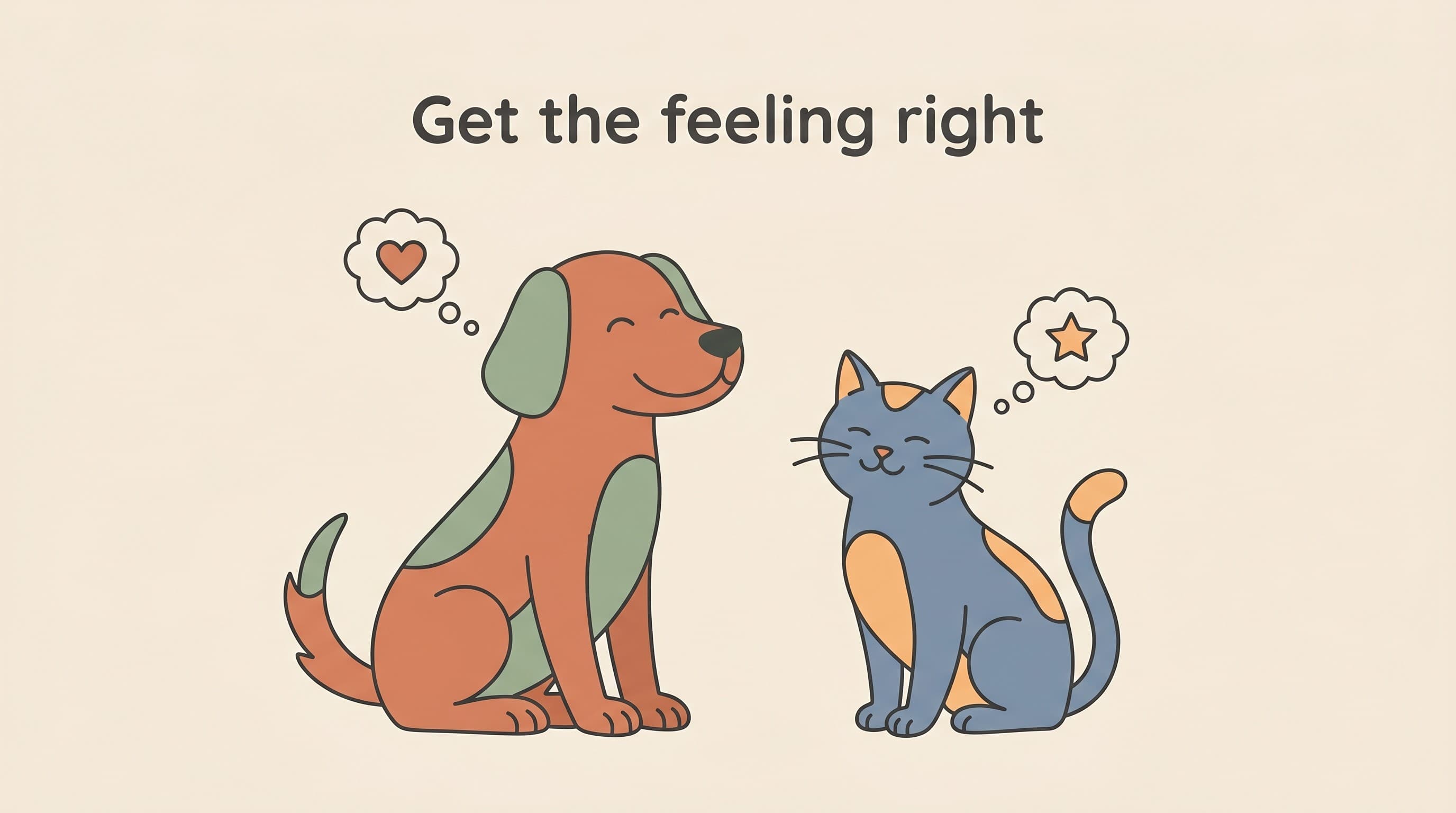
A dog growls at a visitor, a cat lashes out from under the bed, and the question almost every owner asks is "why is he being like this?" The answers we reach for first are usually the wrong ones. He is being dominant. She is doing it out of spite. He knows he has done wrong. She is just a nasty cat. None of those explanations is true, and each one sends you down a path that tends to make the behaviour worse. The modern, clinical way of understanding pet behaviour is quieter and far more useful: behaviour is driven by how an animal feels and what it is trying to achieve in that moment, not by character or a bid for status (Mills, 2017). Get the feeling right, and the plan almost writes itself.
Once you can look at a behaviour and ask "what emotion is driving this?" rather than "what is wrong with my pet?", you stop treating the surface and start treating the cause. We will walk through the emotions that sit behind most problem behaviour, retire the dominance myth properly, and show why the same outward act can mean opposite things in two different animals. Cats get equal billing throughout, because they feel all of this just as keenly as dogs do.
Behaviour is an emotion, not a character flaw
The single most freeing idea here is that behaviour is the visible end of an invisible emotional and motivational state. Your pet is not performing a personality; it is responding to how it feels. The current clinical approach treats emotion and motivation as the things that actually produce a behaviour, which is why two animals can do exactly the same thing for completely different reasons (Mills, 2017). A growl is not a character trait. It is the audible edge of a feeling.
Mammals, dogs and cats included, share a set of deep, ancient emotional systems wired into the brain below the level of conscious thought, and these are remarkably similar across species (Davis & Montag, 2019). The ones that matter most for the problems owners actually face are fear and anxiety, frustration and the anger that rides with it, the seeking or anticipation drive that makes an animal chase and explore, the panic of being separated from its attachment figures, and play (Davis & Montag, 2019). You do not need the neuroscience to use this, only the habit of asking which of these is switched on. A cat that bolts and hides is frightened. A dog that screams at the end of the lead because it cannot reach another dog is frustrated. A pup that shreds the sofa the moment it is left may be in genuine panic, not getting even. These are different feelings, and they need different help.
Why does this matter so much in practice? Because the surface can lie. Fear and frustration are two distinct negative emotions, they frequently drive problem behaviour, and they often look alarmingly similar from the outside, yet they call for different treatment (Mills, 2017). Reading which one is in play, mostly through body language, is therefore the whole game, and our guide on reading your pet's body language is where you learn to tell them apart on sight.
The feelings doing the driving
Fear is the easiest to recognise once you are looking for it. A frightened animal wants the scary thing to go away, or wants to get away from it. The behaviour that follows, freezing, fleeing, hiding, snapping, even biting, is all in service of creating safety and distance. Frustration is its near-twin and the one owners miss most. Frustration is not a loose metaphor; it is a real, measurable emotional state, the negative reaction an animal has when an expectation is violated, such as wanting something and being blocked from reaching it (McPeake et al., 2019). It is worth taking seriously, because dogs with a low tolerance for frustration are more prone to aggressive behaviour, and what helps is patient frustration-tolerance work, not obedience drilling (McPeake et al., 2019).
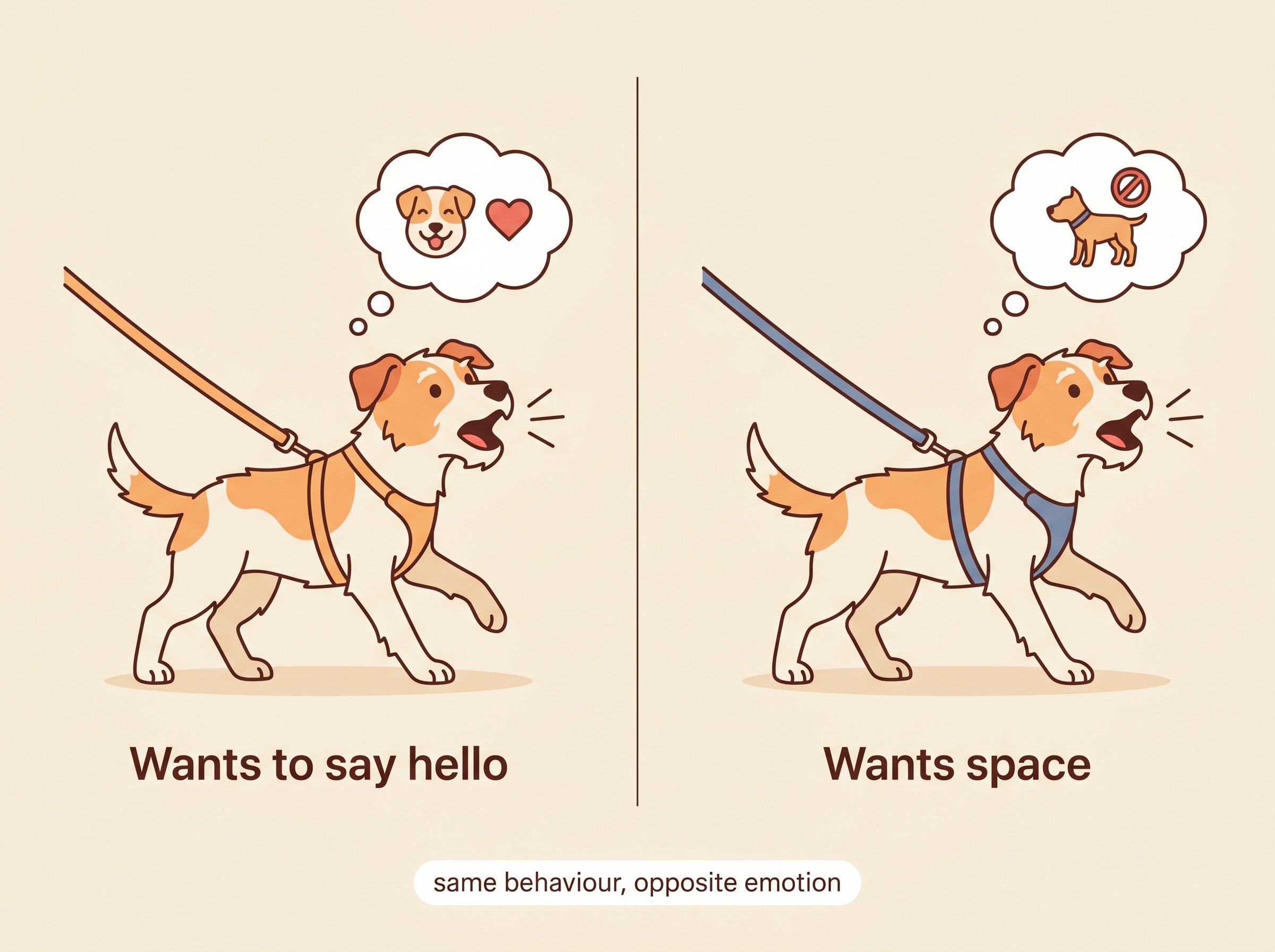
The part that changes how you respond to almost everything is this: the same overt behaviour can come from different emotions in different individuals. This is not theory. When researchers looked at dogs showing similar behaviour at being left alone, the root differed from dog to dog, some were fearful, others simply had a low tolerance for frustration, and the same separation behaviour could be triggered by different emotions entirely (Lenkei et al., 2021). Separation-related behaviour in general is now understood as an umbrella over several distinct states, panic, fear, frustration and boredom among them, rather than one diagnosis, which is exactly why the right plan depends on the underlying feeling (de Assis et al., 2020). We hand off that whole differential to our article on separation anxiety, isolation distress or boredom.
The lead-lunging dog is the cleanest everyday example. Two dogs can bark and lunge identically at the sight of another dog. One is a fearful reactor trying to drive the other dog away; the other is a frustrated greeter who desperately wants to say hello and cannot reach. Same behaviour, opposite emotion, and the two need almost opposite handling. That is the whole premise of lead reactivity explained, so we will point you there rather than repeat it. The growl works the same way: it can carry fear, frustration, pain or the wish to keep a resource, which is why a growl is a message to decode, not a fault to punish, and the deeper read lives in understanding dog aggression.
Why "be the alpha" is the wrong map
If there is one idea worth dismantling completely, it is dominance. The notion that your pet misbehaves because it is climbing some social ladder, and that you must therefore be the "alpha" or "pack leader", is outdated and, used as a training philosophy, actively harmful. Most unwanted pet behaviours are not bids for rank at all; they have usually been accidentally reinforced, or they are expressions of fear and anxiety (AVSAB, 2009). Dominance, properly defined, describes a relationship over a particular resource between two animals at a particular moment. It was never an explanation for why a pet chews, lunges or growls (AVSAB, 2009).
The science the whole alpha model was built on has collapsed underneath it. The original "alpha wolf" picture came from studying unrelated wolves thrown together in captivity, and the researcher most associated with it has since disowned the term: wild wolf packs turn out to be ordinary families led by the breeding parents, not gangs of rivals held down by a despot (Mech, 1999). Dogs are not wolves in any case. So "be the alpha" rests on a premise that its own author has retracted. And there is a hard practical cost to acting on it anyway. Confrontational techniques such as pinning, rolling, staring a dog down or jowl-grabbing frequently provoke aggression, because they frighten an animal that is often already afraid (Herron et al., 2009). That is the short version of why correction backfires; the full case for humane methods, and the evidence against aversive tools, belongs to how animals actually learn, the natural next read once you accept that the problem is a feeling.
The same myth has a feline twin. Cats labelled "evil", "nasty" or "spiteful" are not plotting; that language simply mischaracterises an emotional response, because feline behaviour is driven by the cat's emotional state at that moment, and fear, anxiety, frustration and pain are the core negative drivers behind it (AAFP/ISFM, 2022). And the "guilty look" is perhaps the most persistent myth of all. That hangdog, ears-back, slinking-away expression is not evidence of guilt or revenge; it is a response to your cues and body language, and dogs produce it just as readily when they have done nothing wrong (Horowitz, 2009). The puddle by the door is not a protest. It is an animal that was distressed while you were out.
Two everyday cases, read both ways
Picture a dog that snaps when you reach for the food bowl. Read through the dominance lens, the "fix" is to assert yourself, take the bowl away, show him who is boss, which terrifies an already worried dog and teaches him that hands near food are a genuine threat, making the next snap more likely (Herron et al., 2009). Read through the emotional lens, the snap is fear and the wish to protect something valuable, and the plan becomes the opposite: build positive associations with people approaching, never confront, and rule out pain that might be sharpening his reaction (Mills, 2017). One read makes him more dangerous; the other makes him safer. Any aggression that is escalating, or that has led to a bite, needs safe management and professional help rather than a solo fix, which is what understanding dog aggression is for.
Now a cat that has started weeing on the bath mat and hissing when picked up. "She is being spiteful" leads to scolding, which raises her stress and makes everything worse. The emotional read asks what she is feeling and what need is unmet, because in cats, unmet emotional and environmental needs generate stress that surfaces as exactly this kind of behaviour (AAFP/ISFM, 2013). That points first to a vet check, then to her environment, and our piece on feline stress and enrichment is where the practical framework lives. The lens does not just explain the behaviour. It chooses the plan.
How knowing the driver changes the plan
Once you are thinking in emotions, two early steps fall into place. The first is the one almost nobody else in the dog-training world leads with, and it is medical. Pain and illness are common, badly under-recognised drivers of behaviour change: a conservative estimate is that around a third of behaviour-referral cases involve a painful condition, and in some it approaches eighty per cent (Mills et al., 2020). That is why the first move for almost any new or sudden behaviour problem, and certainly for a sudden change in an older pet, is a veterinary check rather than a training fix. We do not re-run that work-up here; it is the whole subject of is it behaviour or is it medical?, and you can start with our behaviour check to help decide whether a vet visit comes first.
The second step is to name the emotion and aim your plan at it. If the driver is fear, the work is helping a frightened animal feel safe, with predictability, choice and never forcing, which is exactly where helping a fearful pet takes over. If it is frustration, the work is teaching tolerance and managing arousal. If it is panic at being left, it is a graded absence plan. The behaviour you can see is only the smoke. Once you learn to ask what is burning underneath, fear, frustration, pain, an unmet need, you stop fighting your pet and start helping the animal behind the behaviour, and every other guide in this space is built to help you do precisely that.
References
- Mills DS. Perspectives on assessing the emotional behavior of animals with behavior problems. Current Opinion in Behavioral Sciences, 2017;16:66-72.
- Davis KL, Montag C. Selected Principles of Pankseppian Affective Neuroscience. Frontiers in Neuroscience, 2019;12:1025.
- McPeake KJ, Collins LM, Zulch H, Mills DS. The Canine Frustration Questionnaire - Development of a New Psychometric Tool for Measuring Frustration in Domestic Dogs (Canis familiaris). Frontiers in Veterinary Science, 2019;6:152.
- Lenkei R, Farago T, Bakos V, Pongracz P. Separation-related behavior of dogs shows association with their reactions to everyday situations that may elicit frustration or fear. Scientific Reports, 2021;11:19207.
- de Assis LS, Matos R, Pike TW, Burman OHP, Mills DS. Developing Diagnostic Frameworks in Veterinary Behavioral Medicine: Disambiguating Separation Related Problems in Dogs. Frontiers in Veterinary Science, 2020;6:499.
- American Veterinary Society of Animal Behavior (AVSAB). Position Statement on the Use of Dominance Theory in Behavior Modification of Animals. AVSAB, 2009.
- Mech LD. Alpha status, dominance, and division of labor in wolf packs. Canadian Journal of Zoology, 1999;77(8):1196-1203.
- Herron ME, Shofer FS, Reisner IR. Survey of the use and outcome of confrontational and non-confrontational training methods in client-owned dogs showing undesired behaviors. Applied Animal Behaviour Science, 2009;117(1-2):47-54.
- Rodan I, Dowgray N, Carney HC, et al. 2022 AAFP/ISFM Cat Friendly Veterinary Interaction Guidelines: Approach and Handling Techniques. Journal of Feline Medicine and Surgery, 2022;24(11):1093-1132.
- Horowitz A. Disambiguating the "guilty look": Salient prompts to a familiar dog behaviour. Behavioural Processes, 2009;81(3):447-452.
- Ellis SLH, Rodan I, Carney HC, et al. AAFP and ISFM Feline Environmental Needs Guidelines. Journal of Feline Medicine and Surgery, 2013;15(3):219-230.
- Mills DS, Demontigny-Bedard I, Gruen M, et al. Pain and Problem Behavior in Cats and Dogs. Animals, 2020;10(2):318.
Keep track of how your pet is doing
The owners who cope best are the ones who notice changes early. A simple health log shows you what is working, and what is not, before the next vet visit.
Start tracking, freeYou're not doing this alone
Compare treatment journeys and talk to owners managing behaviour & anxiety. Free to join.
Join PetsLikeMine