

Separation anxiety, isolation distress or boredom: which is it?
Alastair Greenway
BVM&S MRCVS
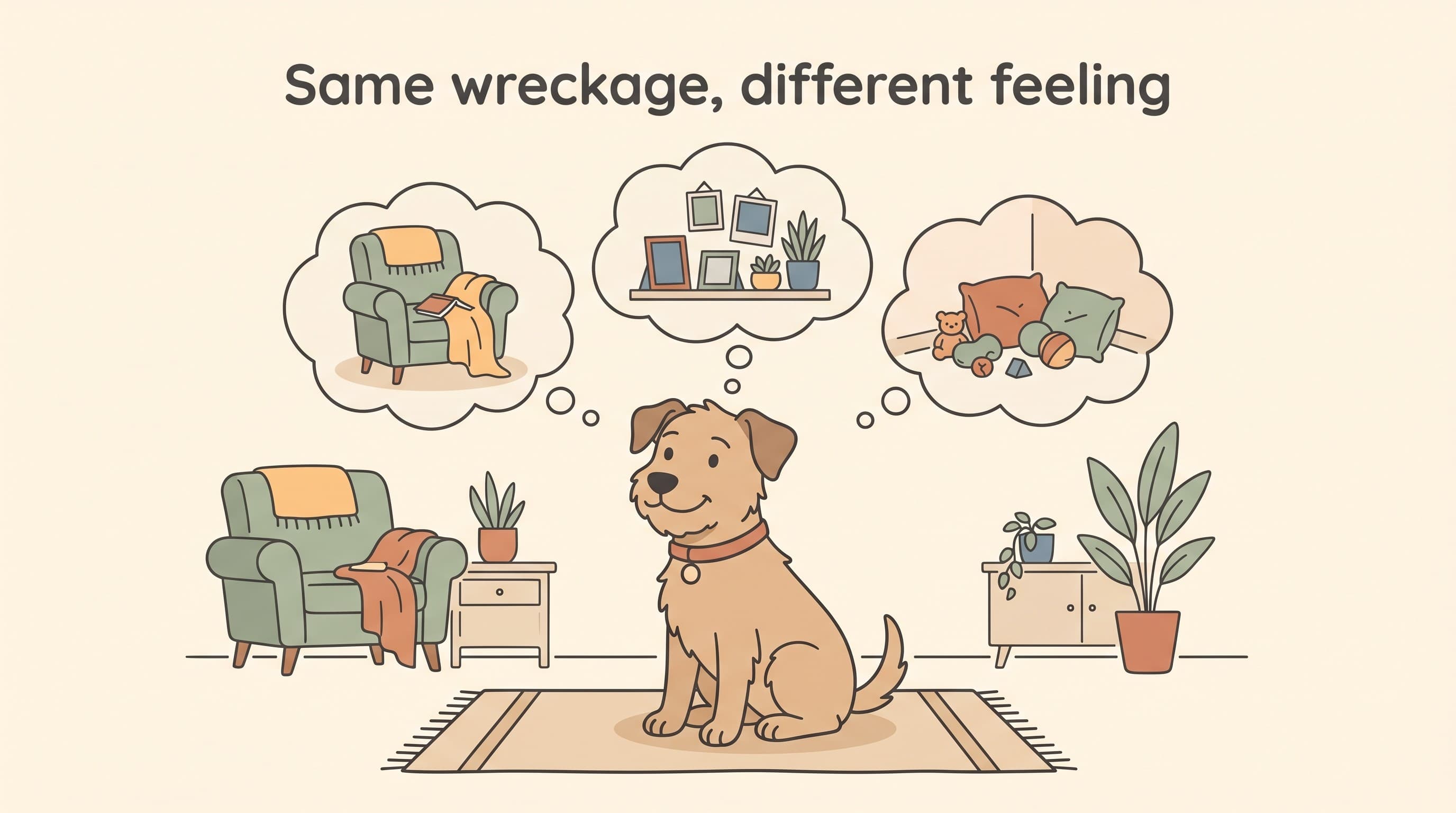
A chewed door frame, a complaint from a neighbour about the howling, a puddle by the back door. Someone has told you it is "separation anxiety", and that phrase tends to close the conversation down, as though there is one condition with one name and one fix. There is not. What people lump together as separation anxiety is really a small family of quite different problems, driven by different emotions, that share one inconvenient feature: they show up when you are not there to see them. A dog panicking at being shut away from you, a dog calmly furious that it cannot follow you out, and a dog simply bored for nine hours can all leave similar wreckage behind, yet they are not the same thing and do not respond to the same plan.
Getting this right is not academic. It is the single decision that determines whether the months of work ahead help your pet or quietly entrench the problem. This piece covers what these problems really are, how they look different once you watch properly, why the "he does it out of spite" stories are wrong, and how to begin telling them apart. The route, the camera and the training plan each have their own guide.
A label that hides four problems
The first thing to retire is the idea that "separation anxiety" is a single, well-defined condition. Modern behaviour medicine increasingly uses the broader term separation-related problems, because the older label assumes the emotion involved is anxiety, which often it is not. "Separation anxiety" is best kept for one presentation, the panic-type; the umbrella term covers the rest.
The clearest evidence comes from a study that let the data sort a large group of affected dogs into natural groupings rather than starting with a theory. It found not one condition but four distinct forms, each with its own behavioural signature and its own underlying emotion (de Assis et al., 2020). One was built around getting out, focused on barriers and exits, and looked like frustration at being prevented from reaching the owner. One was driven by reactivity to outside noises and events, where the absence simply removed the buffer between the dog and a world it found alarming. One was a more inhibited, anxious form, the dog that withdraws rather than rampages. And one was linked plainly to boredom. Four different problems, wearing one borrowed name.
This is why you cannot read the diagnosis off the damage, and why the same outward sign can come from opposite inner states. When researchers looked closely, the fearful, phobia-prone dogs tended to whine, to try to escape, and actually to bark less, while the dogs with a low frustration threshold and a demanding streak barked more and scratched at the door sooner (Lenkei et al., 2021). Barking up a storm and barking hardly at all can both be separation distress: it is the emotion underneath, not the behaviour, that you have to identify.
Four pictures, side by side
A useful way to sort these forms, used widely by behaviourists even though it is more a working heuristic than a hard research category, is to ask what the dog is actually upset about.
True separation anxiety, the panic form, is about a specific person. This dog is bonded to you in particular, and what triggers the distress is the loss of you, not simply being alone. It is the most serious of the group: genuine panic, sometimes with desperate attempts to escape, self-injury at doors and windows, drooling, and distress that does not let up. It is the form most likely to need medication to make any progress possible.
Isolation distress is the cousin owners most often mistake for it. Here the dog cannot bear to be alone, but it is not pining for one particular person: any company will do, and a sitter, another dog or a houseguest settles them. It is a kinder problem to live around, and the useful question it raises is whether your dog needs you or just needs someone.
Frustration at the barrier is the form that surprises people, because it is not driven by fear at all. This dog is not frightened of being alone; it is enraged at being thwarted, and the scratching and destruction are aimed squarely at the door, crate or gate standing between it and where it wants to be. It tends to bark sooner and louder and go at the exit hardest (Lenkei et al., 2021; de Assis et al., 2020), and it calls for managing arousal rather than building safety in a dog that already feels perfectly safe, just balked.
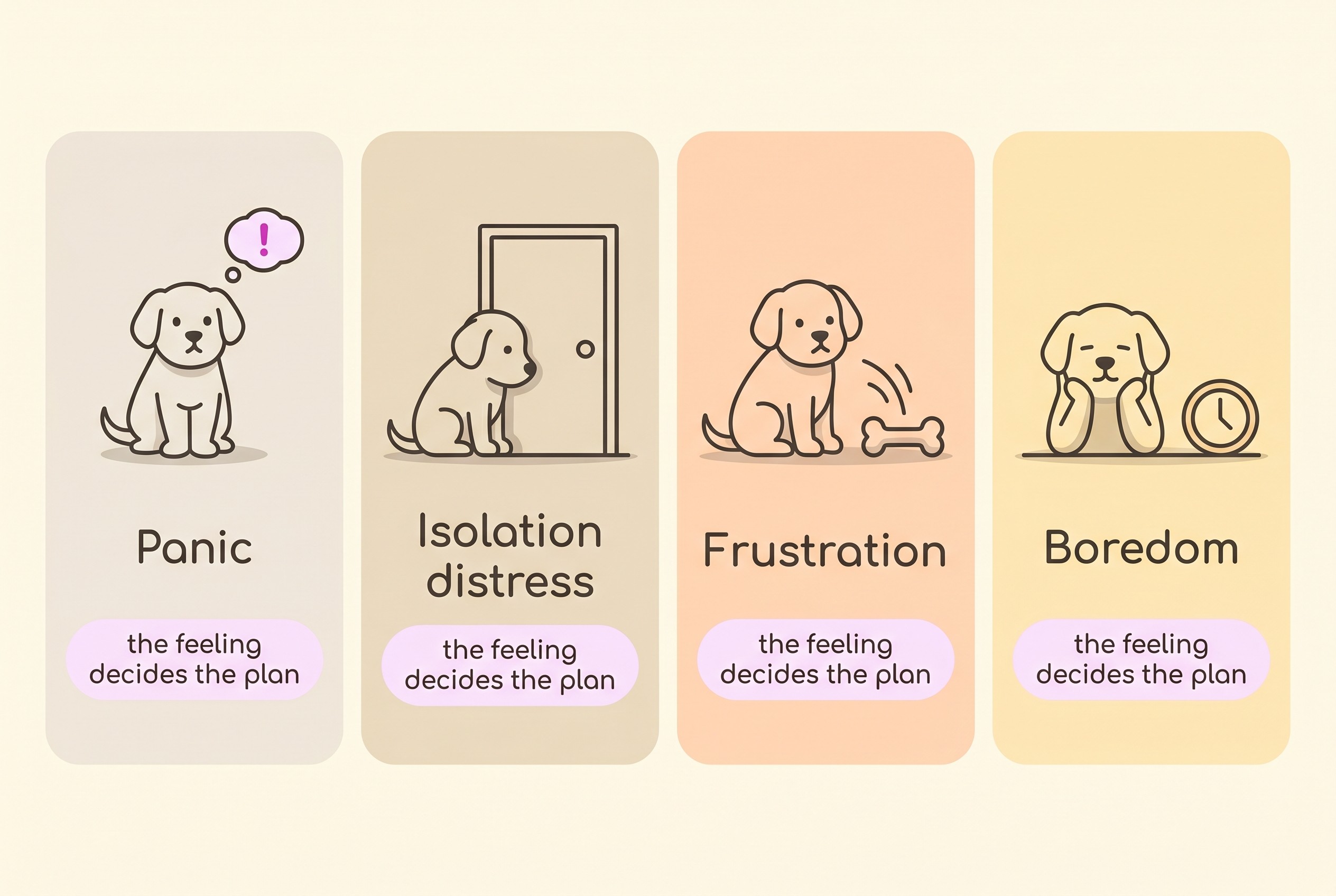
And then there is boredom, the under-stimulated dog with a long empty day and energy to burn, which the data confirm is a form in its own right rather than a lesser version of the others (de Assis et al., 2020). This is often the most responsive of the four: the lever is enrichment and routine, not a months-long fear-reduction programme, and the practical fix lives in our guide on boredom, under-stimulation and enrichment. Just beware the reverse mistake of reaching for it for the wrong dog: a puzzle feeder is wonderful for a bored dog and useless for a terrified one, who will not eat once the panic takes hold.
Spite and attention-seeking: two stories that aren't true
Two ideas need killing off here, because they do real harm: that your pet is being spiteful, and that it is "just attention-seeking". Separation-related behaviour is an emotional and physiological stress response, not a calculated act: panic, or frustration, or fear, in a brain that is genuinely distressed rather than coolly plotting revenge (Flannigan & Dodman, 2001; Lenkei et al., 2021). The guilty look at the door is not a confession; it is a response to your body language and the mess, learned over many tense homecomings. The blame owners pile on themselves is usually misplaced too: the story that you caused this by spoiling your dog, or by it being taken from its mother too early, has not held up, because a case-control study found several attachment-related factors associated with the condition but specifically did not support spoiling or early separation from the dam as causes (Flannigan & Dodman, 2001).
Treating the behaviour as naughtiness points you straight at punishment, which makes every version worse, and the broader untangling of fear, frustration and the "dominance" myth lives in why your pet does this. One last reassurance, because it stops people comforting a frightened animal: you cannot reinforce fear with kindness, because an emotion is not a trick you are paying for. What genuinely backfires is leaving the animal over its threshold, terrified and alone, time after time.
What this looks like in cats
It is a stubborn myth that cats are too aloof to mind being left. In a survey of cat owners, around one in eight cats met the criteria for a possible separation-related problem, the commonest signs being destructive behaviour and excessive vocalisation, followed by inappropriate urination, a flat depressed apathy, aggression and agitation (de Souza Machado et al., 2020). The picture looks quite different from the dog's, which is partly why owners miss it. An older clinical series was even more elimination-heavy: of 136 cats with separation-related problems, the great majority urinated or defecated outside the tray, and most of those that soiled chose the owner's own bed to do it on (Schwartz, 2002). A cat weeing on your pillow while you are away is easy to read as protest, but it is far more likely to be distress.
Because that distress so often shows up as elimination, the feline version comes with a firm rule: rule out illness first. House soiling in cats is medical until proven otherwise, and a cat urinating outside the tray needs a urinary and general work-up before anyone reaches for a behavioural explanation. We hand that entirely to our guide on a cat peeing outside the litter tray. Only once those causes are excluded does the separation angle move to the front.
Telling them apart, and why it matters
You usually cannot work this out by guesswork from the wreckage, so be wary of anyone who diagnoses your dog confidently from a chewed skirting board. Two things make the difference: looking at the whole animal, and getting real evidence of what happens when you leave.
Looking at the whole animal means noticing that these problems rarely travel alone, which is itself a clue. In a series of 215 dogs diagnosed with separation anxiety, fewer than one in five had it in isolation, while the large majority had at least one other behaviour problem, most commonly noise sensitivity (Storengen et al., 2014). A dog that also panics at fireworks points to a fearful temperament framing the whole picture, whereas an otherwise bombproof dog that is merely combustible at the door points more towards frustration.
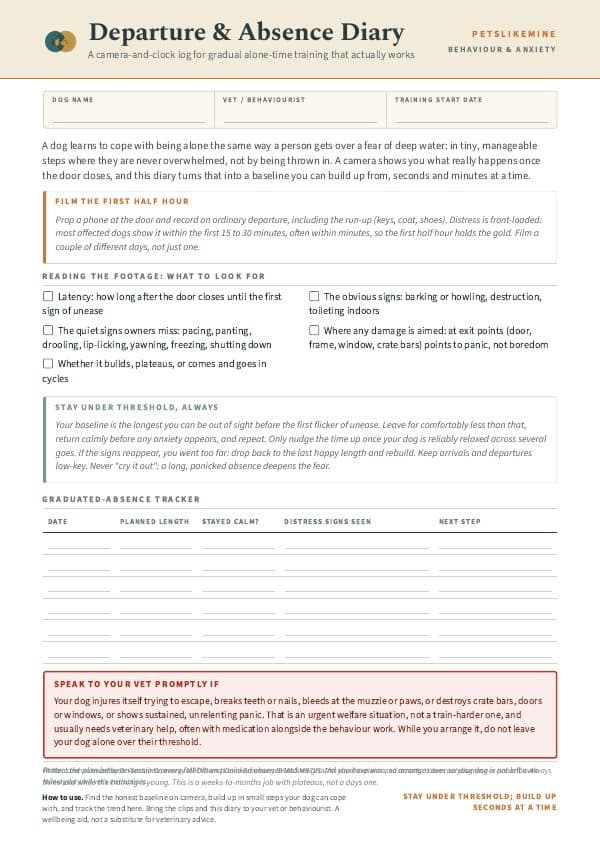
Getting real evidence means, almost always, filming a departure. Owners systematically underestimate what goes on while they are out, because the worst of it can be over before they reach the end of the road: distress often begins within minutes of leaving, and many owners are unaware their dog paces or frets at all (Palestrini et al., 2010). A short recording of the first stretch alone tells you whether the distress is immediate panic or slow-building boredom, and whether the dog is aimed at the exit or shrinking away. Our camera test covers how to film it and what to look for.
Two safety notes belong here. If the behaviour is new, or has worsened suddenly, especially in an older pet, treat that as a reason for a vet check first, because pain and illness are common, hidden drivers of behaviour change, with one estimate putting a painful component in roughly a third of behaviour cases (Mills et al., 2020). The full medical rule-out belongs to is it behaviour or is it medical?, and our behaviour check can help you judge how urgently to act. And a genuinely panicking animal, hurling itself at doors, injuring itself, or distressed without let-up, is a welfare priority, not a slow training project: it needs professional help and very often medication.
Get the differential right and the plan follows. A panic-type dog needs a graded, gentle rebuilding of its tolerance of being alone, usually underpinned by daily anti-anxiety medication so the brain is calm enough to take the training in; far from being a defeat, that medication is what makes the behaviour work possible, and it has its own guide in medication for separation anxiety. A frustration-at-the-barrier dog needs its arousal managed instead, and a bored dog may transform with enrichment. Match the plan to the wrong form and you waste months (Sherman & Mills, 2008; de Assis et al., 2020). Once you know which you are dealing with, our departure plan takes the panic and isolation forms through the training itself.
So do not start with a fix, start with a question: not "how do I stop the chewing" but "what is my pet feeling when I close that door". Answer that, and you have turned a vague, frightening label into a particular animal, with a particular feeling, that you now know how to help.
References
- de Assis LS, Matos R, Pike TW, Burman OHP, Mills DS. Developing diagnostic frameworks in veterinary behavioral medicine: disambiguating separation related problems in dogs. Frontiers in Veterinary Science, 2019;6:499.
- Lenkei R, Farago T, Bakos V, Pongracz P. Separation-related behavior of dogs shows association with their reactions to everyday situations that may elicit frustration or fear. Scientific Reports, 2021;11:19207.
- Flannigan G, Dodman NH. Risk factors and behaviors associated with separation anxiety in dogs. Journal of the American Veterinary Medical Association, 2001;219(4):460-466.
- de Souza Machado D, Oliveira PMB, Machado JC, Ceballos MC, Sant'Anna AC. Identification of separation-related problems in domestic cats: a questionnaire survey. PLOS ONE, 2020;15(4):e0230999.
- Schwartz S. Separation anxiety syndrome in cats: 136 cases (1991-2000). Journal of the American Veterinary Medical Association, 2002;220(7):1028-1033.
- Storengen LM, Boge SCK, Strom SJ, Loberg G, Lingaas F. A descriptive study of 215 dogs diagnosed with separation anxiety. Applied Animal Behaviour Science, 2014;159:82-89.
- Palestrini C, Minero M, Cannas S, Rossi E, Frank D. Video analysis of dogs with separation-related behaviors. Applied Animal Behaviour Science, 2010;124(1-2):61-67.
- Mills DS, Demontigny-Bedard I, Gruen M, Klinck MP, McPeake KJ, Barcelos AM, Hewison L, Van Haevermaet H, Denenberg S, Hauser H, Koch C, Ballantyne K, Wilson C, Mathkari CV, Pounder J, Garcia E, Darder P, Fatjo J, Levine E. Pain and problem behavior in cats and dogs. Animals, 2020;10(2):318.
- Sherman BL, Mills DS. Canine anxieties and phobias: an update on separation anxiety and noise aversions. Veterinary Clinics of North America: Small Animal Practice, 2008;38(5):1081-1106.
Free downloads
Companion worksheets to put what you've read into practice. Free PDFs, print at home.
Keep track of how your pet is doing
The owners who cope best are the ones who notice changes early. A simple health log shows you what is working, and what is not, before the next vet visit.
Start tracking, freeYou're not doing this alone
Compare treatment journeys and talk to owners managing behaviour & anxiety. Free to join.
Join PetsLikeMine