

The departure plan: gradual absence training that actually works
Alastair Greenway
BVM&S MRCVS
A dog learns to cope with being alone the same way a person gets over a fear of deep water: in tiny, manageable steps where they are never actually overwhelmed. Not by being thrown in. The plan that works is unglamorous and a little slow, and it asks you to think in seconds and minutes rather than heroic leaps. But it has the strongest evidence behind it, and done patiently it can rebuild real confidence in a dog who panics the moment your keys come off the hook (Sargisson, 2014).
Two pointers before you start, because this is the "how to retrain it" piece and it leans on its neighbours. First, a sudden or worsening alone-time problem deserves a vet check to rule out pain or illness before you treat it as purely behavioural, which our guide on whether it is behaviour or medical covers, and the behaviour triage tool can help. Second, the plan you run depends on what is driving the distress, panic at being left, frustration at being prevented from following you, or simple under-stimulation, so it is worth reading which kind of separation problem you are dealing with first. The mechanics below are broadly the same, but the emphasis shifts with the driver.
One rule above all: stay under threshold
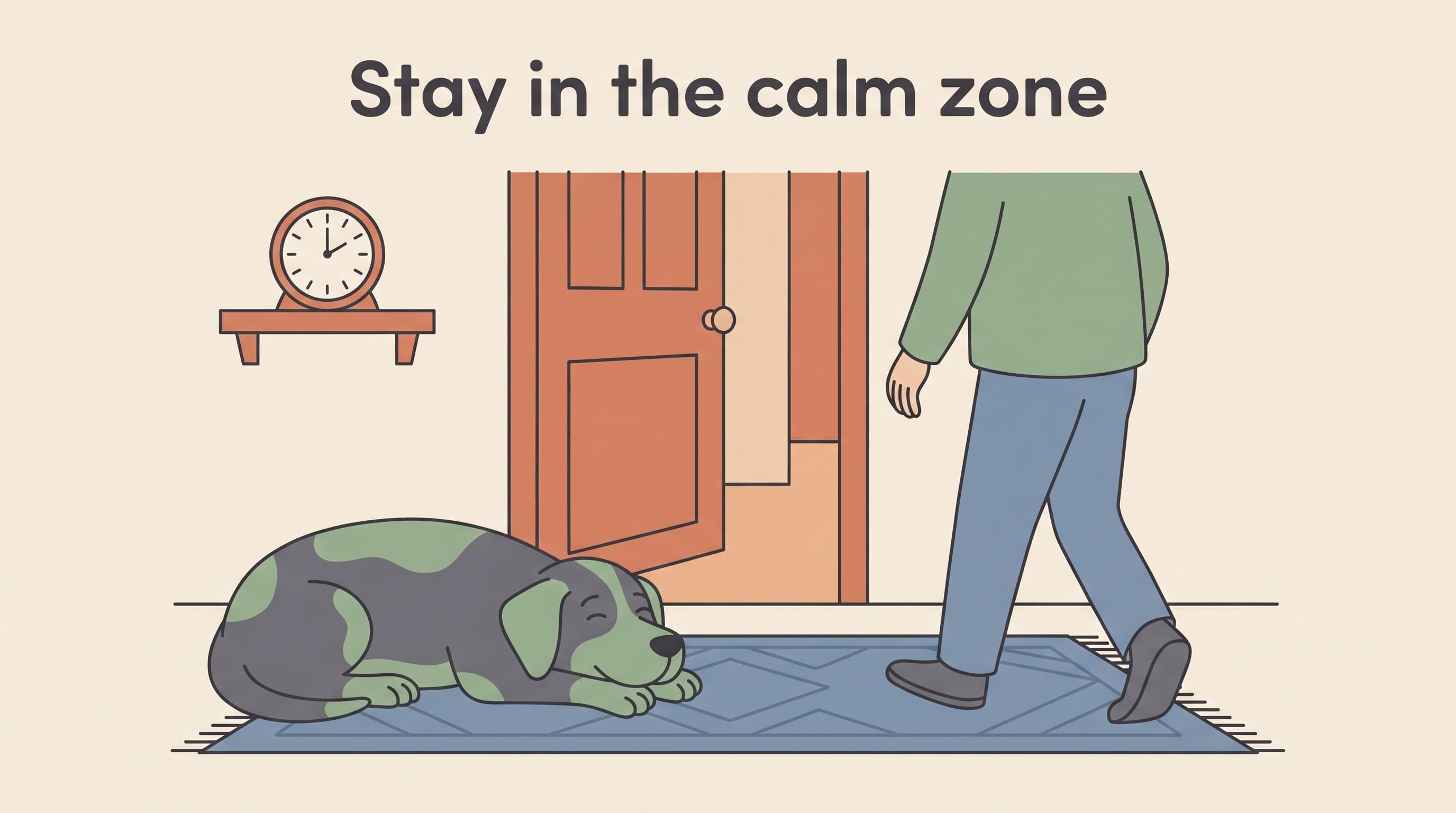
Everything good in this plan comes from one rule. You increase the time your dog is alone only while they stay relaxed, and you never knowingly push them past the point where they start to come unstuck. Behaviour scientists call this systematic desensitisation, and paired with making good things happen during absences it is the most evidence-supported treatment we have for separation-related problems (Sargisson, 2014). The underlying technique, controlled exposure kept below the level that triggers fear, runs through every fear plan, and our guide to desensitisation and counter-conditioning explains the mechanics in full.
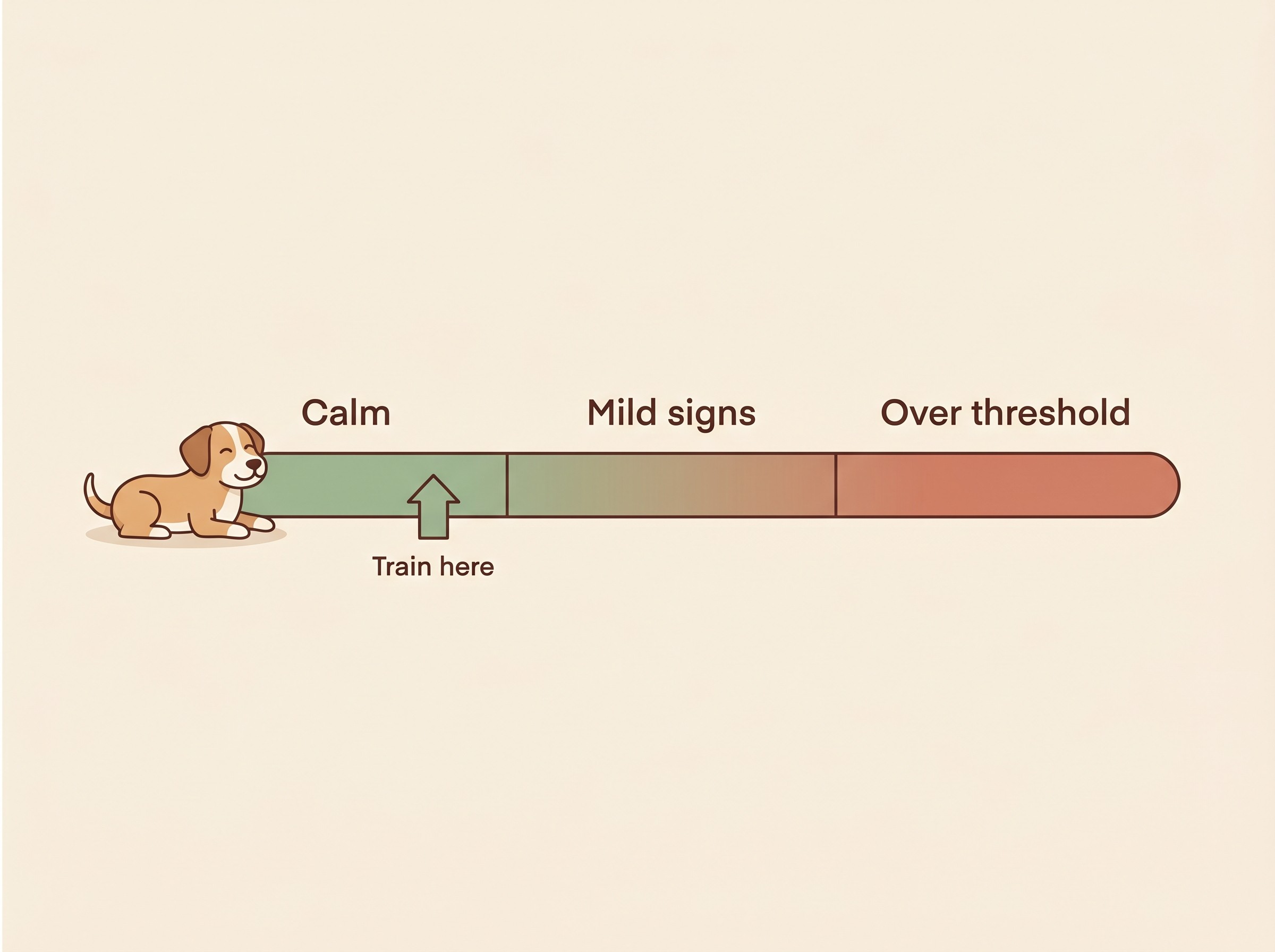
What does "under threshold" mean in practice? It means the absence is short enough that your dog notices you have gone but does not tip into distress: no escalating whining, no pacing, no scrabbling at the door, no drooling, just mild interest or settled calm. The moment you build past that line, you stop teaching "being alone is fine" and start teaching "being alone is frightening," the opposite of what you want. In the controlled study that maps this out most clearly, owners were told not to leave their dog beyond the trained duration between sessions, and progressed only when the dog stayed calm at the current length. The results were encouraging: significant reductions in how often and how severely the dogs reacted to being left, and of the six dogs followed up three months later, the problem behaviour had almost completely disappeared (Butler, Sargisson & Elliffe, 2011). I will grant that this is small, just eight dogs, and the field is short of large trials of graduated-absence training on its own, but the direction of travel is consistent, and structured behaviour-modification programmes hold up well, as you will see.
Why "crying it out" backfires
A lot of well-meaning advice, and a fair bit of older folklore, says to leave the dog to it and let them learn that nothing bad happens. For a genuinely panicking dog this is not just ineffective, it can make things worse. Leaving an animal over threshold for long stretches risks sensitisation, where each frightening absence deepens the fear rather than wearing it away (Sargisson, 2014). It is the difference between getting used to something and being repeatedly frightened by it.
The same logic rules out punishment-based "fixes." Telling a dog off for the mess or the chewing teaches fear of you, not calm about being alone, and the veterinary-behaviour consensus is now firmly that behaviour problems should be addressed with reward-based methods, not aversive ones (AVSAB, 2021). Avoiding punishment is not just kinder, it is protective: in the separation literature, avoidance of punishment is identified as a protective factor, and high frequencies of punishment are associated with more anxious behaviour (Sargisson, 2014).
Find your dog's true starting point
You cannot build steps up from a number you have guessed, so the plan starts by finding your dog's real starting point: the longest you can be out of sight before the first flicker of unease. For some dogs that is two or three minutes. For a severely affected dog it can be seconds, sometimes before you have even reached the door. Neither is a failure, it is simply your true baseline, and every step builds up from there.
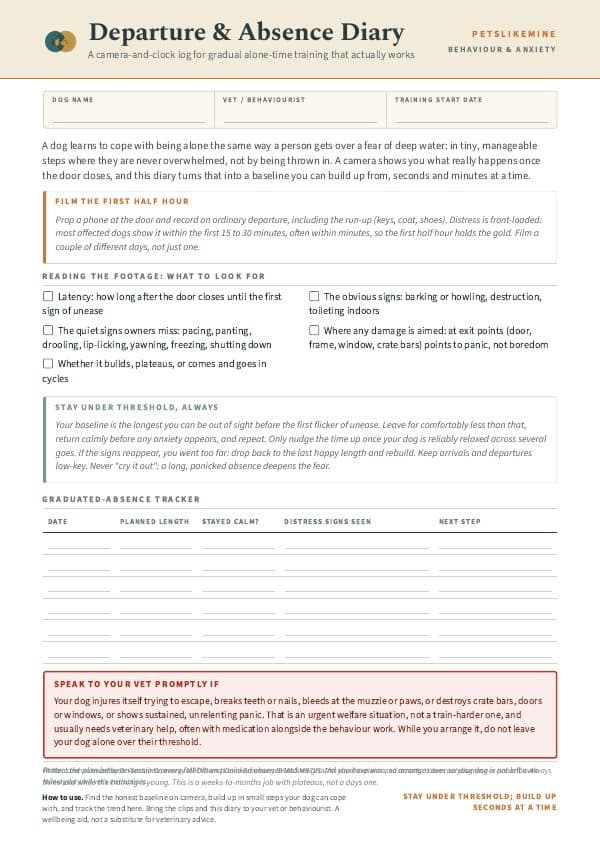
The only reliable way to find that number is to watch what your dog does when you are not there, because the signs peak when nobody is home and owners routinely under-read them. The how of this, filming a departure and spotting the latency to the first sign of distress, belongs to our guide on the camera test. That timestamp is the foundation of everything that follows.
Building up, minute by minute
Once you have your baseline, the work is methodical. You leave for a duration comfortably inside that baseline, return calmly before any anxiety appears, and repeat. When your dog is reliably relaxed at that length across several separate repetitions, you nudge the time up by a small increment, and only then. If at any point the signs reappear, you have gone too far, too fast: drop back to the last duration your dog was happy with, rebuild there, and progress more gently.
Keep arrivals and departures low-key. A calm, matter-of-fact exit and a calm return, rather than an emotional goodbye or a delighted reunion, helps the whole business feel unremarkable. Vary things a little too, so your dog is not simply counting down a predictable routine: different times of day, different doors. The aim is for "you leaving" to lose its power as a signal that something distressing is about to happen.
A word on the pre-departure cues, the keys, the coat, the shoes, that many dogs learn to dread. Some protocols add a step of "decoupling" these, picking up your keys and sitting back down so they stop reliably predicting a frightening absence. It is worth a try if your dog winds up the moment you reach for your keys, but I would not treat it as the heart of the plan, and the field is divided on it, with some arguing that repeatedly firing the cues risks winding a sensitive dog up rather than settling them. The central skill is graded absences kept under threshold (Sargisson, 2014).
It also helps to start each session from a calm state: a cosy spot your dog likes, perhaps a long-lasting chew or a food toy if they will use one, gentle background normality. A pheromone diffuser or other calming aid can support that picture, though see our look at calming aids, pheromones and supplements for what the evidence does and does not show. These support the plan, they do not replace it.
Don't let real absences undo your work
There is one dependency that makes or breaks the whole thing. Your training absences only teach calm if your dog is not, in the rest of daily life, still being left long enough to panic. Every full-blown panicked absence between sessions undoes ground you have carefully won, which is why the study owners were told not to leave their dogs beyond the trained duration (Butler, Sargisson & Elliffe, 2011). In practice that means arranging cover, a sitter, daycare, a neighbour, working-from-home days, so the dog is not left over threshold while the plan is young. The full menu lives in our guide on managing the meantime. It is not an optional extra; it is the scaffolding that lets the training hold.
How long will this take?
Let me set realistic expectations, because false hope helps no one. This is a weeks-to-months job, not a days one, and progress is rarely a tidy upward line. Expect plateaus, where you seem stuck at the same duration, and the odd setback, where a stressful day knocks you back a step. That is normal, and the response is always the same: drop back, rebuild, keep going. The structured behaviour-modification trials ran over roughly eight to twelve weeks, a fair guide to the timescale you are signing up for (Blackwell, Casey & Bradshaw, 2006; King et al., 2000).
The encouraging news is that this kind of structured programme genuinely works. In a controlled trial of a behaviour-modification programme for separation-related disorders, after twelve weeks 56 per cent of owners reported significant improvement and a further 25 per cent slight improvement, backed up by video of the dogs when alone, while untreated dogs did not improve (Blackwell, Casey & Bradshaw, 2006). Track your own progress with the same camera you used for the baseline plus a written record of each session; an absence diary is a tidy way to keep it. Seeing the trend, rather than judging it on a single bad afternoon, is what keeps the plan on course.
When to add medication, and when to get help
If progress stalls, or if your dog is so panicked they cannot settle enough to learn even at the first step, that is the point to talk to your vet about medication. It is not giving up and it is not a substitute for the plan; it is an evidence-based way to calm the brain enough that the desensitisation can take. The point is made cleanly by the pivotal trial of clomipramine, in which every dog, drug and placebo alike, received the same behaviour-modification programme, and adding the drug made dogs improve at least three times faster on the destruction and toileting signs than behaviour therapy plus a dummy tablet (King et al., 2000). The drug enabled the training, it did not replace it. In the UK, clomipramine (Clomicalm) is licensed as an aid in the treatment of separation-related disorders in dogs, only in combination with behavioural modification, and it is a prescription-only medicine your vet must dispense (Clomicalm Tablets for Dogs datasheet, NOAH Compendium). Which drugs, how they work, the weeks-long onset and the rest belong to our guide on medication for separation anxiety.
Some situations should bypass the slow plan and go straight for help. A dog that injures itself, breaks teeth or nails, or destroys barriers trying to escape is not a training-harder problem, it is an urgent welfare situation; the literature describes dogs that have torn the tongue, broken teeth and cut their faces and feet in panic (Sargisson, 2014). That warrants prompt veterinary advice and, in practice, usually a referral to a clinical or veterinary behaviourist, very often with medication alongside the behaviour work. Please do not respond to an escape-artist by shutting them in a crate as a "fix": confining a dog with separation anxiety to a crate can increase stress-related signs, and dogs can injure themselves badly trying to escape it (Sargisson, 2014). For severe or stalled cases, our guide to finding qualified behaviour help explains the referral route. Reaching for that help early is good ownership, not defeat.
What about cats, and could you be making it worse?
This problem is usually framed as a dog one, but it is not dog-only. A questionnaire survey of cats found that around 13 per cent met at least one criterion for a separation-related problem, most often destructive behaviour, excessive vocalisation or house soiling (de Souza Machado et al., 2020). I would be straight with you, though: the feline evidence base is far thinner. That survey rests on owner reports, and the authors themselves caution that the findings still need validating against direct behavioural observation, and there is no cat-grade version of the structured protocol above (de Souza Machado et al., 2020). So for cats, keep it principle-level: predictability and routine, plenty of enrichment, a safe retreat they control, and a vet conversation if signs are marked.
One last reassurance, because it stops many owners comforting a frightened pet. Soothing a scared dog does not "reinforce" the fear: fear is an emotional state, not a behaviour you can reward into being stronger, so providing security reduces distress rather than feeding it. It is a persistent myth, unpicked more fully in our firework night plan, but for now take the permission: a calm, reassuring presence is a help, not a hindrance.
The next move is the practical one. Set up the camera, find your dog's true baseline, line up the cover that stops real absences derailing you, and start building, seconds at a time. It is slow, but it is the version that actually works, and the dog who currently dreads your keys can genuinely learn that being alone is nothing to fear.
References
- Sargisson RJ. Canine separation anxiety: strategies for treatment and management. Veterinary Medicine: Research and Reports, 2014;5:143-151.
- Butler R, Sargisson RJ, Elliffe D. The efficacy of systematic desensitization for treating the separation-related problem behaviour of domestic dogs. Applied Animal Behaviour Science, 2011;129(2-4):136-145.
- American Veterinary Society of Animal Behavior. AVSAB Position Statement on Humane Dog Training. AVSAB, 2021.
- Blackwell E, Casey RA, Bradshaw JWS. Controlled trial of behavioural therapy for separation-related disorders in dogs. Veterinary Record, 2006;158(16):551-554.
- King JN, Simpson BS, Overall KL, et al. Treatment of separation anxiety in dogs with clomipramine: results from a prospective, randomized, double-blind, placebo-controlled, parallel-group, multicenter clinical trial. Applied Animal Behaviour Science, 2000;67(4):255-275.
- Clomicalm Tablets for Dogs (GB only) datasheet. NOAH Compendium of Data Sheets for Animal Medicines, Virbac Ltd.
- de Souza Machado D, Oliveira PMB, Machado JC, Ceballos MC, Sant'Anna AC. Identification of separation-related problems in domestic cats: A questionnaire survey. PLoS ONE, 2020;15(4):e0230999.
Free downloads
Companion worksheets to put what you've read into practice. Free PDFs, print at home.
Keep track of how your pet is doing
The owners who cope best are the ones who notice changes early. A simple health log shows you what is working, and what is not, before the next vet visit.
Start tracking, freeYou're not doing this alone
Compare treatment journeys and talk to owners managing behaviour & anxiety. Free to join.
Join PetsLikeMine