

Managing the meantime: avoiding full-blown absences while you train
Alastair Greenway
BVM&S MRCVS
Most separation anxiety plans don't fail on the training. They fail in the weeks around it. You build a careful departure plan, your dog starts coping with two minutes, then five, then ten, and you feel the first flicker of hope. Then on Thursday you have to be in the office all day, there is no one to help, and your dog spends seven hours in genuine panic. Come Friday, the gains feel as though they have evaporated. They often have.
This article is about that gap: how to get through the real, messy days of work and life without leaving your dog over threshold while the training is still young and fragile. The graded-absence training itself, the how of rebuilding tolerance minute by minute, belongs to our guide on the departure plan, and that is what all of this serves. Here we cover the scaffolding around it, the part that keeps your dog under threshold on the days you cannot be there.
Why one bad absence undoes a week of good ones
To understand why the meantime matters so much, you have to understand the engine the training runs on. Rebuilding tolerance of being alone works through systematic desensitisation: exposing your dog to being left in such tiny, controlled doses that their nervous system never tips into panic, so they slowly learn that absence is survivable. The whole method depends on staying below the threshold at which fear kicks in. In a small within-subjects study of eight dogs, a programme of systematic desensitisation and counter-conditioning kept deliberately sub-threshold significantly reduced both the frequency and the severity of separation-related behaviour, with almost complete resolution in the six dogs followed up three months later (Butler, Sargisson & Elliffe, 2011).
The flip side is what makes the meantime non-negotiable. As the ASPCA puts it, during desensitisation your dog must never experience the full-blown version of whatever provokes the anxiety, which means that during treatment for separation anxiety your dog cannot be left alone except during your desensitisation sessions (ASPCA, n.d.). Every uncontrolled, over-threshold absence is a panic-rehearsal that can undo prior progress. A dog who is learning to cope with thirty minutes, then left abruptly for an afternoon of panic, can have its hard-won gains unpicked in that single afternoon. The training painstakingly builds a sub-threshold condition; one full-blown absence breaches it.
So the meantime is not a holding pattern while the real work happens elsewhere. It is part of the real work, and protecting your dog from genuine absences is what makes the training possible at all.
Change, not the clock, is what bites
There is a temptation, once you grasp this, to swing to the opposite extreme and conclude you must never leave your dog for a single second again. The evidence points somewhere more nuanced and frankly more livable, and this is the part most advice pages miss.
The strongest data we have comes from a study of 1,807 UK pet dogs tracked across the pandemic, when routines lurched from normal to almost-never-alone and back again (Harvey et al., 2022). Among the dogs with no separation problem at the start, the ones at greatest risk of developing new separation-related behaviour were not simply those left the longest. They were the ones whose alone-time had decreased the most during lockdown, and who then faced another abrupt swing when life reopened; the smaller the change in how often a dog was left, the lower the odds of trouble. It was the abrupt change in how much a dog was left, rather than the absolute hours, that drove the risk.
That reframes the whole task. The goal of the meantime is to smooth the transition and avoid over-threshold spikes, not to wrap your dog in cotton wool and let them forget how to be alone at all. So as you read the menu below, hold this in mind: you are managing the gaps to keep your dog's experience of being left gentle and gradual, not abolishing absence as a concept. This study is observational and rooted in a specific moment, so I would not overstate it, but it lines up with everything we understand about how desensitisation works, and it is the most defensible reason to manage rather than panic.
Cover for the days you cannot be there
The practical question is the one that keeps people up at night: I have a job, a life, errands, what am I supposed to do in the meantime? The reassuring answer is that there is a well-established menu, consistent across the welfare authorities, and none of it is cheating. Each option simply ensures your dog has company or supervision so they are not left to panic while the training catches up. The ASPCA suggests taking your dog to work where possible; arranging for a family member, friend or pet sitter to stay with them; or using a doggy daycare or a sitter's house (ASPCA, n.d.). The same source mentions leaving a dog in the car only in genuinely moderate weather, but in the UK I would set that aside almost entirely: a parked car heats fast enough to kill even on a mild, cloudy day. The RSPCA adds that a dog sitter or dog walking service can keep your dog company and break up a longer day (RSPCA, n.d.), and Dogs Trust suggests seeking the help of friends, family, dog sitters and daycares while you build alone-time tolerance gradually, starting with a few minutes and only extending when your dog stays relaxed; they also run a free behaviour support line for qualified advice (Dogs Trust, n.d.).
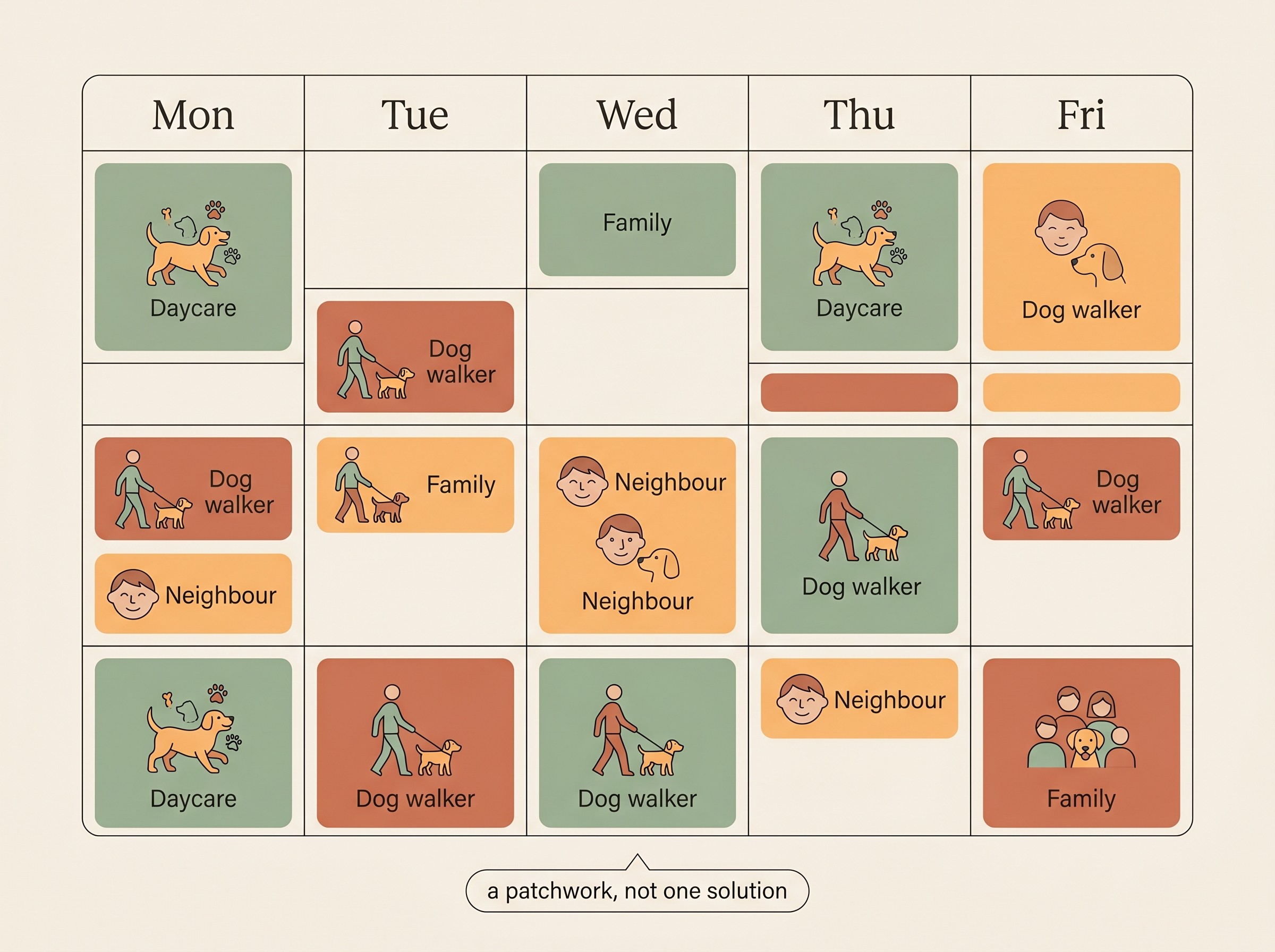
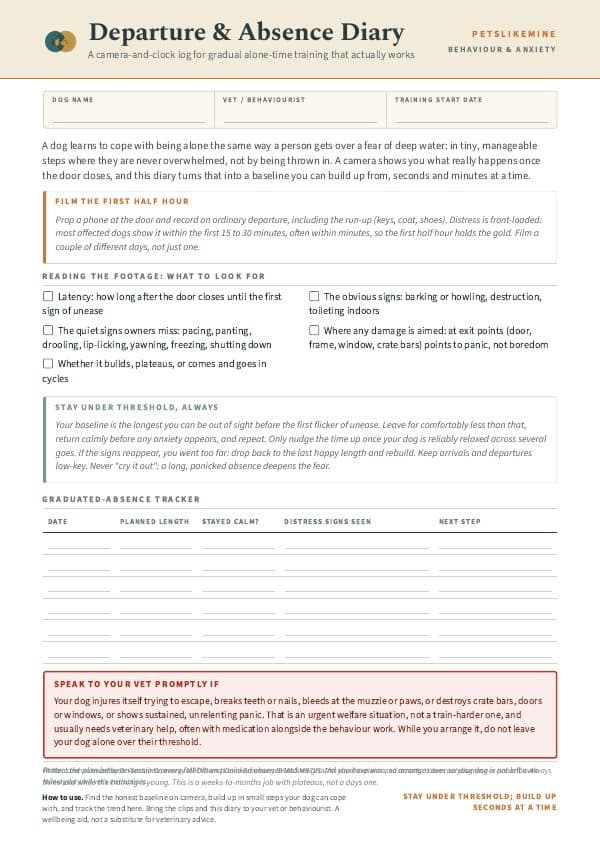
In real life, the answer is rarely one option but a patchwork: daycare on your two long office days, a neighbour at lunchtime on the others, a walker mid-afternoon, your sister for the occasional evening. It feels logistically demanding for a while, because it is, but this is a phase, not forever; as tolerance grows, the scaffolding comes down piece by piece. It helps enormously to write down which arrangements kept your dog calm and which did not, and our printable absence diary is built for exactly this. You will also want a baseline of how your dog behaves when left, which our guide on the camera test shows you how to gather.
Where food toys and the radio fit, and where they don't
This is where a lot of well-meaning advice quietly sets owners up to fail. The two most commonly recommended quick fixes, a stuffed food toy and background noise, both have a real but narrow place, and the danger is mistaking them for a solution.
Take the stuffed food toy first. For a dog with mild separation anxiety, a delicious, long-lasting food toy as you leave can genuinely help, giving them something pleasant to associate with your departure. But the ASPCA is candid that this only works for mild cases, because highly anxious dogs usually will not eat when their guardians are not home (ASPCA, n.d.). A genuinely panicked dog leaves the food untouched, because acute fear suppresses appetite. So the food toy is not a pacifier for a truly distressed dog; it is a gentle aid for a mildly worried one. And a useful diagnostic falls out of this: if you come home to find the food toy barely touched, that is not fussiness, it is a sign the absence was over threshold and the management was not enough that day. The food toy doubles as a litmus test.
Then there is the radio, the single most common piece of folk advice: just leave some music or the telly on. I would gently retire "leave the radio on and hope". Classical music has been shown to calm dogs, but the studies were done on kennelled and shelter dogs in a noisy environment, not on dogs in separation panic. It led kennelled dogs to rest more and vocalise less than other conditions (Kogan, Schoenfeld-Tacher & Simon, 2012), and it reduced stress-related behaviour and physiological stress markers in kennelled rescue dogs, but the dogs habituated to it within a day or two of continuous exposure, so the calming effect faded fast unless the music was varied (Bowman et al., 2015). So sound masking is, at best, a minor background comfort for general arousal. It is not a treatment for separation panic, and a dog who is genuinely terrified of being left will not be talked down by Classic FM. If you are reaching for the radio, an Adaptil diffuser or a calming chew, read our clear-eyed tour of calming aids, pheromones and supplements so you know what these can and cannot do; they are minor adjuncts, not a licence to leave a panicked dog. The enrichment that genuinely helps, sniffing, foraging, the right kind of mental work, is covered in our guide to boredom and enrichment.
What not to do, and when management is not enough
A short, firm list of things to avoid, because each is both common and counter-productive.
Do not punish. This is the most important one. Separation behaviours, the chewed door frame, the puddle in the hall, the howling the neighbours mentioned, are distress responses, not disobedience and not spite. Your dog is not getting back at you; they are panicking. Punishing only adds fear to fear and makes the problem worse, which is why the RSPCA is explicit that you must not physically punish or shout at your dog, and should show no sign of disapproval when you come home to a mess (RSPCA, n.d.). Better to let your dog outside and clean up calmly than to let them see you are annoyed.
Do not crate a dog who is trying to escape. Confinement reassures some dogs, but for an escape-motivated, panicking dog a crate is dangerous. The ASPCA warns plainly that if a dog shows signs of distress in a crate, heavy panting, excessive salivation, frantic escape attempts, persistent howling or barking, then crate confinement is not the right option (ASPCA, n.d.). A dog throwing itself at the bars can break teeth or nails and injure its paws and mouth. Management means keeping your dog safe and under threshold, not locking a frightened animal in a box.
And do not assume a single emotional state is at work. Separation-related behaviour is common, with estimates that between 22.3% and 55% of the general dog population show signs, and it is best understood as an umbrella of different emotional states rather than one condition (de Assis et al., 2020). A bored dog and a panicking dog need different interim measures, and our guide on whether it is separation anxiety, isolation distress or boredom helps you tell them apart. And if your dog's distress is new, escalating, or appeared abruptly, rule out a medical driver first: our behaviour check tool and our guide on whether it is behaviour or medical are the place to start.
That brings us to the escalation point, because for some households the maths simply does not work. If you genuinely cannot assemble management that keeps a severely panicked dog under threshold, white-knuckling through over-threshold days is not the answer, and it is not a moral failing to admit it. That is precisely where daily anti-anxiety medication, prescribed and monitored by your vet, can lower the panic enough to make management and training feasible at all; our guide on medication for separation anxiety explains it without stigma. It is also the trigger to get proper help: the RSPCA's route is to talk to a vet who knows your dog and can refer you to a clinical animal behaviourist (RSPCA, n.d.), and our guide on finding qualified behaviour help walks you through it. A dog who has stopped eating entirely when alone, is toileting indoors out of distress, or is injuring itself trying to escape needs veterinary and behavioural support, not a harder solo effort.
A brief word on cats. Separation-related problems are overwhelmingly a dog topic and the evidence base is almost entirely canine. Feline separation-related problems are recognised but far less studied, with the first questionnaire survey of them only published in 2020 (de Souza Machado et al., 2020), and the interim approach for cats leans on environmental security and enrichment rather than a dog-style departure protocol; our guide on enrichment is the better starting point for a cat.
The thread running through all of this is one freeing idea: the meantime is not lost time. Every day you keep your dog under threshold, whether through daycare, a friend, a walker or medication, is a day the training has a chance to stick and a day your dog is not rehearsing panic. Get the scaffolding right, and your real work, the departure plan, finally has the solid ground it needs.
References
- Butler R, Sargisson RJ, Elliffe D. The efficacy of systematic desensitization for treating the separation-related problem behaviour of domestic dogs. Applied Animal Behaviour Science, 2011;129(2-4):136-145.
- ASPCA. Separation Anxiety. ASPCA (American Society for the Prevention of Cruelty to Animals), n.d.
- Harvey ND, Christley RM, Giragosian K, Mead R, Murray JK, Samet L, Upjohn MM, Casey RA. Impact of Changes in Time Left Alone on Separation-Related Behaviour in UK Pet Dogs. Animals, 2022;12(4):482.
- RSPCA. Separation-related behaviour in dogs. RSPCA (Royal Society for the Prevention of Cruelty to Animals), n.d.
- Dogs Trust. Separation anxiety in dogs. Dogs Trust, n.d.
- Kogan LR, Schoenfeld-Tacher R, Simon AA. Behavioral effects of auditory stimulation on kenneled dogs. Journal of Veterinary Behavior, 2012;7(5):268-275.
- Bowman A, Scottish SPCA, Dowell FJ, Evans NP. 'Four Seasons' in an animal rescue centre; classical music reduces environmental stress in kennelled dogs. Physiology & Behavior, 2015;143:70-82.
- de Assis LS, Matos R, Pike TW, Burman OHP, Mills DS. Developing Diagnostic Frameworks in Veterinary Behavioral Medicine: Disambiguating Separation Related Problems in Dogs. Frontiers in Veterinary Science, 2020;6:499.
- de Souza Machado D, Oliveira PMB, Machado JC, Ceballos MC, Sant'Anna AC. Identification of separation-related problems in domestic cats: A questionnaire survey. PLOS ONE, 2020;15(4):e0230999.
Free downloads
Companion worksheets to put what you've read into practice. Free PDFs, print at home.
Keep track of how your pet is doing
The owners who cope best are the ones who notice changes early. A simple health log shows you what is working, and what is not, before the next vet visit.
Start tracking, freeYou're not doing this alone
Compare treatment journeys and talk to owners managing behaviour & anxiety. Free to join.
Join PetsLikeMine