

Medication for separation anxiety: when, what, and why it is not giving up
Alastair Greenway
BVM&S MRCVS
When a vet says the word "medication" for a behaviour problem, a lot of owners hear something the vet never meant: that they have failed, that they have run out of patience, or that the plan is to dull their dog into a shadow of itself. I want to take that idea apart at the start, because it is the single biggest reason good dogs are left to panic for months longer than they need to. Separation anxiety is not bad behaviour or a training gap you have failed to close. It is a genuine panic and anxiety problem, and a brain in the grip of panic cannot learn. Used well, medication is not a substitute for the work. It is often the thing that makes the work possible.
This article is about the daily, longer-term anti-anxiety medication that treats the underlying state. It is the sixth step in the separation journey for a reason: it sits alongside a behaviour plan, not instead of one, and it is always a vet's decision, never something you source or dose yourself. One note on species: this is written for cats and dogs, but every licensed product and almost every trial here is canine, so I flag the feline reality where it differs.
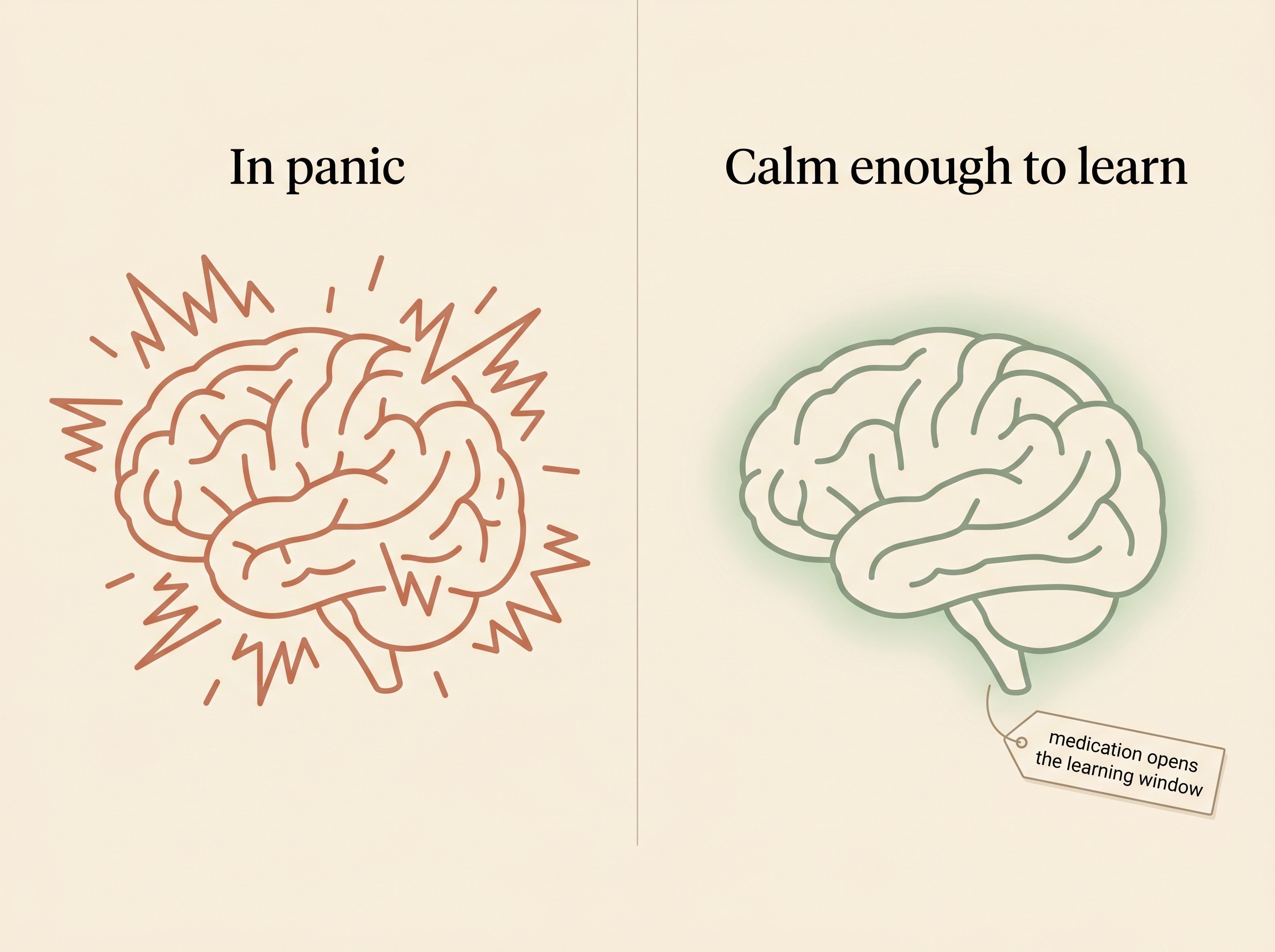
A panicked brain cannot learn
Start with the picture inside the dog. When a dog with separation anxiety is left, the part of the brain that handles fear takes over, and the thinking, learning part goes more or less offline. That matters, because the whole point of a departure plan is to teach the dog a new emotional response to being alone, and that protocol lives in our guide to the departure plan at /articles/separation-anxiety-departure-plan. You cannot teach a new association to an animal too frightened to take anything in. This is why owners who do everything right with the training, patiently and kindly, sometimes hit a wall: the dog is simply too far over threshold to learn.
This is exactly the gap medication fills, and there is good science showing it does it the right way. In a study using a validated spatial judgement-bias test, dogs with separation-related problems treated with fluoxetine alongside a behaviour-modification plan shifted towards a less pessimistic outlook, with the effect most pronounced by the sixth week and consistent with a normalisation of their underlying emotional state (Karagiannis et al., 2015). That is the key finding for anyone worried about "drugging the dog into submission". The medication did not flatten the dogs or switch them off; it lifted their mood towards normal, so that being left felt less threatening. The drug changes how the dog feels, which is what lets the training change what the dog does.
The two drugs, and how they work
In the UK, two molecules are licensed for dogs for separation-related problems. The first is fluoxetine, a selective serotonin reuptake inhibitor, or SSRI, licensed for dogs as Reconcile and as Fluoxevet. It works by blocking the reabsorption of serotonin at the nerve junctions in the brain, which raises serotonin signalling over time and lifts the anxious, low affective state (Crowell-Davis et al., 2019). The licensed dose is 1 to 2 mg per kilogram once daily (Reconcile datasheet, NOAH). The second is clomipramine, a tricyclic antidepressant licensed for dogs as Clomicalm, given at 1 to under 2 mg per kilogram twice daily; unusually for a tricyclic, its serotonin-boosting effect predominates, which is part of why it suits anxiety (Clomicalm datasheet, NOAH).
The detail that matters most is in both datasheets. Each drug is licensed only as an aid to treatment used together with a behaviour-modification plan, not as a stand-alone fix (Reconcile datasheet, NOAH; Clomicalm datasheet, NOAH). That wording is not legal throat-clearing; it reflects what the trials found, which we come to next. The choice between the two is your vet's to make, weighing fluoxetine's once-daily convenience against clomipramine's twice-daily dosing, the side-effect profile for your dog, and cost. Both also exist as cheaper generic and human formulations, and under the prescribing cascade your vet may reach for a licensed veterinary product first, or a generic where clinically appropriate.
What the evidence actually shows
Let me be more careful here than the average page, because overselling helps no one. The headline is this: more dogs improve, and they improve faster, when medication is added to a proper behaviour plan. In a randomised, double-blind, placebo-controlled trial of 95 dogs, standard-dose clomipramine combined with behaviour therapy improved the signs of destruction, defecation and urination at least three times faster than the behaviour plan with a placebo. Notably, that same trial found no significant benefit over placebo for vocalisation, and a low-dose arm showed no significant effect at all, which tells you the dose and the realistic targets both matter (King et al., 2000). For fluoxetine, the published trial reported that around 72% of treated dogs improved by the end of the study against roughly half on placebo, both groups again on a behaviour plan (Simpson et al., 2007).
Now the single most powerful piece of evidence for everything I have argued so far. In the regulatory programme behind fluoxetine, a separate field study tested the drug given without any behaviour-modification plan, and it did not confirm effectiveness; in the regulator's own words the drug alone "did not result in considerable improvement", so the study was used "for safety purposes only" (US FDA Freedom of Information Summary, NADA 141-272, 2007). Read that twice. The drug on its own, with no training alongside it, could not be shown to work. This is the clearest answer there is to the fear that medication is "giving up": it is not a shortcut that replaces the effort, because on its own it falls flat. It is the thing that lets the effort succeed.
And the caveat: even with both in place, this is not a guaranteed cure. In that fluoxetine trial, roughly one dog in four still did not improve despite the combined treatment, and the figure was higher at some earlier points (Simpson et al., 2007). I tell you that so your expectations are realistic, and so a partial response does not read as failure. The goal is a calmer, more able-to-learn dog, not a switch flipped to "fixed".
Onset, side effects, and why your vet has to steer
These drugs take time, and getting that expectation right matters. The UK datasheet notes that clinical improvement may be seen within one to two weeks (Fluoxevet SPC, NOAH), but behavioural-medicine teaching is that the full anxiolytic effect of an SSRI or tricyclic builds over roughly four to six weeks (Crowell-Davis et al., 2019). So do not judge the drug in the first few days, and please do not stop it early because "it is not working". An early signal is possible within a fortnight, but the real assessment comes after several weeks. This slow build is also why the medication is started well before it is needed, not in a panic the night before a difficult absence.
Side effects are usually mild and often settle, but you should know them. For fluoxetine, the most common is reduced appetite, with weight loss seen more often in treated dogs than controls in the field study (32.1% versus 15.7% of dogs losing at least 5% of their body weight), alongside occasional lethargy, mild tremor, vomiting, constipation and panting (Reconcile datasheet, NOAH; US FDA Freedom of Information Summary, NADA 141-272, 2007). Clomipramine most often caused mild, transient vomiting plus the dry-mouth type effects typical of its class (King et al., 2000). A little decreased appetite and quietness in the first week or two usually passes; marked weight loss, persistent vomiting or anything that worries you is a reason to ring your vet, not to stop the tablets yourself. Vets will often want a health check, and sometimes blood tests, before and during a long course, part of why this is prescribed and monitored rather than handed over and forgotten.
The safety points are also precisely why these are prescription-only medicines and never owner-sourced. Fluoxetine is contraindicated in dogs with epilepsy or a history of seizures, and it must not be combined with a monoamine oxidase inhibitor such as selegiline, or with drugs that lower the seizure threshold, because of the risk of serotonin toxicity and seizures (Reconcile datasheet, NOAH). That last group includes acepromazine, the older sedative known as ACP, a phenothiazine that should not be combined with fluoxetine (Reconcile datasheet, NOAH). I leave the full "sedation is not the same as treating fear" argument to our article on event medication at /articles/noise-fear-event-medication, but the contraindication itself shows why your vet, who knows your dog's full history and drug list, has to be the one steering this.
Fitting the medication to the rest of the plan
Daily anti-anxiety medication is one part of a wider approach. Before any of it, the standard first move applies: rule out pain and illness, because some separation-related signs have a genuine medical component, and our guide on whether it is behaviour or medical at /articles/is-it-behaviour-or-medical covers that work-up. It is also worth remembering that separation-related problems are an umbrella of different emotional presentations rather than one single diagnosis (de Assis et al., 2020), and our piece on isolation distress, frustration and boredom at /articles/separation-anxiety-isolation-distress-boredom helps you tell which you face. If you are unsure whether a medical cause remains, or whether the problem warrants referral to a veterinary behaviourist, our public /tools/behaviour-check can help you think it through.
Around the daily medication sit several partners. Over-the-counter calming aids, pheromone diffusers and nutraceutical supplements can be useful adjuncts, and we weigh their evidence at /articles/calming-aids-pheromones-supplements rather than grading it here. Occasionally a vet will add a short-acting, as-needed medication on top of the daily drug to cover one specific, predictable absence, covered at /articles/noise-fear-event-medication. And while the medication does its work, you still need to avoid tipping the dog into full-blown panic, which our guide to managing the meantime at /articles/separation-anxiety-managing-meantime addresses. The drug supports the plan. It does not teach it.
A word on the long view, because owners always ask. Expect a course measured in months rather than days. Fluoxetine has a long half-life, and the UK Fluoxevet datasheet notes that at the end of treatment it is not necessary to taper the dose for that reason (Fluoxevet SPC, NOAH). Even so, many behavioural clinicians still prefer to withdraw gradually after a long course, and to keep treating for a while after the dog is stable, to reduce the risk of relapse (Crowell-Davis et al., 2019). The rule for you is simple: do not stop on a whim, plan for a multi-month course, and make any change of dose or decision to stop with your vet, never abruptly at home.
Finally, the feline footnote I promised. In cats, fluoxetine and clomipramine are used off-licence under veterinary direction for anxiety and marking, with far less separation-specific evidence behind them than in dogs, so do not assume a feline licence exists or that the canine figures transfer neatly. The principle holds, that you treat the underlying fear so the brain is calm enough to relearn, but the evidence is thinner and the use more individualised. Whichever species you are caring for, the takeaway is the same and it is a hopeful one: if your vet suggests medication, they are not giving up on your pet, they are giving the behaviour plan its best possible chance to work. Your next move is to pair it with the departure plan at /articles/separation-anxiety-departure-plan, because that is where the two finally pull in the same direction.
References
- Karagiannis CI, Burman OHP, Mills DS. Dogs with separation-related problems show a "less pessimistic" cognitive bias during treatment with fluoxetine (Reconcile) and a behaviour modification plan. BMC Veterinary Research, 2015;11:80.
- Crowell-Davis SL, Murray TF, de Souza Dantas LM (eds). Veterinary Psychopharmacology, 2nd edition. Wiley-Blackwell, 2019.
- Reconcile (fluoxetine hydrochloride) chewable tablets for dogs: datasheet. NOAH Compendium of Data Sheets for Animal Medicines.
- Clomicalm (clomipramine hydrochloride) Tablets for Dogs: datasheet. NOAH Compendium of Data Sheets for Animal Medicines.
- King JN, Simpson BS, Overall KL, Appleby D, Pageat P, Ross C, et al. Treatment of separation anxiety in dogs with clomipramine: results from a prospective, randomized, double-blind, placebo-controlled, parallel-group, multicenter clinical trial. Applied Animal Behaviour Science, 2000;67(4):255-275.
- Simpson BS, Landsberg GM, Reisner IR, Ciribassi JJ, Horwitz D, Houpt KA, et al. Effects of Reconcile (fluoxetine) chewable tablets plus behavior management for canine separation anxiety. Veterinary Therapeutics, 2007;8(1):18-31.
- Freedom of Information Summary, Original New Animal Drug Application, NADA 141-272, Reconcile (fluoxetine hydrochloride) chewable tablets. US Food and Drug Administration, Center for Veterinary Medicine, 2007.
- Fluoxevet 32 mg Tablets for Dogs: Summary of Product Characteristics. Veterinary Medicines Directorate Product Information Database / NOAH Compendium, 2023.
- de Assis LS, Matos R, Pike TW, Burman OHP, Mills DS. Developing Diagnostic Frameworks in Veterinary Behavioral Medicine: Disambiguating Separation Related Problems in Dogs. Frontiers in Veterinary Science, 2020;6:499.
Keep track of how your pet is doing
The owners who cope best are the ones who notice changes early. A simple health log shows you what is working, and what is not, before the next vet visit.
Start tracking, freeYou're not doing this alone
Compare treatment journeys and talk to owners managing behaviour & anxiety. Free to join.
Join PetsLikeMine