

Is it behaviour or is it medical? Why the first step is a vet check
Alastair Greenway
BVM&S MRCVS
A dog starts snapping when it never used to. A house-trained cat begins weeing on the bed. The first words out of most people's mouths are some version of "what has got into him?" or "she is doing it to spite me." Those reactions are understandable, and they are also, very often, the start of a wrong turn. The single most common sign of pain in animals is not a limp or a yelp. It is a change in behaviour (Camps et al., 2019). A pet cannot tell you its hip aches or its bladder burns, so it tells you the only way it can, by acting differently.
That is why, at PetsLikeMine, almost every behaviour journey begins with a veterinary check. Not because every grumpy dog is sick, but because a worrying number of "behaviour problems" turn out to be medical ones wearing a disguise, and the kind, accurate first move is to rule that out. This article covers why behaviour and medicine are so tangled, which medical conditions hide behind which signs, the situations that need a vet today, and how to make that appointment count.
Reading the sign first, then the cause behind it
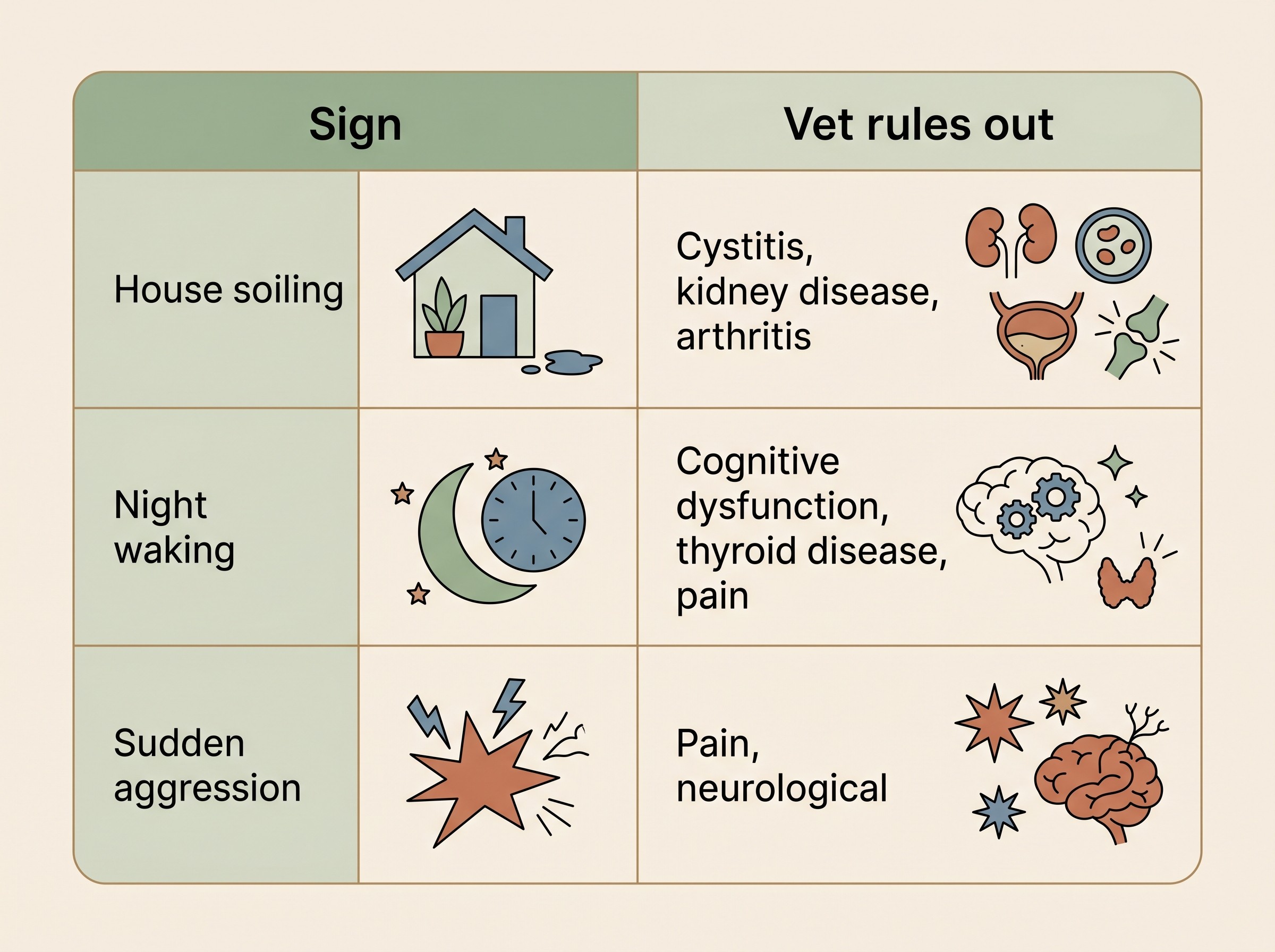
It helps to flip the usual order and start from the behaviour you are actually seeing, then ask what medicine could be behind it.
Sudden aggression or new irritability. A pet that becomes snappy, especially on being handled or touched, is one of the clearest flags for pain (Camps et al., 2019). There is even a recognisable pattern: a dog that was never aggressive before the pain began tends to become impulsively reactive specifically when it is manipulated or handled, whereas a dog that was already a little prickly tends to get more frequent and more intense in its usual flashpoints (Camps et al., 2019). The reassuring flip side is that treating the cause can resolve the behaviour. In one documented case the aggression disappeared within a few days of starting pain relief (Camps et al., 2019). A growl is not a character flaw to be punished out of a pet. It can be a sick animal asking for space, and our piece on understanding aggression takes that further.
House soiling. In cats this is so frequently medical that a medical work-up should come before any behavioural label is applied at all (Carney et al., 2014). The list of possible causes is long: feline idiopathic cystitis, bladder stones, bacterial infection, kidney disease, diabetes, an overactive thyroid, arthritis that makes the tray hard to reach, even parasites (Carney et al., 2014). This matters because house soiling is one of the leading reasons cats are given up to shelters (Carney et al., 2014). A cat is not being vindictive. It may be unwell. The full feline work-up, and the genuine emergency hiding inside it, lives in cat peeing outside the tray.
Night waking, pacing and increased vocalising. In an older pet these are classic signs of canine or feline cognitive dysfunction, the pet equivalent of dementia, but they can equally be a sore body that cannot settle, an overactive thyroid in a cat, or high blood pressure (AAFP, 2021). Cognitive dysfunction signs are often summarised by the DISHA framework, disorientation, altered interactions, sleep-wake disturbance, house-soiling and activity changes, which maps neatly onto the restlessness and night-time vocalising owners describe (Landsberg et al., 2012). The point is not to diagnose it yourself, but to know that "she just yowls at night now" is a clinical sign.
Compulsive licking or repetitive behaviour. Persistent licking at a flank or a paw is sometimes a true compulsive disorder, but it can equally be skin pain, joint pain or a gut problem underneath, and it needs the same medical rule-out, which compulsive behaviour in dogs and cats covers in depth.
Behind all of these sit the broader categories a behaviour-minded vet keeps in mind: endocrine disease, neurological problems including epilepsy and tumours in "silent" areas of the brain, cardiac disease that can affect the ageing brain, pain, and cognitive decline (Camps et al., 2019).
One important caveat. The link between an underactive thyroid and aggression in dogs is genuinely contested, not settled. It is classically associated and treatment sometimes helps, but thyroid medication can shift behaviour even in dogs with entirely normal thyroid function, so for some authors the relationship remains speculative (Camps et al., 2019). In cats, a link between an overactive thyroid and aggression is suggested rather than proven (Camps et al., 2019). So thyroid disease is worth checking, but it is not a clean, guaranteed cause, and be wary of anyone who promises it is.
When it can't wait until next week
Most of this can be sorted at a normal appointment. A few situations cannot wait.
A male cat that is straining to urinate, crying in the litter tray, or passing little or no urine is a genuine, time-critical emergency. This is most likely a blocked bladder, and it can be fatal. Once the urethra is obstructed the kidneys stop being able to do their job within roughly 24 to 48 hours, and the real danger is a rise in blood potassium that can disturb the heart's rhythm and, at worst, stop it (MSD Veterinary Manual; Clinician's Brief). The hopeful part is that it is very treatable when caught quickly, with more than 90% of cats surviving to go home if managed promptly (MSD Veterinary Manual; Clinician's Brief). If you see this, do not wait to see if it settles. Phone your vet, or an out-of-hours service, straight away.
Second, any abrupt personality shift or sudden-onset aggression, particularly in an older pet, warrants prompt veterinary assessment. A pet that changes almost overnight could be in pain, or have a neurological problem, high blood pressure or an endocrine disorder driving it, and that deserves a proper look rather than a training plan (Camps et al., 2019).
Third, resist the urge to dismiss change in an older pet as "just old age." Old age is not a disease, and behaviour change in a senior is frequently driven by something treatable: arthritis, dental pain, failing sight or hearing, thyroid disease, high blood pressure or cognitive dysfunction (AAHA, 2023; AAFP, 2021). Cognitive dysfunction in particular is hugely under-diagnosed. One study estimated its prevalence in older dogs at around 14%, while only about 2% had actually been diagnosed by a vet, so the great majority were simply being missed (Salvin et al., 2010). In cats the numbers climb steeply with age, affecting roughly 28% of cats aged 11 to 14 and around half of those over 15 (Moffat & Landsberg, 2003; Gunn-Moore et al., 2007). Many of these pets can be helped. They just need to be recognised first.
Inside a behaviour-aware examination
A good behaviour-aware consultation is a deliberate effort to exclude medical causes before anyone reaches for the word "behavioural." Expect a thorough physical and orthopaedic examination, careful palpation looking for pain, and attention to the parts of the body that hurt quietly. Depending on the picture, your vet may suggest blood and urine tests, blood pressure measurement, or imaging, because the body can be misbehaving while the exam-room behaviour looks normal (Kwik et al., 2025).
Some dogs that develop a fear of noises, fireworks, thunder, bangs, turn out to have undiagnosed musculoskeletal pain. In one case analysis, dogs with pain developed their noise sensitivity on average around four years later in life than dogs without it (Lopes Fagundes et al., 2018). The proposed explanation is elegant and rather sad: a sudden noise makes a dog flinch and tense a sore body, the tensing hurts, and the brain learns to link the sound with pain (Lopes Fagundes et al., 2018). It is a small study and an association rather than a rule, but a perfect illustration of pain hiding behind what looks like pure "behaviour." We unpack it in the hidden pain link.
What to gather before you go, and why it changes the outcome
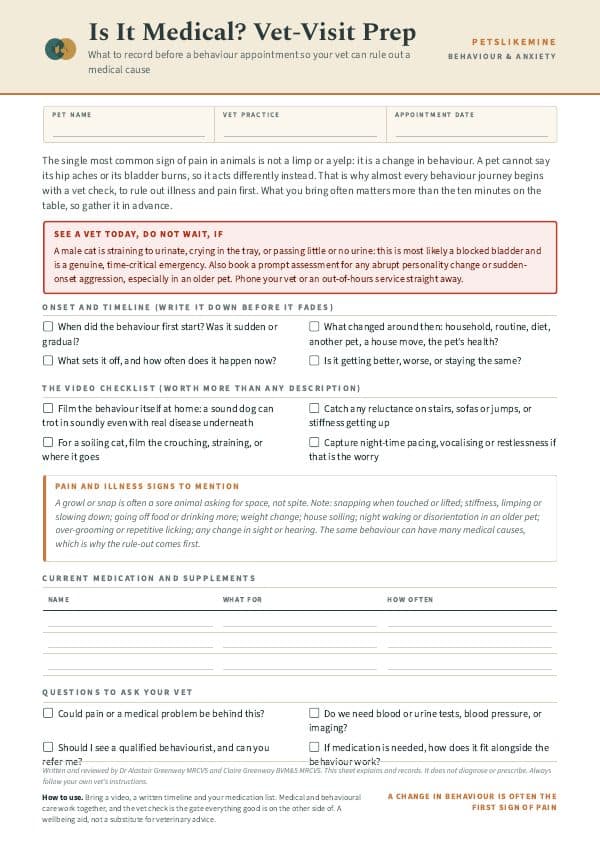
Because the key signs are so often absent in the consulting room, what you bring genuinely improves the diagnosis. A modern, vet-led approach to behaviour cases leans deliberately on a toolbox of owner observations, home footage and a timeline (Kwik et al., 2025), so gather three things before you go.
A video of the behaviour at home is worth more than any description. The dog that walks soundly into the clinic may be filmed limping on the stairs that morning; the cat that crouches and strains is far clearer on camera than in words. A written timeline is the second piece: when the behaviour started, what triggers it, how often it happens, and whether anything has changed in the household or the pet's health. Onset and pattern often point straight at the cause.
Third, our free behaviour triage tool walks you through the same questions a vet would ask, helps you judge whether the situation is urgent, and produces a summary you can take to the appointment.
Medical and behavioural care work together, not either-or
It would be a mistake to read all of this as "it is medical, so it is not behavioural" or the reverse. The two are partners. First-opinion vets are expected to address the medical side of behaviour cases as part of a broader plan, working alongside a qualified behaviourist and you, the owner (Mills & Zulch, 2023). Sometimes treating the pain resolves the behaviour entirely. More often, the medical work clears the ground, settling a body or a brain enough to learn so that the behavioural work can take hold. Medication, where it is needed, is prescribed and monitored by your vet as part of that same plan, rather than being an admission of failure or something to source and dose on your own.
So if your pet's behaviour has changed, the kindest and most useful first step is not a stricter rule or a new gadget. It is a phone call to your vet, armed with a video, a timeline and an open mind. Once illness and pain have been ruled out, you are ready to ask the next question, why the behaviour is happening at all, which is where the emotions behind behaviour picks up the thread, and to find the right person to help through finding real behaviour help.
References
- Camps T, Amat M, Manteca X. A Review of Medical Conditions and Behavioral Problems in Dogs and Cats. Animals, 2019; 9(12): 1133.
- Mills DS, Demontigny-Bedard I, Gruen M, et al. Pain and Problem Behavior in Cats and Dogs. Animals, 2020; 10(2): 318.
- Kwik EJ, Mills DS, et al. Detection of maladaptive pain in dogs referred for behavioral complaints: challenges and opportunities. Frontiers in Behavioral Neuroscience, 2025; 19: 1569351.
- Carney HC, Sadek TP, Curtis TM, et al. AAFP and ISFM Guidelines for Diagnosing and Solving House-Soiling Behavior in Cats. Journal of Feline Medicine and Surgery, 2014; 16(7): 579-598.
- Ray M, Carney HC, Boynton B, et al. 2021 AAFP Feline Senior Care Guidelines. Journal of Feline Medicine and Surgery, 2021; 23(7): 613-638.
- Landsberg GM, Nichol J, Araujo JA. Cognitive Dysfunction Syndrome: A Disease of Canine and Feline Brain Aging. Veterinary Clinics of North America: Small Animal Practice, 2012; 42(4): 749-768.
- Foster JD. Urethral Obstruction in Small Animals. MSD Veterinary Manual (Professional Version), 2024.
- Emergency Management of Urethral Obstruction in Male Cats. Clinician's Brief.
- Dhaliwal R, Boynton E, Carrera-Justiz S, et al. 2023 AAHA Senior Care Guidelines for Dogs and Cats. Journal of the American Animal Hospital Association, 2023; 59(1): 1-21.
- Salvin HE, McGreevy PD, Sachdev PS, Valenzuela MJ. Under diagnosis of canine cognitive dysfunction: A cross-sectional survey of older companion dogs. The Veterinary Journal, 2010; 184(3): 277-281.
- Moffat KS, Landsberg GM. An investigation into the prevalence of clinical signs of cognitive dysfunction syndrome (CDS) in cats (abstract). Journal of the American Animal Hospital Association, 2003; 39: 512.
- Gunn-Moore D, Moffat K, Christie LA, Head E. Cognitive dysfunction and the neurobiology of ageing in cats. Journal of Small Animal Practice, 2007; 48(10): 546-553.
- Lopes Fagundes AL, Hewison L, McPeake KJ, Zulch H, Mills DS. Noise Sensitivities in Dogs: An Exploration of Signs in Dogs with and without Musculoskeletal Pain Using Qualitative Content Analysis. Frontiers in Veterinary Science, 2018; 5: 17.
- Mills DS, Zulch H. Veterinary assessment of behaviour cases in cats and dogs. In Practice, 2023; 45(4): 200-211.
Free downloads
Companion worksheets to put what you've read into practice. Free PDFs, print at home.
Keep track of how your pet is doing
The owners who cope best are the ones who notice changes early. A simple health log shows you what is working, and what is not, before the next vet visit.
Start tracking, freeYou're not doing this alone
Compare treatment journeys and talk to owners managing behaviour & anxiety. Free to join.
Join PetsLikeMine