

Compulsive behaviour: tail-chasing, flank-sucking, light-chasing and more
Alastair Greenway
BVM&S MRCVS
Almost every dog chases its tail now and then, and almost every cat spends a good chunk of the day grooming. So the question owners actually bring to us isn't "is my pet doing this?" but "is the way my pet is doing this a problem?" That's the right question, and it has a real answer. A puppy spinning after its tail in a burst of play, or a cat working through a long, contented wash, is doing something normal. A dog that breaks off from dinner to chase its tail for twenty minutes, that you can't easily call out of it, and that has worn the hair off the tip, is doing something else. That something else is what vets and behaviourists call compulsive behaviour, and this article is about telling the two apart and knowing what to do.
A quick word on the name first, because it matters and because we'd rather be honest than tidy. You'll see these behaviours called "obsessive-compulsive disorder", borrowed straight from human psychiatry. The trouble is that we can't get inside an animal's head to know whether it's having intrusive "obsessions", so many vets prefer the plainer terms compulsive disorder, or the broader umbrella abnormal repetitive behaviour (Tynes & Sinn, 2014; Luescher, McKeown & Halip, 1991). It isn't pedantry. It points at the real lesson of this whole topic, which is that these behaviours are far less "all in the mind" than the label suggests, and far more rooted in genes, early life, stress and, very often, a medical problem hiding underneath.
When a habit tips into a disorder
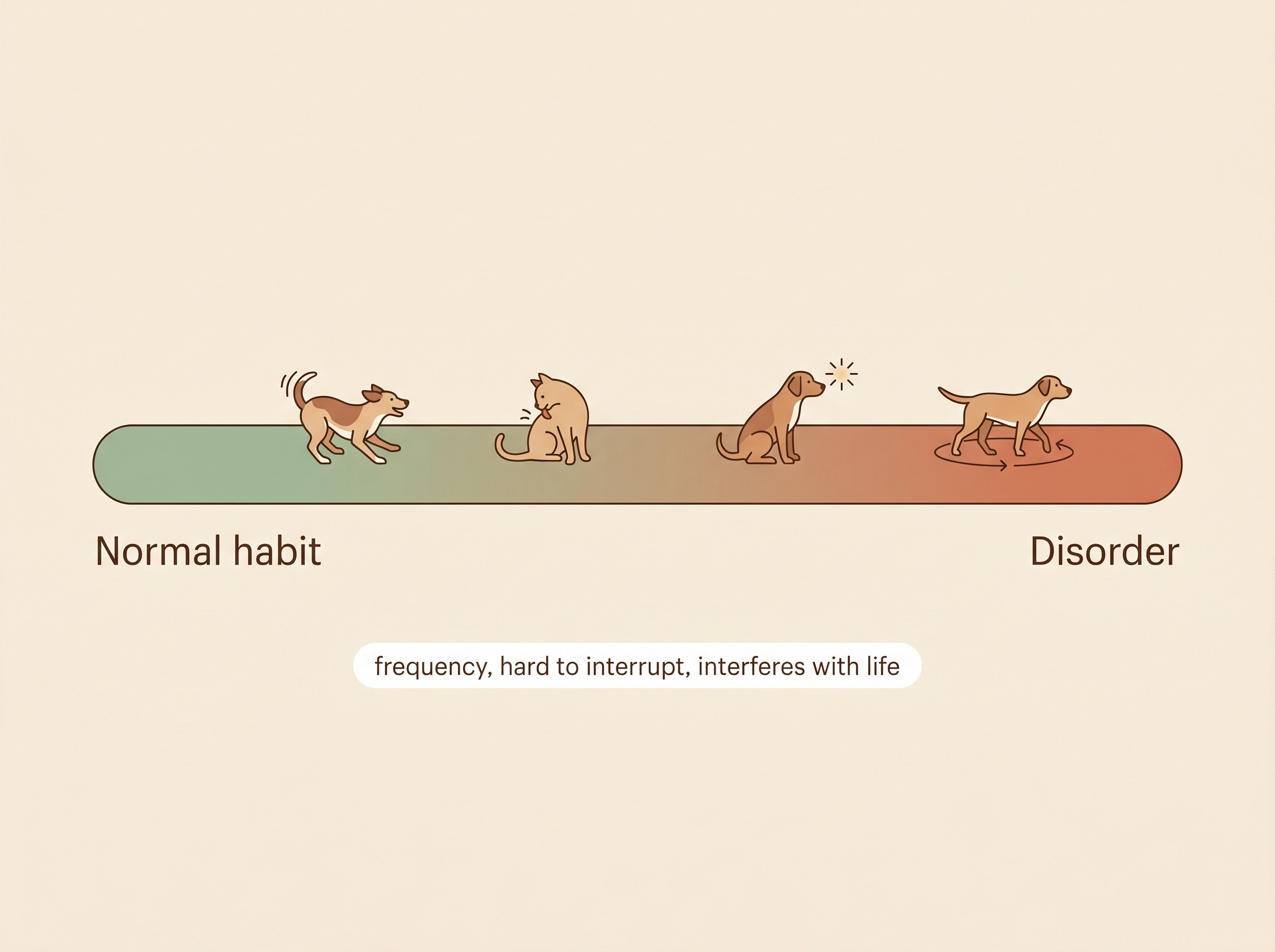
Picture repetitive behaviour as a spectrum rather than an on-off switch. At the harmless end sit the little displacement habits every animal shows when mildly torn or frustrated: a quick scratch, a yawn, a lick of the lips. Compulsive behaviours live at the far end of that same spectrum. They're repetitive, fairly fixed sequences that turn up out of context, seem to serve no obvious purpose, are hard to interrupt, and, the line that really matters, start to interfere with normal life (Luescher, McKeown & Halip, 1991; Tynes & Sinn, 2014). A cat that grooms is fine. A cat that grooms instead of eating, sleeping or interacting, until it's bald in patches, has crossed the line.
So the practical test isn't the behaviour itself but its grip on your pet. Ask yourself how often it happens, and whether it's climbing. Can you interrupt it easily, or does your pet seem locked in, sometimes almost trance-like? Is it spilling into time that should be spent eating, resting or playing? Is it doing physical harm, leaving a raw patch of skin, a bald flank, a sore tail tip? The more of those you answer yes to, the more this has shifted from quirk to disorder, and the more it's worth a proper look rather than a wait-and-see.
The recognised forms cluster by species, which is useful to know so you can spot your own pet in the list. In dogs, the classic presentations are tail-chasing and spinning, flank- and blanket-sucking, repetitive self-licking that can build into a sore called acral lick dermatitis, and the "hallucinatory" looking behaviours of chasing lights and shadows or snapping at invisible flies (Luescher, McKeown & Halip, 1991; Tynes & Sinn, 2014; Overall & Dunham, 2002). In cats, grooming-related behaviour is by far the commonest, that is, overgrooming and hair-chewing, alongside wool- or fabric-sucking, eating non-food items (pica), tail-chasing and pacing (Luescher, McKeown & Halip, 1991; Tynes & Sinn, 2014).
Rule out the medical cause first, always
A great many behaviours that look compulsive either have a medical cause or are kept going by one, so the first move is a vet check, not a behaviour plan. This isn't a disclaimer we tack on for safety. It's the single most important and most often skipped step, and getting it the wrong way round means treating the brain when the problem is in the body.
Cats give the clearest example. When researchers took a group of cats referred specifically for presumed "stress" overgrooming, supposedly the textbook psychogenic case, and worked each one up properly, 76% turned out to have a genuine medical cause of itch, things like allergy or parasites, and only 10% were purely behavioural (Waisglass et al., 2006). In other words, the thing that looks most like a stress habit is, most of the time, a medical problem the cat is responding to. We cover that in depth in our guide to feline overgrooming and psychogenic alopecia, and it's the best argument going for vetting first and labelling later.
Dogs tell the same story in a different accent. Acral lick dermatitis, the licked-raw sore on a leg, is genuinely multifactorial and is usually set off by an underlying primary disease, allergy, infection, parasites, orthopaedic or nerve pain, very occasionally a tumour, with secondary infection then perpetuating the itch-and-lick cycle so it self-sustains (Shumaker, 2019). Treat that as "just anxiety" and you'll get nowhere. And some tail-chasing, particularly the intense, trance-like or aggressive episodes seen in Bull Terriers, can sit alongside partial-seizure-like events, which is a neurological flag worth taking seriously (Moon-Fanelli et al., 2011). Eating non-food objects carries its own risk and is covered, including the obstruction danger, in our article on pica and wool-sucking.
We're not going to teach the full work-up here, because that's owned by our flagship piece on whether a problem is behaviour or medical; the short version is that your vet will want to rule out pain, skin disease, gut disease and neurological causes before anyone reaches for a behavioural label. If you're unsure whether what you're seeing warrants a visit, our behaviour triage tool will help you decide.
Genes and early life, not just bad ownership
Here's where the evidence gets genuinely interesting, and where it should lift some guilt off your shoulders. Compulsive behaviour isn't a verdict on how you're raising your pet. It's biological, often inherited, and shaped by things that happened before you ever met your animal.
The genetics are now concrete. In Dobermans, a stretch of canine chromosome 7 within the neural cadherin gene CDH2 carries susceptibility to compulsive disorder: the risk version of the gene was found in 60% of dogs with multiple compulsions and 43% of less severely affected dogs, against just 22% of unaffected dogs, the first genetic locus ever pinned down for a compulsive disorder in any animal (Dodman et al., 2010). You can see the same heritability in the way these behaviours run in particular breeds. Tail-chasing clusters in Bull Terriers and German Shepherds; flank- and blanket-sucking in Dobermans; light- and shadow-chasing and fly-snapping turn up disproportionately in herding breeds such as Border Collies and in Cavalier King Charles Spaniels (Moon-Fanelli et al., 2011; Dodman et al., 2010; Tynes & Sinn, 2014).
Early life leaves its mark too. In a large survey of dogs with compulsive tail-chasing, affected dogs had on average been separated from their mothers earlier and had had poorer maternal care, and the behaviour tended to start young, around three to six months, before sexual maturity (Tiira et al., 2012). The same study noted some softer associations, dogs given certain vitamin and mineral supplements, vitamin B6 most strongly, chased their tails less, and neutered dogs scored lower, though as an owner survey these are suggestive correlations rather than proof of cause, and I wouldn't want you to read them as a recipe (Tiira et al., 2012). The fair summary is that compulsions sit at a crossroads of genes, early experience, stress and medical disease, and the conflict and frustration that trigger an episode are real drivers, explained more fully in our piece on the emotions behind behaviour.
The boredom myth, carefully handled
There's a tempting story that goes "he's just bored, he needs more walks", and it's worth handling carefully because it's half right and half misleading. Most competitor pages skip the finding that complicates it. In a referral series of 126 cases, canine compulsive disorder was specifically not associated with lack of training, lack of household stimulation, or being shut away on its own; most affected dogs came from breeders, lived in busy multi-pet, multi-person homes, and had had formal training, and males outnumbered females roughly two to one (Overall & Dunham, 2002).
So under-stimulation isn't the whole explanation, and enrichment isn't a complete cure. That said, reducing frustration and boredom is a genuine and important part of management, just not the entire answer, and we set out what good enrichment actually looks like in our guide to boredom and enrichment. Hold both thoughts at once: enrichment helps, and "he's just bored" is too small a story for what's really going on.
While we're clearing up myths, one practical and under-publicised point for cats prone to chasing lights and shadows. More frequent laser-pointer play has been associated with more owner-reported abnormal repetitive behaviours, with laser play the strongest single predictor in the analysis, especially fixating on and chasing lights and shadows (Kogan & Grigg, 2021). That study is correlational, so treat it as a sensible caution rather than a proven cause, but it's an easy adjustment to make: let the cat actually catch something physical at the end of a hunt, and favour a wand toy over the dot that can never be caught.
Why telling them off makes it worse
Owners reach instinctively for two responses that both backfire, and it's worth understanding why so you can resist them. Compulsions are driven by an underlying brew of anxiety, conflict and frustration, so punishing the behaviour simply adds stress to an already stressed animal and tends to make it worse, not better (Luescher, McKeown & Halip, 1991; Tynes & Sinn, 2014). Attention of any kind, even an exasperated "stop that", can inadvertently reward the behaviour and keep it going. Why punishment is the wrong tool across the board, not just here, is covered in our piece on how animals learn.
The better frame is management, not correction. You're aiming to prevent the behaviour being rehearsed and to remove the triggers that set it off, rather than to interrupt and scold it once it starts. That means noticing what tends to precede an episode, a particular frustration, a stressful arrival, a specific room or moment, and adjusting the environment so it doesn't arise, while redirecting calmly to something else rather than making a drama of it.
Building a plan that actually helps
Across the literature the shape of treatment is consistent and sensible, and it stands on three legs. First, treat any underlying medical disease, which is why the vet check comes first and why, for something like an acral lick sore, you're dealing with the skin and the infection as well as the behaviour (Shumaker, 2019). Second, reduce the conflict, frustration and stressors that trigger the behaviour and avoid reinforcing it, the management described above. Third, for established cases, add vet-prescribed medication that acts on the serotonin system. In the 126-case series, behaviour modification combined with medication produced more than a 50% reduction in most animals, and in dogs clomipramine was significantly more effective than amitriptyline (Overall & Dunham, 2002; Tynes & Sinn, 2014).
One important nuance on the medication, because owners ask. The two behaviour drugs licensed in the UK, clomipramine (Clomicalm) and fluoxetine (Reconcile), are authorised specifically for separation-related problems used alongside a behaviour plan, not for compulsive disorder, so using them for compulsions is an off-licence decision your vet makes case by case. We keep the detail of how these drugs work in our article on medication for anxiety; the point here is simply that medication is a legitimate part of the plan for the more severe cases, not a last resort or an admission of failure.
Be realistic about what success looks like. For most pets the goal is meaningful, often substantial reduction with the combined approach, not a guaranteed cure, and behaviours can flare again under stress, so a plan that holds up over the long term matters more than a quick fix. If the behaviour is severe, self-injuring, or comes with those trance-like or aggressive episodes, that's the point to get a clinical behaviourist and your vet working together, and our guide on finding qualified help explains how to find the right person. The thread to hold onto is that compulsive behaviour is far more treatable than it looks, as long as you start in the right place, which is the vet, and resist the two instincts, punishing it and dismissing it as "just boredom", that make it worse.
References
- Tynes VV, Sinn L. Abnormal repetitive behaviors in dogs and cats: a guide for practitioners. Veterinary Clinics of North America: Small Animal Practice, 2014;44(3):543-64.
- Luescher UA, McKeown DB, Halip J. Stereotypic or obsessive-compulsive disorders in dogs and cats. Veterinary Clinics of North America: Small Animal Practice, 1991;21(2):401-13.
- Overall KL, Dunham AE. Clinical features and outcome in dogs and cats with obsessive-compulsive disorder: 126 cases (1989-2000). Journal of the American Veterinary Medical Association, 2002;221(10):1445-52.
- Waisglass SE, Landsberg GM, Yager JA, Hall JA. Underlying medical conditions in cats with presumptive psychogenic alopecia. Journal of the American Veterinary Medical Association, 2006;228(11):1705-9.
- Shumaker AK. Diagnosis and treatment of canine acral lick dermatitis. Veterinary Clinics of North America: Small Animal Practice, 2019;49(1):105-23.
- Moon-Fanelli AA, Dodman NH, Famula TR, Cottam N. Characteristics of compulsive tail chasing and associated risk factors in Bull Terriers. Journal of the American Veterinary Medical Association, 2011;238(7):883-9.
- Dodman NH, Karlsson EK, Moon-Fanelli A, Galdzicka M, Perloski M, Shuster L, Lindblad-Toh K, Ginns EI. A canine chromosome 7 locus confers compulsive disorder susceptibility. Molecular Psychiatry, 2010;15(1):8-10.
- Tiira K, Hakosalo O, Kareinen L, Thomas A, Hielm-Bjorkman A, Escriou C, Arnold P, Lohi H. Environmental effects on compulsive tail chasing in dogs. PLoS ONE, 2012;7(7):e41684.
- Kogan LR, Grigg EK. Laser light pointers for use in companion cat play: association with guardian-reported abnormal repetitive behaviors. Animals, 2021;11(8):2178.
Keep track of how your pet is doing
The owners who cope best are the ones who notice changes early. A simple health log shows you what is working, and what is not, before the next vet visit.
Start tracking, freeYou're not doing this alone
Compare treatment journeys and talk to owners managing behaviour & anxiety. Free to join.
Join PetsLikeMine