

Feline overgrooming: psychogenic alopecia, or something itchier?
Alastair Greenway
BVM&S MRCVS
Most owners never actually catch their cat in the act. That is the strange thing about overgrooming. One day the fur on her belly looks thin, or there is a neat bald stripe down the inside of a back leg, the skin underneath smooth and unbroken. Cats groom in private, often while you are out or asleep, so the first you tend to know of a problem is the result, not the act. And because she seems calm, eats well, and never appears to scratch, the explanation that springs to mind, and that a quick internet search will happily confirm, is stress. A nervy cat soothing herself. Psychogenic alopecia.
It is a tidy story, and it is usually wrong. When cats sent to specialists with a presumed diagnosis of psychogenic alopecia are worked up properly, the large majority turn out to have a physical, itchy reason for the hair loss, not a psychological one. That changes everything about what to do next, so this article is about getting the order right: rule out the itch first, take the stress seriously second, and understand that in plenty of cats it is genuinely both.
What a barbered coat tells you
The classic picture is what vets call a barbered coat. The hair is broken off short rather than missing at the root, so the area feels like stubble or velvet, and it sits in a recognisable distribution: the belly, the inner thighs, the flanks, sometimes the forelegs, the bits a cat can reach with a busy tongue. Importantly, the skin underneath is often completely normal, with no redness or sores. That clean, tidy, symmetrical look is exactly what fools people, because it seems too neat to be a disease and too deliberate to be anything but behaviour.
And here is the catch. Self-induced symmetrical alopecia, that very pattern, is one of the four classic ways an itchy, allergic cat shows its disease, alongside miliary dermatitis, the eosinophilic lesions, and the head and neck excoriation that owners do tend to notice (Favrot, 2013). None of these four patterns tells you the cause on its own. A barbered belly is the textbook appearance of an itchy cat, not proof of an anxious one, and the only reliable way to separate a behavioural cause from a medical one is to exclude the medical possibilities and see what responds to treatment (Favrot, 2013).
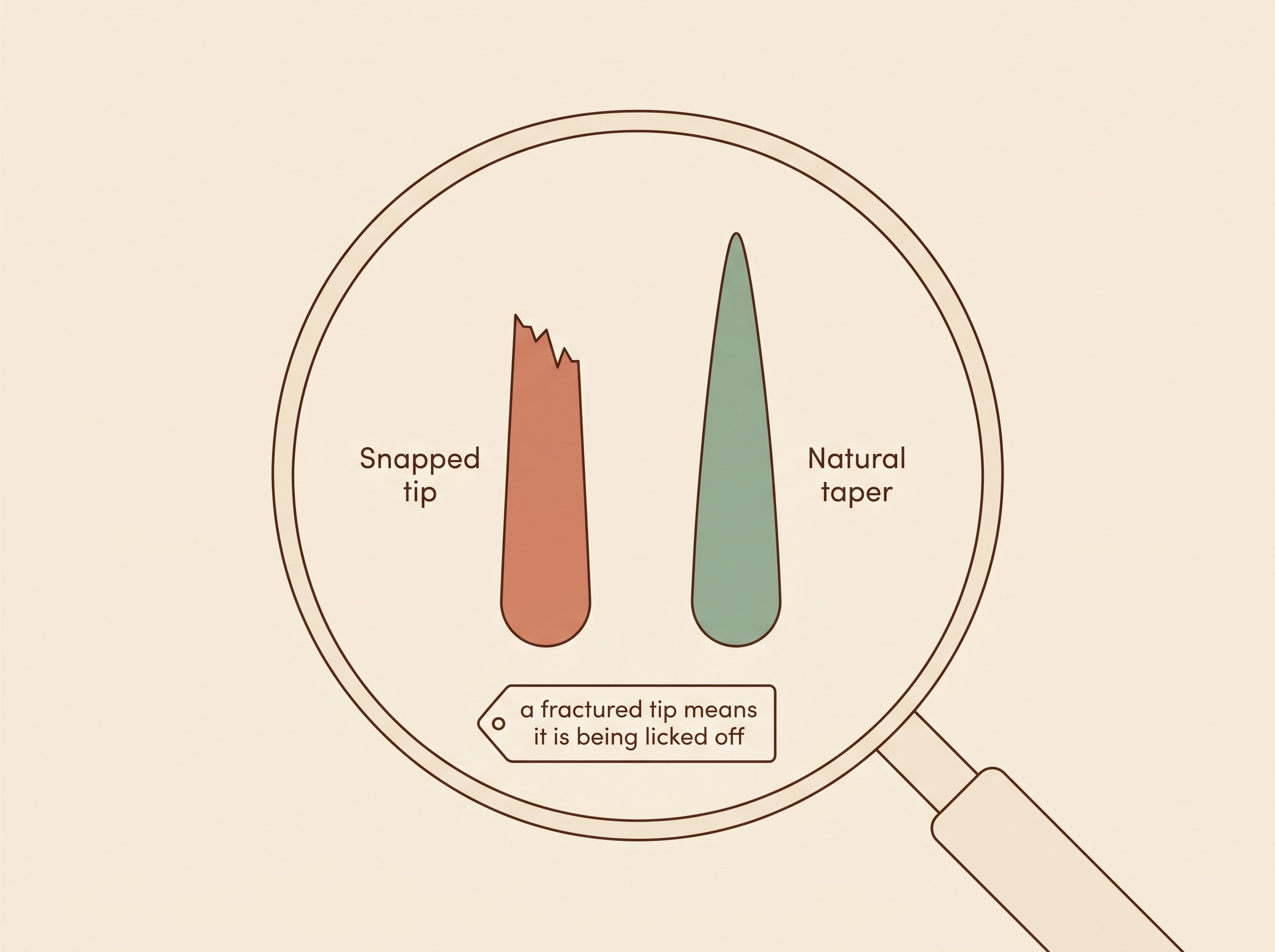
There is a simple way a vet confirms the hair is being removed by the cat rather than falling out on its own, and it shows the work-up is real rather than guesswork. It is called a trichogram: a few hairs are plucked from the edge of the thin patch and looked at under the microscope. Hair that has been bitten or licked off has fractured, ragged, blunt tips, like a snapped pencil; hair shed naturally, or lost to a hormonal process the cat is not causing, has tapered, pointed ends. So before anyone reaches for a diagnosis, the trichogram answers the first question: is she doing this herself? In overgrooming, the answer is yes.
When someone finally checked
For decades the assumption ran the other way: a cat with symmetrical hair loss and no obvious skin disease was treated as a behaviour case by default. Then a group of vets did the obvious thing and checked. In a study of twenty-one cats referred specifically with a presumptive diagnosis of psychogenic alopecia, every cat had a thorough dermatological work-up, screening for parasites, allergies, ringworm and hormonal disease. A medical cause of itch was found in sixteen of the twenty-one, around three quarters of them. Only two cats, roughly one in ten, had psychogenic alopecia and nothing else. The remaining three had a combination, a real medical itch with a behavioural component layered on top (Waisglass et al., 2006).
The commonest culprit by a distance was food. An adverse reaction to something in the diet was diagnosed in twelve cats and suspected in two more (Waisglass et al., 2006). That is the evidence behind the practical rule your vet is likely to follow: think allergy first, parasites close behind. The authors put it about as plainly as veterinary papers ever do, writing that psychogenic alopecia is overdiagnosed in cats and that thorough diagnostic testing should be done before a behavioural cause is blamed for hair loss (Waisglass et al., 2006).
It is a single small series of referral cats, so the exact figure of three quarters is not a universal law for every overgrooming cat in the country. But it is the best direct evidence on this precise question, and it points one way: in the great majority of these cats, something is itching them. That is a far safer place to start than assuming the cause is in her head.
Why you never see her scratch
The biggest reason owners resist the itch explanation is the obvious one: she does not scratch. This is where feline allergy plays its cruellest trick. The licking and barbering is itself the itch response, the feline equivalent of a person scratching, just done with the tongue, and cats very often perform it in private, out of sight, so the only outward sign is the bald patch that turns up later (Torres, 2025). Self-induced alopecia is recognised as one of the ways feline pruritus shows itself, not a separate, calmer thing (Favrot, 2013). So "I never see her scratch" is not evidence against an itch; it is, if anything, the typical presentation.
Two more myths are worth dropping with it. The first is that barbered, clean-skinned fur proves the cause is psychological, when in fact that symmetrical pattern is the standard look of an itchy cat and says nothing on its own about the trigger (Favrot, 2013). The second is the belief that psychogenic alopecia is common. On the evidence it is probably the least common explanation, and the impression that it was everywhere came from older case work that labelled cats behavioural without ever ruling out disease (Waisglass et al., 2006).
Fleas in particular slip the net, because a fastidious overgroomer removes them and their dirt as she licks, so a vet can comb a genuinely flea-allergic cat and find nothing. That is why a proper flea-control trial, not a single inspection, belongs in the work-up (Favrot, 2013). The case for a medical cause is strong even when, especially when, your cat looks for all the world like she is just anxious.
Get the medical work-up first
Because the odds favour a physical cause, the first move is a veterinary visit, not a behaviour plan, and certainly not a calming product bought on a hunch. The general argument for why a vet check comes before any behaviour label, and what that exam involves, is covered in our piece on whether a problem is behaviour or medical, and the public behaviour triage tool will walk you through whether what you are seeing needs a vet first. For overgrooming the rule-out is a dermatological one, and it follows the evidence: a trichogram to confirm the loss is self-inflicted, then a methodical search for the itch. That usually means the flea-control trial above, skin scrapes for mites, and, because food is the front-runner, a properly conducted elimination diet over several weeks, alongside checks for ringworm and, in the right cat, allergies and the occasional hormonal cause (Waisglass et al., 2006; Favrot, 2013).
This is deliberately not a do-it-yourself derm tutorial, and it should not be rushed at home with a shop-bought flea spray and crossed fingers. The work-up has steps because several of these causes hide from a single glance. Done in order, it either finds the thing itching her, or it clears the medical list so that a behavioural diagnosis, if it comes, is one you can trust.
When it really is stress, and when it is both
Genuine psychogenic alopecia does exist. It is best understood as a displacement or compulsive behaviour, a grooming habit that has detached from its normal trigger and become a way of coping with anxiety, frustration or conflict, and it belongs to the same family of feline compulsive disorders as flank-sucking and some forms of pica (Overall & Dunham, 2002). The classic triggers are changes and tensions in a cat's world: a new cat in the house or hostile cats outside the window, building work, a house move, a baby, a disrupted routine. In the case series most often cited for the behavioural view, environmental stress was judged to have started or worsened it in nine of eleven cats (Sawyer et al., 1999).
That same series is one to read with care. It was retrospective and had no formal protocol to exclude medical disease, exactly the gap the later work exposed, so it is useful for describing what stressed overgrooming looks like, but not for estimating how common a purely psychological cause is (Sawyer et al., 1999; Waisglass et al., 2006). Lean on it for the phenotype, not the frequency.
The most useful way to hold all this is to refuse the either/or. In the work-up study, fourteen percent of cats had both a medical itch and a behavioural component (Waisglass et al., 2006). Self-induced grooming injuries are now recognised as abnormal repetitive behaviours and welfare indicators, and in cats with the more severe ulcerative form, improving the environment improved welfare scores and helped the lesions heal, which fits the idea that stress can sustain a grooming loop that began as a simple itch (Titeux et al., 2018). An allergy can light the fire and stress can keep it burning. The right plan, in a cat with both, treats both.
What that stress side looks like in practice is owned by other articles, and I will hand you to them rather than half-cover it here. The indoor cat's environmental needs, the Pandora and feline idiopathic cystitis story, and the five-pillar framework for a calmer home are all in stress, FIC and enrichment for cats; if another cat in the household is the likely stressor, easing inter-cat tension at home is the place to go, and our litter-tray audit and FIC enrichment printables give you a structured way to work through it. The wider picture of what turns a repetitive habit into a true compulsive disorder, in both dogs and cats, sits in compulsive behaviour in dogs and cats, which this article is the feline rule-out companion to.
On medication, keep expectations realistic. Where a behavioural component is confirmed, a vet may consider an off-label antidepressant, fluoxetine or clomipramine, but the evidence is clear that the drug is the junior partner. A controlled trial found clomipramine on its own was not effective; the benefit appears when medication is paired with environmental and behavioural change, which is arguably the more important half of the plan (Veterinary Evidence Knowledge Summary, 2022). Both drugs are unlicensed in cats in the UK and would be prescribed under the veterinary cascade, with monitoring, which is precisely why this is a vet decision and never something to source or dose yourself. The wider framing of daily anti-anxiety medication is in our separation anxiety medication article, and pheromones such as Feliway are weighed up in calming aids, pheromones and supplements.
If your cat has a thinning belly or a bald stripe, the next step is simple, and it is not a guess about her feelings. Book the vet, ask for a trichogram and a proper itch work-up, and start a flea-control and diet plan under their guidance, because the odds say there is something to find. Treat the stress in parallel if her life has reasons to be stressful, since it rarely hurts and often helps. And hold off on the psychogenic label until the itch has genuinely been ruled out, because for most of these cats the kindest thing you can do is stop reading her mind and start checking her skin.
References
- Favrot C. Feline non-flea induced hypersensitivity dermatitis: clinical features, diagnosis and treatment. Journal of Feline Medicine and Surgery, 2013;15(9):778-784.
- Waisglass SE, Landsberg GM, Yager JA, Hall JA. Underlying medical conditions in cats with presumptive psychogenic alopecia. Journal of the American Veterinary Medical Association, 2006;228(11):1705-1709.
- Torres SMF. Itching (Pruritus) in Cats. MSD/Merck Veterinary Manual, 2025.
- Overall KL, Dunham AE. Clinical features and outcome in dogs and cats with obsessive-compulsive disorder: 126 cases (1989-2000). Journal of the American Veterinary Medical Association, 2002;221(10):1445-1452.
- Sawyer LS, Moon-Fanelli AA, Dodman NH. Psychogenic alopecia in cats: 11 cases (1993-1996). Journal of the American Veterinary Medical Association, 1999;214(1):71-74.
- Titeux E, Gilbert C, Briand A, Cochet-Faivre N. From feline idiopathic ulcerative dermatitis to feline behavioral ulcerative dermatitis: grooming repetitive behaviors indicators of poor welfare in cats. Frontiers in Veterinary Science, 2018;5:81.
- Griesser A-C. Does treatment with clomipramine reduce cat psychogenic alopecia? Veterinary Evidence (RCVS Knowledge), 2022;7(2).
Keep track of how your pet is doing
The owners who cope best are the ones who notice changes early. A simple health log shows you what is working, and what is not, before the next vet visit.
Start tracking, freeYou're not doing this alone
Compare treatment journeys and talk to owners managing behaviour & anxiety. Free to join.
Join PetsLikeMine