

Cats that do not get along: easing inter-cat tension at home
Alastair Greenway
BVM&S MRCVS
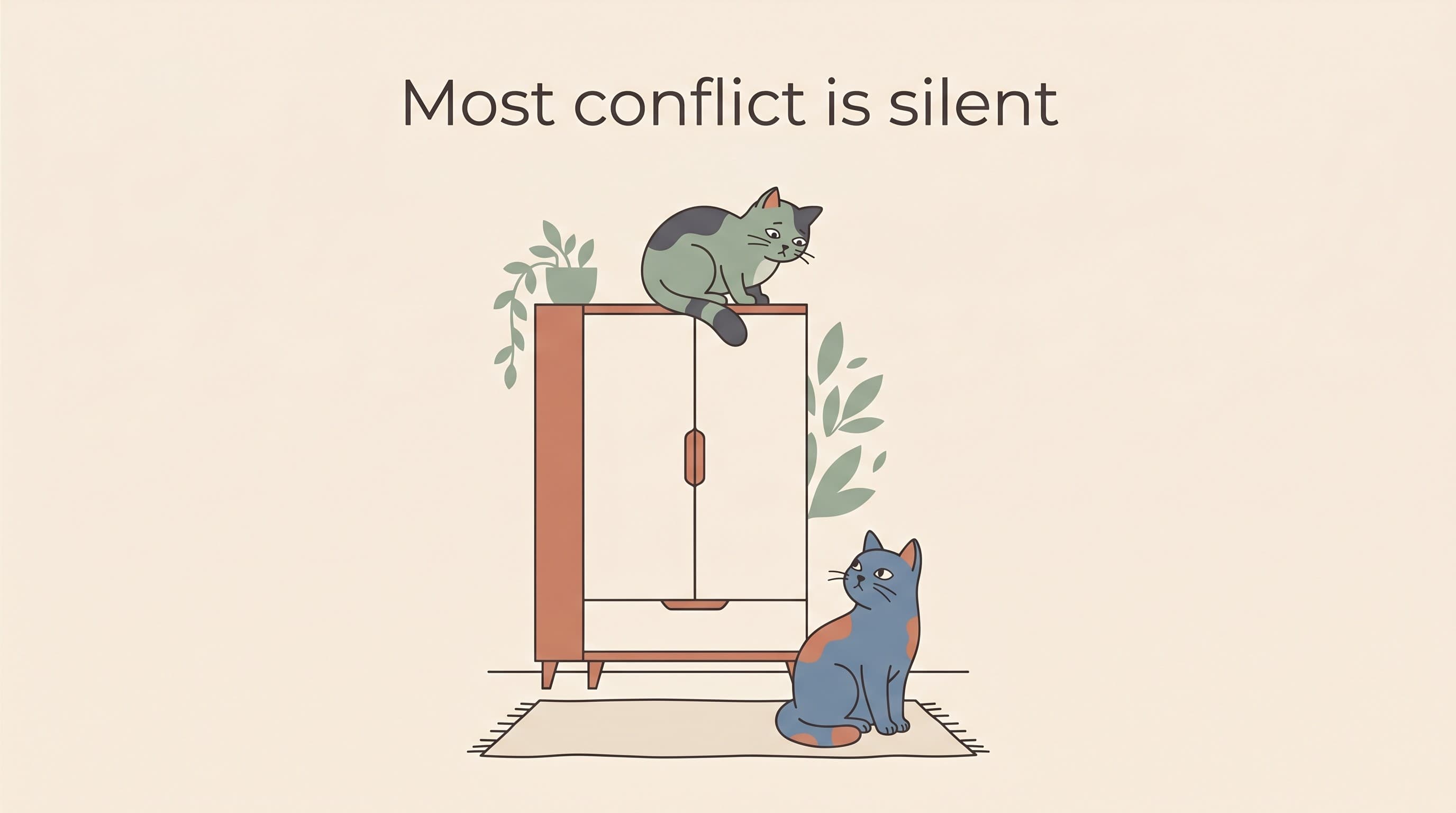
One cat spends its days on top of the wardrobe. There is a puddle by the back door. One of them has a bald patch on its belly. In a multi-cat home, signs like these often mean the cats are not getting along, even when you have never once seen them fight. That reading is usually right, and it matters. Inter-cat tension is one of the most under-recognised problems in multi-cat homes and a documented driver of exactly the spraying, soiling and overgrooming that brought many owners to this section (Rodan et al., 2024). It is also one of the most treatable, once you know what you are looking at.
One quick but important fork before we go on. If a cat has suddenly stopped eating, is hiding constantly, or is straining, crying or producing little urine, that is a vet visit, not a behaviour project, because illness and pain can sit underneath a behaviour change. A male cat straining to pass urine is a genuine emergency: a blocked bladder can be fatal within a day. Our article on ruling out illness when a cat pees outside the tray covers that, and the behaviour-check tool will help you decide whether this is a vet problem first. With that flagged, let us talk about the cats.
Cats are social, just not the way dogs are
The old line that "cats are solitary, they will sort it out themselves" is both wrong and quietly harmful. The domestic cat descends from a solitary, territorial ancestor and can live perfectly well alone, but it is more accurately described as facultatively social: where resources allow, cats form structured social groups (Crowell-Davis et al., 2004; Rodan et al., 2024). The key word is structured. Members of a group actively choose each other: they allogroom, licking around each other's head and neck, they allorub, rubbing flanks together to swap scent and build a shared "group odour", and they rest in contact and play together. Cats outside the group are not casually allowed in, and integration, when it happens at all, is a gradual business of many small interactions, not a switch that flips because two cats share a kitchen (Crowell-Davis et al., 2004).
This is the bit that catches people out. Putting two unrelated cats in the same house does not make them one social group, and it never automatically will. Cats living alongside others they are not bonded to, and do not tolerate, experience real and ongoing distress, and that chronic stress is the engine behind a lot of feline disease (Rodan et al., 2024). So if your two are not friends, you have not failed and they are not being difficult: you have asked two individuals who did not choose each other to share territory, which is genuinely hard for a cat. You can map who is actually bonded by quietly noting, over a week, which cats groom and rub on which, and who sleeps touching whom. Two that never do any of this, even after years together, are tolerating rather than bonded, which is worth knowing before you start.
Why the trouble stays silent
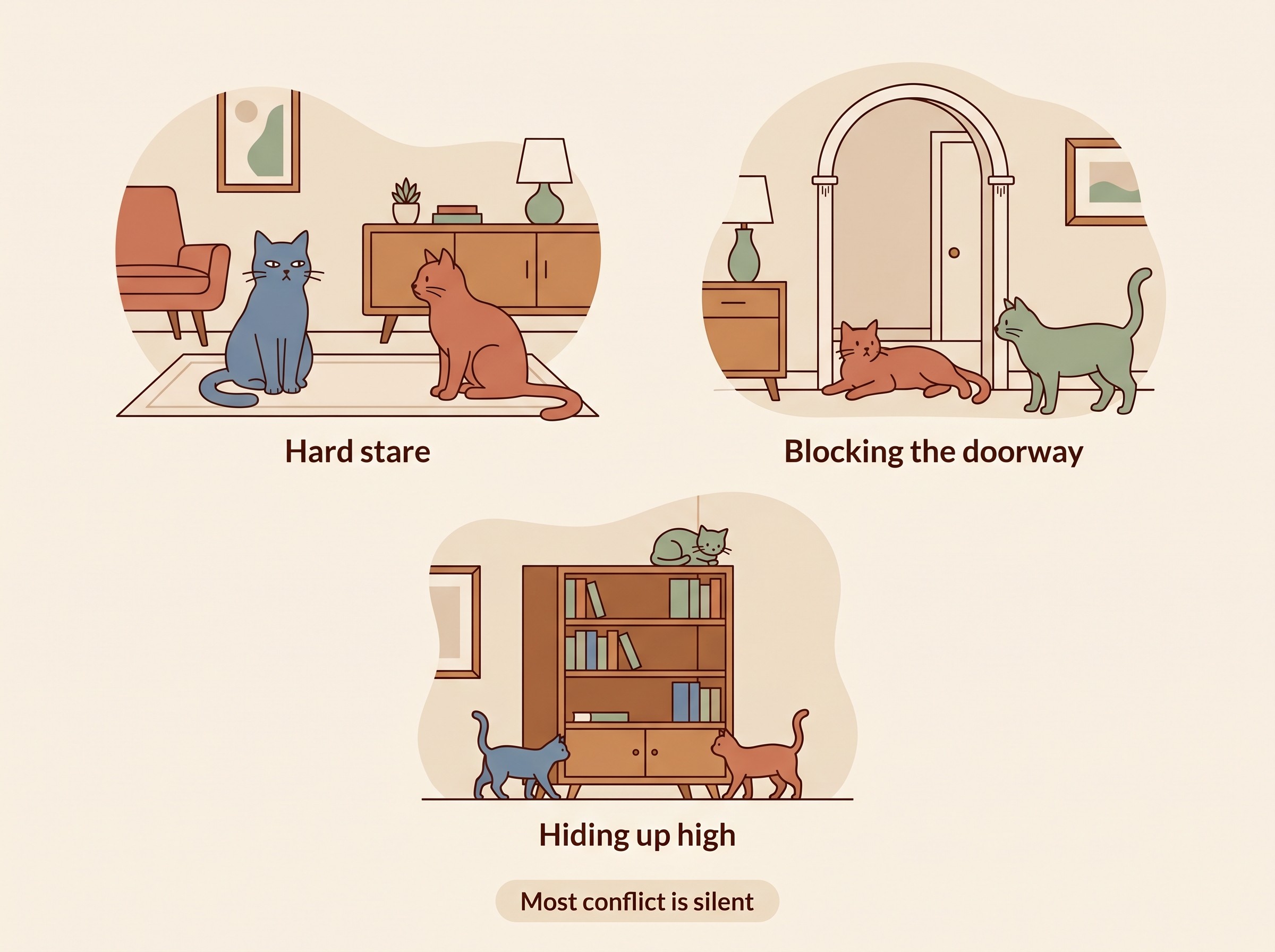
Here is the single most important thing to understand: in most homes there is no fighting. Overt aggression is the exception. The 2024 AAFP guidelines on inter-cat tension list the real signs as staring and blocking, reduced appetite, inactivity, disturbed sleep, reduced or altered elimination, hiding and avoidance, and displacement behaviours such as overgrooming, and they note that staring was the most frequently displayed sign of all (Rodan et al., 2024). A hard stare across the room, one cat freezing as another walks past, a cat that suddenly will not use the landing or the kitchen, these are the language of conflict, and they are easy to miss precisely because nothing dramatic happens.
There is a deeper reason this tension does not resolve on its own. Unlike many social mammals, cats have very few reconciliation behaviours and do not generally offer gestures to make up after a disagreement, so a stand-off can develop and simply sit there, neither cat holding the skills to defuse it (Rodan et al., 2024). The comforting assumption that time and proximity will heal a feline rift is, biologically, the wrong bet, and without your intervention the tension tends to persist, silently, sometimes for years. This is also why it is so often missed: owners frequently assume cat-to-cat tension is simply normal and the chance to step in early slips by (Ramos, 2019). It is not normal in the sense of being fine to leave; it is common, which is a different thing.
Give every cat its own everything
The single biggest practical lever you have is resources, and the principle is straightforward: provide multiple, separated, distributed key resources so that no cat has to share, queue, or run a gauntlet past a rival to get what it needs. This is the second of the five pillars of a healthy feline environment, covering food, water, toileting, scratching, resting and play, and our feline stress, FIC and enrichment article walks through all five in full, so I will keep the framework brief and stay on the multi-cat application (Ellis et al., 2013).
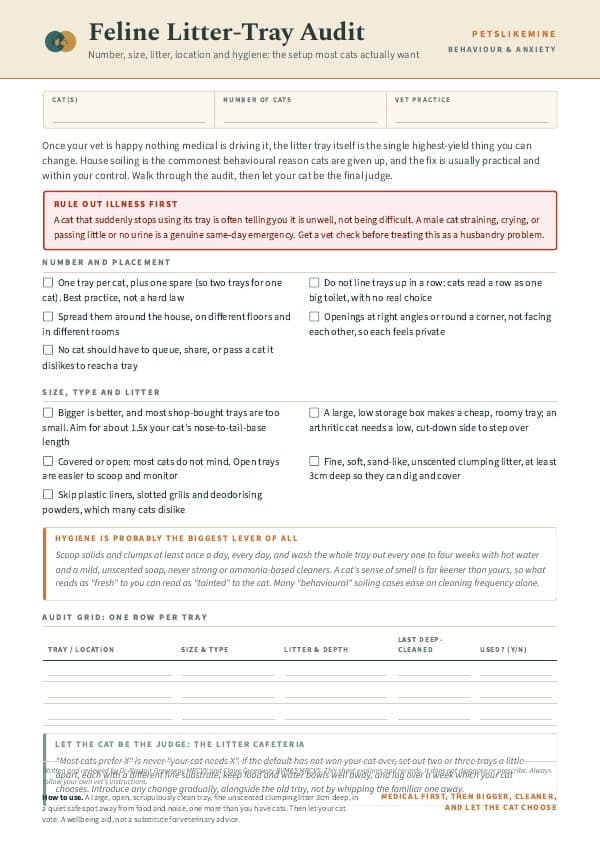
The working rule is one of each key resource per cat, plus one extra, sited in different places around the home rather than lined up in a row (Rodan et al., 2024; Ellis et al., 2013). A feeding station with two bowls side by side is not two resources, it is one contested spot, and the same logic applies to litter, where separated trays in separate locations matter as much as the number (the detailed tray maths belongs in our litter-tray audit). The aim throughout is that a more anxious cat can eat, drink, toilet and rest without being watched by, or in line of sight of, the cat it is wary of.
Vertical space deserves a special mention because it does so much for so little. Access to height, shelves, the top of a wardrobe, a tall cat tree, a cleared bookcase, increases each cat's sense of control, lets cats time-share a room by passing each other without confrontation, and gives a worried cat somewhere genuinely its own to retreat and monitor from (Rodan et al., 2024). Where floor area is fixed, building upwards is often the single most effective change you can make.
When it is more serious: separate, then reintroduce slowly
For mild tension, getting the resources right is often most of the cure. But where conflict is more entrenched, where one cat is being actively bullied, hiding most of the day, or has stopped eating, the evidence-based approach is to separate the cats fully for a period of days to weeks, each with its own resources, then carry out a slow, staged reintroduction as though they were strangers meeting for the first time (Rodan et al., 2024; Ramos, 2019). Even in milder cases, daily short periods of separation can help, giving each cat restful, off-guard time when it need not keep one eye on a rival (Rodan et al., 2024).
The reintroduction itself is a worked example of desensitisation and counter-conditioning, the technique our desensitisation and counter-conditioning article explains in full. You rebuild the relationship in stages, never pushing a cat over the threshold into fear or aggression: first swap scents between the separated cats, swapping bedding between the rooms and feeding on opposite sides of a closed door, then allow controlled visual access, then brief, supervised time in the same space, all the while pairing the sight and scent of the other cat with good things like food and play (Rodan et al., 2024). You move to the next step only when both cats are relaxed at the current one, and drop back the moment either is not. The whole process can run to several weeks or months, and that is normal, not failure (Rodan et al., 2024). You are doing deliberately, in small safe steps, the relationship-building cats cannot do for themselves.
This is not just theory. In a survey of households adopting a new cat, around half of multi-cat homes reported fighting when the new one arrived, and an aggressive first encounter predicted more fighting over the following year (Levine et al., 2005). A staged introduction is far easier than undoing a bad one.
Two safety points matter here. Never break up a cat fight or tense stand-off with your hands: you risk a serious bite or scratch, and a cat that cannot reach the rival it is fixated on will readily redirect that aggression onto whatever is closest, which can be you or another pet, and can itself spark lasting conflict between two cats who were previously fine (Rodan et al., 2024; Ramos, 2019). Interrupt with a barrier instead, a cushion or a piece of card held between them to break the eye contact, or a sudden noise, never your body (Rodan et al., 2024). And keep the medical fork in view: a cat that goes off its food, hides relentlessly, or shows any urinary signs needs a vet, because stress disease such as FIC, and urethral obstruction in male cats, sit right alongside this picture (Rodan et al., 2024).
What about pheromones and medication?
You will have seen synthetic feline appeasing pheromone products (sold in the UK as Feliway Friends) marketed for exactly this. The realistic grade is that they are a reasonable, low-risk adjunct, not a fix. In a randomised, double-blind, placebo-controlled pilot of 45 households, owner-rated aggression fell in both the treated and placebo groups, with the pheromone favoured: the between-group difference reached significance at some assessment points but not at the end of treatment, and after the diffusers came out the treated cats held their gains while the placebo group slipped back (DePorter et al., 2019). It is one small, owner-rated pilot, so treat a diffuser as support for a proper resource-and-reintroduction plan rather than a replacement, and set it up a day or two before you start. Our calming aids, pheromones and supplements article gives the fuller picture.
Medication has a place in stubborn or severe cases, but the rule is firm: psychoactive medication should only ever be used alongside environmental and behaviour change, never instead of it (Rodan et al., 2024). The usual choice is an SSRI such as fluoxetine, which in cats is an off-licence use prescribed and monitored by your vet (the licensed veterinary form, Reconcile, is authorised for dogs, not cats) and takes several weeks, typically four to six, to take full effect. Used well it can take the edge off the fear in a cat too anxious to cope, which then lets the environmental work land. It is not something to source or dose yourself. The same guidelines find no good evidence that CBD oil helps feline behaviour problems, and advise against it (Rodan et al., 2024). A cat that is severely anxious as an individual, not just in conflict within the group, may benefit from the wider approach in our helping a fearful pet article.
What success actually looks like
Let me be straight about the destination, because false promises help no one. Not every pair of cats becomes friends, and toleration is an entirely valid, recognised goal: cats that simply coexist without affection, but equally without conflict, are a perfectly acceptable outcome (Rodan et al., 2024). You are not trying to manufacture a bonded pair grooming on the sofa; you are aiming for a home where every cat feels safe, has unfettered access to everything it needs, and is no longer stressed by the others. For mild tension caught and treated promptly, the outlook is genuinely good (Rodan et al., 2024).
In a small minority of cases, despite everything done well, two cats cannot safely share a home, and rehoming one to a calmer setting is the kindest, most humane option, not a defeat (Rodan et al., 2024; Ramos, 2019). That is a hard sentence to read, but a candid one is better than a guilt-laden struggle that leaves a cat living in fear for years.
For most homes it does not come to that. Watch for a week, distribute the resources so no cat has to compete, and where conflict is entrenched, work through the slow reintroduction above. The multi-cat resource map and social-group tracker sheets make the mapping concrete, and if the trouble is mostly urine on the walls rather than tension you can see, our spraying versus squatting article will help you read what the marking means. Get the territory right, and most cats that "do not get along" can, at the very least, learn to live and let live.
References
- Rodan I, Ramos D, Carney H, DePorter T, Horwitz DF, Mills D, Vitale K. 2024 AAFP intercat tension guidelines: recognition, prevention and management. Journal of Feline Medicine and Surgery, 2024; 26(7): 1-30.
- Crowell-Davis SL, Curtis TM, Knowles RJ. Social organization in the cat: a modern understanding. Journal of Feline Medicine and Surgery, 2004; 6(1): 19-28.
- Ramos D. Common feline problem behaviors: aggression in multi-cat households. Journal of Feline Medicine and Surgery, 2019; 21(3): 221-233.
- Ellis SLH, Rodan I, Carney HC, Heath S, Rochlitz I, Shearburn LD, Sundahl E, Westropp JL. AAFP and ISFM feline environmental needs guidelines. Journal of Feline Medicine and Surgery, 2013; 15(3): 219-230.
- Levine E, Perry P, Scarlett J, Houpt KA. Intercat aggression in households following the introduction of a new cat. Applied Animal Behaviour Science, 2005; 90(3-4): 325-336.
- DePorter TL, Bledsoe DL, Beck A, Ollivier E. Evaluation of the efficacy of an appeasing pheromone diffuser product vs placebo for management of feline aggression in multi-cat households: a pilot study. Journal of Feline Medicine and Surgery, 2019; 21(4): 293-305.
Free downloads
Companion worksheets to put what you've read into practice. Free PDFs, print at home.
Keep track of how your pet is doing
The owners who cope best are the ones who notice changes early. A simple health log shows you what is working, and what is not, before the next vet visit.
Start tracking, freeYou're not doing this alone
Compare treatment journeys and talk to owners managing behaviour & anxiety. Free to join.
Join PetsLikeMine