

Desensitisation and counter-conditioning: the two techniques behind every fear plan
Alastair Greenway
BVM&S MRCVS
A dog that comes apart at fireworks, a cat that flattens itself at the sight of the carrier, a dog that explodes at other dogs on the lead: three very different problems, and underneath, the same two techniques doing the work. They have slightly clumsy names, desensitisation and counter-conditioning, but the idea behind them is simple, and once it clicks you will spot it running through every good behaviour plan on this site. So it is worth learning properly, once, here. Everything else is just this method aimed at a particular trigger.
Here is the shift to make at the outset. These techniques do not set out to stop the behaviour. They set out to change the feeling underneath it. A dog does not bark and lunge because it has decided to be difficult; it does so because something frightens or frustrates it, and the barking is what fear and frustration look like from the outside (we cover those emotional drivers properly in why your pet does this). Suppress the outward behaviour alone and the fear is still there, waiting. Change the underlying emotion and the behaviour fades, because the reason for it has gone. That is why this approach lasts in a way that telling a dog off never does (Poggiagliolmi, 2018; Overall, 2013).
What the two techniques actually are
They are two separate tools that happen to work brilliantly together, so it helps to see them apart first.
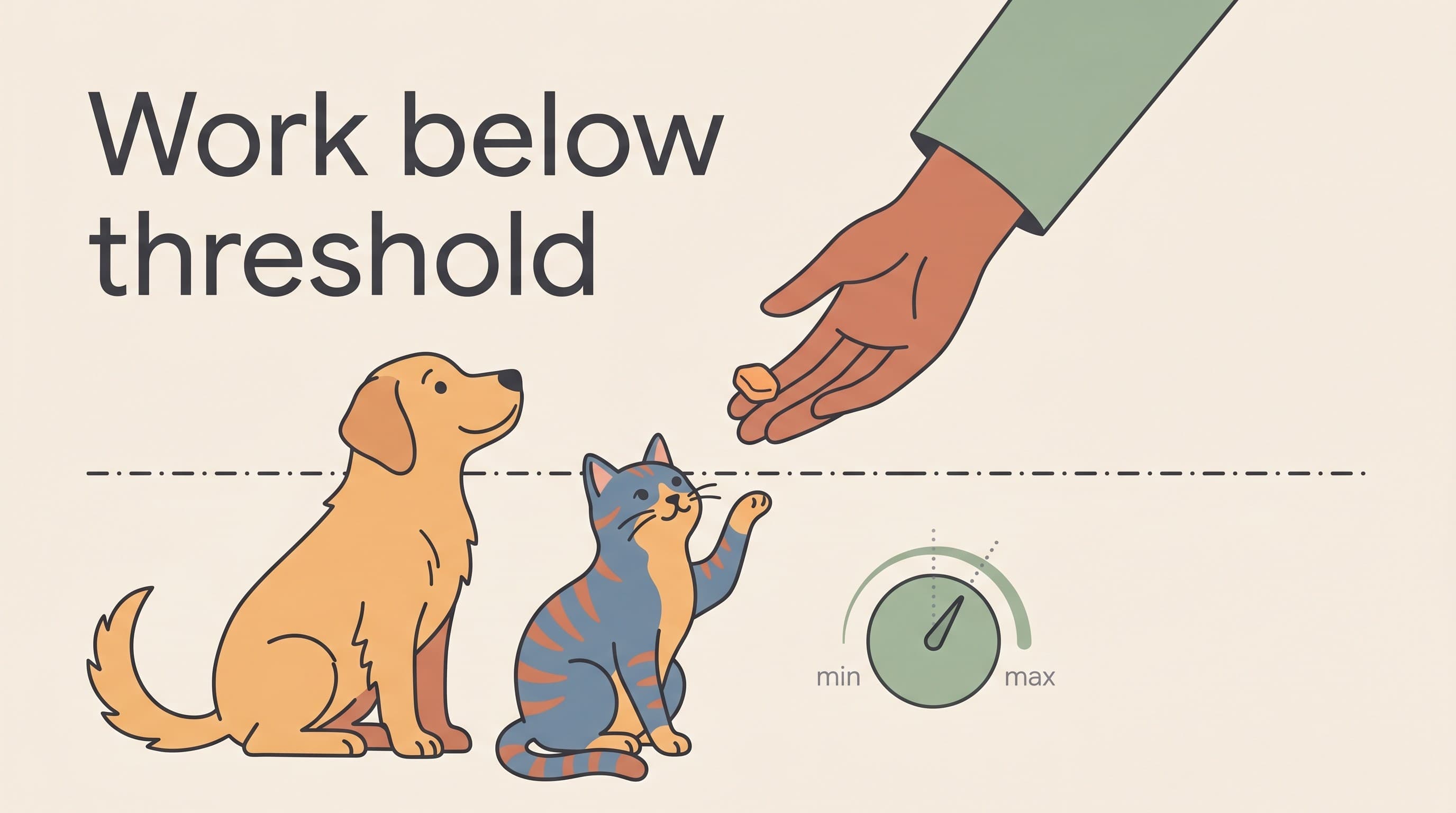
Desensitisation means controlled, graded exposure to the thing your pet is worried about, starting at a level so mild that it produces no fear at all. You begin with the trigger turned right down, a recording of fireworks at a whisper, the dreaded other dog a street away, the carrier sitting closed in the corner of the room, and you let your pet simply be calm in its presence. Then, slowly, you turn the dial up, but only as fast as your pet stays relaxed, so that the body learns there is nothing to brace against. Done well, you eventually arrive at full intensity with a pet that no longer reacts (Poggiagliolmi, 2018; Landsberg, Hunthausen & Ackerman, 2013).
Counter-conditioning means changing what the trigger predicts. Right now, the doorbell or the hoover or the approaching dog predicts something bad, and your pet's body responds accordingly. Counter-conditioning overwrites that association by reliably pairing the trigger with something your pet genuinely loves, almost always high-value food, sometimes play. Done consistently, the trigger stops being a warning of something frightening and starts being the thing that reliably comes just before roast chicken. The emotional response shifts from "oh no" to "oh good," and that shift is the whole point (Poggiagliolmi, 2018; Landsberg, Hunthausen & Ackerman, 2013).
How you pair them carries a small but important detail, and it is one of the commonest things people get backwards. The trigger has to come first and the food second, every time, because the whole job is to teach your pet that the trigger predicts the good thing. The scary sound happens, then the chicken appears. The other dog comes into view, then the treats start. Do it the other way round, food out first and the trigger arriving while your pet is already eating, and you teach the reverse lesson, that good things predict something frightening, which is precisely the association you are trying to undo (Poggiagliolmi, 2018). Trigger, then food. Always that order.
In practice you almost never use one without the other, and you should not try to. The combined approach, sometimes written DSCC, is the cornerstone of treating fears, anxieties and phobias in veterinary behavioural medicine, and it is what most of the good evidence actually tests (Poggiagliolmi, 2018; Hammerle et al., 2015). Treat it as one move: expose at a level that does not frighten, then feed something wonderful while you do.
Threshold: the one idea that makes or breaks it
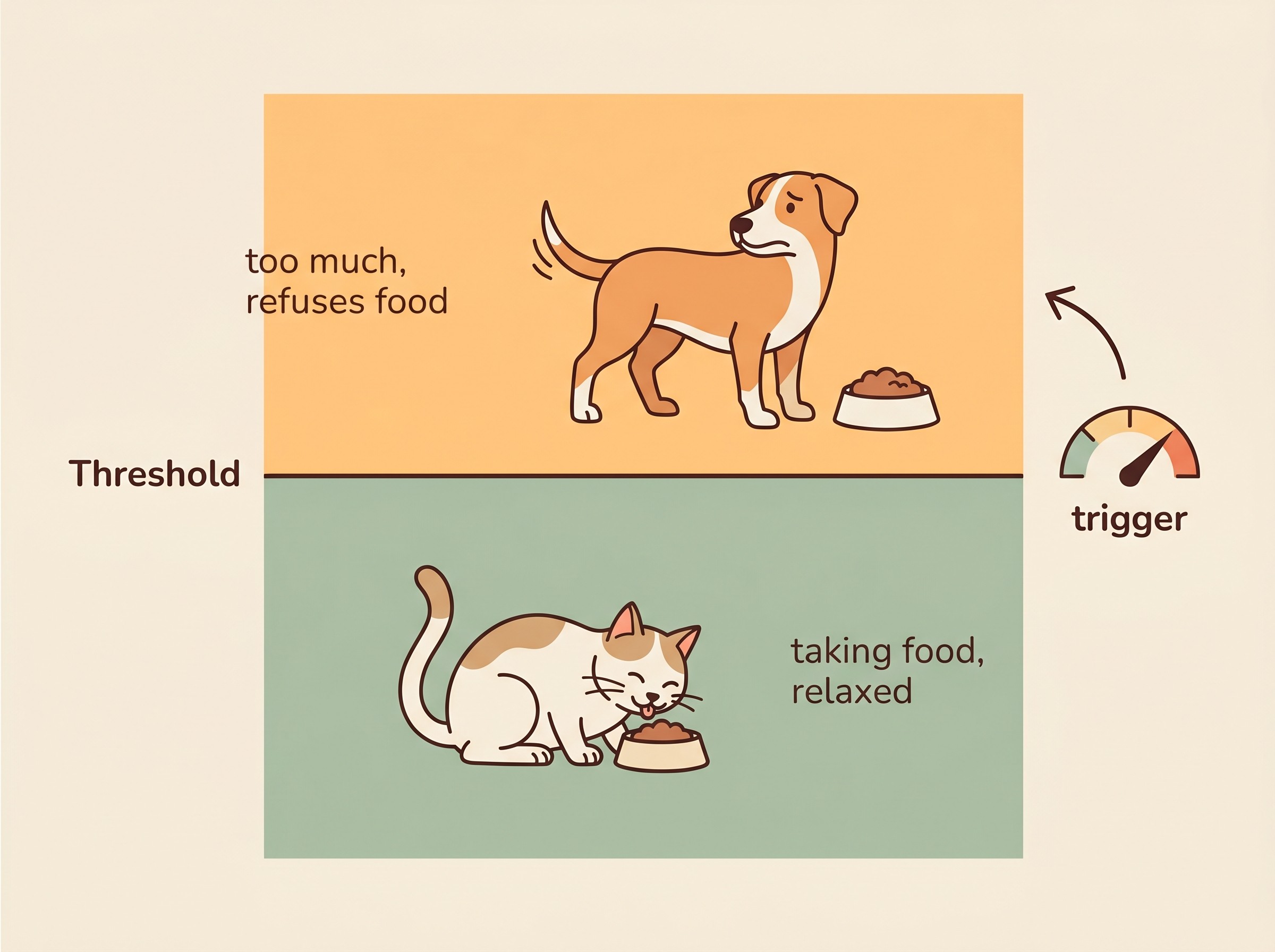
If you take only one concept away, make it this one, because it is where nearly every home attempt succeeds or fails. Your pet has a threshold, a level of trigger below which it notices but stays under control, and above which it tips into fear and can no longer think, learn or eat. The entire programme lives below that line. You work in steps small enough that the fear ideally never switches on during a session at all (Poggiagliolmi, 2018; Overall, 2013).
Pairing food with the trigger has a practical genius to it, because food gives you a live read-out of where the threshold is. A pet that is under threshold will happily take the chicken; a pet that has gone over it stops eating, turns away, or cannot be tempted at all. So the food is doing two jobs at once: building the new, positive association, and telling you, moment to moment, whether you are still in the zone where learning can happen. If your pet will not eat, you are too close, too loud, or moving too fast, and the right move is to calmly increase the distance or turn the volume down until the appetite comes back (Poggiagliolmi, 2018). This read-out works just as well for a cat, whose distress is quieter and easier to miss than a dog's: a cat that refuses a lick of tuna or churu it would normally mug you for has already told you that you are over the line.
Threshold is also not a fixed number, which trips a lot of people up. It moves. A pet that is tired, sore, hungry, or already rattled by an earlier bad encounter has a lower threshold that day, and small stresses stack up through a day until a trigger that was fine in the morning is too much by evening. This is one practical reason the medical side matters: pain in particular lowers tolerance, and in one review of referred behaviour cases a conservative estimate was that around a third involved an underlying painful condition, with the true figure possibly higher, so ruling out pain and illness first is genuinely part of the plan, not a tick-box exercise (Mills et al., 2020). Our is it behaviour or is it medical article and the behaviour check tool are the place to start before any training, precisely because a sore body keeps moving the goalposts you are trying to train against.
Building the ladder
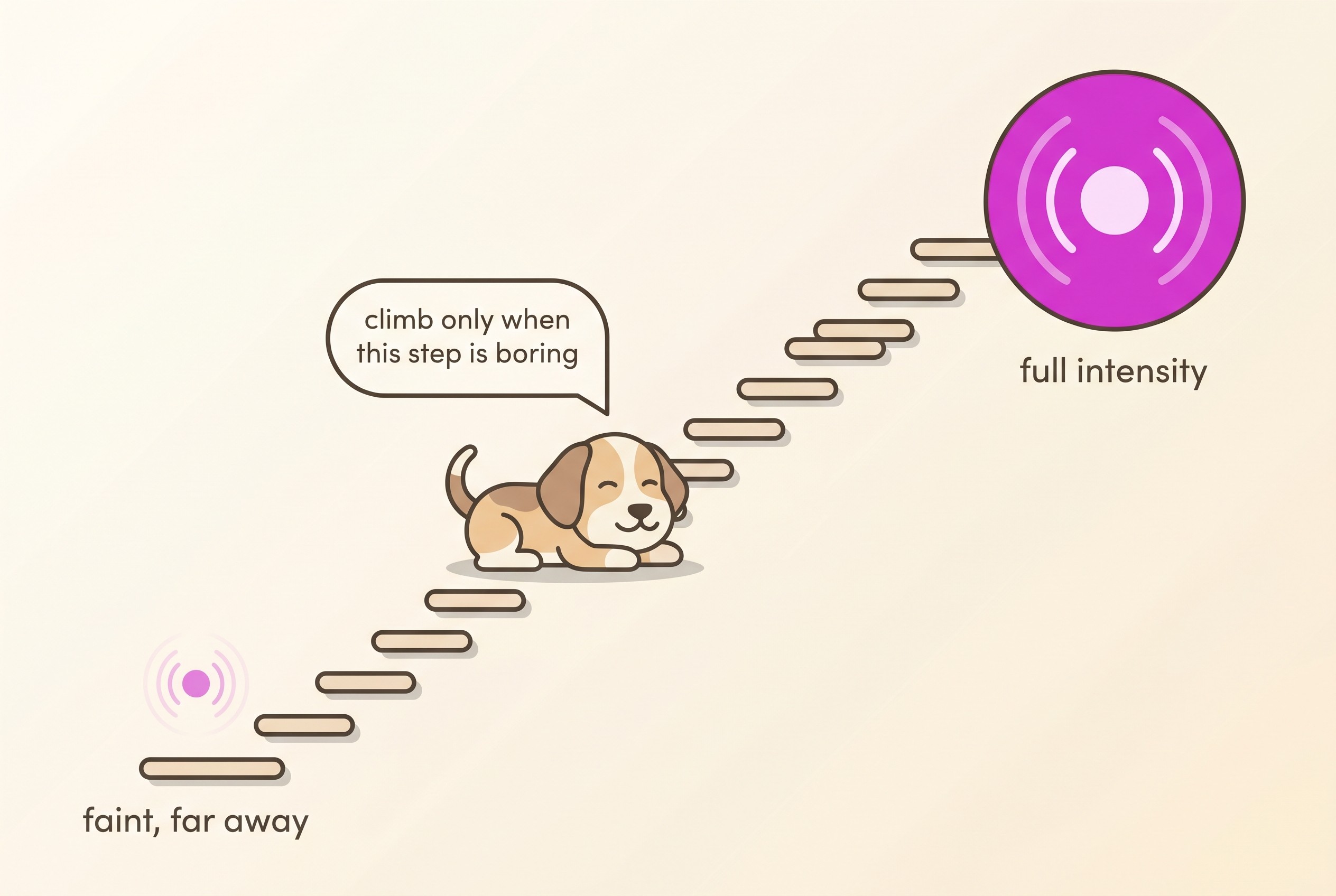
You stay under threshold by breaking the trigger down into a ladder of small, ranked steps, sometimes called a gradient or a fear ladder, and climbing it one rung at a time. What varies between rungs is whatever makes the trigger more or less intense for your pet, and that is usually distance, volume, duration, movement, or some combination.
For a dog worried about other dogs, the rungs are mostly distance: a calm dog visible far across a field, then a little closer, then closer again, never moving up until the current rung is genuinely easy (this lead-specific version, with the engage-disengage game and the emergency U-turn, lives in our reactive-dog walking plan). For noise fear, the rungs are volume and realism on a recording, turned up by tiny increments across weeks (the full sound version is in sound desensitisation for noise fear). For a dog that panics when left, the rungs are seconds and minutes of absence, built up gradually (see the separation departure plan). And cats absolutely belong here too: a cat that hates the carrier can have it left out as ordinary furniture, then fed near it, then fed inside it, then with the door touched, then closed for a single second, each rung paired with something delicious, long before any trip is attempted.
Space the rungs more closely than feels necessary. The cost of a step too small is merely a slightly slower week, while the cost of a step too large is a frightened pet and lost ground. For the carrier-phobic cat, "fed near the carrier" is not one rung but several: a bowl two metres away, then one metre, then touching the carrier, then just inside the open doorway, then a little deeper, each held until it is dull before the next. That is five rungs out of what an impatient owner would have called one.
Whatever the trigger, the rules of climbing hold. Stay on a rung until it is boring, not just tolerable. Keep sessions short, a few minutes at most, and end every one on a good rep while your pet is still relaxed, rather than pushing for one more that tips them over. And expect the ladder to have wobbles. Plateaus, where progress seems to stall for a while, are normal and not a sign of failure. A bad day, or a real-life ambush by the very trigger you are training, can knock you back a rung or two, and the correct response is simply to drop back to a rung your pet can manage and rebuild, not to grind on regardless. A printable fear-ladder worksheet can help you map your own rungs out before you start.
When it tips over into flooding
The commonest way these plans fail is going too fast, and it is worth understanding why that is not merely slow progress but actively harmful. Expose a pet to the trigger at full, frightening intensity and just hold them there in the hope they will "get used to it," and you are no longer doing desensitisation. You are doing something quite different called flooding, and it is the opposite of what you want. Flooding risks sensitisation, the pet becoming more frightened rather than less, and it can badly damage the trust between you. Overall is explicit that flooding is not the same as desensitisation and that it is more likely to make an animal worse, so it should be avoided (Overall, 2013), and the failure mode owners most need warning about is exactly this: too much, too loud, too close, too soon makes fear worse, not better (Overall, 2013; Poggiagliolmi, 2018).
So the popular advice to "just expose them until they get over it" is not a gentler version of this method, it is the trap this method exists to avoid. If at any point your pet cannot eat, freezes, tries to flee, or tips into barking and lunging, you have crossed the line into flooding for that moment, and the kind and effective move is to create distance and bring the intensity back down.
Two related worries are worth retiring while we are here. The first is the fear that you will "reinforce" the fear by feeding or comforting a frightened animal. You will not. Fear is an emotional state, not a trick your pet is performing for treats, and pairing the trigger with food is the very mechanism that changes that emotion for the better (Poggiagliolmi, 2018). The second is the idea that telling the dog off, or correcting it, will sort the behaviour out faster. It will not, and this is where this technique stands apart from old-fashioned correction-based approaches. Punishment may briefly suppress the outward signs while leaving the fear underneath untouched, and it carries real risks of fallout, including more fear, more aggression and a damaged bond, with no evidence that it works better than reward-based methods (AVSAB, 2021). We lay out that evidence in full in how animals actually learn; the short version is that changing the emotion beats suppressing the symptom, every time.
How well it works
It would be easy to oversell this, so let me be straight about what the evidence shows, because that is part of doing right by you. Desensitisation and counter-conditioning is the best-supported, lowest-risk approach we have for fear, but the controlled evidence base is real rather than enormous, the studies are mostly small or survey-based, and the effects are meaningful rather than miraculous.
In a controlled study of eight dogs with separation-related behaviour, a programme built on systematic desensitisation, with counter-conditioning and other advice alongside it, produced significant reductions in how often and how severely the problem occurred, and the six dogs followed up three months later showed near-complete resolution; interestingly, the authors judged the desensitisation itself to be the critical ingredient (Butler, Sargisson & Elliffe, 2011). A randomised controlled trial of a standardised four-week home programme for dogs frightened at the vet reduced fearful body posture during examination, and most owners who stuck with it reported their dog was less afraid, although physiological measures and several specific fear behaviours barely shifted, so the authors fairly described the effect as only mildly effective (Stellato et al., 2019). And in a large owner survey of dogs with firework fear, providing food and play in response to the noise, which is everyday counter-conditioning, was rated among the most effective approaches and was the only category associated with improvement even in the most severely affected dogs, well ahead of passive options (Riemer, 2020). Set against the evidence that aversive, correction-based methods measurably worsen welfare, raising stress behaviours and cortisol (Vieira de Castro et al., 2020), the picture is consistent: this is the method to reach for.
Two caveats worth stating plainly. The first is that almost all of this controlled work is in dogs; the underlying learning principles apply just as well to cats, and the same approach is the standard of care for feline carrier and handling fear, but the formal trial evidence in cats is thinner, so treat the feline side as well-reasoned rather than heavily proven. The second is that progress is usually a matter of weeks and months rather than days, and results are not guaranteed. Expect a gradual climb with the odd setback, not a switch that flips.
One last point that often goes unsaid. Medication is not the opposite of this technique, nor is it cheating. A brain that is too panicked to eat cannot get under threshold, and cannot learn, so for some pets an anti-anxiety medication prescribed by your vet lowers the baseline just enough that desensitisation and counter-conditioning can finally start to work; for some animals a single dose given before a stressful event is enough to bring them calm enough to begin (van Haaften et al., 2017). All of these are prescription decisions for your vet, never something to source or dose yourself. We cover where daily and event medications fit in separation anxiety medication and in event medication for noise fear, and the vet-handling side in fear of the vet and cooperative care. If your pet's fear involves panic, aggression, or simply has not budged after a fair, patient attempt, that is the moment to bring in a qualified clinical behaviourist rather than struggling on alone, and our guide to finding real help shows you how to find one and what good help looks like. Get the threshold right, climb slowly, feed something wonderful in the right order, and you are already doing the thing that every fear plan on this site is quietly built on.
References
- Poggiagliolmi S. Desensitization and counterconditioning: when and how? Veterinary Clinics of North America: Small Animal Practice, 2018; 48(3): 433-442.
- Overall KL. Manual of Clinical Behavioral Medicine for Dogs and Cats. St Louis: Elsevier Mosby, 2013.
- Landsberg G, Hunthausen W, Ackerman L. Behavior Problems of the Dog and Cat. 3rd ed. Edinburgh: Saunders Elsevier, 2013.
- Hammerle M, Horst C, Levine E, et al. 2015 AAHA Canine and Feline Behavior Management Guidelines. Journal of the American Animal Hospital Association, 2015; 51(4): 205-221.
- Mills DS, Demontigny-Bedard I, Gruen M, et al. Pain and problem behavior in cats and dogs. Animals, 2020; 10(2): 318.
- American Veterinary Society of Animal Behavior (AVSAB). Position Statement on Humane Dog Training. AVSAB, 2021.
- Butler R, Sargisson RJ, Elliffe D. The efficacy of systematic desensitization for treating the separation-related problem behaviour of domestic dogs. Applied Animal Behaviour Science, 2011; 129(2-4): 136-145.
- Stellato AC, Jajou S, Dewey CE, Widowski TM, Niel L. Effect of a standardized four-week desensitization and counter-conditioning training program on pre-existing veterinary fear in companion dogs. Animals, 2019; 9(10): 767.
- Riemer S. Effectiveness of treatments for firework fears in dogs. Journal of Veterinary Behavior, 2020; 37: 61-70.
- Vieira de Castro AC, Fuchs D, Morello GM, Pastur S, de Sousa L, Olsson IAS. Does training method matter? Evidence for the negative impact of aversive-based methods on companion dog welfare. PLOS ONE, 2020; 15(12): e0225023.
- van Haaften KA, Eichstadt Forsythe LR, Stelow EA, Bain MJ. Effects of a single preappointment dose of gabapentin on signs of stress in cats during transportation and veterinary examination. Journal of the American Veterinary Medical Association, 2017; 251(10): 1175-1181.
Keep track of how your pet is doing
The owners who cope best are the ones who notice changes early. A simple health log shows you what is working, and what is not, before the next vet visit.
Start tracking, freeYou're not doing this alone
Compare treatment journeys and talk to owners managing behaviour & anxiety. Free to join.
Join PetsLikeMine