

The reactive-dog walking plan: distance, engagement and the U-turn
Alastair Greenway
BVM&S MRCVS
A dog that lunges, barks or growls at other dogs on the lead puts you into a particular routine: scanning the path ahead, that dropped-stomach moment when another dog appears, the apology to a stranger while you haul your own dog past. It is exhausting, and it is very easy to start believing you have a "bad dog". You do not. Reactivity is common and treatable. In one UK owner survey, 22% of owners reported their dog showing aggression, meaning barking, lunging, growling or biting, toward unfamiliar dogs (Casey et al., 2013), and in a large US survey 85% of dogs showed at least one problem behaviour, with fear and anxiety the most common category and aggression second (Dinwoodie et al., 2019). You are in very ordinary company.
What follows is the plan itself: the actual walk, the decisions you make minute to minute, the skills you teach and the mistakes that set you back. It is not the explainer on what reactivity is and is not (that is lead reactivity explained), nor the theory of why the technique works (that is desensitisation and counter-conditioning). It is the protocol you take out of the front door. One thing first, because it underpins everything: if the reactivity is new or has suddenly got worse, get a vet check before you start training, because pain and illness can cause and worsen irritability and reactivity, and that rule-out is covered in is it behaviour or medical (Mills et al., 2020).
Distance is the whole game
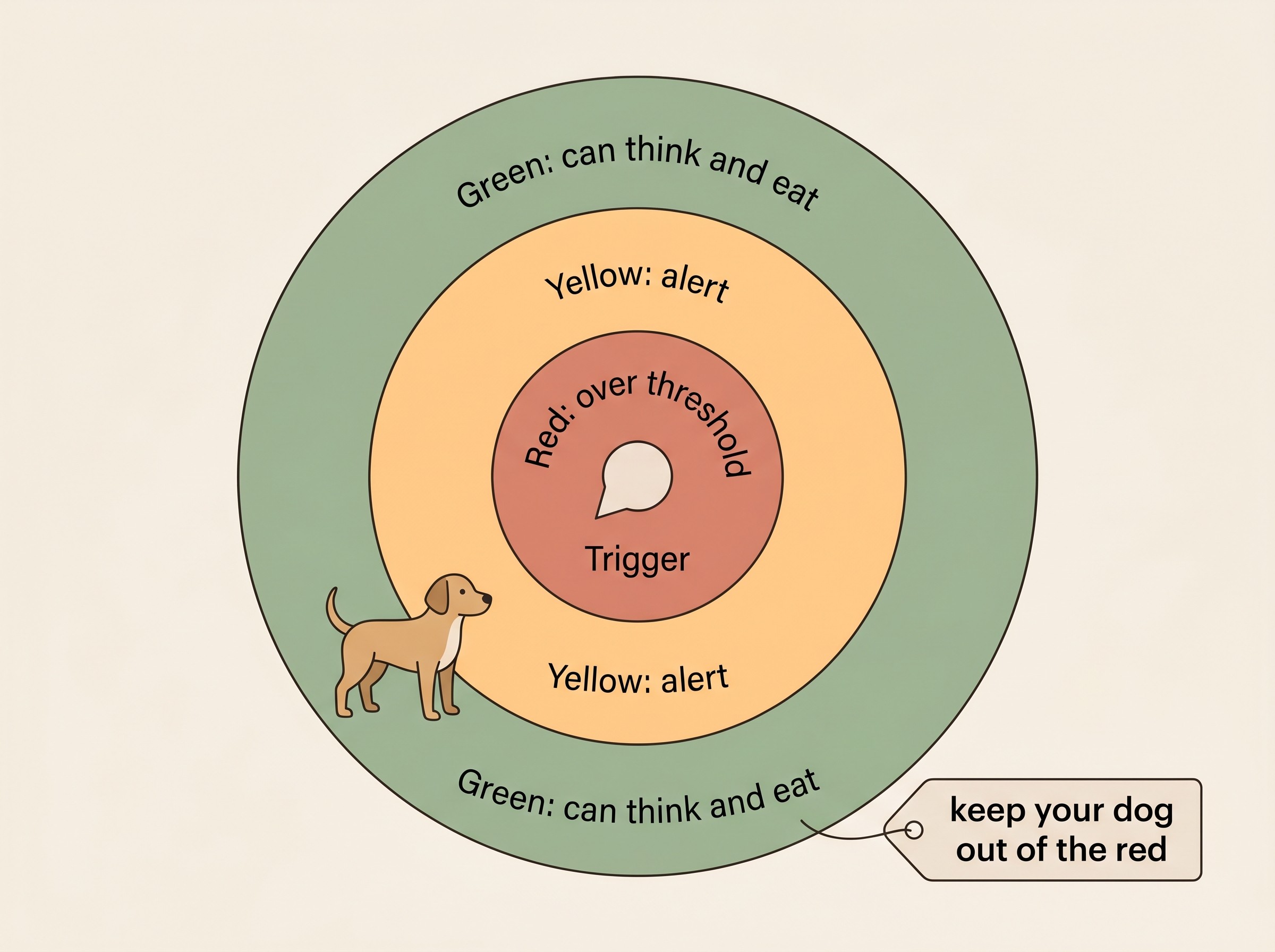
Distance is your most powerful tool, and almost everything else is in service of it. The principle is "below threshold", keeping your dog far enough from the trigger that they notice it but can still think, eat and respond to you, rather than losing their head. A dog over threshold is not being naughty and is not learning anything useful; their thinking brain has effectively gone offline, and no amount of treats or cues will reach them.
This matters more than it sounds, because the alternative is actively harmful. Pushing a frightened dog too close, too soon, is a version of flooding, forcing exposure with no escape, and repeated over-threshold encounters do not desensitise a dog. They sensitise it. They make the fear worse (AVSAB, 2021; Horwitz & Mills, 2009). So when you read advice to "just keep walking past other dogs and they will get used to it", understand that for a reactive dog this is often the opposite of treatment.
What counts as "enough" is individual and changes by the day: a dog that copes at twenty metres on a calm morning may need fifty when a bouncy off-lead spaniel comes round a corner. It is a moving line, not a fixed number, and the whole skill is reading your dog early and making distance before the explosion, not after it.
Reading your dog, and bailing early
To stay under threshold you have to spot trouble before it arrives, which means watching your dog at least as much as you watch the path. The early signs that your dog has clocked a trigger and is starting to tip are usually quiet: a sudden freeze, a hard fixed stare, a closed mouth where there was panting, a lip-lick, ears pricked hard forward, food suddenly going ignored. These are your cue to act, not to wait and see. The full ladder of these signals, and why they matter, is laid out in reading your pet's body language.
The moment you see those signs, you bail. This is not failure; it is the single most useful habit you can build. Every reaction you allow rehearses the very behaviour you are trying to change, and it is far easier to interrupt a dog that has just noticed a trigger than one already three feet off the ground.
One thing you must never do here: do not punish the growl, the freeze or the hard stare. It is tempting, because these signals are embarrassing and feel like the problem. They are not the problem; they are the smoke alarm. Punishing or suppressing a dog's warnings can remove the warning without removing the underlying fear, so a dog may eventually escalate to a bite with fewer or no signals first (AVSAB, 2021). Your job is to lower the fear, never to silence the alarm.
A toolkit for the moment
A handful of simple skills, taught at home first and then on real walks, give you something to do in the moment besides panic. None is a magic trick; they work because they keep your dog under threshold and change how they feel about the trigger, the counter-conditioning principle explained in desensitisation and counter-conditioning.
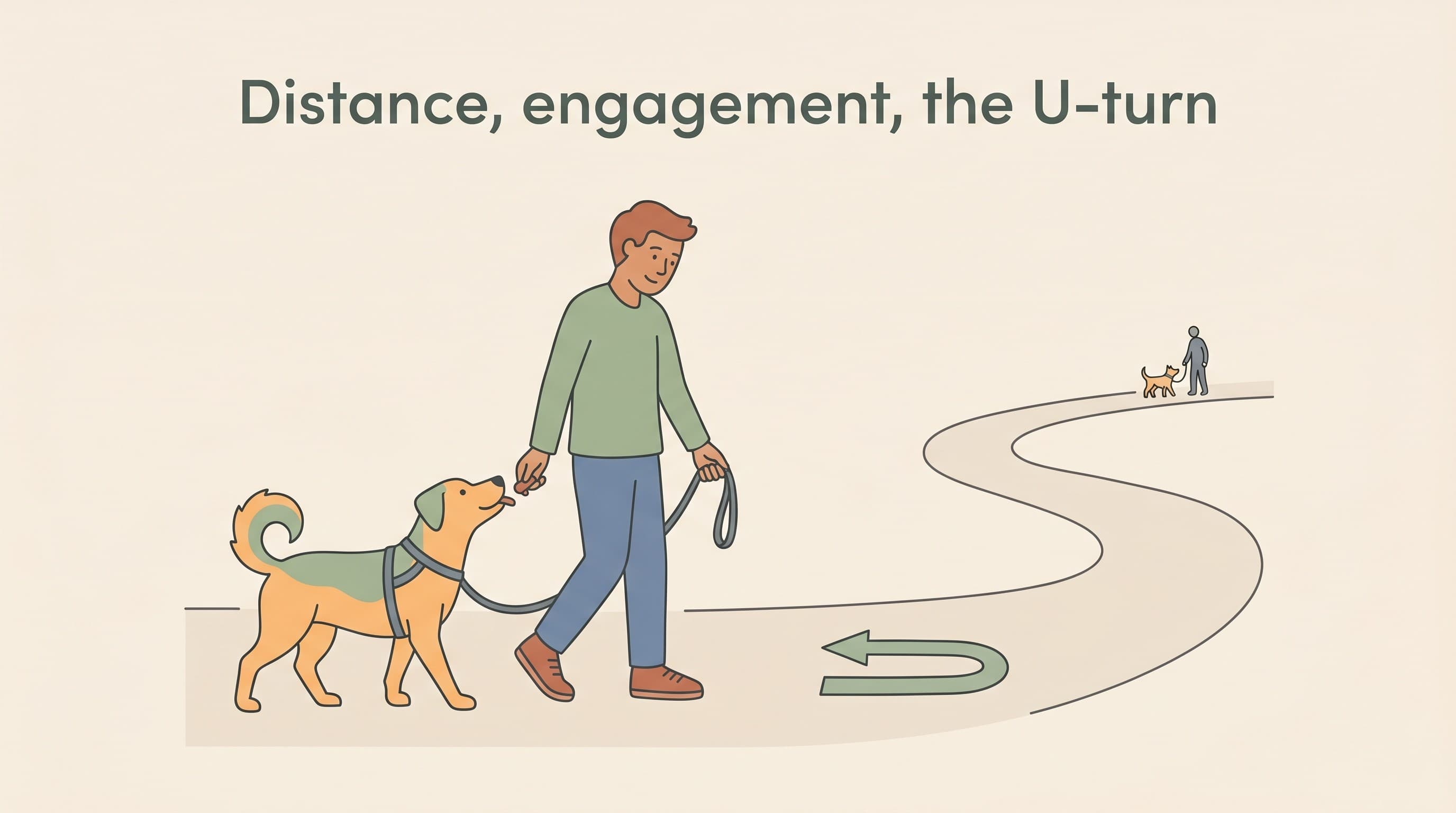
The emergency U-turn. This is your bread and butter. On a happy cue ("this way!", "let's go!"), you and your dog turn smoothly together and walk off away from the trigger. Practise it on quiet walks with no trigger present until it is automatic and even fun, so that when you need it, your dog turns with you rather than planting and staring. It is how you buy distance fast, and the move you will use most.
Find it, the scatter-feed. Toss a handful of small treats into the grass and let your dog put their nose down and forage. This is not just a distraction: sniffing and foraging are genuinely calming, welfare-positive activities, and two weeks of nosework shifted dogs toward a more optimistic outlook where heelwork did not (Duranton & Horowitz, 2019). A scatter-feed lowers arousal, gets your dog's head down and away from the trigger, and buys you a few seconds to reassess.
Look at that. Rather than demanding your dog ignore the trigger, you teach them to glance calmly at it and then look back to you for a reward. The technique comes from Leslie McDevitt's Control Unleashed (McDevitt, 2007), and the related engage-disengage version, where you mark your dog for noticing the trigger and then again for voluntarily turning away, was developed from it by trainer Alice Tong (Tong, Karen Pryor Clicker Training). Worked below threshold, it turns the trigger from something that predicts tension into something that predicts good things and a check-in with you. A reliable hand-fed "look at me" cue, taught first with no distractions, sits alongside it for holding your dog's attention while you make distance.
Let me be straight about the evidence. These named protocols, "Look at That", engage-disengage, and the wider distance-based approach of Behavior Adjustment Training (Stewart, 2016), are widely used and built on sound principles, but they have not been proven individually by controlled trials as named programmes. Their backbone is the general evidence for desensitisation, counter-conditioning and reward-based learning, which is solid (AVSAB, 2021). Treat them as well-founded tools, not guaranteed cures.
Setting the walk up to win
Where and when you walk is not a side issue, and choosing your routes is not cheating. Antecedent arrangement, the deliberate shaping of the environment so your dog rarely meets a trigger over threshold, has a vital role in any behaviour-modification plan and is endorsed as such, not treated as a cop-out (AVSAB, 2021; AAHA, 2015). In practice this means walking at quiet times, early morning or late evening; choosing open spaces with good sightlines and room to peel away, rather than narrow pavements and blind corners; and having an exit in mind before you need one. On a bad day, when the world is full of triggers and your dog is already wound up, the kindest option is sometimes to skip the walk and do sniffing games in the garden instead. A reactive dog does not owe anyone a long walk past a gauntlet of other dogs, and a single over-threshold blow-up can undo a fortnight of careful work.
When you misjudge it
Sooner or later you will get caught out. A dog appears from a gateway, a jogger rounds a hedge with a loose dog, and suddenly you are far closer than you wanted to be. This happens to everyone; it is part of real walks, not a failure of the plan. Have a script ready so you are not improvising in the moment: cue your U-turn and move away calmly; if turning is not possible, scatter food to drop your dog's head and arousal; put a parked car, a bin or a tree between you as a visual block; and keep moving until you are back under threshold. Stay as relaxed as you can in your own body and voice, because tension travels straight down the lead.
What you do not do is yank, jerk or correct your dog through it. Reward-based methods are the standard of care, and aversive tools, prong, choke, slip and e-collars, and lead-jerking, should be avoided: they raise stress and post-training cortisol, can worsen aggression, and there is no evidence they are necessary or more effective (Vieira de Castro et al., 2020; China et al., 2020). Tellingly, in that UK survey, aggression toward other dogs on walks was associated with the use of punishment-based training (Casey et al., 2013). The short version, with the full case in how pets learn: reward vs punishment, is that frightening a dog who is already frightened makes the problem worse, not better.
Gear, pace and knowing when to call for help
Equipment manages your dog; it does not train them. The right kit keeps walks safe and gives you control while the training does the real work, but no harness or collar changes how your dog feels. For dogs that pull, a non-tightening front-clip Y-front harness offers the best balance of control and welfare, while tightening harnesses, martingales and head collars carry more discomfort and need care (Townsend et al., 2022). The full guide to fitting a harness, the long-line, and why a muzzle is a kind and responsible safety tool, lives in equipment for reactivity.
The plan also flexes by type. A frightened dog trying to drive other dogs away needs you to prioritise distance and safety, whereas a frustrated dog that wants to reach them needs more focus on calm and arousal control. This shared protocol works for both, but which parts you lean on depends on which you have, and that differential is teased apart in frustrated greeters vs fearful reactors.
Finally, expect slow, non-linear progress, and do not let a "fix it in a weekend" promise tempt you to push too fast. The technique is rarely the limiting factor; consistency and pace are. A standardised four-week desensitisation and counter-conditioning programme in another setting was only mildly effective, and 44% of owners did not stick to the protocol, which tells you that staying under threshold and keeping going matter far more than speed (Stellato et al., 2019). When you have a bad week, and you will, the answer is almost always more distance for a while, not more pressure. If there is genuine bite risk, or you are working consistently and seeing no progress, get qualified help, and finding behaviour help shows you how; if you are unsure who you need, the behaviour check will point you to the right next step.
References
- Casey RA, Loftus B, Bolster C, Richards GJ, Blackwell EJ. Inter-dog aggression in a UK owner survey: prevalence, co-occurrence in different contexts and risk factors. Veterinary Record, 2013;172(5):127.
- Dinwoodie IR, Dwyer B, Zottola V, Gleason D, Dodman NH. Demographics and comorbidity of behavior problems in dogs. Journal of Veterinary Behavior, 2019;32:62-71.
- Mills DS, Demontigny-Bedard I, Gruen M, et al. Pain and problem behavior in cats and dogs. Animals, 2020;10(2):318.
- American Veterinary Society of Animal Behavior. AVSAB Position Statement on Humane Dog Training. AVSAB, 2021.
- Horwitz DF, Mills DS, editors. BSAVA Manual of Canine and Feline Behavioural Medicine. 2nd ed. Gloucester: British Small Animal Veterinary Association, 2009.
- Duranton C, Horowitz A. Let me sniff! Nosework induces positive judgment bias in pet dogs. Applied Animal Behaviour Science, 2019;211:61-66.
- McDevitt L. Control Unleashed: Creating a Focused and Confident Dog. South Hadley (MA): Clean Run Productions, 2007.
- Tong A. Reducing Leash Reactivity: The Engage-Disengage Game. Karen Pryor Clicker Training.
- Stewart G. Behavior Adjustment Training 2.0: New Practical Techniques for Fear, Frustration, and Aggression in Dogs. Wenatchee (WA): Dogwise Publishing, 2016.
- Hammerle M, Horst C, Levine E, et al. 2015 AAHA Canine and Feline Behavior Management Guidelines. Journal of the American Animal Hospital Association, 2015;51(4):205-221.
- Vieira de Castro AC, Fuchs D, Morello GM, et al. Does training method matter? Evidence for the negative impact of aversive-based methods on companion dog welfare. PLOS ONE, 2020;15(12):e0225023.
- China L, Mills DS, Cooper JJ. Efficacy of dog training with and without remote electronic collars vs. a focus on positive reinforcement. Frontiers in Veterinary Science, 2020;7:508.
- Townsend L, Dixon L, Buckley L. Lead pulling as a welfare concern in pet dogs: what can veterinary professionals learn from current research? Veterinary Record, 2022;191(1):e1627.
- Stellato AC, Jajou S, Dewey CE, Widowski TM, Niel L. Effect of a standardized four-week desensitization and counter-conditioning training program on pre-existing veterinary fear in companion dogs. Animals, 2019;9(10):767.
Keep track of how your pet is doing
The owners who cope best are the ones who notice changes early. A simple health log shows you what is working, and what is not, before the next vet visit.
Start tracking, freeYou're not doing this alone
Compare treatment journeys and talk to owners managing behaviour & anxiety. Free to join.
Join PetsLikeMine