

Lead reactivity: why your dog lunges and barks, and what it is not
Alastair Greenway
BVM&S MRCVS
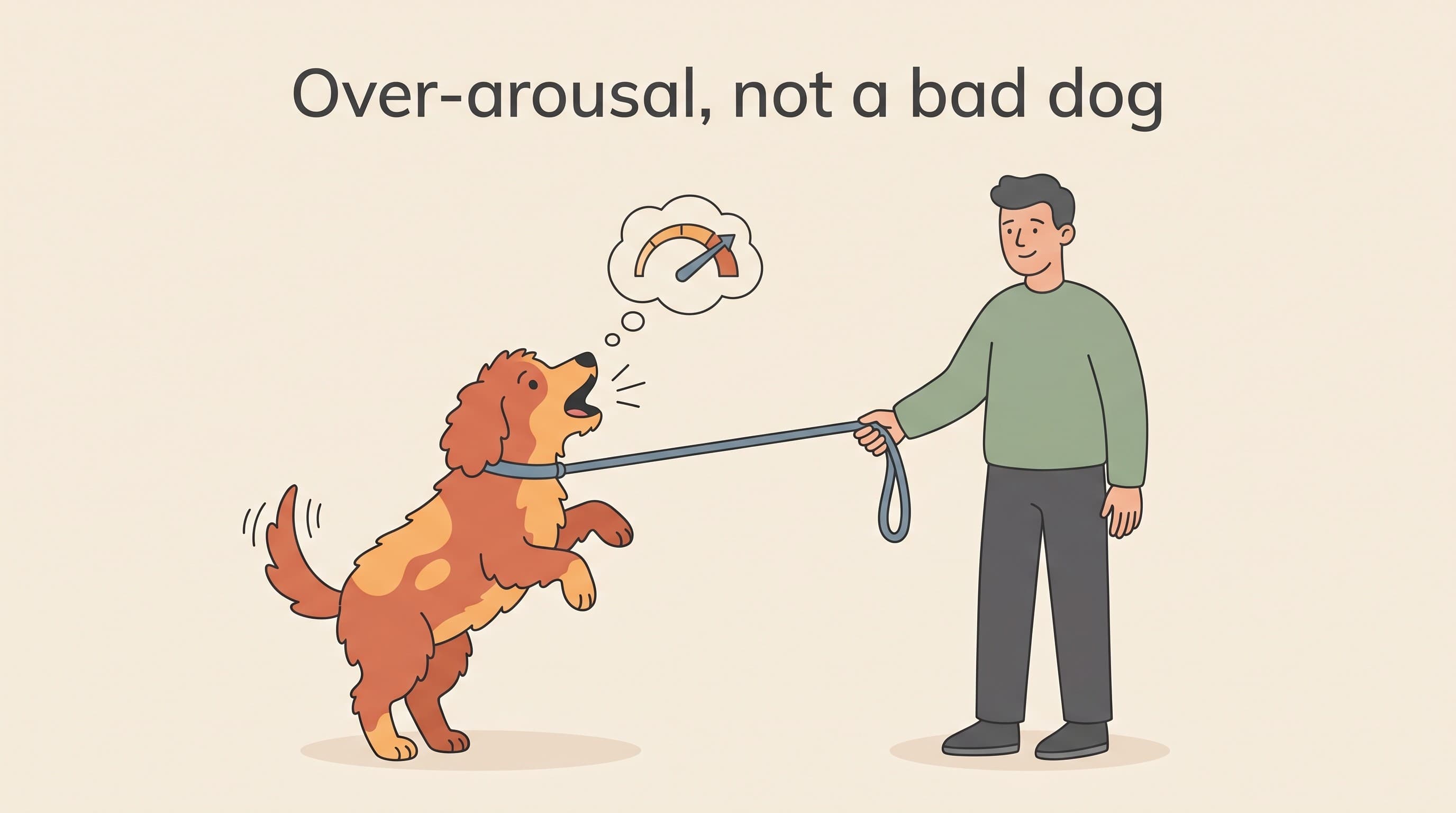
A dog appears across the road, the lead goes taut, and your dog rears up barking and lunging while you stand there red-faced and apologising. It is one of the most common scenes owners describe to us, and one of the most misunderstood. If you live with it, the first thing worth saying plainly is that you are not failing and your dog is not bad. Almost everyone who deals with lead reactivity has been handed the wrong explanation for it at some point.
The clearest way to understand reactivity is as an over-reaction. A reactive dog becomes overly aroused by everyday things, other dogs, people, bikes, joggers, that a settled dog would simply notice and move past, and a leash-reactive dog is one that does this specifically while on the lead, often while being perfectly civil with the same things off it (Cornell Riney Canine Health Center, n.d.). That last detail matters more than almost anything else here, and we will come back to it, because the lead is not an innocent bystander in this picture. It is part of the cause.
What the word actually means
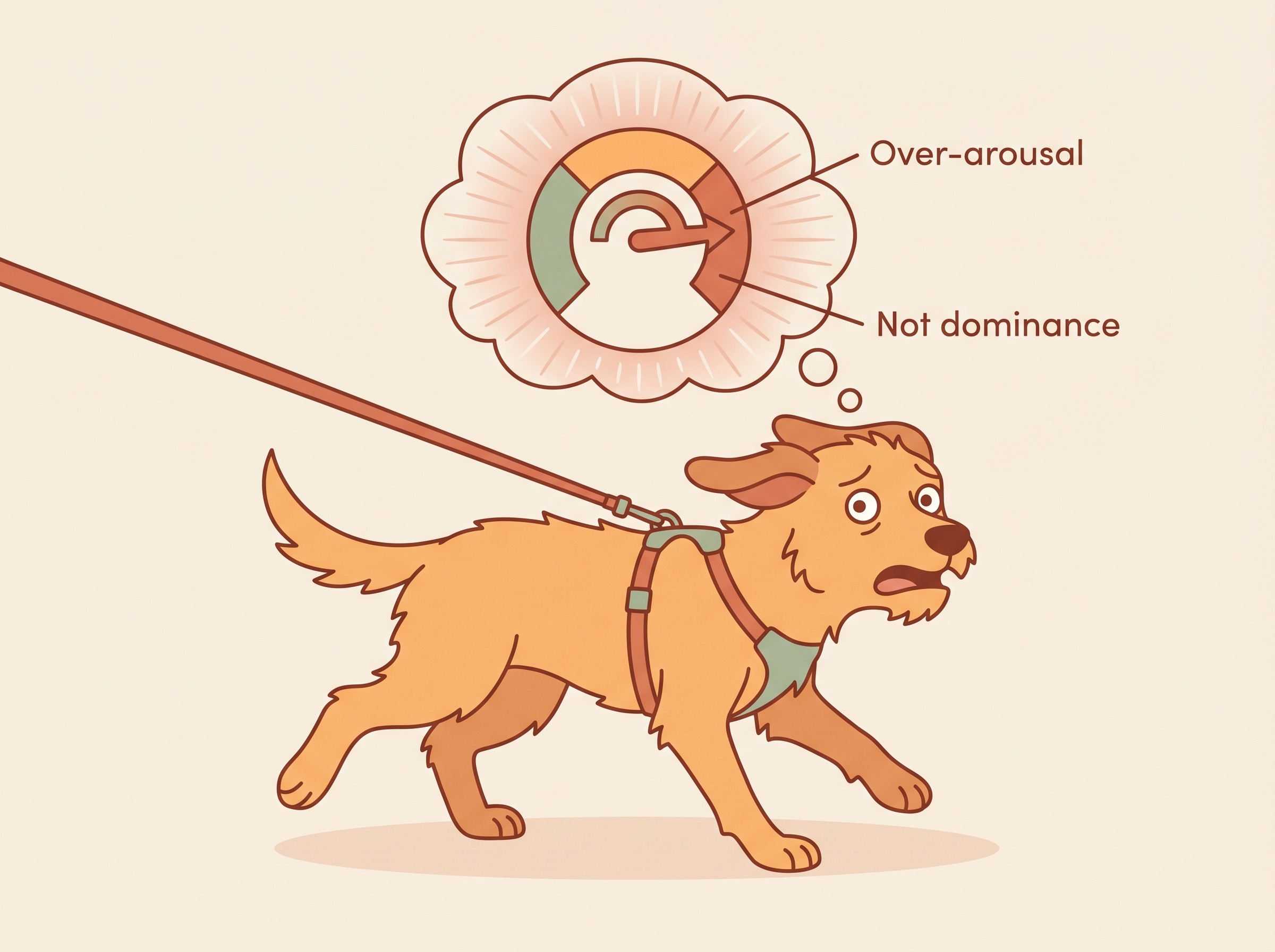
Let me be precise about the term, because the confusion around it does real harm. Reactivity is over-arousal, an emotional system tipping over its own threshold, and it is not the same thing as aggression. Reactive dogs are not necessarily aggressive dogs, although reactivity can, if it is left to rehearse and worsen, tip into aggression over time, which is exactly why it has to be taken seriously rather than waved away (Cornell Riney Canine Health Center, n.d.). Hold those two ideas apart, because the moment you mislabel an over-aroused dog as an aggressive one, you reach for the wrong tools and you make the problem worse.
So what is going on under the bark? At its core, reactivity is a failure of self-control under high arousal rather than a flaw of character. When researchers compared dogs that responded aggressively when provoked with those that did not, the aggressive responders showed measurably poorer self-control on a delay-of-gratification test, and it was self-control specifically, rather than the ability to learn a rule, that tracked with aggression (Gobbo and Zupan Šemrov, 2022). In plain terms, the dogs that could not wait were the dogs that snapped. That fits an arousal-and-emotion model far better than any notion of a wilfully dominant or naughty dog. Your dog is not calculating. Your dog is over threshold, flooded, and out of road to think.
That brings us to the misreads, the three explanations you have probably been offered and can now safely retire.
Three things it is not
It is not dominance, and your dog is not "bad". This is the oldest and stickiest myth, and it is simply wrong. Most undesirable behaviours in pet dogs have nothing to do with priority access to resources or any social bid to be "the boss"; they are far better explained by emotion and by accidental learning, which is exactly why confrontational, dominance-based methods are not recommended and tend to provoke the very aggression they claim to cure (AVSAB, 2008). A lunging dog on a lead is not trying to run your household. It is having an emotional emergency. We unpack the full motivational picture, and put the dominance idea properly to bed, in why your pet does this.
It is not, usually, a desire to fight. Because the display looks so violent, the natural assumption is that your dog wants to do harm. For the great majority of leash-reactive dogs, that is not true: they are over-threshold and over-aroused, not, like a genuinely aggressive dog, determined to cause harm (Cornell Riney Canine Health Center, n.d.). I would rather be straight with you than merely reassuring, though. A minority of dogs genuinely are, or become, truly aggressive, and that is a different and more serious track. If you suspect your dog falls there, understanding aggression is the article to read next.
It is not the dog being "fine really, just excited". The flip side of over-reassurance is dismissal. The fearful dog that lunges is genuinely distressed, and treating it as harmless excitement misses the welfare problem and the risk. Reactivity sits between these two errors, more than naughtiness, less than malice, and the accurate frame is the one that actually helps you fix it.
Two engines: fear and frustration
If reactivity is over-arousal, the next question is what is doing the arousing, and here there are two main engines. Some dogs are afraid, and some are frustrated, and although the explosion can look identical from the end of the lead, the two are pulling in opposite directions. The fearful dog wants the trigger to go away and is trying to create distance. The frustrated dog wants to get to the trigger and is furious at being prevented. Same bark, same lunge, opposite goals.
This distinction is the single most useful thing you can learn about your own dog, because it changes the plan completely, and it has its own dedicated article: frustrated greeters versus fearful reactors. For now, hold onto the principle that there are two engines and they need different handling, and resist the urge to guess which one you have before reading that piece, because the tells are subtle and the cost of getting it wrong is a plan aimed at the wrong problem.
Frustration deserves a word here because it is so often overlooked. It is a genuine, measurable emotional state, not a loose metaphor: the negative reaction a dog has when it is motivated towards something but a barrier blocks the way and its expectation of reaching it is violated (McPeake et al., 2019). The researchers who built the modern measure of canine frustration found it linked, to varying degrees, with aggressive displays and with redirected behaviour, the snap that lands on you or the other dog in the household instead of the thing on the horizon, when the goal stays out of reach (McPeake et al., 2019). And a lead, as we are about to see, is precisely the kind of barrier that breeds it.
How the lead itself makes it worse
The lead is not a neutral piece of equipment that simply happens to be attached while your dog reacts. It is part of the mechanism.
Think about what the lead removes. For the fearful dog, it removes flight. A dog that meets something frightening and is free to leave will usually just leave, increasing distance until it feels safe again. Clip it to a lead and that option vanishes; the dog cannot retreat, so it does the only other thing on the menu, which is to try to drive the threat away by making itself big and loud. For the frustrated dog, the lead removes access. The very researchers who built the canine frustration measure name it explicitly: among the everyday situations that elicit frustration in pet dogs are physical barriers and being restrained or pulling on the lead, both of which thwart a dog from reaching something it wants (McPeake et al., 2019). The lead, in other words, is a textbook frustration-generator.
There is good behavioural evidence underneath this, not just theory. When dogs are walked on a lead, normal greeting is measurably suppressed. In a study that filmed the same dogs along the same route, once on lead and once off, an encounter was about half as likely to turn into an interaction when the subject dog was on the lead rather than off it, and when the other dog was also leashed an off-lead dog was almost four times more likely to interact than the leashed one (Westgarth et al., 2010). Leashed dogs also sniffed the ground far less, a median of around four per cent of their time on lead against about sixteen per cent off it (Westgarth et al., 2010). The lead strips out the normal canine sequence of approach, arc, sniff and disengage, and replaces it with a head-on, frozen, tethered stand-off, close to the worst possible way for two dogs to meet. None of this means the lead causes aggression directly, and that study did not claim it did; it measured how often dogs interact, not whether they fight. But it tells you plainly that the lead changes the encounter, and not for the better.
This is why "off lead he's completely fine" is so common, and why it is diagnostic rather than puzzling. For many dogs, being civil off lead and explosive on it is not a contradiction at all. It is the signature of barrier frustration, the dog that wants to greet but cannot, rather than proof that the dog is secretly "fine" and just being difficult. What that pattern means for your specific dog belongs to the frustrated greeter versus fearful reactor article, but the broad point stands: the lead is shaping the behaviour, so any full explanation of reactivity has to put the lead at the centre, not the margins.
Why you should never punish the lunge
One more thing matters before you take a single step, because it is a safety point. The lunge is not the start of anything. It is the top of a ladder of quieter signals your dog almost certainly gave first, the look-away, the lip-lick, the freeze, the low grumble, escalating only when the earlier, more polite requests for space were missed or ignored. Dogs work up this ladder in steps, and a dog that repeatedly finds its early warnings ignored, or learns that they are punished, may dispense with those lower rungs altogether and go straight to the snap (Shepherd, 2009). Punishing the bark or the lunge, then, does not address the emotion underneath it; it suppresses the warning while leaving the fear or frustration fully intact, which can make a dog more dangerous, not less, because you have taught it to skip its own early signals. The ladder itself, and how to read those early signals, is taught in reading your pet's body language. Do not punish the lunge.
There is a medical footnote to all of this, too, and it is not a small one. Pain lowers the threshold for irritability and over-reaction, so a dog that has suddenly become reactive, or grown markedly worse for no obvious reason, deserves a vet check to rule out an underlying physical cause before you assume the problem is purely behavioural. This is not a fringe concern: pain turns out to be involved in a substantial share of behaviour cases, and it is easy to miss because the dog never limps, it just has a shorter fuse. We cover that properly in is it behaviour or is it medical, and the interactive behaviour check will help you decide whether a medical work-up should come first. If your vet does reach for medication as part of a wider plan, that is a prescribing decision made and monitored by them, not something to source or dose on your own.
Where to start, and the hopeful part
So where does this leave you, standing on the pavement with a dog that has just turned itself inside out? In a much better place than the myths suggest, because reactivity is genuinely treatable, and the route is well worn. The work is not about correcting or dominating your dog. It is about keeping it under threshold so its thinking brain stays online, and steadily changing how it feels about the things that set it off. The practical, step-by-step method, the distance, the engage-and-disengage, the emergency U-turn, the scatter feeding, has its own home in the reactive-dog walking plan, and that is the article to read the moment you finish this one. It is where the doing begins.
Two final reassurances to take with you. First, the goal is not to manufacture a dog that adores every other dog it meets; it is a dog that can notice a trigger and carry on, calmly, with you. That is an achievable bar. Second, the embarrassment you feel on those walks is real and worth naming, because the social toll of a reactive dog is one of the heaviest and least acknowledged parts of all this. The next step is to stop trying to win the encounter and start setting your dog up to avoid needing to, and the walking plan will show you exactly how.
References
- Cornell University College of Veterinary Medicine, Riney Canine Health Center. Reactivity in dogs. Cornell Richard P. Riney Canine Health Center, n.d.
- Gobbo E, Zupan Šemrov M. Dogs Exhibiting High Levels of Aggressive Reactivity Show Impaired Self-Control Abilities. Frontiers in Veterinary Science, 2022; 9: 869068.
- American Veterinary Society of Animal Behavior (AVSAB). Position Statement on the Use of Dominance Theory in Behavior Modification of Animals. AVSAB, 2008.
- McPeake KJ, Collins LM, Zulch H, Mills DS. The Canine Frustration Questionnaire—Development of a New Psychometric Tool for Measuring Frustration in Domestic Dogs (Canis familiaris). Frontiers in Veterinary Science, 2019; 6: 152.
- Westgarth C, Christley RM, Pinchbeck GL, Gaskell RM, Dawson S, Bradshaw JWS. Factors affecting dog-dog interactions on walks with their owners. Applied Animal Behaviour Science, 2010; 125(1-2): 38-46.
- Shepherd K. Behavioural medicine as an integral part of veterinary practice: the canine ladder of aggression. In: Horwitz DF, Mills DS, eds. BSAVA Manual of Canine and Feline Behavioural Medicine, 2nd edn. Gloucester: British Small Animal Veterinary Association, 2009: 13-16.
Keep track of how your pet is doing
The owners who cope best are the ones who notice changes early. A simple health log shows you what is working, and what is not, before the next vet visit.
Start tracking, freeYou're not doing this alone
Compare treatment journeys and talk to owners managing behaviour & anxiety. Free to join.
Join PetsLikeMine