

Understanding aggression: it is communication, not character
Alastair Greenway
BVM&S MRCVS
When a dog growls, snaps or bites, the first thing most owners reach for isn't a training question at all. It's a question about who their dog is. Is he a bad dog? Did I get this wrong? Is something broken in him? I want to take that question off the table straight away, because it's the wrong one, and it leads owners down some genuinely harmful paths. Aggression is not a character flaw, and it's not a personality type. It's communication. It's a context-dependent response to what your dog believes is happening to him, almost always a threat of some kind, and it's one of the most normal and ancient tools a dog has for avoiding a fight rather than starting one (RSPCA, 2026; Frank, 2013).
That reframe matters because it changes everything you do next. Once you stop asking "what is wrong with my dog's character" and start asking "what is my dog responding to, and why," aggression becomes a problem you can actually work on. The deeper "how to fix it" lives in the articles this one links to, and the single most important early step, a vet check, gets its own.
Warnings come before bites, almost always
The "he bit without warning" dog is one of the saddest things we see in practice, because more often than not, the warnings were there. They were just quiet, and somewhere along the line the dog learned that giving them did not work, or worse, got him told off.
Dogs escalate through a fairly predictable sequence sometimes called the ladder of aggression. Long before a snap or a bite, a worried dog offers low-key signals: a lip-lick, a yawn, turning the head away, looking away, then a freeze, then a growl, then a snap, and only then a bite (Shepherd, 2009). Each rung is a request for space, an attempt to defuse the situation without anyone getting hurt. A growl is not your dog being "bad." A growl is your dog being honest. It is him telling you, in the clearest language he has, that he is not coping and needs the thing to stop.
This is why the single most important safety message in the whole of aggression is also the most counter-intuitive: never punish a growl. It feels natural to tell a growling dog off, but if you suppress that warning, you do not remove the underlying fear or discomfort that produced it. You simply teach the dog that growling earns punishment, so he stops growling. What you are left with is a dog who has lost his early-warning system and now jumps straight to the bite, the genuinely unpredictable dog that everyone is so frightened of (RSPCA, 2026; AVSAB, 2009). Protect the growl. It is doing you a favour.
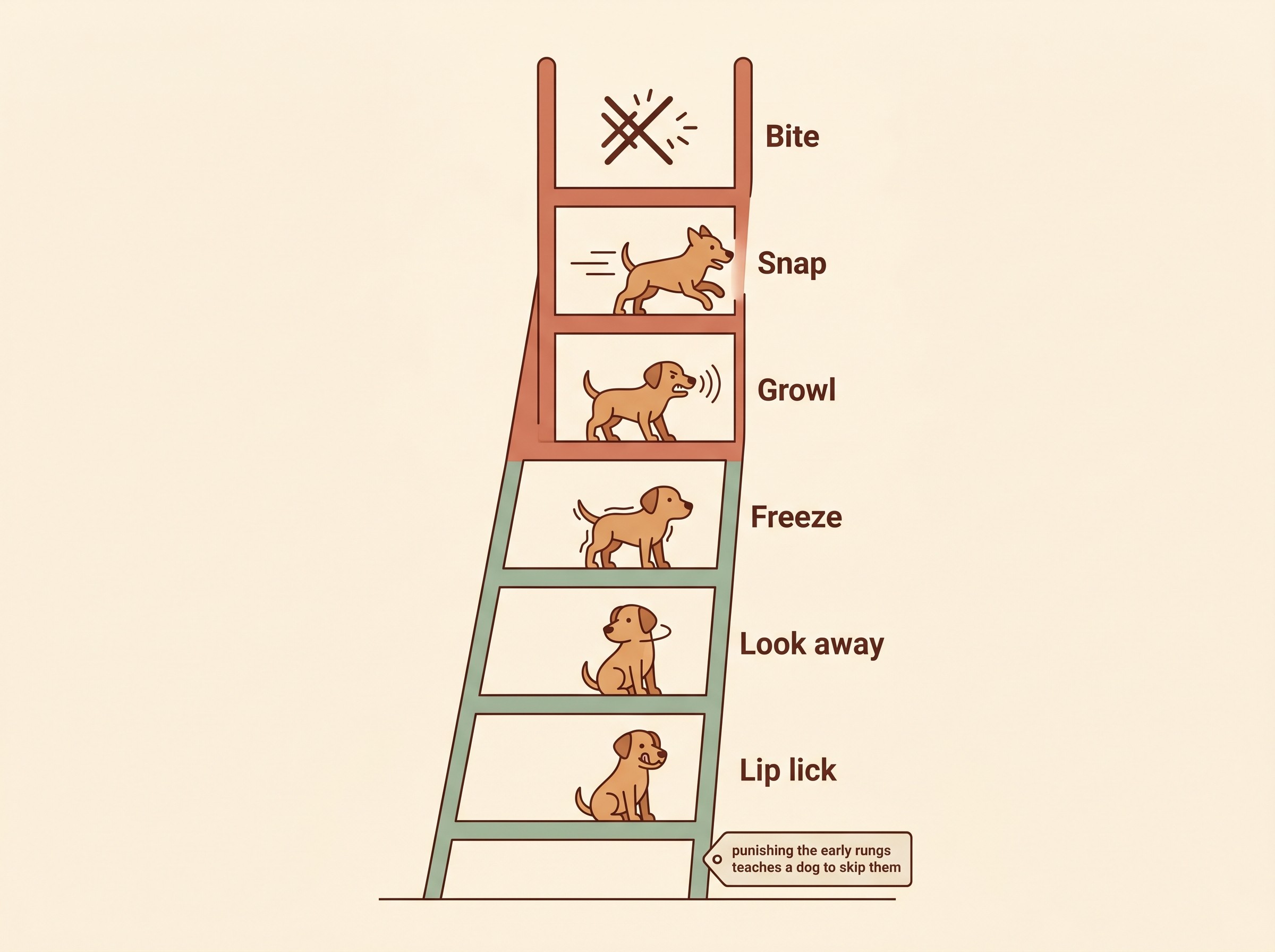
There is a great deal more to reading these signals, and learning to spot the low rungs early is one of the most useful skills you can build, so we have given it its own home in reading your pet's body language.
What is your dog actually responding to?
Because aggression is a response, the useful question is always: a response to what? Behaviour specialists classify aggression not by how fierce it looks but by what is motivating it and in what context, because the motivation is what tells you how to help (Frank, 2013; Overall, 2013). The same outward growl can come from very different places, and naming the right one is most of the work.
Fear and anxiety sit behind a large share of it. A frightened animal that cannot escape, or has learned that escape does not work, will often choose to drive the threat away instead, and fear and anxiety are among the commonest causes of aggression there are (AVSAB, 2009). Frustration is another driver, the dog who desperately wants to get to something and cannot reach it. So is the urge to guard a valued resource, a bone, a toy, a comfy spot, a person, which is so common and so fixable that it has its own guide in resource guarding in dogs.
Two more are worth naming because owners so often misread them. Territorial and protective aggression is aimed at an intruder, real or imagined, crossing into space the dog feels responsible for: the lunge at the postman through the letterbox, the bark at a visitor on the doorstep. And redirected aggression is the one that feels most "out of nowhere": a dog wound up to its limit by one trigger it cannot reach, a cat through a window, a dog across the road, turns and bites whatever is closest instead, which is sometimes the owner who reached for the collar at exactly the wrong moment. None of these is the dog being vindictive. Each is an over-aroused animal doing the only thing that made sense to it in that second.
The deeper "why," the emotional and motivational systems underneath all of this, and the long-overdue retirement of the "dominance" idea, are covered properly in why your pet behaves the way it does. For now the point to carry is simply that aggression is a symptom with several possible causes, and the label that matters is not "aggressive dog" but "what is this dog responding to."
One category genuinely stands apart, and it is worth flagging so you do not misread it. Predatory behaviour, the silent, focused chase of a small fast-moving thing, is not aggression in the emotional sense at all. There is no anger in it, no warning ritual, no ladder, and it is triggered by movement rather than by threat (Frank, 2013; Overall, 2013). It is more closely related to the act of hunting and feeding than to the fearful, defensive aggression most of this article is about, which is exactly why almost everything here, the warnings, the "it is fear," needs to be set aside for the dog who is chasing rather than threatening. Predatory behaviour is handled differently, and the framing in this article does not apply to it.
Why "dominance" is the wrong lens
You will still hear, from a surprising number of sources, that an aggressive dog is being "dominant," "trying to be alpha," or "challenging you," and that the answer is to assert yourself over him. Please be very careful with this advice, because it is both wrong and dangerous.
The modern veterinary position is that most unwanted behaviours are not about an animal seeking rank or priority over you. They arise far more often from accidental reinforcement and, very commonly, from fear and anxiety (AVSAB, 2009). And the "show him who is boss" toolkit does measurable harm. When researchers surveyed owners of dogs referred for behaviour problems, confrontational techniques provoked an aggressive response in a striking proportion of the dogs they were used on: hitting or kicking in 43 percent, growling back at the dog in 41 percent, forcing an item out of the mouth in 39 percent, an "alpha roll" in 31 percent, and staring the dog down in 30 percent (Herron et al., 2009). Reward-based approaches, by contrast, provoked aggression in very few dogs, around 2 percent for food rewards (Herron et al., 2009). Confrontation does not earn respect. It frightens an already frightened animal into defending itself, and it can directly make the problem worse by ratcheting up the fear that was driving the behaviour in the first place (AVSAB, 2009). The full case against aversive methods, and the learning science behind why kindness works better, lives in how animals actually learn.
Rule out pain first
Here is the finding that surprises almost every owner, and that we, as vets, think about before anything else: a hidden source of pain is one of the commonest drivers of aggression, and it is routinely missed.
Pain can produce aggression directly, as a defensive reaction to avoid physical contact that might cause more hurt, and it can take a dog who was already a bit grumpy in certain situations and make those reactions more frequent and more intense (Camps et al., 2019). In one case series of dogs whose aggression turned out to be pain-related, two-thirds had hip dysplasia, and tellingly, the dogs who had become newly aggressive after their pain began were more impulsive and attacked with little or no warning, especially when they were handled or restrained (Camps et al., 2012). The reason this matters so much is that pain rarely announces itself: a dog with sore hips or a grumbling spine often never limps, it simply develops a shorter fuse, so the change reads as a behaviour problem rather than a medical one. Across behaviour-referral caseloads more broadly, the suspected involvement of pain has been reported anywhere from 28 to 82 percent, which is not a population estimate but a clear signal that pain belongs near the top of the list (Mills et al., 2020). The conclusion the evidence pushes us toward is blunt: every aggressive dog, even one whose aggression looks entirely "normal" and context-appropriate, deserves to have an underlying pain condition ruled out (Camps et al., 2019).
This is why, for almost any change in your dog's behaviour, the first move is not a trainer but a vet. We cover exactly what is being checked and why in is it behaviour or is it medical, and if you want a quick steer on whether what you are seeing warrants an urgent look, especially a sudden or out-of-character change, the behaviour check tool will help you triage it.
Safety, a realistic prognosis, and getting real help
None of this is a project to take on alone, and aggression is not a problem to experiment with using tips from the internet, this article included. A dog who has shown aggression needs a proper assessment, usually involving your vet and often a referral to a qualified clinical behaviourist, and frequently it needs vet-prescribed medication working alongside the behaviour plan rather than instead of it. That medication is always a prescribing decision made and monitored by your vet, never something to source or dose on your own. Where to find genuine, qualified help, and how to tell a real behaviourist from someone who simply calls themselves one, is set out in finding behaviour help.
I want to be straight about prognosis, because false reassurance and doom are equally unhelpful. The reassuring part is real: most aggression improves a great deal with the right combination of careful management, behaviour modification and, where needed, medication. The caveat is that "improvement" usually means safe, reliable management of the situations that trigger it, rather than a guaranteed "cure," and the outlook depends heavily on how predictable the behaviour is. Aggression with a single clear trigger, where a known approach or contact sets it off, is more predictable and more manageable; aggression that is offensive, out of the blue, and fires across many different contexts is less predictable and therefore more dangerous (Frank, 2013). A minority of cases are genuinely serious, and there are situations where the kindest, most responsible path involves very hard conversations. We handle those, along with what to do after a bite, the safety and legal side, and positive muzzle training, with the care they deserve in after a dog bite: safety, law and help.
One last thing to let go of, because it weighs on people: this is not about breed, and it is not about something rotten in your dog. No dog is born "an aggressive dog." Aggression is about the individual animal and the specific situation he finds himself in, which is precisely why it can be understood, and why so much of it can be helped (RSPCA, 2026). So the most useful thing you can do today is also the calmest: book that veterinary check, keep everyone safe in the meantime, and stop punishing the growl. You are not dealing with a bad character. You are dealing with a dog who is trying to tell you something, and you are about to start listening properly.
References
- RSPCA. Aggression in dogs (advice and welfare). Royal Society for the Prevention of Cruelty to Animals, 2026.
- Frank D. Aggressive behaviour in dogs and cats: classification by motivation and context. In: Canine and feline behavioural medicine, 2013.
- Shepherd K. Behavioural medicine as an integral part of veterinary practice (the canine ladder of aggression). In: Horwitz DF, Mills DS, eds. BSAVA Manual of Canine and Feline Behavioural Medicine, 2nd edn. Gloucester: BSAVA, 2009.
- American Veterinary Society of Animal Behavior. Position Statement on the Use of Dominance Theory in Behavior Modification of Animals. AVSAB, 2009.
- Overall KL. Manual of Clinical Behavioral Medicine for Dogs and Cats. St Louis: Elsevier Mosby, 2013.
- Herron ME, Shofer FS, Reisner IR. Survey of the use and outcome of confrontational and non-confrontational training methods in client-owned dogs showing undesired behaviors. Applied Animal Behaviour Science, 2009;117(1-2):47-54.
- Camps T, Amat M, Manteca X. A Review of Medical Conditions and Behavioral Problems in Dogs and Cats. Animals, 2019;9(12):1133.
- Camps T, Amat M, Mariotti VM, Le Brech S, Manteca X. Pain-related aggression in dogs: 12 clinical cases. Journal of Veterinary Behavior, 2012;7(2):99-102.
- Mills DS, Demontigny-Bedard I, Gruen M, et al. Pain and Problem Behavior in Cats and Dogs. Animals, 2020;10(2):318.
Keep track of how your pet is doing
The owners who cope best are the ones who notice changes early. A simple health log shows you what is working, and what is not, before the next vet visit.
Start tracking, freeYou're not doing this alone
Compare treatment journeys and talk to owners managing behaviour & anxiety. Free to join.
Join PetsLikeMine