

Resource guarding: food, toys and space, and how to handle it safely
Alastair Greenway
BVM&S MRCVS
A dog that stiffens over a bone, gulps its food faster when you walk past the bowl, or curls a lip when someone reaches for the stolen sock is showing you one of the most misunderstood behaviours in dogs. Resource guarding has a reputation for being sinister, a sign of a "dominant" or "bad" dog, and that reputation drives owners straight toward the response most likely to make it worse. Guarding something valuable is, at root, normal canine behaviour, the legacy of an animal for whom holding onto food or a safe resting spot once had real survival value. It tips over into a problem when the intensity or context is out of proportion, and, handled calmly and correctly, it is one of the more manageable behaviour problems you will meet.
The broader picture, why aggression is communication not character, why warnings precede bites, and why the dominance frame is wrong, belongs to our overview of understanding aggression, and is worth reading first. Here we stay tight on one question: your dog guards things, so what do you actually do about it, safely.
What guarding actually is
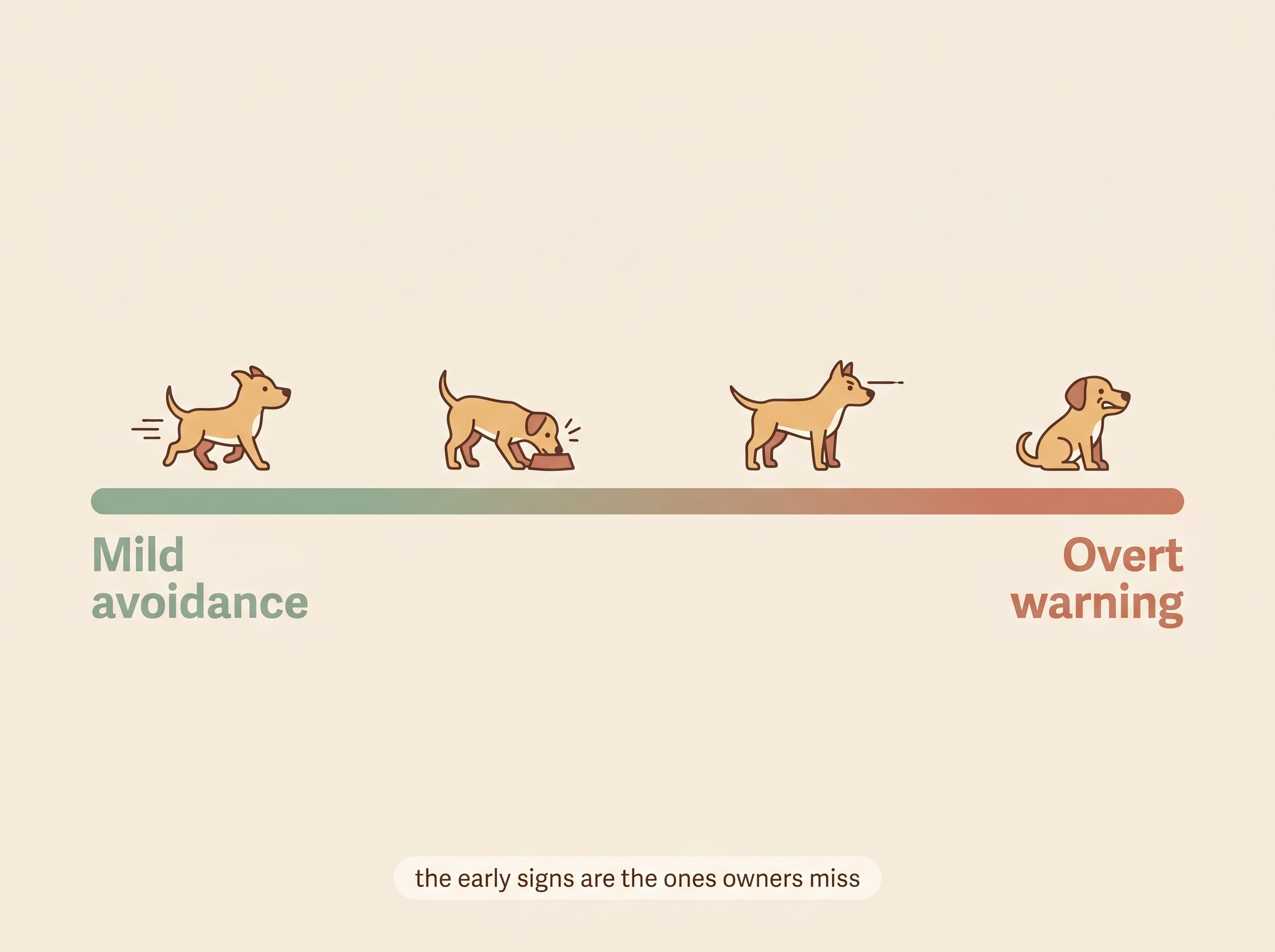
It helps to start with a precise definition. A panel of canine-behaviour experts defined resource guarding as the use of avoidance, threatening, or aggressive behaviours by a dog to retain control of food or non-food items in the presence of a person or another animal (Jacobs et al., 2018). The important word is the first one: avoidance. Most guarding is not a snarling crisis. It sits on a continuum that runs from a dog quietly taking its chew to the other side of the room and eating faster, through freezing and stiffening, up to overt aggression at the far end. The same panel preferred "resource guarding" over "possessive aggression" precisely because labelling the whole spectrum as "aggression" is misleading and pushes owners toward confrontation they would otherwise avoid (Jacobs et al., 2018).
That spectrum is why guarding so often seems to "come out of nowhere." It almost never does. Owners are genuinely good at spotting a dog that snaps or bites, and good at recognising a dog with no guarding at all, but relatively poor at noticing the quiet early signs in between: the rapid eating, the body that turns to block you from the bowl, the brief freeze and the hard stare over a stolen item (Jacobs et al., 2017). So the bite that "appeared overnight" was usually the top of a ladder the dog had been climbing for weeks. Learning to read the low rungs is both the safety message and the prevention, and the full early-warning catalogue, the freeze, the whale eye, the lip-lift, the stiffening, sits in our guide to reading your pet's body language.
One caveat belongs here first. A dog that suddenly starts guarding when it never used to, or one that guards its bed or resting spot rather than its dinner, may be protecting a body that hurts. Pain makes any animal defensive of itself, so new-onset or escalating guarding deserves a veterinary check before you assume it is purely behavioural, and our article on whether a problem is behaviour or medical walks through that rule-out.
Why confrontation backfires
The traditional advice, be the boss, put your hand in the bowl while he eats, take the chew away so he learns to accept it, is not just outdated. It is actively counterproductive, and we now have the figures to say so.
In a large survey of dog owners, removing the food dish during meals was associated with more resource guarding, not less, while adding palatable food during meals and teaching the dog to give things up were associated with reduced guarding (Jacobs et al., 2018). From the dog's point of view, if your approach to the bowl reliably means the food vanishes, you have proven that you are a threat to its dinner, and a sensible dog responds by guarding harder. The confrontation creates the very problem it claims to cure.
It also provokes bites. When owners of dogs referred for behaviour problems used directly confrontational methods, aggression was common: forcing an item out of the dog's mouth triggered it in nearly four in ten dogs (39 percent), an "alpha roll" or staring the dog down in around a third, and hitting or kicking in over forty percent (Herron et al., 2009). Reward-based methods provoked aggression in only a tiny fraction, around two percent for offering a food reward (Herron et al., 2009). This is why modern professional bodies are unequivocal: only reward-based methods should be used, because aversive and confrontational handling risks increasing fear and aggression and damaging your relationship with your dog, with no evidence it works better (AVSAB, 2021). The deeper "why," how learning works and why punishment backfires, is laid out in our guide to how animals learn. The conclusion is simple: confrontation loses.
Safety and management first
Before any training, you change the environment so nobody gets hurt and the dog never gets to rehearse the guarding. Management is not a failure to train, it is the foundation that makes training possible, and for some households it is most of the answer.
The principle is to remove the conflict rather than win it. Feed a guardy dog somewhere it will not be disturbed, behind a baby gate, in a separate room, in its crate if it likes the crate, so there is no traffic past the bowl. Pick up and put away the high-value items that trigger the worst guarding, the long-lasting chews, the stolen treasures, the particular toy, so the dog is not left alone with the thing it feels it must defend. If your dog grabs something it should not have and guards it, do not wade in: a swap for something better, a piece of cheese tossed away from the item, usually buys you the moment to retrieve it calmly, and a planned "trade" beats a tug-of-war every time. Chasing the dog to wrestle the item back only confirms that you are a thief, makes the next theft more exciting, and teaches the dog to swallow contraband fast, which is how socks become surgical emergencies.
If guarding has tipped into genuine aggression, a muzzle, introduced kindly and positively so the dog is happy to wear it, is a responsible safeguard rather than an admission of defeat. The full muzzle-training protocol, and what to do if guarding has already caused a bite, including the legal side, belong to our article on after a dog bite, so I will simply flag the muzzle here as a kind tool and point you there.
Teaching the dog that approach is good news
Once the dog is safe and not rehearsing the problem, the actual rehabilitation rests on one elegant idea: you change how the dog feels about a person or another animal approaching its resource. Instead of approach predicting loss, you make approach reliably predict something even better arriving. This is counter-conditioning, and applied to guarding it is sometimes called the "give to get" or trade approach.
In practice, at a distance the dog is comfortable with, you walk towards it while it has a moderate-value item, drop something genuinely delicious near it, and walk away again. You have added value, taken nothing, and left. Repeated patiently, the dog's response shifts from "here comes the thief" to "here comes the good stuff," and the guarding melts because the loss it was defending against stops happening. Separately, you teach a happy, well-paid "drop" or "swap" as a trained behaviour in calm, low-stakes moments, so that giving things up becomes a rewarding habit long before you need it in earnest. This matches the evidence: adding palatable food and teaching the dog to give items up were the very things associated with less guarding in the owner survey (Jacobs et al., 2018).
The rule that makes this work is to stay under threshold: always work at a distance and item-value where the dog stays relaxed and never has to guard, then close the gap in small steps only as it stays loose and happy. Push too close too fast and you are no longer counter-conditioning, you are flooding. The full theory of thresholds and how to build a ladder lives in our guide to desensitisation and counter-conditioning, and a written "trade and drop" plan is worth keeping by the kitchen if structure helps. A realistic word on what to expect: this rests on association studies and established counter-conditioning principles rather than a large controlled trial of a guarding cure, so treat it as a reliable, evidence-aligned way to manage and reduce the behaviour, not a guaranteed switch-off.
People versus other dogs
Guarding from people and guarding from other dogs are partly different problems, and owners often wrongly assume a dog that shares happily with the family will share happily with the new puppy. Dogs living in multi-dog households are more likely to show guarding behaviours, including overt aggression, avoidance and rapid ingestion, than dogs living alone, and higher impulsivity and higher fearfulness raise the risk of guarding aggression in both contexts (Jacobs et al., 2018).
The practical upshot is that multi-dog homes need management built in as routine, not as a reaction to a fight. Feed dogs separately, in different rooms or behind barriers, every time. Hand out chews and high-value items only when the dogs are apart, and pick up what is left over before they are back together. You are not waiting to see whether they will squabble, you are arranging the household so the squabble never gets the chance to start, because every guarding incident the dogs rehearse makes the next one more likely. Where tension between housemate dogs has already escalated, that is its own topic with its own safety rules, covered in our article on dog-to-dog aggression in the home.
Heading it off in puppies and new arrivals
Prevention is easier than cure, and the early weeks are where most of it happens. The aim is simple: a puppy should grow up with no reason to believe that human hands near its food or chew ever mean loss, only gain. Walk past the eating puppy and drop a tastier morsel into the bowl, so an approaching person becomes the best thing that can happen rather than a threat to be seen off. Teach a cheerful "swap" from the start, trading a held item for a treat and then often handing it straight back, so giving things up is a winning move. The one thing not to do is the old "put your hand in the bowl and take it away to show who's boss" routine, which teaches the opposite of what you want and is associated with more guarding, not less (Jacobs et al., 2018): the point of approaching the bowl is to add, never subtract. The same logic applies to any newly adopted dog whose history you do not know, and to a puppy from a large litter or a deprived start, both of which can incline a dog to guard.
Children, and the line you do not cross
One combination is not a training project but a hard safety rule: small children and a dog's food, chews, or resting place. The reason is sobering. In dogs assessed after biting a child, the bites to children under six happened in a resource-guarding context far more often than in older children (44 percent versus 18 percent), and the biting dog was usually one the child knew well, very often the family's own, rather than a stray or a stranger (Reisner et al., 2007). This is why guarding around young children is a line you manage rather than a behaviour you "train the dog to tolerate" by exposure.
The rule is separation and supervision around all resources: children and dogs are never left together unsupervised near food, chews, bones, or the dog's bed, and the dog is given a safe place to eat and rest where small hands cannot reach. Do not try to teach the dog to accept a toddler approaching its bowl by letting it happen, because you are gambling with a child's face. The full set of household rules, how to teach children to behave around dogs and how to set the home up safely, is owned by our article on children and dogs, and a children-and-dogs household-rules sheet is worth printing for the fridge if you have both under one roof.
Knowing when to bring in help
Mild guarding, the dog that quietly takes its chew elsewhere, often resolves with nothing more than sensible management and the give-to-get approach above. But some signals mean a problem has outgrown a do-it-yourself plan and warrants a clinical behaviourist working with your vet: guarding that has caused a bite or a near-miss, guarding aimed at children, guarding that is escalating despite your doing the right things, or a dog so aroused around its resources that it cannot settle enough to learn. Severe cases genuinely need professional help, and occasionally vet-prescribed anti-anxiety medication is a useful adjunct for the very anxious or highly aroused dog, always decided and prescribed by your vet alongside the behaviour plan rather than reached for first. Who is actually qualified, how referral works, and how to tell a good behaviourist from someone selling dominance and "guaranteed fixes," is set out in our guide to finding real behaviour help.
If you are not sure where your dog sits, whether this is a manageable quirk or something that needs a vet and a behaviourist, our behaviour triage tool will help you judge how serious it is and whether a medical check should come first. Start there, start the management today, and resist with everything you have the urge to take the bone away to "show him who's boss." That single instinct, more than the guarding itself, is what turns a fixable problem into a bite.
References
- Jacobs JA, Coe JB, Widowski TM, Pearl DL, Niel L. Defining and Clarifying the Terms Canine Possessive Aggression and Resource Guarding: A Study of Expert Opinion. Frontiers in Veterinary Science, 2018;5:115.
- Jacobs JA, Pearl DL, Coe JB, Widowski TM, Niel L. Ability of owners to identify resource guarding behaviour in the domestic dog. Applied Animal Behaviour Science, 2017;188:77-83.
- Herron ME, Shofer FS, Reisner IR. Survey of the use and outcome of confrontational and non-confrontational training methods in client-owned dogs showing undesired behaviors. Applied Animal Behaviour Science, 2009;117(1-2):47-54.
- American Veterinary Society of Animal Behavior (AVSAB). Position Statement on Humane Dog Training. AVSAB, 2021.
- Reisner IR, Shofer FS, Nance ML. Behavioral assessment of child-directed canine aggression. Injury Prevention, 2007;13(5):348-351.
Keep track of how your pet is doing
The owners who cope best are the ones who notice changes early. A simple health log shows you what is working, and what is not, before the next vet visit.
Start tracking, freeYou're not doing this alone
Compare treatment journeys and talk to owners managing behaviour & anxiety. Free to join.
Join PetsLikeMine