

Children and dogs: prevention and the safety rules that matter most
Alastair Greenway
BVM&S MRCVS
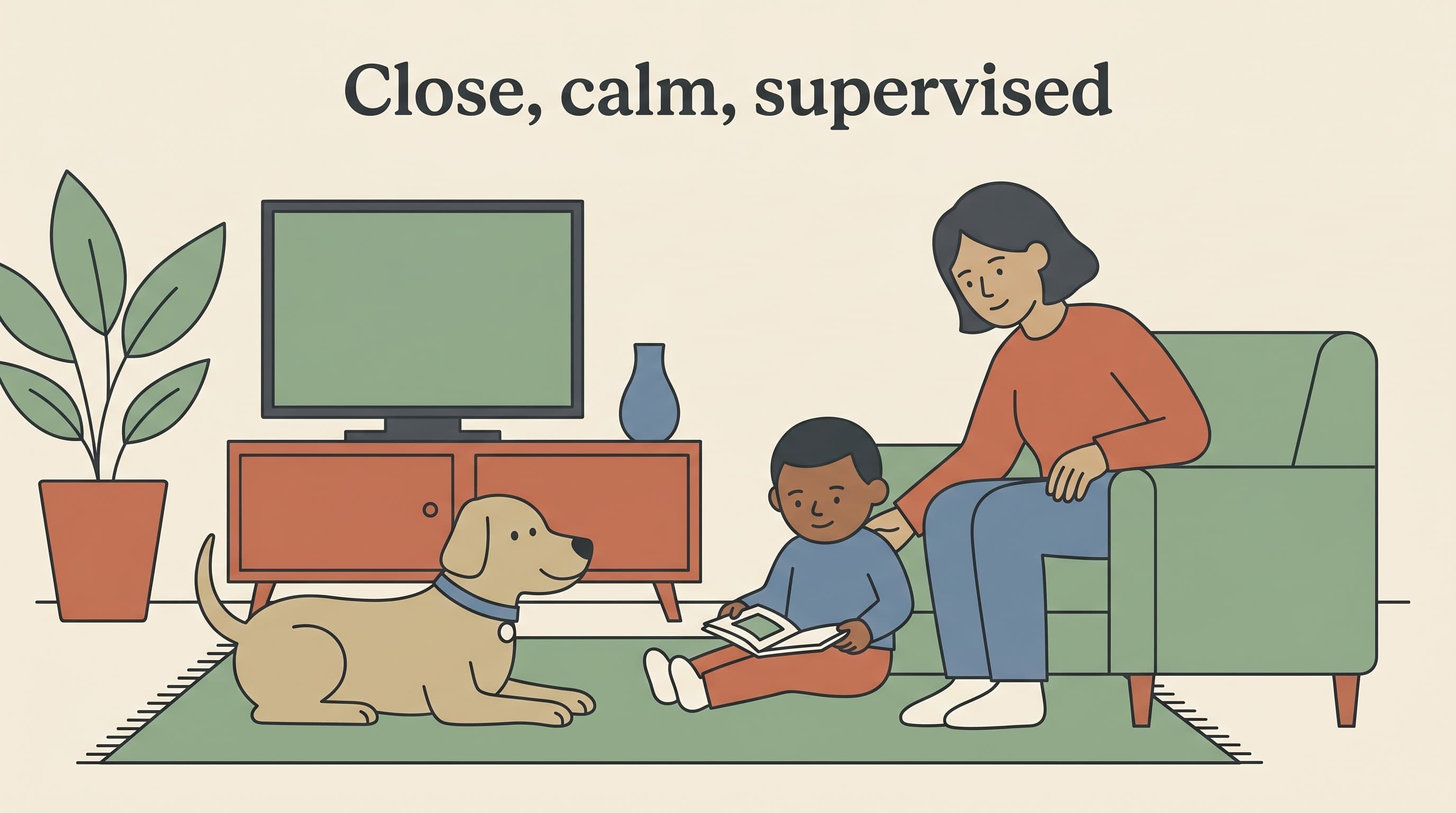
Child safety around dogs is usually written about with shock statistics and frightening photographs, and that approach helps nobody. It just frightens the families who least need frightening. The bites children suffer are not random bolts of lightning from unknowable, dangerous dogs. They cluster, with striking consistency, in a small handful of predictable situations, with the family's own familiar dog, and active supervision plus a few simple rules removes most of the risk. This is one of the most preventable injuries in childhood, and you can do the preventing.
The uncomfortable part, which there is no point softening, is that the dog people picture as the danger, a strange, aggressive dog in the street, is almost never the one that bites a child. The dog that bites a child is overwhelmingly the family dog, at home, in the middle of an ordinary, affectionate moment that nobody saw coming. Understanding why is what lets you prevent it, so let us look at what the evidence actually shows and then turn it into rules you can use today.
What the evidence shows, without the scaremongering
Children are among the age groups most affected by dog-bite hospital admissions in England, and that alone is reason to take this seriously. In a study of admissions across two decades, children aged fourteen and under accounted for around a quarter of all hospital admissions for dog bites, with the highest rates in young school-age children (Tulloch et al., 2021). One piece of context is worth knowing, though, because it cuts against the "it is getting worse" headlines. While overall admissions have risen sharply, that rise has been driven almost entirely by adults, with the child admission rate staying broadly stable over the same twenty years (Tulloch et al., 2021).
Where do these bites happen, and from which dog? This is the single most important and most counter-intuitive fact in the whole subject. In UK data, the dog that bites a child is owned by a member of the family in around seventy percent of cases, and children are most often bitten at home (Jakeman et al., 2020). In a trauma-centre series of bitten children, seventy-two percent already knew the dog (Reisner et al., 2011). This is not a "stranger danger" problem. It is a problem that happens on your own sofa, with a dog your child loves.
And in young children, the pattern is even more specific. In the under-sevens, most bites were to the face, and they typically followed a positive, gentle interaction that the child started, with a stationary, familiar dog, indoors (Reisner et al., 2011). The youngest children are the most likely of all to be hurt around the head and neck, partly because their height brings their face level with a dog's (Jakeman et al., 2020). That combination, small child plus a quiet, friendly, resting dog plus a cuddle, is not the situation most parents are watching for, which is exactly why it is the one that catches them out.
Why it happens, and why it is rarely a "bad dog"
If the biter is the familiar family dog in an affectionate moment, what is actually going wrong? The evidence points to two situations above all others. In a behaviour-clinic series of dogs that had bitten children, the youngest children, those under six, were most often bitten in relation to food guarding or other resource situations, in around forty-four percent of their cases, while roughly one in seven were bitten during benign contact: petting, hugging, kissing, or bending over the dog (Reisner et al., 2007). Older children were more often bitten in territorial situations (Reisner et al., 2007). So the two great risks to a small child are a dog that is guarding something and a dog that is being loved at a moment, or in a way, it cannot cope with.
Now for the part that should change how you think about your own dog. In that same series, the biting dogs were overwhelmingly not "dangerous dogs" in any meaningful sense. Eighty-seven percent had fear-related aggression as their main behavioural diagnosis, three-quarters showed an anxiety abnormality on assessment, and two-thirds had never previously bitten a child at all (Reisner et al., 2007). Two-thirds of the owners had even attended formal obedience classes (Reisner et al., 2007). The dog that bites a child is typically a frightened, anxious, ordinary family pet that has been pushed past what it can tolerate, not a monster anyone should have spotted. Prevention is about managing situations, not about identifying a bad dog, because the data say you usually cannot identify one in advance. The emotional reasons a frightened dog reacts are explored in our guide to why pets behave the way they do.
There is a corollary worth stating plainly, because it cuts both ways. Breed is not a reliable predictor of whether a dog will bite. The factors that actually reduce bites are matching the dog to the household, early socialisation, training, supervision and education, not breed (AVSAB, 2014). And in the one study that looked at what predicts how bad a bite is, it was the age of the person bitten, not the size or type of dog, that came out as the predictor (Owczarczak-Garstecka et al., 2018). That should reassure you out of "it is a [breed], so it is fine" just as firmly as out of "it is a [breed], so it is dangerous." Both are false comfort and false alarm.
One more thread, mentioned once and handed on: a dog that has suddenly become snappy when it never used to be may be in pain, and pain is a common, overlooked driver of a previously gentle dog turning. Rule that out first with your vet, and our article on whether it is behaviour or something medical walks through how.
Supervision that actually works
This is where most safety advice goes wrong, so I want to be precise. The instinct is to teach the children the rules and trust them to keep themselves safe. The evidence says that does not work on its own, and we will come to why in a moment. The intervention with the best prevention rationale is not the child's judgement but the adult's. As the UK review puts it, close supervision by an adult who is both physically near the dog and child and able to read dog body language has real potential to prevent bites (Jakeman et al., 2020).
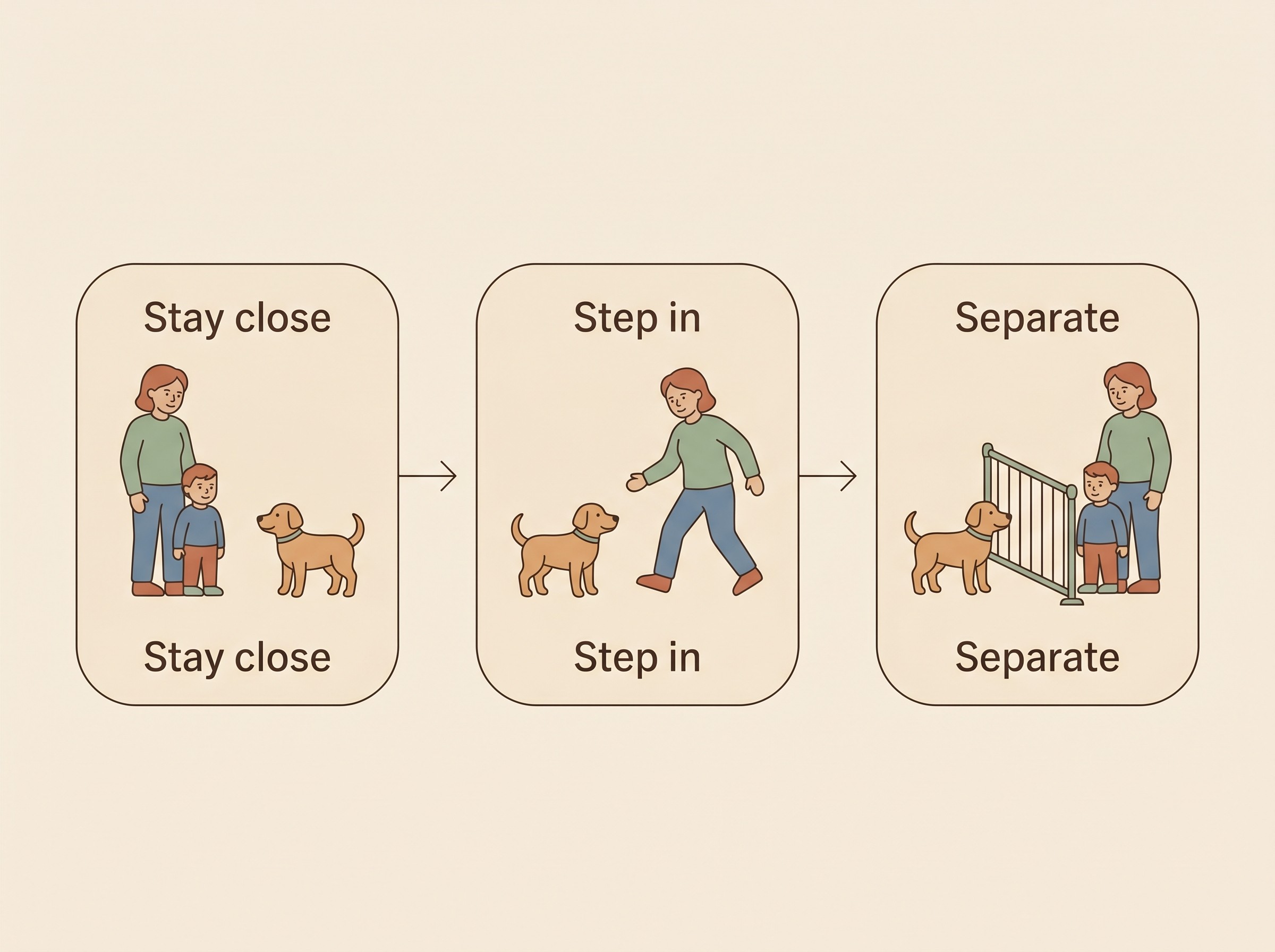
Notice the two halves of that. Near, and able to read the dog. Supervision from the kitchen while the children and the dog are in the lounge is not supervision. Supervision while scrolling your phone two feet away is not really it either. Dogs Trust gives this a usefully memorable shape: stay close, step in, separate (Dogs Trust, accessed 2026). You stay within arm's reach during any child-dog interaction, you step in the moment the dog shows the smallest sign of discomfort, and, above all, when you cannot actively watch, you physically separate them. The RSPCA's rule is blunt and correct: never leave a child alone in a room with any dog, including your own (RSPCA, accessed 2026).
That phrase "including your own" is doing the heavy lifting, and it is hard advice precisely because it asks you to manage the dog you trust completely. But the data are unambiguous that the trusted family dog at home is the one usually involved, so separation when you step out of the room, even for two minutes, even just to answer the door, is the cornerstone of the whole thing. A baby gate, a closed door, a crate the dog likes, any reliable barrier will do. A "child-dog supervision plan" and a "safe-space and separation plan", named in this space, can help you set this up at home.
The short list of rules that prevent real bites
Translate all of the above into concrete house rules and the list is short, specific, and tied directly to the situations the evidence flags.
First, leave a resting, sleeping or eating dog completely alone. A dog that is asleep, or settled on its bed, or eating its dinner, or working on a chew, is a dog that should not be touched, startled or approached by a child, because resource situations and disturbed-resting-dog situations are where the youngest children are most often bitten (Reisner et al., 2007; RSPCA, accessed 2026). Give the dog a bed or crate that is genuinely child-free, an off-limits safe space it can retreat to and not be followed into, with an easy way out so it never feels cornered. Keep food bowls, chews and high-value toys out of the child's reach and orbit entirely. The actual technique for changing how a dog feels about people near its food is a separate skill, covered in our guide to resource guarding; the rule here is simpler, which is to keep the child and the guarded thing apart in the first place.
Second, no hugging, kissing, lying on, climbing on, or leaning over the dog, and no face-to-face contact, especially for toddlers. This is the rule parents find hardest, because a child hugging the dog looks like love, and it usually is. But benign cuddling contact is one of the two leading triggers for bites to small children (Reisner et al., 2007), and the human movements that increase in the seconds before a bite are precisely tactile contact and leaning or standing over the dog (Owczarczak-Garstecka et al., 2018). It is no coincidence that a small child, whose face arrives close to a dog's during exactly these manoeuvres, is so often bitten on the face (Reisner et al., 2011). Teach affection that keeps the face away and the dog free to move: gentle strokes on the shoulder or chest, never around the head or in an embrace.
Third, teach "the dog comes to you," not "go to the dog." Let the dog choose to approach, and let it choose to leave. A dog that can walk away from a child is a dog that does not have to escalate to a snap to get space. This single habit, of always letting the dog opt in and opt out, quietly prevents a great many corner-and-grab incidents.
Teaching children, frankly: a supplement, not a safeguard
It would be easy, and reassuring, to tell you that teaching your children the rules above keeps them safe. I am not going to, because the evidence will not support it.
Education programmes reliably improve what children know. A meta-analysis found a real gain in children's knowledge after dog-safety teaching (Shen et al., 2017). But knowing is not doing. That same review found that no study had demonstrated a reduction in actual bites, and the evidence that these programmes change children's real behaviour was weak (Shen et al., 2017). The Cochrane review, the highest tier of evidence synthesis, reached the same sober conclusion: there is no direct evidence that educational programmes reduce dog-bite rates in children, and education should not be relied on as a stand-alone strategy (Duperrex et al., 2009). Even a well-designed teaching tool that improved children's risk recognition on screen did not change what they actually did with a real dog in the room (Schwebel et al., 2012).
There is a deeper reason for this, and it is the one that should settle the question of who keeps the child safe. Young children genuinely cannot reliably read a frightened or warning dog. Four- and five-year-olds have a very limited ability to interpret dog signals, and although accuracy improves markedly in six- to twelve-year-olds, who read the signals correctly in more than eight cases in ten, the signals the youngest children misread worst of all are the stressed and fearful ones, which they tend to take for playfulness or affection (Eretová et al., 2020). Since the dog that bites is usually the frightened one giving subtle fearful signals, the very child you most want protected is the one least able to see the warning. That is precisely why the safeguard has to be the supervising adult, not the child's judgement.
None of this means dropping the teaching, and here is the balancing note, fairly stated: one school programme that did not measurably reduce the number of bites did appear to reduce their severity, with the injuries that still occurred coming out milder (Kienesberger et al., 2021). So teach your children the rules by all means, because it may make the bites that do happen less serious and it builds good lifelong habits. Just hold it in its proper place, as a supplement to active adult supervision and management, never as a substitute for it.
When your dog has already shown something
Everything so far has been prevention before anything has gone wrong. If your dog has already shown any aggression toward a child, a growl, a snap, a stiffening, a freeze over its bowl, a curled lip, the situation is different and the response is not "train it out at home and hope." It is a clear signal to act now: separate the dog and child reliably so it cannot happen again while you sort things out, book a vet check to rule out pain or illness as a driver, and get qualified behaviour help rather than improvising.
It helps to know that the dog is almost certainly trying to tell you something before it ever bites. Dogs, as Dogs Trust puts it, tend to "whisper" before they "shout," moving away, licking their lips, tucking the tail, turning the head (Dogs Trust, accessed 2026), and warning behaviours reliably build in the seconds before a bite (Owczarczak-Garstecka et al., 2018). Learning to see those early whispers is one of the most protective skills you can build, and the actual signals, along with why you must never punish a growl, belong to our guide on reading your dog's body language. If you are weighing up whether a growl or snap near your child is an emergency, our public behaviour check will help you triage it.
For the road from here, the next steps are clear and someone has already mapped them. If your dog has bitten or shown serious aggression to a child, including what the law requires of you and how muzzle training fits in, go to our guide on what to do after a dog bite, and for an acute, frightening incident right now, our overview of behaviour emergencies and bites. To find the right professional, a vet, a qualified clinical animal behaviourist or an accredited trainer, our guide to finding behaviour help explains who does what. And if you are raising a puppy now, gently and positively introducing it to calm, sensible children during its early weeks is genuinely protective for the future, as our guide to the socialisation window describes. None of these is a counsel of despair. They are the well-trodden path from "something happened" to "we handled it well," and taking the first step on it today, separate and book the vet check, is the single most protective thing you can do.
References
- Tulloch JSP, Owczarczak-Garstecka SC, Fleming KM, Vivancos R, Westgarth C. English hospital episode data analysis (1998-2018) reveal that the rise in dog bite hospital admissions is driven by adult cases. Scientific Reports, 2021;11:1767.
- Jakeman M, Oxley JA, Owczarczak-Garstecka SC, Westgarth C. Pet dog bites in children: management and prevention. BMJ Paediatrics Open, 2020;4(1):e000726.
- Reisner IR, Nance ML, Zeller JS, Houseknecht EM, Kassam-Adams N, Wiebe DJ. Behavioural characteristics associated with dog bites to children presenting to an urban trauma centre. Injury Prevention, 2011;17(5):348-353.
- Reisner IR, Shofer FS, Nance ML. Behavioral assessment of child-directed canine aggression. Injury Prevention, 2007;13(5):348-351.
- American Veterinary Society of Animal Behavior. AVSAB Position Statement on Breed-Specific Legislation. AVSAB, 2014.
- Owczarczak-Garstecka SC, Watkins F, Christley R, Westgarth C. Online videos indicate human and dog behaviour preceding dog bites and the context in which bites occur. Scientific Reports, 2018;8(1):7147.
- Dogs Trust. Dogs and children: living happily together. Dogs Trust, accessed 2026.
- RSPCA. Children and dogs: how they can live together. RSPCA, accessed 2026.
- Shen J, Rouse J, Godbole M, Wells HL, Boppana S, Schwebel DC. Systematic Review: Interventions to Educate Children About Dog Safety and Prevent Pediatric Dog-Bite Injuries: A Meta-Analytic Review. Journal of Pediatric Psychology, 2017;42(7):779-791.
- Duperrex O, Blackhall K, Burri M, Jeannot E. Education of children and adolescents for the prevention of dog bite injuries. Cochrane Database of Systematic Reviews, 2009;(2):CD004726.
- Schwebel DC, Morrongiello BA, Davis AL, Stewart J, Bell M. The Blue Dog: Evaluation of an Interactive Software Program to Teach Young Children How to Interact Safely With Dogs. Journal of Pediatric Psychology, 2012;37(3):272-281.
- Eretova P, Chaloupkova H, Hefferova M, Jozifkova E. Can Children of Different Ages Recognize Dog Communication Signals in Different Situations? International Journal of Environmental Research and Public Health, 2020;17(2):506.
- Kienesberger B, Arneitz C, Wolfschluckner V, Flucher C, Spitzer P, Singer G, Till H, Castellani C. Child safety programs for primary school children decrease the injury severity of dog bites. European Journal of Pediatrics, 2021;181(2):709-714.
Keep track of how your pet is doing
The owners who cope best are the ones who notice changes early. A simple health log shows you what is working, and what is not, before the next vet visit.
Start tracking, freeYou're not doing this alone
Compare treatment journeys and talk to owners managing behaviour & anxiety. Free to join.
Join PetsLikeMine