

Socialisation done right: the puppy and kitten window, and what to do if you missed it
Alastair Greenway
BVM&S MRCVS
Early in life there is a stretch of a few weeks when a puppy or a kitten decides, more or less for keeps, whether the world is a safe place. Get a little gentle, varied experience into them during it, and you tend to end up with a confident adult who takes new people, places and noises in their stride. Miss it, and you can end up with an animal who finds ordinary life frightening, through no fault of their own and, just as importantly, no fault of yours. Few areas in behaviour reward prevention as richly as this one does, and none is so badly served by the usual "take them everywhere" platitudes, which is why it earns a clear-eyed article.
I want to do two things here. First, set out plainly what this window is, how it differs between dogs and cats, and what good socialisation actually looks like, because most of what owners are told is either vague or quietly wrong. Then, for the many of you reading this with an adult rescue at your feet rather than an eight-week-old on your lap, give a realistic account of what can be done once the window has closed.
What this early window is, and why it weighs so much
You will see it called the "sensitive period," and the classic work on it in dogs is now over half a century old. Scott and Fuller's selective-rearing studies, and the isolation experiments that followed, described a special stretch of early life when "a small amount of experience will produce a great effect on later behavior," opening at around three weeks and tapering off by roughly twelve to fourteen weeks as a natural wariness of anything new begins to set in (Scott & Fuller, 1965; Freedman, King & Elliot, 1961). The American Veterinary Society of Animal Behavior puts the reason for its importance plainly: because the first three months are the period when sociability outweighs fear, this is the prime window for a puppy to adapt to new people, animals and experiences (AVSAB, 2008).
What happens, or fails to happen, in those few weeks casts a very long shadow. In a study of around six thousand Finnish pet dogs, the level of socialisation between seven weeks and four months of age had the strongest association of any factor studied with both fear of dogs and fear of strangers in adulthood (Puurunen et al., 2020). Dogs raised in a non-domestic environment, an outdoor kennel, garage, barn or shed, and lacking experience of urban surroundings between three and six months of age, were more likely to show avoidance and aggression toward unfamiliar people (Appleby, Bradshaw & Casey, 2002). Under-exposed puppies tend to become more fearful over time, and that fear can present as avoidance, withdrawal or fear-related aggression (Serpell & Jagoe, 1995). The flip side is just as real: appropriately socialised puppies are less likely to show aggression and fearfulness as adults (Howell, King & Bennett, 2015).
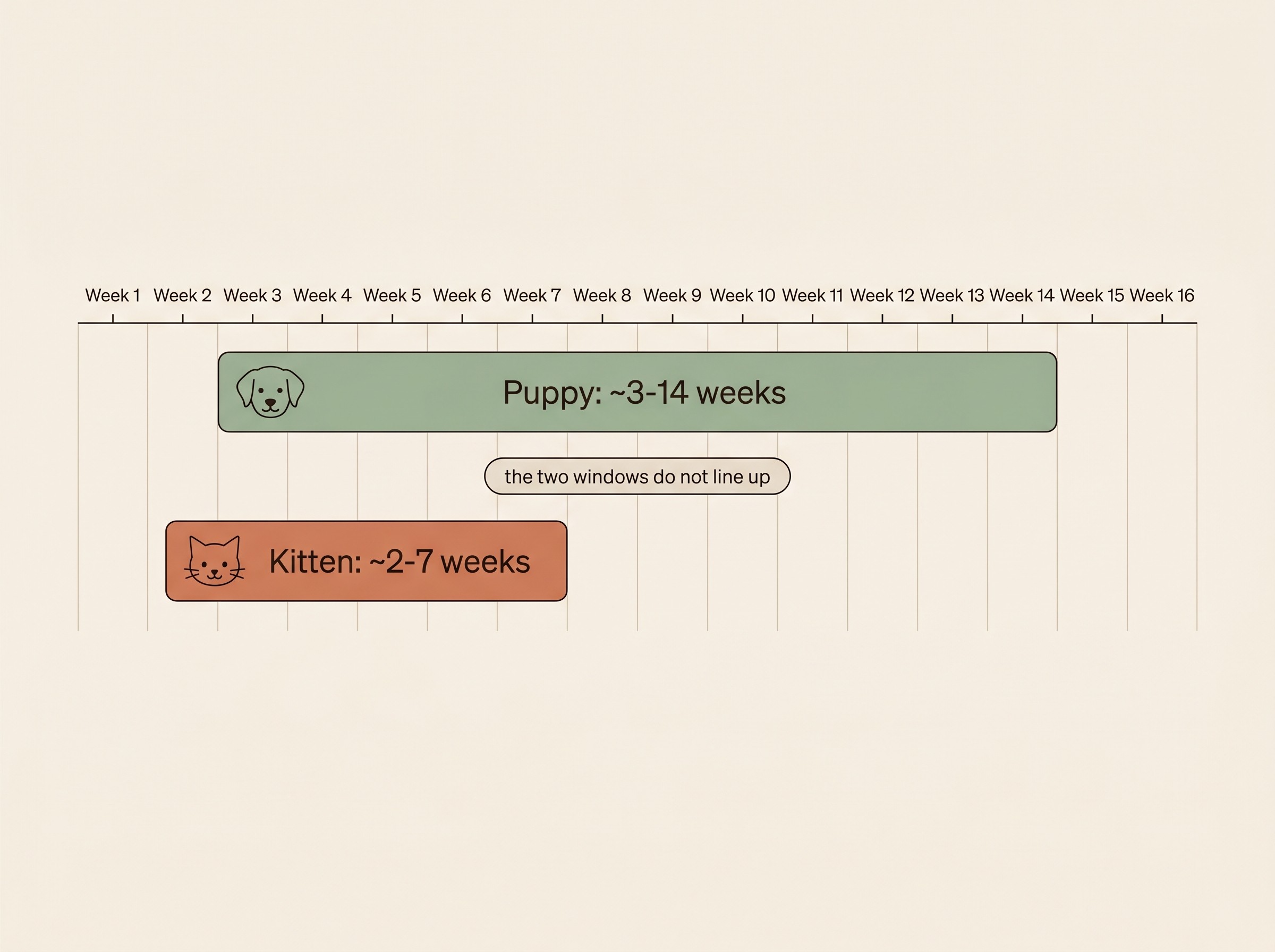
A caveat before we go on: this is a soft sensitive period, not a guillotine. The dog literature is fuzzy about whether the door is mostly shut at twelve weeks or fourteen, and it varies with breed and individual, so treat the numbers as a strong guide to where your effort matters most, not a deadline that snaps shut overnight.
Cats run on a different, earlier clock
A lot of cat owners get caught out by what comes next, so it is worth getting right. The feline sensitive period is both earlier and shorter than the canine one. Karsh's experiments placed the kitten socialisation period as beginning at about two weeks of age and coming to an end, apparently spontaneously, at about seven weeks, terminated by the onset of a fear reaction toward unfamiliar things (Karsh, reported in Karsh & Turner, 1998, and reviewed in Casey & Bradshaw, 2008). Reactions keep maturing for a while after that, with a kitten's behavioural "style" of responding to handling mainly formed in the first four months of life (Lowe & Bradshaw, 2002), but the core window has largely closed before most kittens are even homed.
That carries a blunt practical consequence. Since kittens usually go to their new homes at eight weeks or later, the irreplaceable early work, the gentle handling that builds a friendly cat, falls to the breeder, foster carer or rescue, not to you. That is not a counsel of despair, it is a reason to choose where your kitten comes from carefully and to ask what handling they have had. And the early work pays off in measurable ways. In a study of thirty-seven rescue kittens given either standard or enhanced socialisation between two and nine weeks of age, owners of the enhanced-socialised cats reported significantly higher emotional support from their cats a year later, and fewer of those cats showed behaviour indicating fear of humans (Casey & Bradshaw, 2008).
How it is done matters too, and it points to a theme worth holding onto: variety beats volume. Quantity is not nothing. Around five hours of handling a week between two and twelve weeks of age produced effects still detectable at a year (McCune, 1995), and increasing daily handling from fifteen to forty minutes increased how much time kittens later spent close to people (Karsh & Turner, 1998). But who does the handling matters more than the raw minutes. Kittens handled by five different people made fewer attempts to escape from a stranger than kittens handled by just one person or not at all (Collard, 1967). So when the advice says "let them meet several people," there is a real number behind it, and it is not one.
Good socialisation, and the myth that wrecks it
The single most damaging misconception is that socialisation means meeting as many people, dogs and places as fast as possible. It does not. The opposite of good socialisation is flooding, and it can do real harm. The evidence that early experience helps is all about positive, controlled, varied exposure kept below the level that frightens the animal (AVSAB, 2008; Casey & Bradshaw, 2008). Overwhelm a puppy at a loud, crowded event, or hand a nervous kitten round a room of grabbing children, and you risk teaching them that the world is exactly as alarming as they feared. You sensitise rather than socialise.
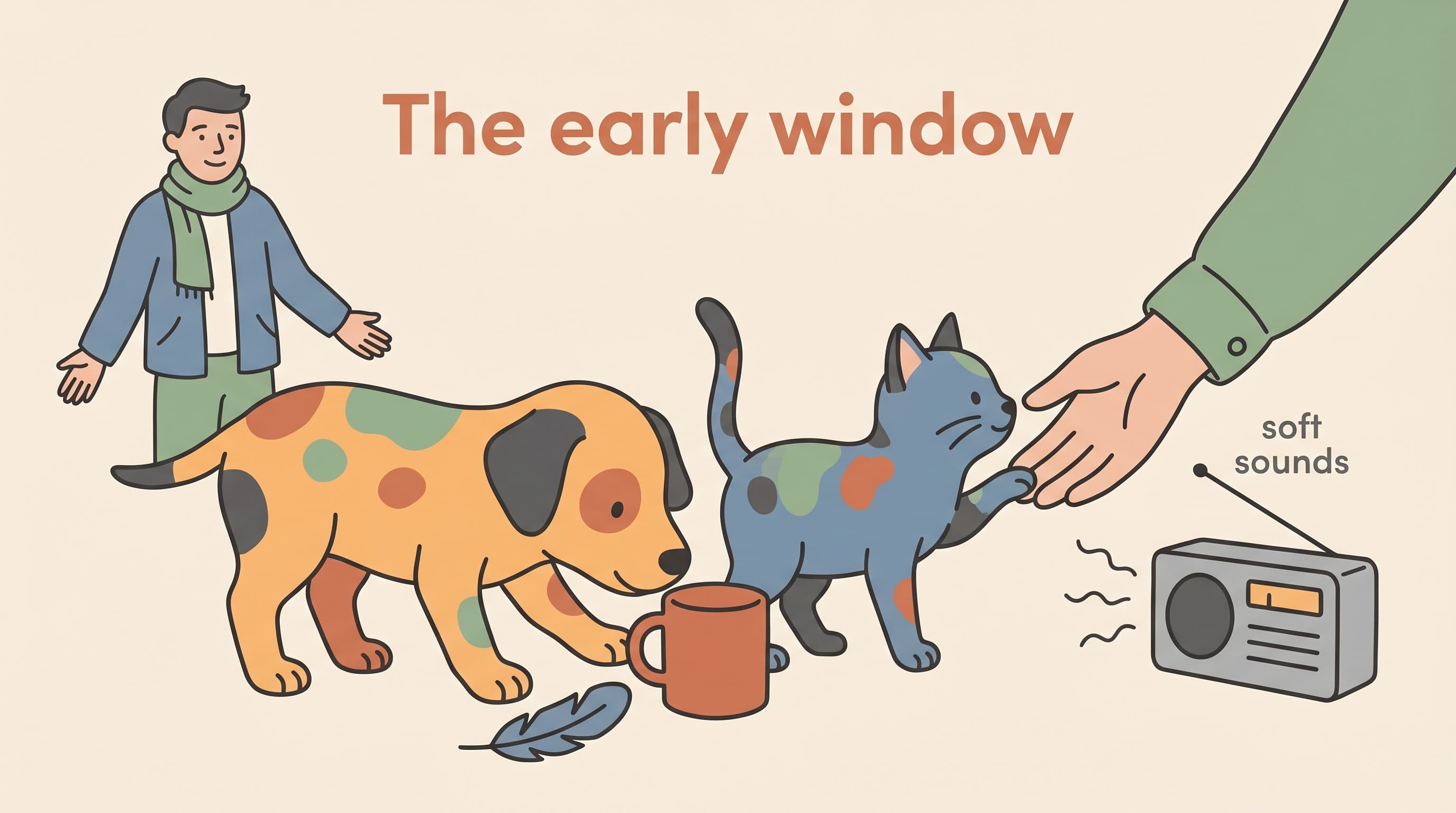
So picture it less as a checklist to blast through and more as a series of small, pleasant introductions at the animal's own pace: a puppy meeting one calm adult who drops a treat and ignores them, a few seconds of a novel surface, a vacuum cleaner heard from across the room rather than chased round it, a car journey that ends somewhere nice. You are aiming for an animal who notices something new, has a good time, and relaxes, not one who merely copes. If they freeze, back away, or cannot take food, you have gone too far, and the fix is more distance and less intensity, never pushing through. The mechanics of building those good associations belong to desensitisation and counter-conditioning, covered in full in our guide to desensitisation and counter-conditioning, and a socialisation diary keeps your exposures varied and gentle rather than repetitive.
A word here so you do not shoulder blame that is not yours. Temperament is not purely down to experience. Friendliness toward people in cats is shaped by genetics as well as early learning, and the maternal environment leaves its mark on puppies too (Casey & Bradshaw, 2008; Appleby, Bradshaw & Casey, 2002). Genetics set the range your animal can occupy; socialisation places them within it. A shy pup from shy parents was never going to be bombproof, and that is not a failing on your part.
If you missed the window: realistic hope, not false promises
Plenty of you are not raising a puppy or kitten at all. You have an adult, often a rescue with no known history, who is wary of strangers, or other dogs, or simply of life. So let me be straight in both directions, because both false despair and false promises do harm here.
The hopeful part is real. An under-socialised adult can improve. The deficit is well documented (Puurunen et al., 2020), and the clinical approach to closing it works: graded, gentle exposure that keeps the animal under its fear threshold, paired with good things, so the world is slowly relearned as safe. It is the same desensitisation and counter-conditioning used everywhere in fear work, just applied to social experiences, and you will find the how-to in our guide to desensitisation and counter-conditioning. The caveat is that it is slower and more demanding than getting it right first time, and the ceiling may be lower. Some animals stay cautious for life. The goal for these adults is a safe, low-stress life on their own terms, not a bombproof one, and that is a perfectly good goal.
Because this is really a fear-treatment job rather than a socialisation one, the bulk of the practical programme lives in our article on helping a fearful pet. Two specifics sit elsewhere by design: getting a nervous cat comfortable with the carrier and handling is covered in fear of the vet and cooperative care, and the parallel early-life skill of learning to be left alone lives in building alone-time tolerance in puppies.
One last distinction, because it changes what you should do. If a previously confident adult suddenly becomes fearful, that is usually not a socialisation gap surfacing late. New-onset fear in an animal who was fine before is far more likely to be pain, illness or a specific frightening event, and the first move is a veterinary check, as we explain in is it behaviour or is it medical; our behaviour check tool will help you sort whether a new wariness is behavioural or medical. And if you are doing the early work now, hold on to the long view: a few weeks of calm, varied, happy introductions is some of the highest-value time you will ever invest in your pet, quietly lowering the odds of everything from a frightened vet visit to a bite years later (Howell, King & Bennett, 2015; and see children and dogs for the bite-prevention payoff).
References
- Scott JP, Fuller JL. Genetics and the Social Behavior of the Dog. University of Chicago Press, 1965.
- Freedman DG, King JA, Elliot O. Critical period in the social development of dogs. Science, 1961;133(3457):1016-1017.
- American Veterinary Society of Animal Behavior. AVSAB Position Statement on Puppy Socialization. AVSAB, 2008.
- Puurunen J, Hakanen E, Salonen MK, et al. Inadequate socialisation, inactivity, and urban living environment are associated with social fearfulness in pet dogs. Scientific Reports, 2020;10:3527.
- Appleby DL, Bradshaw JWS, Casey RA. Relationship between aggressive and avoidance behaviour by dogs and their experience in the first six months of life. Veterinary Record, 2002;150(14):434-438.
- Serpell J, Jagoe JA. Early experience and the development of behaviour. In: Serpell J, ed. The Domestic Dog: Its Evolution, Behaviour and Interactions with People. Cambridge University Press, 1995:79-102.
- Howell TJ, King T, Bennett PC. Puppy parties and beyond: the role of early age socialization practices on adult dog behavior. Veterinary Medicine: Research and Reports, 2015;6:143-153.
- Karsh EB, Turner DC. The human-cat relationship. In: Turner DC, Bateson P, eds. The Domestic Cat: The Biology of its Behaviour. Cambridge University Press, 1988:159-177.
- Casey RA, Bradshaw JWS. The effects of additional socialisation for kittens in a rescue centre on their behaviour and suitability as a pet. Applied Animal Behaviour Science, 2008;114(1-2):196-205.
- Lowe SE, Bradshaw JWS. Responses of pet cats to being held by an unfamiliar person, from weaning to three years of age. Anthrozoos, 2002;15(1):69-79.
- McCune S. The impact of paternity and early socialisation on the development of cats' behaviour to people and novel objects. Applied Animal Behaviour Science, 1995;45(1-2):109-124.
- Collard RR. Fear of strangers and play behavior in kittens with varied social experience. Child Development, 1967;38(3):877-891.
- Stepita ME, Bain MJ, Kass PH. Frequency of CPV infection in vaccinated puppies that attended puppy socialization classes. Journal of the American Animal Hospital Association, 2013;49(2):95-100.
- Squires RA, Crawford C, Marcondes M, Whitley N (WSAVA Vaccination Guidelines Group). 2024 guidelines for the vaccination of dogs and cats. Journal of Small Animal Practice, 2024;65(5):277-316.
Keep track of how your pet is doing
The owners who cope best are the ones who notice changes early. A simple health log shows you what is working, and what is not, before the next vet visit.
Start tracking, freeYou're not doing this alone
Compare treatment journeys and talk to owners managing behaviour & anxiety. Free to join.
Join PetsLikeMine
Socialise and manage disease, do not choose between them
Now the question that paralyses new puppy owners, and where the common advice is, on the evidence, harmful. You will be told to keep the puppy indoors until the vaccination course is finished, which lands right in the middle of the sensitive period. That trades a low risk for a high one. The disease risk during well-managed early socialisation is genuinely small: in 279 vaccinated puppies attending socialisation classes, none were suspected of or diagnosed with parvovirus, and vaccinated puppies in classes were at no greater risk than vaccinated puppies kept out of them (Stepita, Bain & Kass, 2013). The behavioural cost of waiting, by contrast, is large: behavioural problems, not infectious diseases, are the leading cause of death in dogs under three years of age (AVSAB, 2008).
The message, then, is not "ignore vaccination," and please do not read it that way. It is "socialise and manage disease risk together," which is exactly the position taken by the global vaccination guidelines: the window of susceptibility to infection overlaps the ideal socialisation window, and the benefits of well-run socialisation outweigh the small disease risk of starting before the core course is complete (WSAVA Vaccination Guidelines Group, 2024). In practice a puppy can start well-run classes from around seven to eight weeks, having had at least one set of vaccines at least seven days beforehand plus a first worming, on a clean, cleanable surface, away from the veterinary practice itself (AVSAB, 2008; WSAVA Vaccination Guidelines Group, 2024). Carry an unvaccinated pup through high-traffic or unknown areas, and steer clear of dog parks and dogs of unknown vaccination status. This is mainstream veterinary best practice, not a fringe view. Your own vet knows the disease picture in your area and your puppy's vaccination status, so plan the timing with them rather than on a general rule alone.