

Fear of the vet and the groomer: cooperative care and Fear Free handling
Alastair Greenway
BVM&S MRCVS
The carrier comes out and the cat is gone under the bed. The lead goes on for a trip to the groomer and the dog plants all four feet at the door. By the time you reach the waiting room your pet is panting, trembling, perhaps growling at a receptionist they have met a dozen times, and you are apologising and quietly dreading the next twenty minutes. Almost every owner knows this scene. It is miserable, and it is more than an inconvenience: fear of the vet and the groomer makes good handling dangerous, sours every future visit, and, worst of all, can quietly stop a pet getting the care it needs.
The good news is that this is one of the most workable problems in the whole space, and most of the work happens at home, long before you reach the clinic. This article puts fear work to use in vet and grooming contexts: the happy visit, the carrier, the handling games, the consent behaviours, and the proper place of vet-prescribed pre-visit medication. For the wider picture of helping an anxious animal feel safe, and the foundations of choice and control that everything here rests on, start with our guide to the fearful pet.
Why this matters more than it looks
It is tempting to treat vet fear as a one-day-a-year nuisance you grit your teeth through. The data say otherwise, and cats are the clearest example. In a survey of more than a thousand cat caregivers, 88.7% of cats showed impaired welfare at all stages of the visit, and, tellingly, around a third of owners said that witnessing their cat's stress put them off bringing the cat to the practice at all (Rodan et al., 2022). That is the link that should worry us most: fear quietly erodes preventive care. The wider picture is the same. The Bayer Veterinary Care Usage Study found that roughly half of cats were not receiving regular veterinary care, that 58% of owners said their cat hated the vet, and that for 38% even thinking about the visit was stressful (Volk et al., 2011). A frightened pet is a pet who gets seen less, diagnosed later, and treated harder.
There is a second reason to take this seriously, and it feeds on itself. Cats in particular have good long-term memory and can be marked by a single bad experience, so one rough visit shapes the next (Rodan et al., 2022), and the same holds for dogs at the vet and the groomer. Every forced handling session does not just get you through today, it makes tomorrow worse, which is why doing this gently, and starting early, is the efficient choice as well as the kind one. There is also a payoff that matters to us as vets: a pet who tolerates handling is a pet you can actually examine, so the next time something is genuinely wrong, a medical rule-out is possible rather than a wrestling match. Worth saying too, a sudden new intolerance of handling, in a pet who used to cope, is itself a flag to get checked, because pain is a common and hidden driver. Our behaviour check tool can help you decide whether a change like that warrants a vet visit.
Restraint does not keep them safe
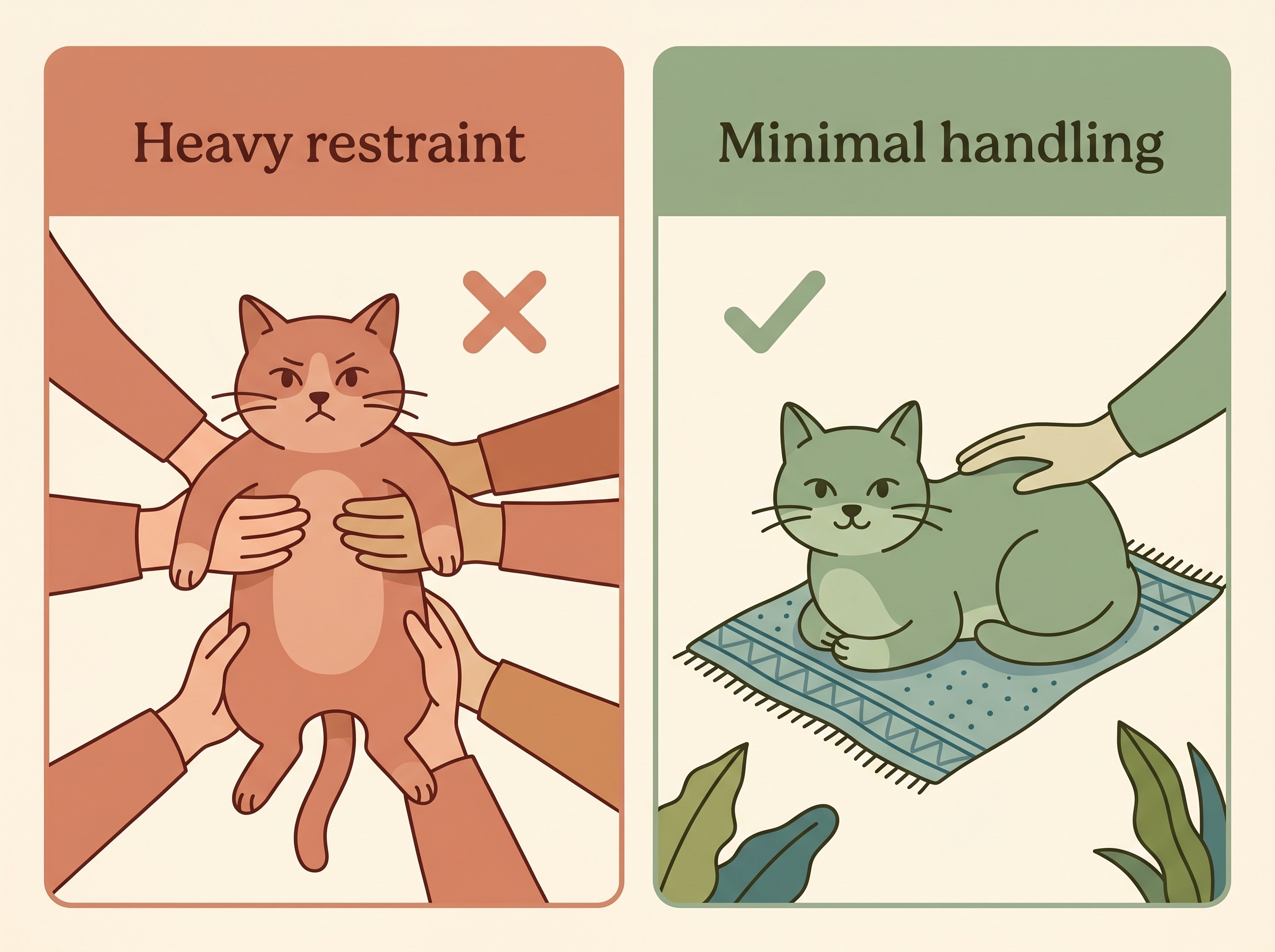
If there is one idea worth dismantling, it is the belief that holding a frightened animal firmly is the responsible thing to do, that it keeps everyone safe and gets the ordeal over with quickly. The evidence points the opposite way. In a controlled study of feline handling, cats placed in full-body restraint were 8.2 times more likely to struggle, showed more lip-licking, flattened ears, raised breathing rates and dilated pupils, and their examinations took more than twice as long; cats handled with light, passive restraint were 6.1 times more likely to stay calmly on the table after they were released (Moody et al., 2018). Restraint does not shorten the bad experience. It deepens it, lengthens it, and teaches the animal that next time will be worse.
This is now the settled professional position. The current feline handling guidelines explicitly discourage heavy restraint such as full-body pinning and scruffing, because minimal handling consistently produces fewer signs of fear; giving the animal a perceived sense of control, and letting a cat choose to approach rather than be grabbed, is treated as fundamental (Rodan et al., 2022). The kind approach and the effective approach turn out to be the same thing: less handling, more breaks, and a way out. This is the heart of Fear Free and low-stress handling, and it is why you are entirely within your rights to ask a practice or a groomer to pause, take a break, or try again another day rather than push a panicking animal through.
At home: the carrier, happy visits and handling games
For cats, the carrier and the car are genuinely half the battle, and this is where home work pays off most. Carrier training works, and we have good evidence for it. In a randomised study, cats given a positive, reward-based carrier training programme over several weeks went on to show lower stress scores during car travel, did not hide or pant in the car, were more likely to take food, and had shorter veterinary examinations than untrained cats (Pratsch et al., 2018). The principle is simple even if the patience is hard: leave the carrier out as a normal, pleasant piece of furniture rather than a once-a-year trap, feed in and around it, and build up to short car trips that do not end at the vet. A frightened cat being allowed to stay tucked in the carrier base as a safe refuge, rather than being tipped out onto the table, is welfare-positive, not "giving in" to the fear.
The broader toolkit applies to both species. Happy visits, where you pop into the practice for a treat and a fuss and then leave with nothing scary having happened, steadily rebuild a positive association, and consistent gentle handling makes an animal easier and safer to work with over time (Rodan et al., 2022). Handling games at home, gently touching paws, ears and the muzzle and pairing each touch with something good, prepare a dog for the groomer's clippers and the vet's examination. This is desensitisation and counter-conditioning applied to a specific context, and the underlying method is covered in full in our guide to desensitisation and counter-conditioning; here you are simply pointing it at the carrier, the car, the nail clippers and the consulting table.
The most powerful version of this is cooperative care: teaching the animal to be an active, willing participant who can signal consent to continue, or ask for a pause. Behaviours like a chin rest on your hand, stationing on a mat, holding still for a nail or an injection, and positive muzzle conditioning all let the animal say "I am ready" and "I need a break." The concept is well established in low-stress practice and is strongly welfare-aligned, and a pilot study in dogs found early signs that cooperative-care training shifted a physiological marker of negative emotion during examination in the right direction (Wess et al., 2022). The controlled outcome evidence is still small and mixed, so consent work is best-practice technique rather than proven cure. A muzzle, taught kindly, deserves a mention as a consent and safety tool rather than a punishment; the gear basics and positive muzzle training live in our piece on reactivity equipment, harnesses and muzzles. For the carrier and car specifically, pheromone sprays such as Feliway and Adaptil are often worth a try as an adjunct, and the evidence for those sits with our calming aids and pheromones guide. A printable cat carrier training plan and a happy vet visit checklist are available to keep you on track.
Pre-visit anxiety medication: the vet-led part
Sometimes the fear is too big for home training to carry on its own, and this is where pre-visit medication earns its place. The framing matters: these are not sedatives that simply flatten an animal, and they are emphatically not something to source or dose yourself. They are vet-prescribed anxiety-relieving medicines, given before the visit, that lower the fear enough for the gentle work to be possible. Used well, they make a single visit calmer and stop it poisoning the next one.
For cats, there is now a genuinely important development for UK owners. Pregabalin, sold as Bonqat, is a licensed prescription-only veterinary medicine specifically indicated for the relief of acute anxiety and fear associated with transport and veterinary visits, given at 5 mg/kg roughly an hour and a half before travel (EMA, 2021). In the pivotal field trial of more than two hundred cats across several countries, it produced significantly better transport and examination ratings than placebo, with only mild, transient wobbliness or sleepiness as side effects (Lamminen et al., 2023). Gabapentin is the other well-evidenced option and is widely used, although in the UK it is off-licence and prescribed under the veterinary Cascade: a single dose given around ninety minutes before transport significantly lowered owner-rated stress scores and made cats easier to examine, with temporary sedation, unsteadiness or occasional drooling (van Haaften et al., 2017). Having a licensed feline choice in Bonqat, alongside the well-tried off-licence gabapentin, is a real step forward.
For dogs, the picture is a little different and worth spelling out. There is no licensed canine pre-visit anxiolytic in the UK, so the medicines used are off-licence under the Cascade, with your written consent. Trazodone has the best vet-visit evidence: it reduced stress behaviours in hospitalised dogs (Gilbert-Gregory et al., 2016), and in a crossover trial a single dose given before transport lowered both owner-rated and video-rated stress during the examination compared with placebo (Kim et al., 2022). Gabapentin is sometimes used too, though its dog vet-visit data are more mixed, with one placebo-controlled study finding only a modest effect (Stollar et al., 2022), so it tends to be a second string. In practice your vet will choose and trial the right drug for your individual dog rather than reaching for a fixed prescription, and any pre-visit medication should be trial-dosed at home before the day so you know how your pet responds. The deeper detail on these and other situational drugs sits with our guide to event medication for noise and fear. It is worth bringing a pre-visit medication discussion guide to the conversation so you and your vet can plan it together.
Choosing a calmer practice and groomer, and the long game
Where you take your pet matters too, because not every premises is set up to handle fear well. In the UK, the most useful badge to look for is the ISFM Cat Friendly Clinic accreditation, awarded at Bronze, Silver and Gold levels, which recognises practices that have invested in feline-aware handling, quieter waiting, separate dog and cat areas and gentler technique. Fear Free, founded in the United States in 2016 around a fear, anxiety and stress scale and the considered use of pre-visit medications, is now international and well worth knowing as a philosophy, and many UK vets and groomers are now trained in low-stress handling even where they hold no formal certificate. It is entirely reasonable to phone ahead, ask how a practice or groomer approaches frightened animals, request the first or last appointment of the day when it is quietest, ask to wait in the car until the consulting room is free, and decline any handling that involves forcing or scruffing. A good professional will welcome this, not bristle at it.
The deeper point is that easier care is a lifetime project, not a single fix. Every calm carrier trip, every happy visit, every nail trimmed without a fight is a small deposit in an account you will draw on for years, and the cat or dog who learns that the vet and the groomer are survivable, even pleasant, is a pet who gets seen sooner and treated more gently when it actually counts. If your pet is young, the very best time to start is now, before any fear takes hold, by gently pairing handling, the carrier and short happy visits with good things, and our guide to the socialisation window covers getting that right from the start. If your pet already finds it hard, pick one thing this week, perhaps just leaving the carrier out with a treat inside, or asking your vet about a pre-visit plan before the next appointment, and build from there. You are not stuck with the trembling animal in the waiting room. With a bit of patience, and a profession increasingly on your side, that picture can genuinely change.
References
- Rodan I, Dowgray N, Carney HC, et al. 2022 AAFP/ISFM Cat Friendly Veterinary Interaction Guidelines: Approach and Handling Techniques. Journal of Feline Medicine and Surgery, 2022;24(11):1093-1132.
- Volk JO, Felsted KE, Thomas JG, Siren CW. Executive summary of the Bayer veterinary care usage study. Journal of the American Veterinary Medical Association, 2011;238(10):1275-1282.
- Moody CM, Picketts VA, Mason GJ, Dewey CE, Niel L. Can you handle it? Validating negative responses to restraint in cats. Applied Animal Behaviour Science, 2018;204:94-100.
- Pratsch L, Mohr N, Palme R, Rost J, Troxler J, Arhant C. Carrier training cats reduces stress on transport to a veterinary practice. Applied Animal Behaviour Science, 2018;206:64-74.
- Wess L, Boehm A, Schuetzinger M, Riemer S, Yee JR, Affenzeller N, Arhant C. Effect of cooperative care training on physiological parameters and compliance in dogs undergoing a veterinary examination - a pilot study. Applied Animal Behaviour Science, 2022;250:105615.
- European Medicines Agency. Bonqat (pregabalin): European Public Assessment Report and Summary of Product Characteristics. EMA, 2021.
- Lamminen T, Korpivaara M, Aspegren J, Palestrini C, Overall KL. Pregabalin Alleviates Anxiety and Fear in Cats during Transportation and Veterinary Visits - A Clinical Field Study. Animals, 2023;13(3):371.
- van Haaften KA, Forsythe LRE, Stelow EA, Bain MJ. Effects of a single preappointment dose of gabapentin on signs of stress in cats during transportation and veterinary examination. Journal of the American Veterinary Medical Association, 2017;251(10):1175-1181.
- Gilbert-Gregory SE, Stull JW, Rice MR, Herron ME. Effects of trazodone on behavioral signs of stress in hospitalized dogs. Journal of the American Veterinary Medical Association, 2016;249(11):1281-1291.
- Kim S-A, Borchardt MR, Lee K, Stelow EA, Bain MJ. Effects of trazodone on behavioral and physiological signs of stress in dogs during veterinary visits: a randomized double-blind placebo-controlled crossover clinical trial. Journal of the American Veterinary Medical Association, 2022;260(8):876-883.
- Stollar OO, Moore GE, Mukhopadhyay A, Gwenin C, Croney C. Effects of a single dose of orally administered gabapentin in dogs during a veterinary visit: a double-blinded, placebo-controlled study. Journal of the American Veterinary Medical Association, 2022;260(9):1031-1040.
Keep track of how your pet is doing
The owners who cope best are the ones who notice changes early. A simple health log shows you what is working, and what is not, before the next vet visit.
Start tracking, freeYou're not doing this alone
Compare treatment journeys and talk to owners managing behaviour & anxiety. Free to join.
Join PetsLikeMine