

Event medication that works: Sileo, trazodone, imepitoin and why ACP is the wrong choice
Alastair Greenway
BVM&S MRCVS
Most dogs who dread fireworks night have, at some point, sent their owner home with a small white tablet "to knock him out for the evening." It is one of the most well-meaning pieces of advice in pet care, and one of the most outdated. The drug is almost always acepromazine, and why it is the wrong choice tells you something important about how event medication is supposed to work. A frightened animal does not need to be switched off. It needs to be made less afraid. Those are not the same thing.
What follows is a straight tour of the medicines a vet might actually reach for to get a noise-phobic pet through an event: what each one does, when it is given, and how good the evidence really is. A quick frame first: none of these are things you can buy or dose on your own. Every option here is vet-prescribed, some formally licensed for noise in the UK and some used off-licence under the prescribing cascade, and the most useful thing you can do is have the conversation with your vet well before the season, not on the afternoon of bonfire night. And before any of it, the usual first step applies. If the fear is new, worsening, or your dog seems sore, rule out pain and illness first, which we cover in is it behaviour or medical? and, for the surprising noise-pain connection specifically, in the hidden pain link.
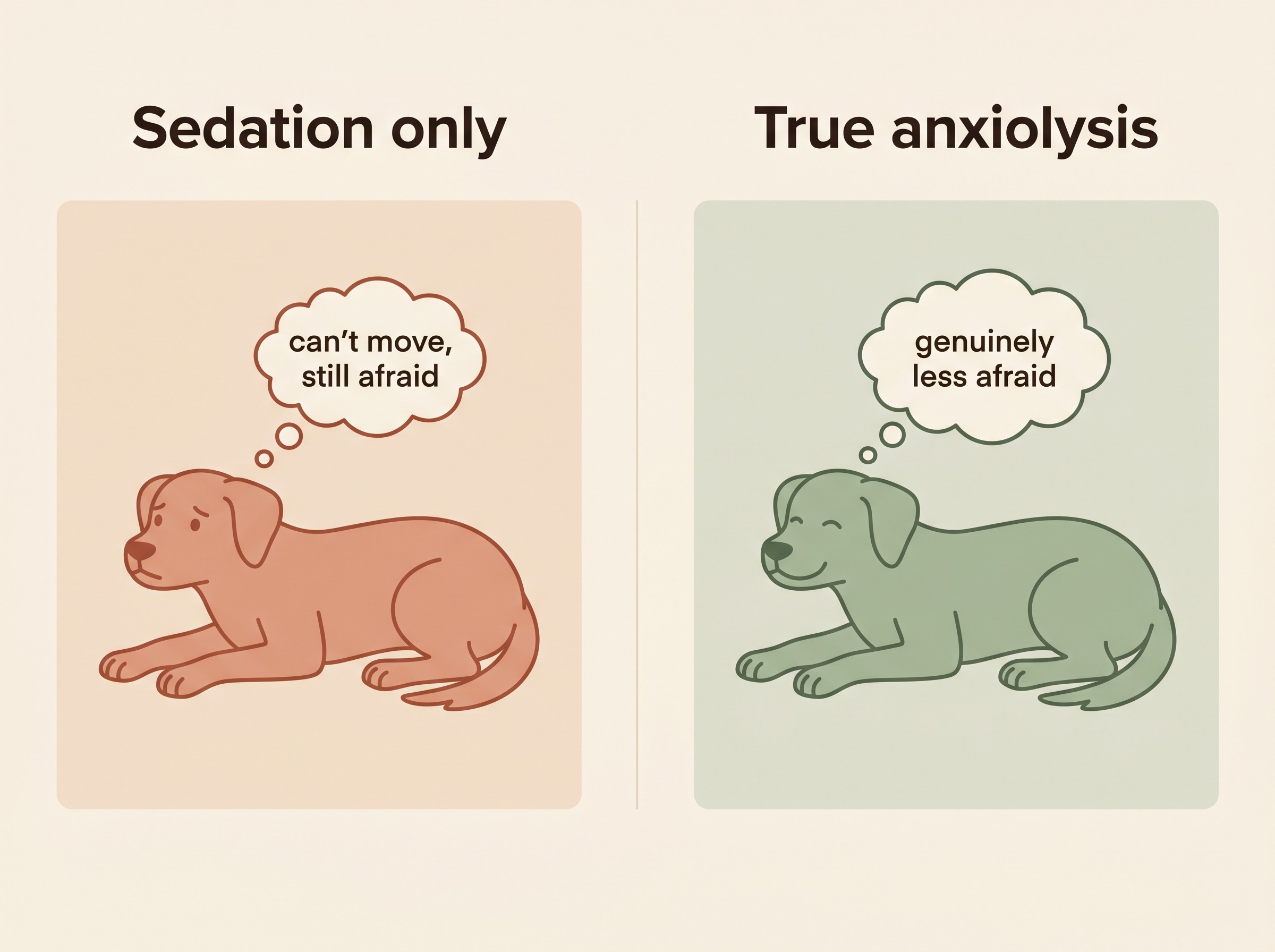
Fear needs anxiolysis, not just sedation
Here is the distinction that everything else hangs on. Acepromazine, usually shortened to ACP, is a sedative. It blocks dopamine receptors and reduces an animal's ability to move, but it has no anxiolytic effect, meaning it does nothing to reduce the fear itself (ESVCE, 2022). Worse, sensory perception can be left intact or even heightened, so the noise still lands just as hard while the dog is physically unable to respond to it. The lay phrase for this is a "chemical straitjacket," and it is a fair description: the animal looks calm because it cannot do otherwise, while inside it is every bit as terrified.
This is not a fringe opinion. The European Society of Veterinary Clinical Ethology, a specialist body, states plainly that acepromazine "has no anxiolytic effect and therefore it is not appropriate to manage acute fear/phobic states," and that its misuse "can potentially increase sensitization to noise, worsening the severity of the phobic state" (ESVCE, 2022). In other words, sedating a frightened dog without touching the fear may deepen the phobia over time, the exact opposite of what you wanted, because the animal is held still and forced to endure the very thing it cannot escape.
To be fair, ACP is not a banned or useless drug. It has a legitimate role as a pre-anaesthetic premedicant, where no calming-of-fear effect is needed or expected (ESVCE, 2022). The point is narrower than "ACP is bad": it is the wrong tool for noise fear, because fear needs anxiolysis. Once you hold that idea, the rest of the options make immediate sense, because every one is chosen for its effect on the fear, not merely on the legs.
Two products carry a UK noise licence
Two products carry an actual UK licence for noise fear in dogs, and that licensing matters, because it means each has been through a regulated efficacy trial rather than borrowed from another use.
First is dexmedetomidine oromucosal gel, sold as Sileo, the only UK-licensed medicine designed specifically for this job. Its licensed indication is "for the alleviation of acute anxiety and fear associated with noise in dogs" (Sileo SPC, NOAH). It is an alpha-2 adrenoceptor agonist, given not as a tablet but as a gel measured onto the gum between cheek and lip, where it absorbs through the lining of the mouth. The technique matters: it must sit on the gum and not be swallowed, because once swallowed it is far less well absorbed and may not work, and the syringe is dosed in marked increments by the dog's weight (Sileo SPC, NOAH). You give it at the first sign of anxiety, or as soon as you know the trigger is coming, and it can be repeated every two hours up to five doses in an event (Sileo SPC, NOAH). The evidence is genuinely good: in a randomised, double-blind, placebo-controlled trial run on New Year's Eve, an excellent or good effect was seen in 72% of treated dogs (64 of 89) against 37% on placebo (34 of 93) (Korpivaara et al., 2017). Reassuringly for a long firework season, repeated use across a series of events is safe, most dogs stayed fully responsive and able to walk normally an hour after a dose, and the need to medicate falls over time, with the odds of needing a dose dropping by more than a quarter with each successive event and half of dogs skipping treatment for at least one event altogether (Gruen et al., 2020).
Second is imepitoin, sold as Pexion, which now carries a UK and EU indication "for the reduction of anxiety and fear associated with noise phobia in dogs" alongside its older epilepsy licence (Pexion SPC, NOAH). It is a partial agonist at the benzodiazepine site of the GABA-A receptor, and it differs in one key respect: it is not a last-minute drug. For the noise indication the licensed dose is 30 mg/kg twice daily, started two days before the expected noise and continued through the day itself (Pexion SPC, NOAH). In its pivotal trial a good or excellent result was nearly five times more likely than on placebo (cumulative odds ratio 4.7; Engel et al., 2019). The main caveat is wobbliness: transient ataxia was the commonest side effect, seen in about 35% of treated dogs, usually settling within a day or two of continued dosing (Engel et al., 2019). Because it is loaded in advance, imepitoin is useless if you remember it on the night, which is exactly why a pre-season plan beats a panic.
Off-licence options, used under the cascade
Beyond the two licensed products sit several drugs used off-licence for situational anxiety, meaning your vet prescribes them under the cascade because they judge them helpful, even though they carry no specific UK noise licence. They are genuinely useful, but the evidence is more modest, and it is right to say so.
Trazodone is a serotonin antagonist and reuptake inhibitor, given off-licence for situational stress. In a study of 120 hospitalised dogs it reduced stress behaviours such as lip-licking, panting, whining and whale eye within about 90 minutes and was well tolerated across a wide dose range (Gilbert-Gregory et al., 2016), and an earlier case series of 56 dogs found it a useful add-on with relatively minor side effects (Gruen & Sherman, 2008). Gabapentin is used the same way: in a placebo-controlled crossover trial of 18 storm-phobic dogs, a single dose of 25 to 30 mg/kg given at least 90 minutes before storms significantly reduced owner-rated fear, with ataxia the commonest side effect (Bleuer-Elsner et al., 2021). Note that "owner-rated" and just 18 dogs are real limits: this is helpful evidence, not the last word. Benzodiazepines such as alprazolam are the fastest-acting of the group, given 30 to 60 minutes before a trigger, but with two cautions. A minority of dogs show a paradoxical reaction, becoming more agitated or disinhibited rather than calmer, which is why a first dose should always be trialled in advance on a quiet day under supervision and never given for the first time before leaving a dog alone (MSD Veterinary Manual). Vets do sometimes combine these drugs, for instance trazodone with gabapentin, but that is a clinical decision for an individual animal, not something to stack at home.
Timing is the thread running through all of this. Imepitoin is loaded two days ahead; Sileo, gabapentin and the benzodiazepines are given acutely, minutes before or at the first flicker of worry. Whichever your vet chooses, trial it once well before the season so you both know how your pet responds on a calm evening rather than discovering a paradoxical reaction on the worst possible night. A pre-season check is the natural moment to raise this, and our behaviour check can help you frame that conversation.
A separate word about cats
Cats are too often left out of this conversation, and the reality is that they are under-served. Firework fear in cats is real but badly under-recognised. In a large owner survey, most affected cats showed clear distress, with hiding, fleeing and trembling all common, yet owners sought advice for cats far less often, around 23%, than for dogs, around 54% (van Herwijnen et al., 2024). They suffer, but more quietly, and so they slip under the radar.
The harder truth is that no event medication is licensed for noise fear in cats at all. Gabapentin is the pragmatic off-licence mainstay for feline situational anxiety, with the best controlled evidence coming from the vet-visit and transport setting rather than firework-specific trials (van Haaften et al., 2017), so its use here is a reasonable extrapolation by your vet rather than something a noise trial has proven. That gap is not a reason to leave a frightened cat alone. It is a reason to plan ahead with your vet, lean harder on a well-prepared hiding place and the environment, and accept that the picture for cats is simply less settled than for dogs.
How medication fits the bigger plan
Event medication is a support, not a standalone fix, and it works best as one layer of a plan. The interventions owners rate most effective are actually the behavioural ones: counter-conditioning was rated effective by more than 70% of owners and relaxation training by 69%, with desensitisation to noise recordings at 55% (Riemer, 2020). The medicines above are what get a pet through the night with less distress while that longer work does its job.
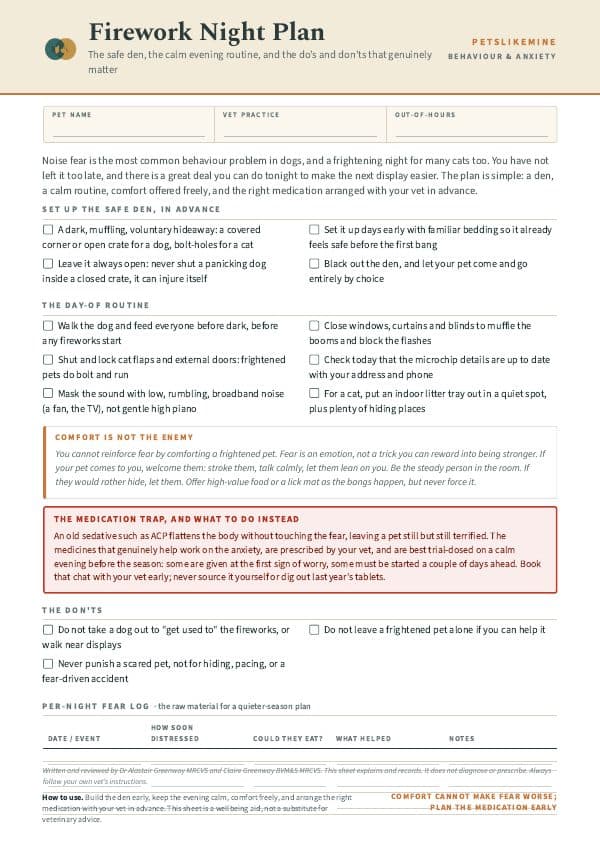
So pair the right drug with the two things that surround it. On the night, the medication sits inside your firework night plan: the safe den, the masking sound and the permission to comfort a frightened pet. Between seasons, the real progress comes from sound desensitisation, the off-season retraining that medication is there to support rather than replace. The over-the-counter calming aids and pheromones you may have seen, things like Adaptil, sit alongside all of this and are weighed up honestly in calming aids, pheromones and supplements. And if the fear is severe, year-round, or bound up with other anxieties, that is the point to get proper help, set out in finding real help. For a dog whose anxiety runs deeper than the firework season, the conversation shifts from these event drugs to daily anti-anxiety medication, a different approach covered in medication for separation anxiety.
The single most powerful move costs nothing and happens long before any drug is dispensed: book the pre-season chat with your vet now, while the evenings are still quiet. Decide together which option fits your pet, trial it on a calm night, and make sure anything that needs loading in advance is in the cupboard with days to spare. Do that, and you walk into the next noisy night with a real plan in hand rather than a white tablet and a hope.
References
- European Society of Veterinary Clinical Ethology (ESVCE). Position statement on the use of acepromazine for the prevention/treatment of noise fears and phobias. ESVCE, 2022.
- Orion Corporation / Zoetis. Sileo 0.1 mg/ml oromucosal gel for dogs (dexmedetomidine): Summary of Product Characteristics. NOAH Compendium of Data Sheets for Animal Medicines.
- Korpivaara M, Laapas K, Huhtinen M, et al. Dexmedetomidine oromucosal gel for noise-associated acute anxiety and fear in dogs - a randomised, double-blind, placebo-controlled clinical study. Veterinary Record, 2017;180(14):356.
- Gruen ME, Case BC, Robertson JB, Campbell S, Korpivaara M. Evaluation of repeated dosing of a dexmedetomidine oromucosal gel for treatment of noise aversion in dogs over a series of noise events. Veterinary Record, 2020;187(12):489.
- Boehringer Ingelheim. Pexion 100 mg and 400 mg tablets for dogs (imepitoin): Summary of Product Characteristics. NOAH Compendium of Data Sheets for Animal Medicines.
- Engel O, Muller HW, Klee R, Francke B, Mills DS. Effectiveness of imepitoin for the control of anxiety and fear associated with noise phobia in dogs. Journal of Veterinary Internal Medicine, 2019;33(6):2675-2684.
- Gilbert-Gregory SE, Stull JW, Rice MR, Herron ME. Effects of trazodone on behavioral signs of stress in hospitalized dogs. Journal of the American Veterinary Medical Association, 2016;249(11):1281-1291.
- Gruen ME, Sherman BL. Use of trazodone as an adjunctive agent in the treatment of canine anxiety disorders: 56 cases (1995-2007). Journal of the American Veterinary Medical Association, 2008;233(12):1902-1907.
- Bleuer-Elsner S, Medam T, Masson S. Effects of a single oral dose of gabapentin on storm phobia in dogs: a double-blind, placebo-controlled crossover trial. Veterinary Record, 2021;189(7):e453.
- MSD Veterinary Manual. Treatment of Behavior Problems in Animals. MSD Veterinary Manual (online), accessed 2026.
- van Herwijnen IR, Vinke CM, Arndt SS, Roulaux PEM. Firework aversion in cats and dogs as reported by Dutch animal owners. Veterinary and Animal Science, 2024;26:100402.
- van Haaften KA, Forsythe LRE, Stelow EA, Bain MJ. Effects of a single preappointment dose of gabapentin on signs of stress in cats during transportation and veterinary examination. Journal of the American Veterinary Medical Association, 2017;251(10):1175-1181.
- Riemer S. Effectiveness of treatments for firework fears in dogs. Journal of Veterinary Behavior, 2020;37:61-70.
Free downloads
Companion worksheets to put what you've read into practice. Free PDFs, print at home.
Keep track of how your pet is doing
The owners who cope best are the ones who notice changes early. A simple health log shows you what is working, and what is not, before the next vet visit.
Start tracking, freeYou're not doing this alone
Compare treatment journeys and talk to owners managing behaviour & anxiety. Free to join.
Join PetsLikeMine