

The hidden pain link: when noise fear is a sign of undiagnosed pain
Alastair Greenway
BVM&S MRCVS
Some dogs who are frightened of fireworks, thunder or sudden bangs are not "just" noise-phobic. They are in pain, and nobody has spotted it yet. It surprises almost everyone, owners and vets alike, the first time they meet the idea. The fear of the noise is real, but sitting underneath it is a sore hip, a stiff spine or aching joints that has quietly changed the whole shape of how that dog reacts to sound. Treat the noise fear on its own and you may make slow, frustrating progress. Find and treat the pain as well, and the whole picture can shift.
This is one of the more important and least-known ideas in canine behaviour. I want to do two things: walk you through what the evidence actually shows, including its real limits, because this is a small and young field and I would rather you trusted me than oversold it; and give you the three practical signals that should make you, or your vet, stop and ask "could this dog be in pain?" If your dog's noise fear fits the pattern, the most useful thing you can do is take that thought to your vet. This is a closer look at one thread of the bigger picture covered in is it behaviour or is it medical?, and it is the thread worth pulling.
Where the idea came from
The idea began with a small but careful study from a UK referral clinic. Researchers compared two groups of dogs that had all been referred for noise sensitivity: ten with a confirmed musculoskeletal pain problem, and ten who were pain-free. They then looked, in detail, at how the noise fear behaved in each group (Lopes Fagundes et al., 2018).
The differences were striking. In the pain group, the noise fear had typically begun much later in life, at around six years old on average, compared with around two years in the pain-free dogs, an onset nearly four years later (Lopes Fagundes et al., 2018). A later review of pain and problem behaviour independently restated this, noting that "the average age of onset of noise reactivity in pain related cases was 6 years of age compared to 2 years of age in pain-free dogs" (Mills et al., 2020). Two separate looks at the same data landing on the same number matters, and we will come back to why.
The pain-group dogs also spread their fear far more widely. Eight of the ten generalised their fear, with five coming to avoid the specific places where the frightening noise had happened and three avoiding car travel altogether, against only two of the ten pain-free dogs, described in the review as a "greater tendency to avoid a very wide range of locations associated with the noise" (Lopes Fagundes et al., 2018; Mills et al., 2020). There was one more quiet clue: the pain-group dogs tended to hide rather than run to their owner, possibly because being touched or handled when sore made things worse (Mills et al., 2020). If your dog used to seek you out in a storm and now takes himself off to a corner, that is worth noticing.
How was the pain found? Not by guesswork. The dogs were worked up properly, with physical examination, radiographs in eight and an MRI in one, and the diagnoses were the everyday culprits: hip dysplasia or hip problems in five, degenerative joint disease of the limbs in four, and a focal spinal change called spondylosis in one (Lopes Fagundes et al., 2018). These are common, ordinary sources of canine pain, which is precisely the point.
How a sore body changes the way a dog hears a bang
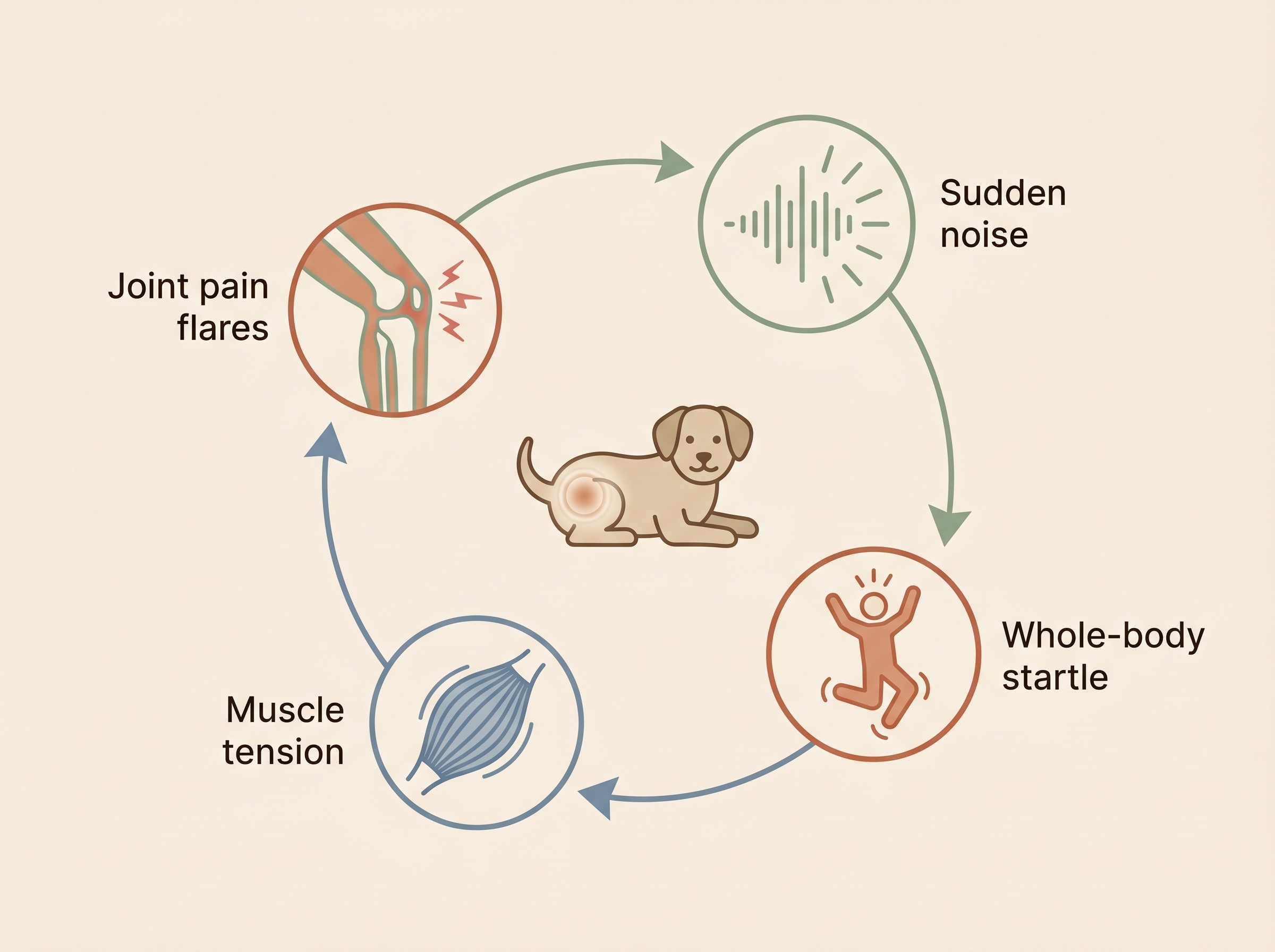
So what could link a painful hip to a fear of fireworks? The leading explanation is a simple, biologically sensible loop, and it is worth understanding because it makes everything else click into place.
When any dog hears a sudden loud noise, the body reacts before the mind catches up: a startle response, muscles tensing all over in a split second. In a dog with a comfortable body that tensing is harmless and passes. But in a dog whose hips or spine already hurt, that same reflexive clench can wrench a sore joint and send a jolt of pain through the body. The dog now has a frightening noise and a flare of pain arriving together, and the brain does what brains are built to do: it forms an association. The noise, and then the place where the noise happened, become linked to pain, which is why the fear grows and spreads to new sounds and new locations (Lopes Fagundes et al., 2018).
A broader mechanism sits on top of this. Chronic pain does not just hurt in the moment; it lowers an animal's whole resilience to stress, producing what behaviourists call a negative cognitive bias, a tendency to expect the worst, alongside heightened anxiety, all of which make problem behaviours more likely and more intense (Mills et al., 2020). So a dog in ongoing pain is primed to find the world more threatening, and a loud bang lands on an already frayed nervous system. The startle-and-tense loop explains the specific link to a sore body and to particular places; the cognitive-bias picture explains why pain ramps up fear more generally.
Three signals that should make you think "pain"
This is the part to take to your vet, because the same study that found the link also handed us a usable set of warning signs. If your dog's noise fear fits this pattern, it is a flag, not a diagnosis, but a flag worth acting on (Lopes Fagundes et al., 2018).
Start with later onset. Noise fear that starts, or sharply worsens, in a middle-aged or older dog should raise an eyebrow, because the typical noise-phobic dog develops the problem young. A previously bombproof seven-year-old who suddenly cannot cope with fireworks is telling you something has changed, and a changed body is a strong candidate. This fits a wider pattern: a large Norwegian survey of over five thousand dogs found a genuine trend of noise fear increasing with older age, so late-onset noise fear is a real phenomenon, not a fluke of one clinic (Storengen & Lingaas, 2015). That study did not test for pain, so I will not stretch it to say more, but it confirms that noise fear is not always an early, fixed trait.
Next, watch for fear that generalises. If the fear is spreading, from fireworks to thunder to the washing machine to the bin lorry, or from one room to the whole house, that widening is the kind of pattern the pain-group dogs showed (Lopes Fagundes et al., 2018).
And then there is avoiding specific places. A dog that now refuses the garden, baulks at a particular room, or has started dreading the car may have linked a noise, a place and a flare of pain, and place-avoidance and car-avoidance were notably more common in the dogs that turned out to be sore (Lopes Fagundes et al., 2018).
If one or more of these rings true, our behaviour check triage tool will help you decide whether a pain work-up belongs in your dog's plan, and it is built for exactly this question of "is this medical?".
How real pain slips past everyone
It is fair to ask: if these dogs were in pain, how did nobody notice? The answer is what makes the premise plausible rather than far-fetched.
Osteoarthritis is one of the commonest sources of chronic pain in dogs, strongly tied to age, and genuinely under-diagnosed. UK primary-care data put the recorded rate of appendicular osteoarthritis at around 2.5% of dogs a year, roughly 200,000 dogs in the UK annually, with a median age at diagnosis of 10.5 years and the highest risk in dogs over twelve (Anderson et al., 2018). Notably, the same researchers noted that the true figure is almost certainly higher, because these cases are under-recorded even in veterinary records (Anderson et al., 2018). The condition is widely recognised across the profession as under-diagnosed, in part because owners miss the early signs (American Animal Hospital Association).
Here is the trap that hides it: many people assume a dog in pain will obviously limp. A great many do not, especially when the arthritis is in both hips or both knees, because there is no good leg to limp onto, and the dog simply slows down, stiffens up, and is quietly labelled as "getting old." That is exactly why a sore, middle-aged or older dog can be carrying real, treatable pain that nobody has spotted, and why a new fear of noises might be the first loud signal that body gives. Pain is common in behaviour cases generally too: across six referral clinics, a conservative estimate was that around a third of dogs referred for behaviour problems had a relevant painful condition, and at some clinics the figure approached eighty per cent (Mills et al., 2020). So while "he has just got grumpier and more nervous with age" feels like an explanation, a genuine, fixable pain problem can masquerade as an age-related change in temperament, and that is a far more hopeful possibility than resignation.
What treating the pain does, and what it does not
So does finding the pain help? In the study, it did. Every one of the pain-group dogs was reported to improve with treatment, the single exception being a dog whose owner declined pain relief, and by review most of both groups had resolved to their owners' satisfaction (Lopes Fagundes et al., 2018).
But I want to be precise about what that means. The dogs were treated with a combined approach, pain relief alongside behaviour work, so the improvement cannot be put down to the painkiller alone (Lopes Fagundes et al., 2018). Treating the pain removes a hidden driver and makes the behaviour work far more effective; it does not mean a tablet cures noise phobia. The two belong together, and controlling pain can help the retraining, the sound desensitisation and counter-conditioning, finally stick, because you are no longer trying to teach calm to a dog whose body keeps punishing it.
A safety point that genuinely matters here: assessing pain and trialling pain relief is strictly a job for your vet, never something to attempt at home. Many human painkillers, including paracetamol and ibuprofen, are toxic to dogs and can be fatal, so please never reach for the bathroom cabinet. The action to take here is a conversation, not a treatment: ask your vet to assess your dog for pain, and to consider a pain trial if it is warranted. Where pain relief sits alongside the event medication some dogs need for fireworks night is, again, a vet's call to make with you.
How sure can we actually be?
Let me be straight about the strength of the evidence, because it is the most important caveat in this piece.
The core study is small, with just twenty dogs in total, retrospective, and qualitative, drawn from a single referral clinic (Lopes Fagundes et al., 2018). The authors said plainly that no statistical significance should be read into their findings, the pain-free dogs were not imaged or pain-trialled to the same degree, and referral clinics see more severe and complicated cases than the average vet. So this is not proof that noise fear is "caused by" pain in most dogs. It is a plausible, clinically important association and a sensible hypothesis, and it should be held as exactly that.
What gives it real weight is the combination of three things: the pattern was strikingly consistent within that small group; it was independently restated and supported by a separate, broader review of pain and behaviour (Mills et al., 2020); and it rests on solid ground underneath, a believable biological mechanism plus the well-documented fact that painful osteoarthritis is common, age-linked and under-diagnosed in dogs (Anderson et al., 2018). You do not need to overclaim the twenty-dog study for the idea to be worth acting on, because the background facts carry it. The leading voices in this field have reached a clear practical conclusion: dogs with noise sensitivities should be carefully assessed for pain, especially when they show these later-onset, generalising, place-avoiding features, and where pain is suspected it is reasonable to treat it early rather than waiting for behaviour therapy to fail first (Lopes Fagundes et al., 2018; Mills et al., 2020).
That is the takeaway worth carrying into your next vet visit. If your dog's fear of noises started late, is spreading, or is making him avoid places he used to be fine in, do not file it under "old age" or "just his nature." Mention the possibility of pain out loud, and let your vet take it from there. For the wider picture of why noise fear happens and worsens, our overview on noise and firework fear is the place to go next, and if storms or gunshots are your dog's particular trouble, thunderstorms, gunshots and the generally noise-sensitive pet carries the pain link into those specifics.
References
- Lopes Fagundes AL, Hewison L, McPeake KJ, Zulch H, Mills DS. Noise Sensitivities in Dogs: An Exploration of Signs in Dogs with and without Musculoskeletal Pain Using Qualitative Content Analysis. Frontiers in Veterinary Science, 2018; 5:17.
- Mills DS, Demontigny-Bedard I, Gruen M, et al. Pain and Problem Behavior in Cats and Dogs. Animals, 2020; 10(2):318.
- Storengen LM, Lingaas F. Noise sensitivity in 17 dog breeds: Prevalence, breed risk and correlation with fear in other situations. Applied Animal Behaviour Science, 2015; 171:152-160.
- Anderson KL, O'Neill DG, Brodbelt DC, et al. Prevalence, duration and risk factors for appendicular osteoarthritis in a UK dog population under primary veterinary care. Scientific Reports, 2018; 8:5641.
- American Animal Hospital Association (AAHA). Canine osteoarthritis: An underdiagnosed condition. AAHA Trends Magazine.
Free downloads
Companion worksheets to put what you've read into practice. Free PDFs, print at home.
Keep track of how your pet is doing
The owners who cope best are the ones who notice changes early. A simple health log shows you what is working, and what is not, before the next vet visit.
Start tracking, freeYou're not doing this alone
Compare treatment journeys and talk to owners managing behaviour & anxiety. Free to join.
Join PetsLikeMine