

Noise and firework fear: why it happens and why it worsens with age
Alastair Greenway
BVM&S MRCVS
Trembling at fireworks, hiding at the first rumble of thunder, bolting at a slammed door: this is the single most common behavioural problem in dogs, and one of the most under-recognised in cats. It is not an odd quirk or a sign of a soft pet. Two things owners are most often told about it happen to be the two things that are wrong. The first is that the pet will simply grow out of it. The second is that there is little to be done. It rarely fades on its own, and it is genuinely treatable, the earlier the better.
Think of this piece as the map to the whole noise-fear section: how common and under-reported the problem is, what the usual triggers are, why it tends to worsen without help, who is most at risk, and the quieter but very real picture in cats. The hands-on parts, the firework night plan, the off-season retraining, the medication and the surprising link to pain, each have their own article, and I will point you to them as we go.
Far more common than owners realise
When researchers actually count, noise fear turns out to be everywhere. In a survey of more than 13,700 dogs, noise sensitivity was the most prevalent of seven anxiety-related traits studied, affecting around 32% of dogs, and fear of fireworks was the single commonest sub-trait at about 26% (Salonen et al., 2020). A broad review of the field puts the proportion of pet dogs affected at between a quarter and half of the whole population (Riemer, 2023). Whichever figure you take, this is one of the most common things a vet sees, even if it rarely walks through the door as the reason for the visit.
Why does it rarely walk through the door? Because owners massively under-report it. In one careful study, only about a quarter of owners described their dog as fearful of noises when asked a general question, yet roughly half of those same owners went on to report at least one clear fear behaviour, trembling in 43%, barking in 38%, and seeking out people in 35%, once they were asked in a structured way (Blackwell et al., 2013). Tellingly, fewer than a third of owners with an affected dog had ever sought professional advice about it (Blackwell et al., 2013).
The gap between a quarter and a half is not researchers contradicting each other. The number you get depends on how you ask, and most of us do not register trembling or hiding as fear until someone helps us name it. If you have ever said your pet is not really bothered by fireworks while they shiver behind the sofa, the first useful step is to call it what it is.
The triggers, in rough order
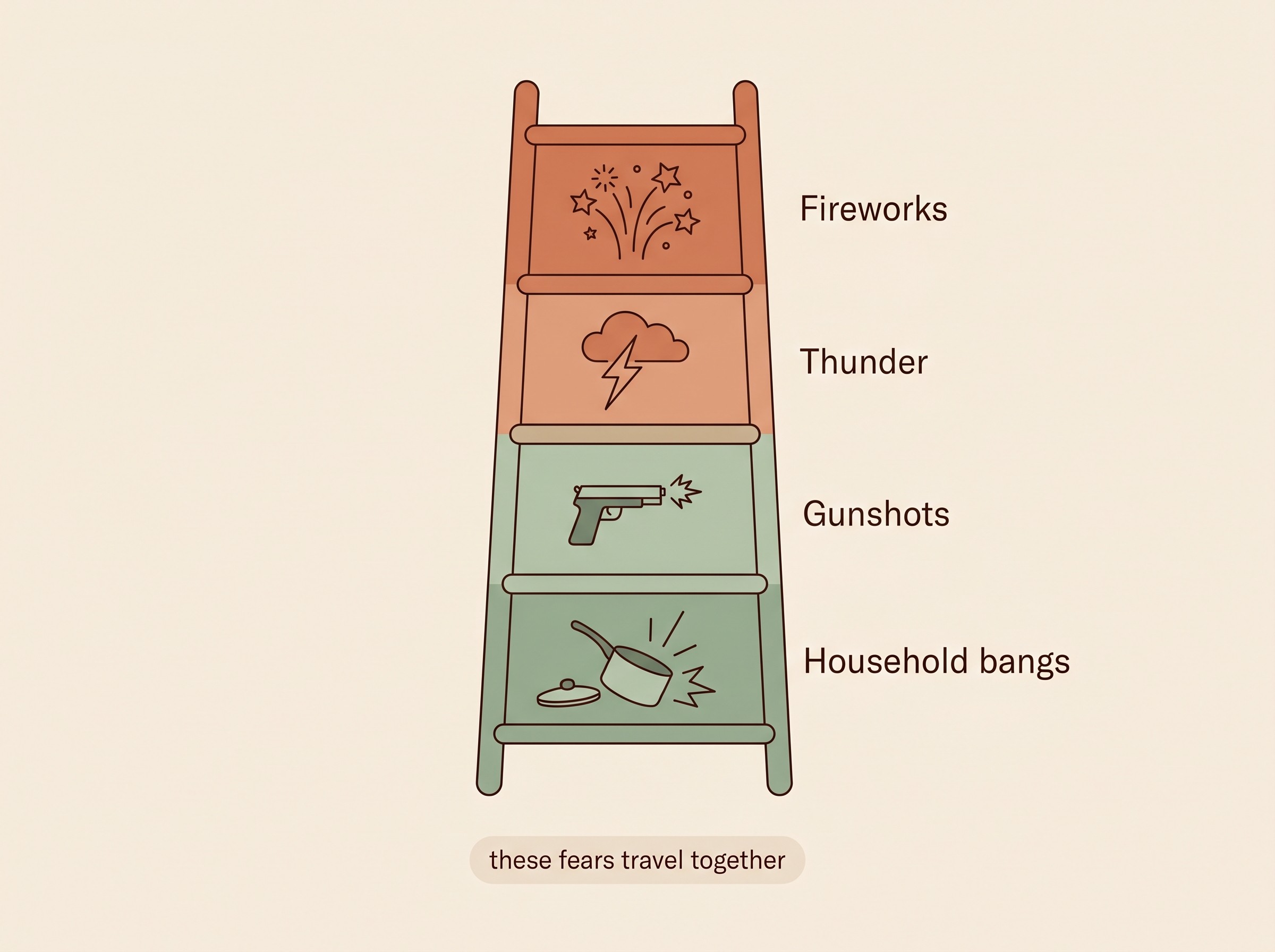
Noise fears cluster around a recognisable set of sounds. Fireworks are the most common trigger, followed by thunder, then gunshots and bird-scarers, with everyday household and traffic bangs further down the list (Riemer, 2023). One large breed survey of more than 5,000 dogs found around 21% showed a strong or very strong fear of fireworks, about 14% of gunshots, and only a small minority were strongly frightened by heavy traffic (Storengen & Lingaas, 2015).
What is striking is that these fears travel together. A dog frightened of fireworks is much more likely to also fear thunder and gunshots, with the strongest overlap of all between fireworks and gunshots (Storengen & Lingaas, 2015). The common thread is not the firework or the storm specifically. It is the sudden, loud, unpredictable bang the brain has learned to dread, which is why a pet frightened of one noise often broadens to several over time.
If storms or gunshots are your pet's main trigger rather than fireworks, there are extra complications, the static charge and pressure changes of a storm and the unpredictability of a rural shoot, worth understanding in their own right. Our article on thunderstorms, gunshots and the generally noise-sensitive pet covers those, and the firework season has its own dedicated night plan.
Why it gets worse, not better
One belief does more harm than any other, because it costs pets years of avoidable distress: the idea that a frightened young dog will grow out of it. The evidence points firmly the other way. Both large surveys that have looked at age found that noise fear, on average, increases as dogs get older rather than fading (Storengen & Lingaas, 2015; Salonen et al., 2020). Most affected dogs first show signs in their first or second year of life, and without help the fear tends to deepen from there (Riemer, 2023).
What is going on underneath is sensitisation, essentially the opposite of getting used to something. With many harmless but startling experiences, an animal habituates: the response shrinks with repetition until the sound barely registers. Noise fear works in reverse. Each frightening exposure teaches the brain a little more firmly that the sound predicts danger, so the next time the response is bigger, not smaller, and the fear feeds on its own repetitions. This is well-established clinical understanding rather than a single headline experiment, and it is why "just keep exposing them and they'll cope" is such poor advice (Sherman & Mills, 2008; Riemer, 2023).
Let me be clear about what the evidence actually shows. The breed surveys are cross-sectional, comparing different dogs of different ages at one moment, so they tell us older dogs are more fearful on average, which is consistent with fears worsening but does not prove that any given dog is destined to deteriorate. The fair way to put it is that noise fear tends to worsen, and rarely improves on its own, rather than that it always gets worse like clockwork. One nuance is worth knowing: a genuinely new noise fear appearing for the first time in a dog over about six years of age is relatively uncommon, and when it does it deserves a closer look (Riemer, 2023), for reasons I will come to.
Who is most at risk, and the pain connection
Several things load the dice. Breed and genetics clearly matter: firework fear ranged enormously between breeds in one study, from around 8% in some to over 30% in others, and the early typical onset points to an inherited component (Storengen & Lingaas, 2015). The heritability of noise sensitivity has been estimated at moderate levels, with figures varying by breed, trait and method but typically falling in the region of 0.1 to 0.3, and genetic regions linked to noise sensitivity have now been mapped, underlining that this is partly wired in rather than purely a matter of how a pet was raised (Salonen et al., 2020; Riemer, 2023). Sex plays a smaller part, with females showing modestly higher odds of firework fear (Storengen & Lingaas, 2015).
Genes are not the whole story, and that is good news, because the rest is where you can make a difference. Mixed-breed dogs have scored highest for noise fear in more than one study, pointing to environment and early experience rather than breed alone (Riemer, 2023). In fact, after age, the factor most strongly associated with firework and thunder fear was how many different experiences a dog had during the early socialisation period, with more early, positive exposure linked to less fear later (Riemer, 2023). That is precisely why getting socialisation right in the puppy and kitten window is one of the best preventive investments you can make.
There is one more risk factor that almost no competitor page mentions, and it is the one I most want you to file away. In dogs, noise sensitivity that appears later in life, or worsens out of the usual pattern, can be a sign of undiagnosed pain. Dogs with musculoskeletal pain in one study developed their noise sensitivity around four years later than pain-free dogs, at about six and a half years old rather than under three (Lopes Fagundes et al., 2018). The proposed explanation is that the body tensing and startling at a loud bang aggravates a sore joint, so the dog learns to dread not just the sound but the discomfort that follows. The full story, the mechanism, the signs and how treating the pain can ease the fear, lives in our dedicated article on the hidden pain link. For now, the headline is enough: a later-life or unusually sudden noise fear is a reason to see your vet, not just a behaviourist.
Cats are frightened too, just more quietly
Cats are too often left out of this conversation, and they should not be. A large owner survey found that 76.8% of cats showed fear during fireworks, almost identical to the 77.4% of dogs in the same study (van Herwijnen et al., 2024). We notice it less not because cats mind it less, but because they show it differently. Where a frightened dog may pace, vocalise and seek out its owner, a frightened cat overwhelmingly hides, in 75.9% of cases, flees in around 65%, and freezes in 43% (van Herwijnen et al., 2024). A cat tucked silently under the bed reads as coping far more easily than a dog trembling at your feet, and the same study found owners do identify firework fear less readily in cats than in dogs (van Herwijnen et al., 2024).
So if your cat vanishes the moment the bangs start and reappears subdued hours later, do not file that under cats being cats. That is fear, it can deepen, and it is worth managing. The practical tweaks for a frightened cat, where to site a hiding place and how to make the night feel safe, sit within our firework night plan.
The hopeful part: this is treatable
I have been candid about how common and how progressive noise fear is, so let me be equally clear about the optimism. This is one of the more treatable problems in all of behaviour. Preventive training has been shown to stop noise fears developing in the first place, in both puppies and adult dogs, and structured desensitisation and counter-conditioning using recordings has been shown to reduce established fears (Riemer, 2023). Vets are encouraged to recognise and treat noise fear at the first sign of it, because left untreated it risks the bond between pet and owner breaking down, and in the worst cases leads to relinquishment (Sherman & Mills, 2008).
In practice that means a small toolkit, each piece with its own article. The long game, the actual cure, is patient sound retraining done in the calm of the off-season, covered in sound desensitisation and built on the underlying desensitisation and counter-conditioning technique. The short game, getting your pet through the next bad night, is the firework night plan. And where management is not enough, there are effective, vet-prescribed event medications that calm the fear rather than just sedate the body. One myth to retire along the way: comforting a frightened pet does not reinforce the fear, because fear is an emotion, not a trained behaviour, and there is no reason to withhold reassurance from a pet who comes to you for it (Riemer, 2023). The full version of that myth-bust sits within the night plan.
The first move, though, is the one this whole space is built around. Before you settle on "it's just a behaviour thing," rule out the medical, because a noise fear that is new, worsening, or oddly timed can be your pet telling you something hurts. Our guide to whether it is behaviour or medical walks through that, and the behaviour check tool will help you work out, in a few minutes, whether you are seeing fear, whether a pain or medical cause needs ruling out first, and where to go next.
References
- Salonen M, Sulkama S, Mikkola S, et al. Prevalence, comorbidity, and breed differences in canine anxiety in 13,700 Finnish pet dogs. Scientific Reports, 2020;10:2962.
- Riemer S. Therapy and Prevention of Noise Fears in Dogs - A Review of the Current Evidence for Practitioners. Animals, 2023;13(23):3664.
- Blackwell EJ, Bradshaw JWS, Casey RA. Fear responses to noises in domestic dogs: Prevalence, risk factors and co-occurrence with other fear related behaviour. Applied Animal Behaviour Science, 2013;145(1-2):15-25.
- Storengen LM, Lingaas F. Noise sensitivity in 17 dog breeds: Prevalence, breed risk and correlation with fear in other situations. Applied Animal Behaviour Science, 2015;171:152-160.
- Sherman BL, Mills DS. Canine Anxieties and Phobias: An Update on Separation Anxiety and Noise Aversions. Veterinary Clinics of North America: Small Animal Practice, 2008;38(5):1081-1106.
- Lopes Fagundes AL, Hewison L, McPeake KJ, et al. Noise Sensitivities in Dogs: An Exploration of Signs in Dogs with and without Musculoskeletal Pain Using Qualitative Content Analysis. Frontiers in Veterinary Science, 2018;5:17.
- van Herwijnen IR, Vinke CM, Arndt SS, Roulaux PEM. Firework aversion in cats and dogs as reported by Dutch animal owners. Veterinary and Animal Science, 2024;26:100402.
Free downloads
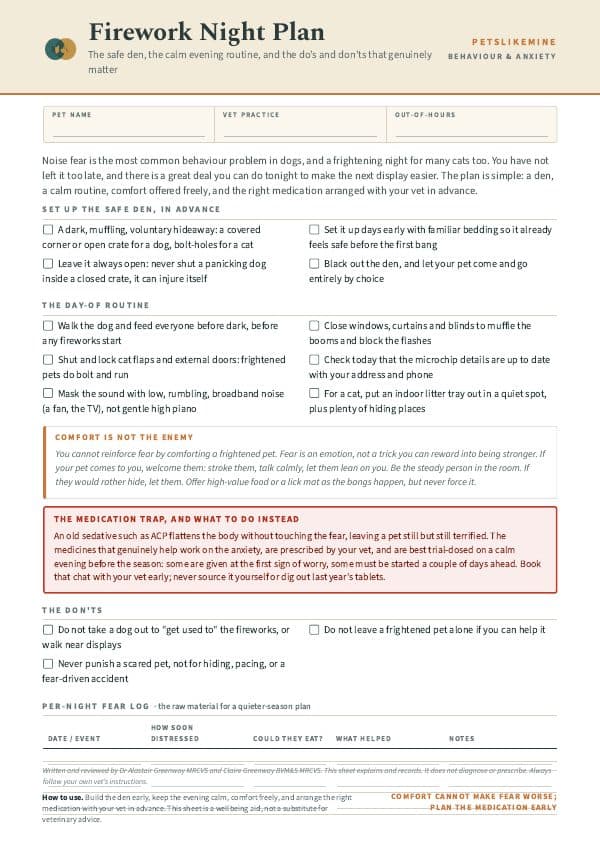
Companion worksheets to put what you've read into practice. Free PDFs, print at home.
Keep track of how your pet is doing
The owners who cope best are the ones who notice changes early. A simple health log shows you what is working, and what is not, before the next vet visit.
Start tracking, freeYou're not doing this alone
Compare treatment journeys and talk to owners managing behaviour & anxiety. Free to join.
Join PetsLikeMine