

Thunderstorms, gunshots and the generally noise-sensitive pet
Alastair Greenway
BVM&S MRCVS
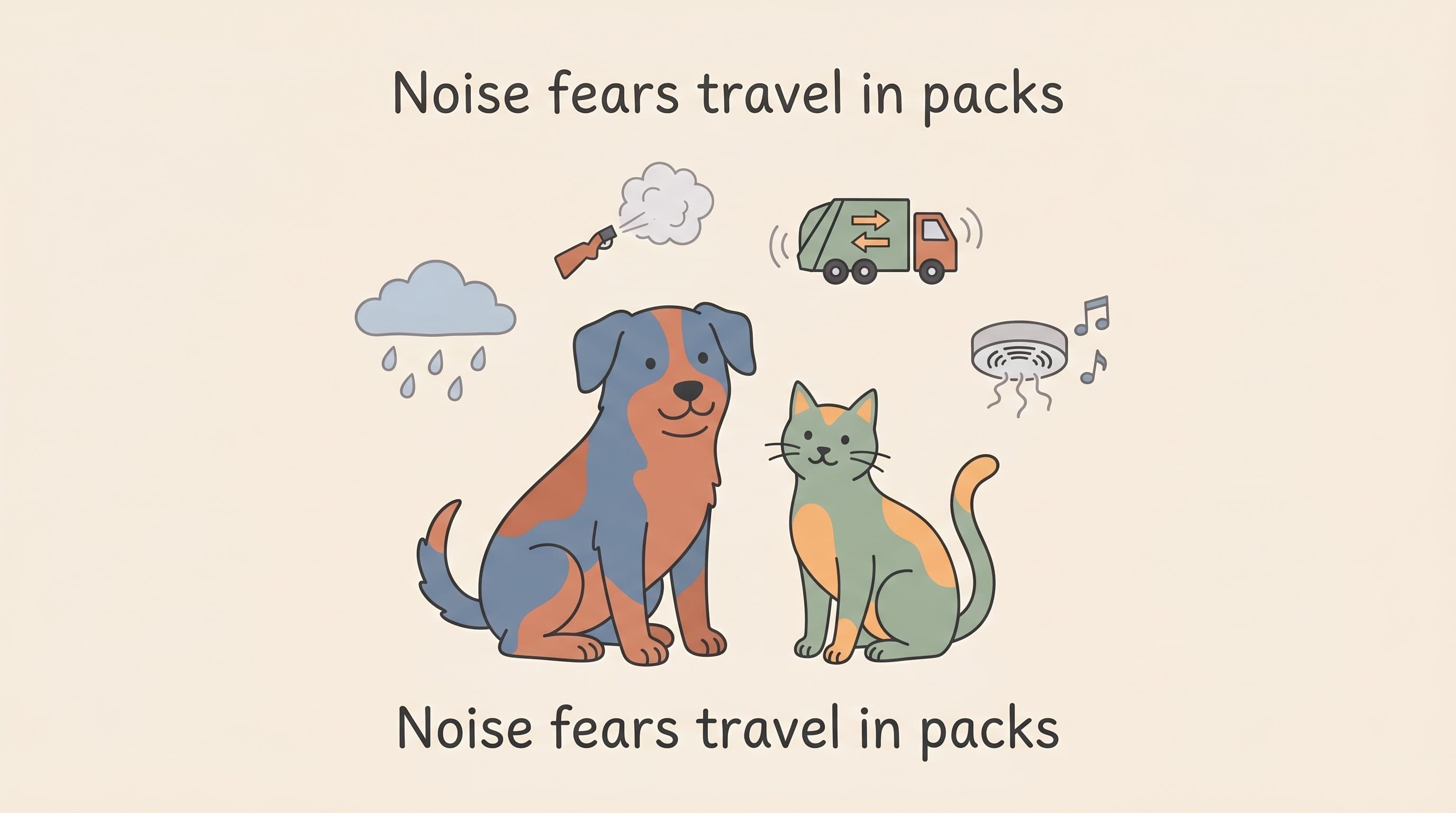
Fireworks get all the attention, and fair enough, they fill our waiting rooms every November. But a great many noise-fearful pets are not really firework dogs, or not only firework dogs. They are the ones who pace an hour before the first rumble of a storm you cannot yet hear, who flatten themselves at the crack of a shotgun two fields away, who flinch at the bin lorry, the smoke alarm, the door slamming. If that sounds like your pet, read on. Noise fears travel in packs, and understanding the triggers beyond fireworks, especially thunderstorms and gunshots, changes how you manage them.
Start with the encouraging part: this is common, well recognised, and treatable. In a survey of 5,257 dogs across 17 breeds, around a quarter were reported fearful of noises, and the fears clustered, with the strongest correlation of all sitting between fireworks and gunshots (Storengen and Lingaas, 2015). A dog frightened of one loud bang is genuinely more likely to fear others, which is why "he's just scared of fireworks" so often undersells the picture.
Why a storm is harder to retrain than a firework
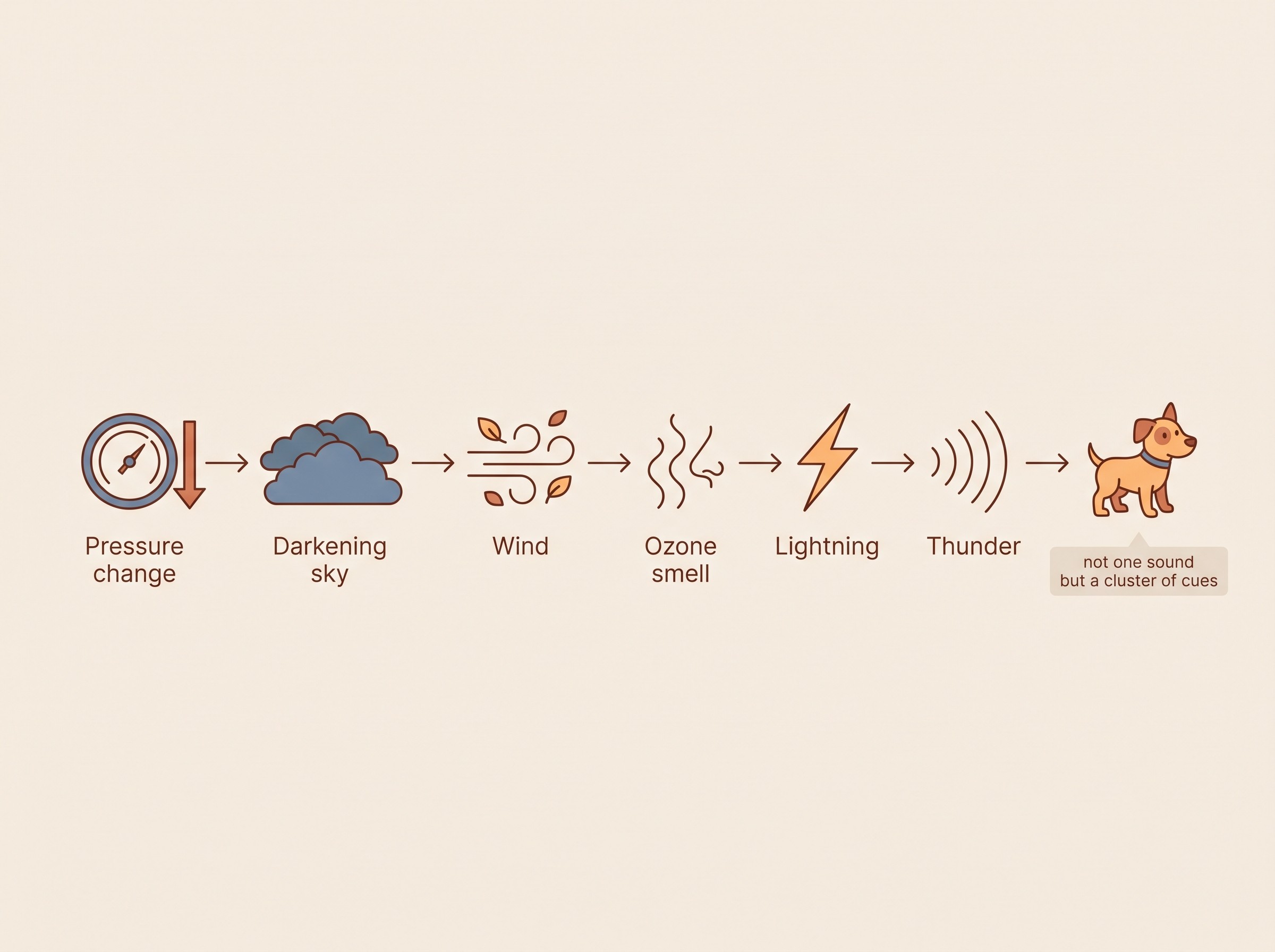
It is tempting to lump storms and fireworks together as "loud noises the dog hates," but storm phobia is the tougher of the two, because a storm is not a single sound. It arrives as a whole cluster of cues: a change in barometric pressure, darkening skies, rising wind, the smell of ozone, rain, lightning, and only then the thunder (North and Bennett, 2025). Many storm-phobic dogs react to the early, quieter parts of that sequence, which is why yours may be trembling and seeking you out well before you register that weather is on the way. The dog is reading the warning signs.
That cue-cluster is what makes storms so hard to retrain. The off-season method, sound desensitisation, plays a recording of the trigger very quietly and builds tolerance from there. It works well for many noises, but a recording can only reproduce the thunder, not the pressure drop, the failing light, the ozone or the wind, which are the very cues a storm-phobic dog often reacts to first, so retraining the sound alone leaves much of the trigger untouched. Storms are also genuinely unpredictable in a way a booked display is not, and dogs appear to respond differently to that uncertainty (Overall, Dunham and Frank, 2001). You cannot put a storm in the diary, give the ahead-of-time medication and prepare the den the way you can for Bonfire Night, and one unexpected storm fiercer than anything you have rehearsed can undo weeks of work (North and Bennett, 2025).
None of this makes desensitisation useless for storms, only that it is a partial, longer game, best aimed at the thunder while you lean more heavily on management and a prepared safe space for the whole event. The how-to, the volume ladder and the common mistakes, lives in our guide to sound desensitisation in the off-season; expect storms to be the stubborn one.
Does static electricity really explain it?
You will read, on a great many pet websites stated as fact, that storm-phobic dogs hide in the bath to discharge the static that builds up in their coat, and that this is why an anti-static cape helps. It is a tidy story, but it is unproven. When researchers compared a genuine anti-static cape against a near-identical placebo cape with the property removed, dogs improved on both, by 63 per cent with the real cape and 36 per cent with the placebo, with no significant difference between them (Cottam and Dodman, 2009). Any benefit came from wearing a snug cape at all, not from static, though as a small study of 23 dogs it cannot disprove the idea outright either. The practical lesson is in the more mundane explanation for the bath: the room is small, enclosed and cool, and it muffles sound. That tells you what your dog is actually asking for, an enclosed, quiet refuge you can provide deliberately rather than hoping a special coat does the work.
Living near the guns
Gunshots are the other big non-firework trigger, and a serious one: in the same survey, 14 per cent of dogs showed strong or very strong fear of gunshots, second only to fireworks at 21 per cent, and the two fears were the most tightly linked of any pair (Storengen and Lingaas, 2015). For a pet living near farmland, shooting estates or clay grounds, this is not a once-a-year problem but a recurring, often seasonal one, frequently bound up with bird-scarers and other bangs you do not control.
The practical angle here is calendar and management. Where you can, map the predictable bits, the shooting season, when bird-scarers tend to fire, harvest and bonfire activity, so you are not caught out, and on days you expect bangs, walk early and keep your pet securely indoors with sound masking through the worst of it. For the bird-scarer you cannot predict, the long game is desensitising to recorded gunshots in the quiet off-times, which, unlike storms, record reasonably faithfully because the bang really is most of what the dog fears. The night-of playbook we wrote for fireworks adapts almost wholesale to a heavy shooting day, so borrow it from our firework night plan rather than reinventing it.
When the fear is everything, not one bang
Some pets are not storm or gunshot dogs but broadly sound-sensitive: wary of the hoover, the doorbell, dropped pans, the motorbike outside. This deserves taking seriously, because owners systematically under-recognise it. In one structured study, around half of owners reported at least one sign of noise fear when asked carefully, even though only a quarter had called their dog "fearful" on a general questionnaire, and the subtler signs, hiding, going still, trembling or seeking you out, are the ones most often missed or not read as fear (Blackwell et al., 2013). These fears also rarely travel alone: in one classic study, dogs with noise fear had around an 88 per cent likelihood of also having separation anxiety, and storm-phobic dogs an 86 per cent likelihood, and the authors urged screening for all three whenever one shows up (Overall, Dunham and Frank, 2001). So if you are treating only the storms and your dog also struggles to be left alone, you may be fixing one corner of a larger problem. A generally sound-sensitive pet usually needs the broader anxiety picture addressed, which is exactly what our noise and firework fear explainer and our guide to helping a fearful pet are written for, ideally with your vet or a behaviourist rather than chasing single triggers one at a time.
Late-onset or spreading fear: the red flag
Here is a point most noise-fear advice misses, and one of the most useful a vet can make. If your pet's noise sensitivity starts late in life, or suddenly begins to generalise, now frightened of the garden where the bang happened, refusing the car, avoiding a room, that pattern deserves a pain and orthopaedic work-up, not just behaviour work. The reason is a striking piece of research: comparing noise-sensitive dogs with and without underlying musculoskeletal pain, the painful dogs developed their noise fear about four years later on average, at around six and a half years against under three, and their fear had generalised far more widely, with avoidance of places and situations in 8 of 10 painful dogs against just 2 of 10 of the others (Lopes Fagundes et al., 2018). The proposed mechanism is that a startle tenses an already sore body, and the dog links the pain to the place or the sound, and encouragingly, those dogs improved when their pain was treated alongside the behaviour work. The mechanism and what to expect are covered in our article on the hidden pain link behind noise fear, our behaviour check tool helps you decide whether to bring it in, and ruling out pain and illness first is the foundation of the whole space, set out in is it behaviour or is it medical.
Managing the unpredictable trigger, and where medication fits
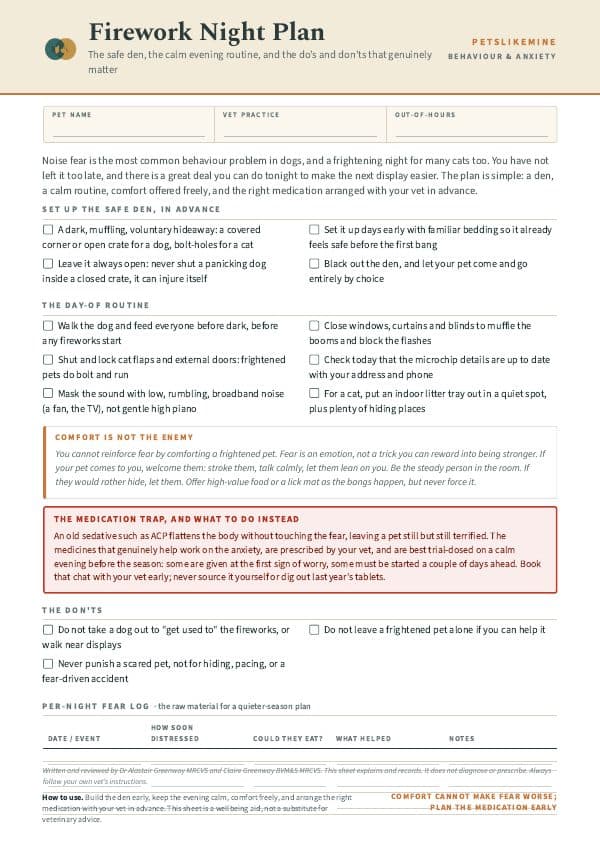
Because storms and stray bangs cannot be scheduled, management leans on having things ready before you need them. The core is a prepared safe space: an enclosed, quiet spot your pet has chosen or you have built, available at all times, never a place they are shut into or dragged out of. Sound masking helps, as does closing curtains against lightning, and the single most evidence-backed tweak is to make that space somewhere good things happen, since providing food or play during noise exposure is associated with a significant improvement in dogs' fear, and across treatments, medication, relaxation training and counterconditioning come out as the most effective measures (Riemer, 2020; Riemer, 2023). The detailed den-and-routine plan is in our firework night plan, and it adapts well to storms, provided you keep the components on standby rather than deploying them to a timetable.
Medication has a real place here, especially for storms, precisely because you cannot fully retrain the trigger. The combined approach works: in one open-label trial, a protocol of clomipramine, alprazolam and behaviour modification improved 30 of the 32 storm-phobic dogs that completed it (Crowell-Davis, Seibert et al., 2003), and for the unpredictable storm your vet can plan an ahead-of-storm anxiolytic, given when the forecast turns. I am deliberately not naming or dosing drugs, because getting the right one and the timing correct is a conversation for your vet, and several options used for noise fear are prescribed off-licence in the UK; the choices, including why some old sedatives are the wrong one, are in our guide to event medication for noise fear. Be aware that the thunderstorm evidence is older and thinner than the firework evidence, resting largely on case series and small open trials, so plans here are experience-led rather than backed by the weight of data.
A habit that ties this together is a simple noise diary, logging what set your pet off, how they reacted and what helped. Patterns emerge that you would otherwise miss, and it gives your vet or behaviourist something concrete to work from.
What about cats?
Cats are affected too, and not noticing does not mean they are fine. In a large survey of Dutch owners, 76.8 per cent of cats showed fear during fireworks, almost identical to the 77.4 per cent of dogs, but cats express it differently: they predominantly hide (75.9 per cent) and flee (64.6 per cent), and their fear is more easily overlooked than a dog's (Van Herwijnen et al., 2024). A cat who vanishes under the bed during a storm is frightened, not aloof.
I want to be candid about the evidence. There is far less treatment research in cats than in dogs, and no established feline equivalent of the canine noise-phobia drug trials, so do not assume canine protocols transfer across. What you can do is genuinely helpful: provide several safe, enclosed hiding places both high and low, never drag a hiding cat out, keep the environment calm and predictable through storm and firework seasons, and raise persistent fear with your vet. If your cat hides to the point of not eating, not using the litter tray, or seeming unwell, that crosses from understandable fear into something to check, and the behaviour check tool is a good first step. The same kindness that helps a frightened dog, a safe place and no forcing, is what a frightened cat needs, even if the toolkit beyond that is thinner.
Noise fear is rarely about a single bang, and any pet whose fear arrives late or spreads fast may be telling you something about pain. Map your pet's real triggers, get the safe space and, where needed, the medication ready before the next storm rather than during it, and treat the wider anxiety rather than chasing one noise.
References
- Storengen LM, Lingaas F. Noise sensitivity in 17 dog breeds: prevalence, breed risk and correlation with fear in other situations. Applied Animal Behaviour Science, 2015; 171: 152-160.
- North S, Bennett S. Storm phobia and the wider picture of noise sensitivity in dogs (review). 2025.
- Overall KL, Dunham AE, Frank D. Frequency of nonspecific clinical signs in dogs with separation anxiety, thunderstorm phobia, and noise phobia, alone or in combination. Journal of the American Veterinary Medical Association, 2001; 219(4): 467-473.
- Cottam N, Dodman NH. Comparison of the effectiveness of a purported anti-static cape (the Storm Defender) vs. a placebo cape in the treatment of canine thunderstorm phobia as assessed by owners' reports. Applied Animal Behaviour Science, 2009; 119(1-2): 78-84.
- Blackwell EJ, Bradshaw JWS, Casey RA. Fear responses to noises in domestic dogs: prevalence, risk factors and co-occurrence with other fear related behaviour. Applied Animal Behaviour Science, 2013; 145(1-2): 15-25.
- Lopes Fagundes AL, Hewison L, McPeake KJ, Zulch H, Mills DS. Noise sensitivities in dogs: an exploration of signs in dogs with and without musculoskeletal pain using qualitative content analysis. Frontiers in Veterinary Science, 2018; 5: 17.
- Riemer S. Effectiveness of treatments for firework fears in dogs. Journal of Veterinary Behavior, 2020; 37: 61-70.
- Riemer S. Therapy and prevention of noise fears in dogs - a review of the current evidence for practitioners. Animals, 2023; 13(23): 3664.
- Crowell-Davis SL, Seibert LM, Sung W, Parthasarathy V, Curtis TM. Use of clomipramine, alprazolam, and behavior modification for treatment of storm phobia in dogs. Journal of the American Veterinary Medical Association, 2003; 222(6): 744-748.
- van Herwijnen IR, Vinke CM, Arndt SS, Roulaux PEM. Firework aversion in cats and dogs as reported by Dutch animal owners. Veterinary and Animal Science, 2024; 26: 100402.
Free downloads
Companion worksheets to put what you've read into practice. Free PDFs, print at home.
Keep track of how your pet is doing
The owners who cope best are the ones who notice changes early. A simple health log shows you what is working, and what is not, before the next vet visit.
Start tracking, freeYou're not doing this alone
Compare treatment journeys and talk to owners managing behaviour & anxiety. Free to join.
Join PetsLikeMine